Author Archives: John Keller

Unknown's avatar

About John Keller

I am a retired Lutheran pastor whose intention is to consent to God's gracious presence and actions within.

The Father Challenge

This post is a little longer than most, but it ties yesterday’s post with Father’s Day

A favorite author of mine is John Ortberg. He once wrote about his three small children that when they would go out to eat, there was only one place they ever wanted to go, and it was “the shrine of the golden arches.” His children seemed to be convinced that they had a McDonald’s-shaped vacuum in their souls. The kids always want the same thing: a combination of the food — about which they really don’t much care — and a little prize. It’s not much of a prize, really, just some cheap little plastic thing, but in a moment of marketing genius, the folks at McDonald’s gave it a particular name: the Happy Meal. It is “the meal of great joy.” You aren’t just buying chicken McNuggets and a plastic princess, you’re buying HAPPINESS.

Every now and then he tried to talk them out of it. He told them to order whatever they wanted and he would give them a quarter so they can buy their own trinket and everyone would come out ahead. But the chant went up, “We want a Happy Meal. We want a Happy Meal.” Other customers stared at the skinflint of a father who won’t buy his kids the meal of great joy.

So, he bought them the Happy Meal. And it makes them happy –for about a minute and a half. The problem was that the happy wore off. The contentment did not last.

You never hear of a young adult coming back to his parents and saying, “Gee, Dad, remember that Happy Meal you gave me? That’s where I found lasting contentment and lifelong joy. I knew if I could just have that Happy Meal, I would be content for a lifetime, and I am. Thank you. There’ll be no need for therapy for this boy.”

You would think, kids being fairly bright these days, that sooner or later they would catch on to this deal and say, “You know, I keep getting these Happy Meals and they don’t give me lasting happiness, so I’m not going to be a sucker any more. I’m not going to set myself up for frustration and disappointment any more.” But it never happens. They keep buying Happy Meals and they keep not working.

Of course, only a child would be so foolish. Only a kid would be so naive as to think that contentment could be acquired through some kind of external acquisition. Only someone very young would have a high enough stupid quotient to believe that lasting happiness could come by a change in external circumstances. Right?

Ortberg’s final reflection is this: The truth about human beings is that as we grow up, we don’t get any smarter; our Happy Meals just keep getting more expensive. The world around us tells us that happiness is always just one Happy Meal away. That new car, new boat, new deck, new lake cabin will somehow meet our need for happiness. Our ever-growing pursuit of happiness rarely seems to make us happy.

Perhaps we need a whole new perspective. A perspective Jesus offer for us.

“If anyone wants to become my followers, let them deny themselves, take up their cross daily and follow me. What does it profit them if they gain the whole world, but lose themselves?” Mark 8:34, 36

Where do you find your source of happiness?

Lord Jesus, show me your path to joy.

Name That Commandment IIb

Yesterday I made simplistic remarks about our capitalist economic system, especially the principle of supply and demand.  Fortunately a reader, a professor of economics, gave me a gracious critique of my explanation. She wrote,

I’m not sure if it is society today or human nature which creates the demand for more.    Hobbes contended people operate based on self interest while Locke didn’t believe this was always true.  . . .  The law of demand and supply are not causal models as much as they are descriptive models or this is simply what we observe in the world.  It is true that suppliers only supply what people want but it isn’t true that they have unlimited powers to make this happen as the many failed products and services can attest.

My critique is not on capitalism per se. God made us with wants and desires that are not evil in themselves.  I appreciate how the market allows us to enjoy an amazing amount of products: from Guatemalan mangos to Korean cell phones. I appreciate how the market can reward hard work.

My critique is on the pervasive nature of marketing and advertising.   I am not against all advertising.  My father worked as a newspaper advertising salesperson most of his life.    I like to know when a new product can enhance my life or where I can find a favorite product at a cheaper price.   What I struggle with is the constant barrage of messages that seem to tell me that my life story is incomplete or empty unless I have this product.   Coca Cola has been doing this in its television commercials for years.

In the novel, The Gospel According to Larry, 17 year-old Josh Swenson starts a website that attacks the consumer waste that he sees.  Josh decides to have only 75 possessions, counting all clothes, school supplies, recreational equipment, and software. He has an exact list of how many possessions he has. If he wants a new CD or book he has to sell an old one or trade for it. This means every purchase is a major decision and he takes it seriously.  The novel helped me reflect on the wants and needs of my life.

You show me the path of life.
In your presence there is fullness of joy.
Psalm 16:11

Do you think our culture overemphasizes consumption?

Lord Jesus, teach me to be a good steward of my material blessings.

Name that Commandment Part II

The ninth and tenth commandments*, “You shall not covet,” are the two most challenging commandments in our culture today.  Our consumer society is built on the idea that an individual does not have enough. It is the economic law of supply and demand.  We must create a “want” for more stuff, so that we have a demand to produce more stuff.   If there is no demand for something, there is no reason to produce it.    

Yet our mass market culture is good at producing wants.  We are constantly seeing/hearing/experiencing messages that tell us to want something, anything and everything. We are caught in the game of “wanting” the newest whatever because everyone else has it and we “need” it.  Our culture constantly stokes the fire of desire.   So when we hear the commandment, “you shall not covet,” it seems so bizarre and difficult.  Confirmation students are not the only people wrestling with this.  

Several years ago I took a group of seniors on a tour boat ride around Lake Minnetonka.  The tour guide started telling us about the large homes that surround the lake. “This property was purchased for $5 million dollars, and the new owner remodeled with another $5 million.” Or “That property was purchased for $7 million, the old house torn down, and a new house built for $10 million.”  After the boat ride, I told the group of seniors, “We just spent the afternoon breaking the tenth commandment.”  Now we may not  want a house on Lake Minnetonka, but looking and pricing such homes rarely feeds our contentment center.  

So how do we obey this commandment?  By shifting our focus away from this constant barrage for “bigger, better and more” to the Gospel message that I am loved and accepted by God just the way I am.   My real identity is not a consumer who needs more, but a steward who hold everything as a trust from God. I truly need to hear God’s message of gracious acceptance on a consistent basis.  Otherwise the culture’s message that “You are not good enough, unless you buy this or pursue that’ will win our souls. 

 How do you define “coveting?”  How do you deal with it?

 Lord Jesus, help me to seek you with all my heart and soul.

 *Martin Luther in his catechism followed the Roman Catholic tradition from St. Augustine in numbering the commandments. Presbyterians, Episcopalians and others use a slightly different system that combines the ninth and tenth commandments.

Name That Commandment

Our confirmation students had a written test in which they wrote about the commandment that was most challenging to them.  Two commandments were frequently cited:  the second and tenth commandments.  Both are worthy of further reflection.   I will start with the second commandment and post on the tenth tomorrow.

The second commandment, “you shall not take the name of the Lord your God in vain,” reflects the power of words.  What we say matters.   God has given us a tremendous gift in being able to call out to him in prayer, praise and thanksgiving at anytime and in any situation.  God is like a mother who walks through a crowded noisy mall, hears a child’s cry and knows the child is her daughter or son.  God knows and responds to the cry of our hearts when we sing with joy or shout in terror.  What a privilege to be able to call upon the creator of the universe!

With this privilege in mind, we see how disrespectful it is to use God’s name to curse others, to inflict harm upon others.  Yes, we are creatures with powerful emotions like anger and rage.  Yes, we can be provoked by the actions of others to say things we wish we hadn’t. Yes, cursing has become more pervasive, even acceptable in our culture. Still we are not ruled by our emotions nor by cultural norms, but have the capacity to choose how to respond to our emotional stirrings.  Jesus calls us to love our enemies and pray for those who persecute us (Matthew 5:44).  We need to pray for God’s help to keep his name holy.

One confirmation student did have a valid observation.  He observed people being very cavalier, or bored, in worship as they mumbled God’s praise.  Can our worship become so casual that we begin to take God’s name in vain?  Can we be disrespecting God because we are daydreaming instead of truly praising his Holy name?  I appreciate how confirmation student can sometimes help me see the God’s truth in a new light.

Lord Jesus, thank you for the gift of your name.  Help me to cherish it always.

Jonah, Nineveh and Nahum

Tomorrow night (Tuesday, June 14), Resurrection will host its first Summer Lite Worship at 7:00 pm.  A central component is the study of neglected, yet vital Bible stories.  Our first four weeks will be the book of Jonah.

"Jonah Prophet 1" by artist Reza Badrossama

Many Christians see the book of Jonah simply as a children’s story that has no relevance to today’s world.  The only part they know is that Jonah was swallowed by a whale (or great fish).  Yet the book has a great message that is told with humor, style and grace that speaks to us today. 

Jonah is listed among the prophetic books of the Bible, yet it is so different.  While the other prophetic books are composed of primarily prophetic poems, Jonah has one prophetic speech that is less than ten words.  Whereas most prophetic books have some description of how God called the prophet to speak, Jonah goes into great detail in how he runs away from God’s call to go to Nineveh.  The contrasts all have a purpose that drives Jonah’s message for us.  I am looking forward to our study.

One key feature in the story that is challenging to understand is the city of Nineveh.  Nineveh was not a city in ancient Israel, but of an arch-enemy.  Nineveh was the capital of the great Assyrian empire.   The Assyrians captured the northern kingdom of Israel in 722 BCE and destroyed it as an independent nation.  The Assyrians nearly captured the southern kingdom of Judah as well.  The brutality and cruelty of the Assyrian empire was legendary. Nineveh became a symbol of all that was evil and hated.  The book of Nahum is a long Hebrew poem celebrating Nineveh’s destruction by the Babylonians in 612 BCE.

O King of Assyria, your people are scattered on the mountain with no one to gather them.  There is no assuaging your hurt, your wound is mortal. All who hear the news about you clap their hands over you. For who has ever escaped your endless cruelty? Nahum 3:19

 As Americans, we have trouble identifying with such hatred, because we have not been dominated by other nations. Yet Israel had a deep hatred of Nineveh as symbol of raw power and brutality.

In what ways is hatred appropriate ever appropriate for Christians?  

Lord Jesus, help me to follow your call no matter what.      

Miami Heat and Pentecost

Wade, Bosh and James of the Heat

I have been watching the NBA Finals this week: Miami Heat and Dallas Mavericks.  The Heat made news last summer when they brought together superstars LeBron James, Dwayne Wade and Chris Bosh.  With such individual firepower the Heat was expected to walk away with the championship.  But individual superstars do not make a team so right now Dallas is ahead in the series three games to two.  Even though Miami has more talent, they are not playing together well, especially in the fourth quarter. 

The Finals have me thinking about the TEAM of Pentecost.  One of the amazing things about Pentecost is that the Holy Spirit came mightily to the assembled disciples as a team.  The Spirit did not just “zap” Peter and have him preach.  The tongues of fire were on the whole group, anointing them to be the Body of Christ together. In the Old Testament God’s Spirit anointed individuals like Moses or Elijah.  Now the whole church has the power.

 I think as Americans we struggle with the significance of community.  My college history professor contrasted the colonies in New England with those of Virginia.  The New England colonies were community-based with people living in town together. The Virginia colonists were scattered on large plantation where the individual made his way in the new land.  After contrasting the two models my professor emphasized that the Virginia model became our American ideal of the rugged individualist who makes it through the world by him or herself.

Even in matters of faith we often disparage community. As Americans, we tend to focus on our individual faith and commitment, how our personal faith is a private matter of the heart.  Organized religion is suspect for being “organized.”

Yet we all live in community and our faith is rarely a total individual experience.  We learn from others: parents, teachers, pastors, and spiritual leaders.  We read books written by others, sing songs written by others, and reflect upon questions asked by others.  Our faith can be deeply personal, but needs a community to thrive and live.  The Holy Spirit does not leave us isolated but calls us to trust, live and serve together as the Christ’s body in the world.

How are you living your faith in community with others?

Lord Jesus, keep the Holy Spirit active in us so we can be the Body of Christ together.  

Down and Out

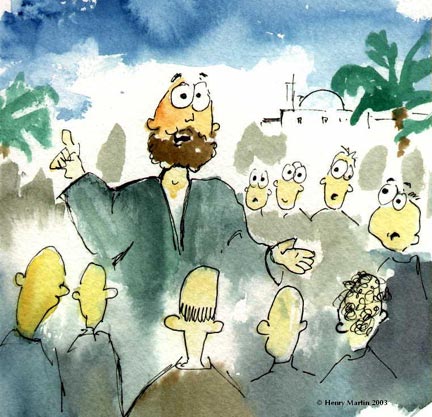
Peter at Pentecost by artist Henry Martin

Last night I met with an amazing group of people who are passionate about using their gifts and strengths for God’s kingdom through Resurrection Lutheran. We are working as a team to prepare for a workshop titled “Discover Your Call – Uncovering Your Dependable Strengths” on November 4 and 5.   The workshop will equip members of Resurrection for service in the world.  

In preparation we watched part of a DVD from Luther Seminary that emphasized the concept that God came “down” to us in Jesus Christ, so we don’t need to “climb” up to God through our actions or good deeds.  As one speaker said, “God does not need your good works. Your neighbor does.”  God calls us to use our gifts and strengths “out” in the world for our neighbor.  Thus the title of the DVD: “Down + Out: Where Grace Takes You.    

God has created each of us with dependable strengths.  God “wires” each of us differently with different abilities, passions and dreams.  Isolated each of us can do a little, but together as the church we can do so much more.  The church is a movement of people, working together to bring healing and hope to a broken world.  The church is not simple to gather in a building and feel good about ourselves.  No, we are to go OUT.

We are to be God’s hands and feet, his voice and presence among the people we interact with each day. This is what Lutheran mean by the word: vocation or calling.  God calls us to serve in the world.

On the day of Pentecost, the Holy Spirit pushed the disciples out into a confused, perplexed world.   Peter was called to preach, but all the disciples had to use their gifts and strengths once the people responded to Peter’s message about Jesus.  They each used their dependable strengths to lead the church out of Jerusalem and into every corner of the world.

What are your dependable strengths and how are you using them in your calling?

Lord Jesus, help me to discover my dependable strengths and to use them for service in your world.


Organizational Care

Seth Godin, wrote an intriguing post recently about caring and organizations:

No organization cares about you. Organizations aren’t capable of this.

Your bank, certainly, doesn’t care. Neither does your HMO or even your car dealer. It’s amazing to me that people are surprised to discover this fact.

People, on the other hand, are perfectly capable of caring. It’s part of being a human. It’s only when organizational demands and regulations get in the way that the caring fades.

If you want to build a caring organization, you need to fill it with caring people and then get out of their way. When your organization punishes people for caring, don’t be surprised when people stop caring.

I began to wonder if that is true of a congregation.  Certainly one of the confessed values of a Christian congregation is to care, to love, to be like Jesus. But what does care look like?  Here leadership is essential. Leadership within the congregation can promote a culture of care, can model what caring looks like, and how collectively and individually we care.

Pentecost by artist Jean Sader

This Sunday is Pentecost, the church holiday in which we celebrate the coming of the Holy Spirit to ignite the birth of the church. Fifty days after Jesus’ death and resurrection, the first disciples remained huddled in a room in Jerusalem.  As described in Acts 2, the outpouring of the Holy Spirit was dramatic: a mighty rush of wind, tongues of fire on people’s heads, and multiple languages suddenly heard.  A huge crowd gathered outside the room, amazed, perplexed, confused.  What was this?

Here is where caring leadership stepped up.

 But Peter, standing with the eleven, raised his voice and addressed the crowd. Act 2:14

Peter took the leadership role and modeled how this new community would express itself.  He cared for the assembled crowd by telling them the story of Jesus Christ and how his life, death and resurrection had changed the world.  His words were tough at time, reminding the people of their participation in Jesus’ crucifixion.  Yet Peter, with the support of the eleven, did the most loving thing possible: he called people to trust in Jesus.  At Resurrection, we would say Peter “called all people to a vibrant life of faith in Christ.”

How does the church promote or restrict caring?

Lord Jesus, teach me to care as you cared for others.

Prayer Challenge

Looking to Heaven in Prayer

Last Sunday I challenged the worshipping community at Resurrection to a prayer commitment.  Following Jesus’ example of prayer in John 17 where he looked to heaven, I asked people to pray for three things and to commit at least five minutes daily to this task.  Consistent prayer is vital to a congregation’s mission.  Are you open to a prayer challenge? 

The first part of my challenge is to pray for those who are close to you: your spouse, children, siblings, parents, or significant others.  Jesus prayed for his disciples.  They had shared years of ministry together and had become a family.  He asked his Father in heaven to protect his disciples.   Our prayers for loved one can be that simple: for God to bless, protect and encourage them. 

Second, I encourage you to pray for your congregation’s missionIn our secular age, it is easy to forget that congregations have a God-given mission to accomplish.  Jesus gave his mission to his disciples: to proclaim “eternal life, that they may know you, the one true God, and Jesus Christ whom you have sent” (John 17:3).   At Resurrection we have that same mission, only we call it the Vibrant Life of Faith in Christ. 

Third, I invite you to pray for your adversary, for the person with whom you struggle daily or weekly.   It might be someone at work, at home or in your neighborhood.   In Matthew 5:44, Jesus told the disciples, “Love your enemies and pray for those who persecute you.” 

A friend told me about his struggle to love his adversary.  Every day as he went to work he saw a picture of the person and felt this internal anger rise up.  It got to the point where he would take a different route to work so as to avoid the picture. He was discussing this with his wife when she suggested that instead of avoiding it, he simply pray for God’s blessing and joy to be with his adversary, to envision the person covered in God’s light.  He listened to his wife and started praying.  At first there was no change in his emotions, but he persevered.  Gradually he felt his animosity dissipate.  He grew to see his adversary as a fellow child of God. 

What are your prayer challenges?

Lord Jesus, bless my family, church and enemies.

Habitat Day

Yesterday, five of us from Resurrection worked at a Habitat for Humanity house in St. Paul. In spite of the heat and humidity we hung sheet rock in the upstairs bedrooms. The challenge was learning how to put up ceiling sheet rock, especially above the stair case. Fortunately our crew had an excellent crew chief, Roger Henry, who showed us the right techniques and special tricks to get the job done.

Roger Henry

I have known Roger for over a decade. He has been a long-time volunteer and champion of Habitat for Humanity. He brings his own tools to the work site and gladly teaches novices like myself how to use them. He knows that most Habitat volunteers are not skilled construction workers and that he could probably do the job more easily by himself. Yet teaching others is one of his passions and joys. I like working with Roger (but please don’t tell him that!).

I also have an abiding passion for Habitat for Humanity. I believe in its mission to build safe, affordable housing for people in need. They do NOT give away homes, but they invest in people. Any potential home owner needs to put over 500 hour of sweat equity into the organization, he or she needs to attend classes about home ownership responsibilities, and the family will have a mortgage when they move into the home. As Millard Fuller, the founder of Habitat, once said, “Habitat is not a handout, but a hand-up.” The modest house we worked on yesterday is only 1400 square feet and will probably house a family of five or more. Twin Cities Habitat has built more than 850 since its inception in 1985. Learn more at their website.

Hard Work and Good Food

And whenever I have worked at a Habitat site, I have enjoyed a great lunch!

As I reflect on the day, I am extremely thankful for organizations like Habitat for Humanity and for individuals like Roger Henry. They are expressions of hope and joy and make me smile. In a world that often seems dark and foreboding, they shine with the light of Christ.

In the same way, let your light shine before others, so that they may see your good works and give glory to your Father in heaven. Matt. 5:16

What people or organizations give you hope in today’s world?

Lord Jesus, may we together shine with your light of hope.