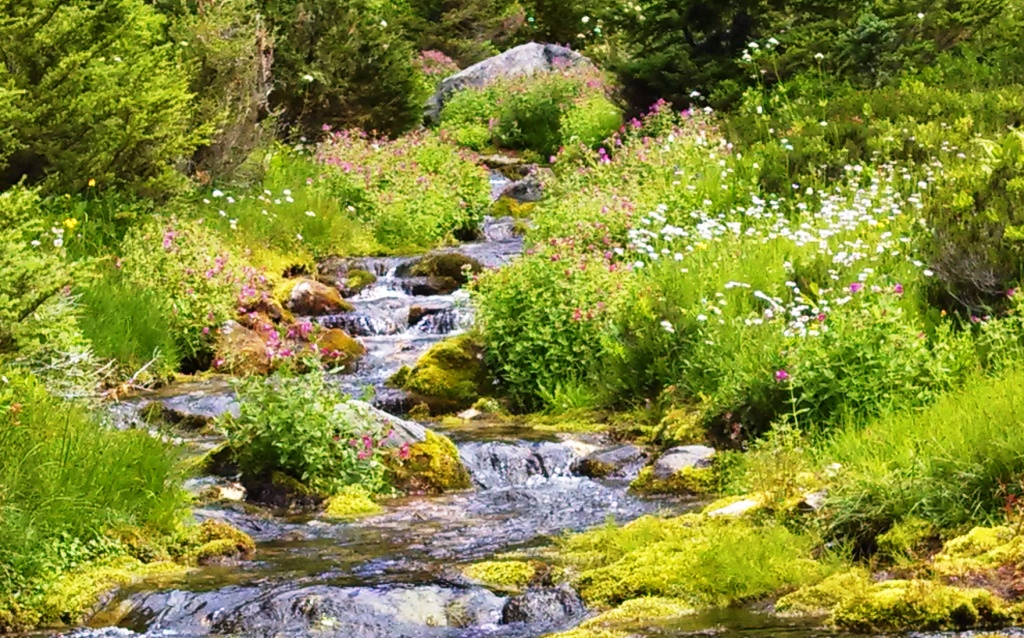
Category Archives: backpacking

Days Six, Seven and Eight: A Peaceful End

My final days hiking on the PCT had a certain lightness of being. First, my pack was becoming lighter as I consumed my daily granola, tortillas and trail mix. Second, my legs and heart had strengthened during the daily routine of hiking up and down mountain passes. Third, after my fall in Sitkum creek, my loss of glasses gave everything a kind of dream-like quality. Finally, I had been using my phone as a camera and the battery began to die so I took fewer pictures.  All this meant that I simply tried to be in the moment.

On day six, I was traveling along some of the most beautiful alpine country in the North Cascades. The alpine lupine and Indian paintbrush were abundant. The clouds cleared from around Glacier Peak and it remained the dominate peak to my north even as I hiked south.

Another blogger’s picture of Lake Sally Ann.  (Theo’s Roaming and Rambling)

The temperatures rose and I decided to take a quick dip in Lake Sally Ann. The cold water renewed me after miles of dusty hiking.
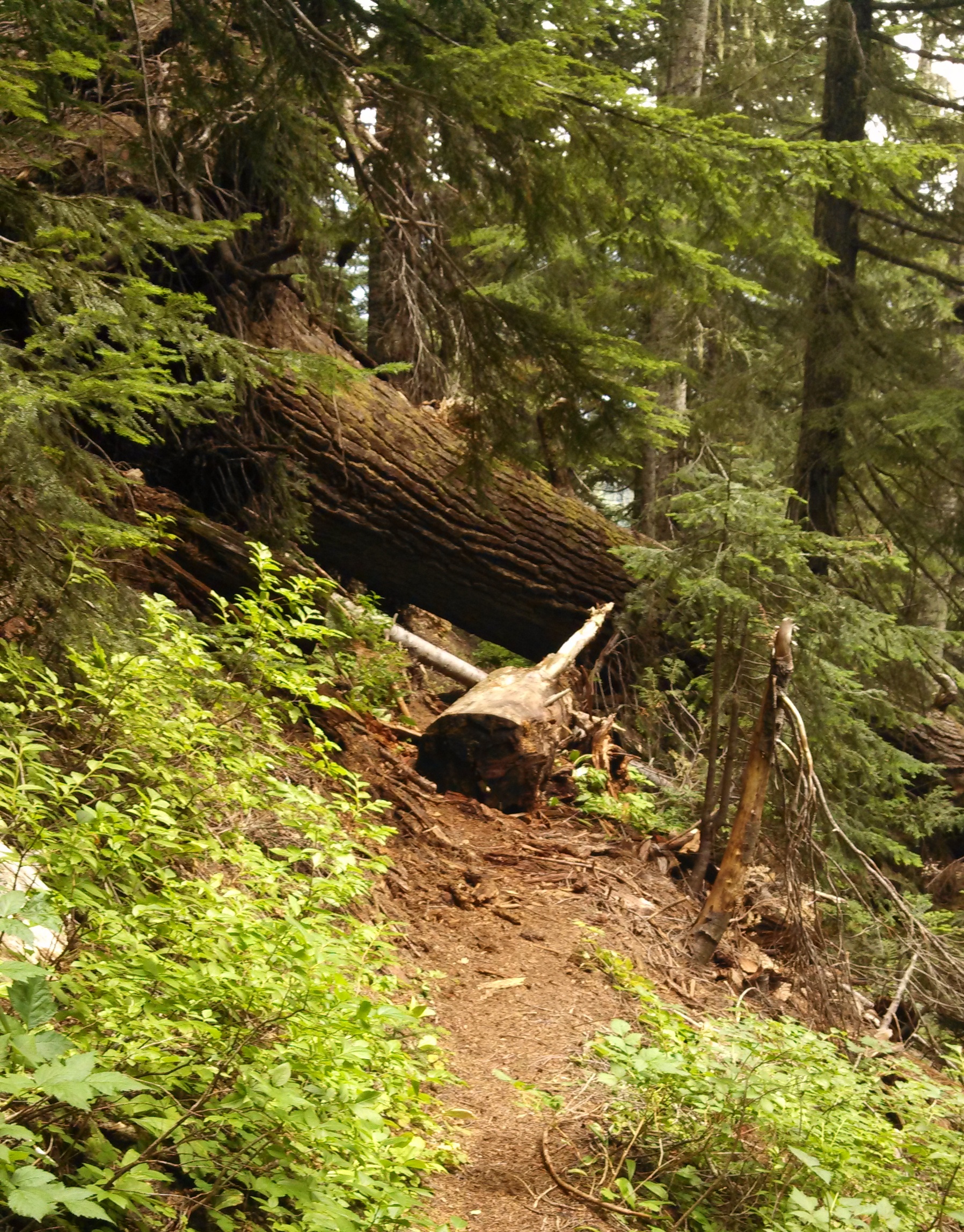
Blocked TrailAfterwards I came to a section of trail where a winter storm had blown down scores of trees across the trail.  Later I met a trail crew that was slowly clearing the many down trees. I say “slowly” not because they were lazy, but rather because in Glacier Peak Wilderness Area they could only use hand tools. No gas power chain saws were allowed.

That night I camped at a small campsite near a small stream, thankful for the trail crews, the silence and the trail itself.  The trial has many similarities to life.   Though the path may be blocked at times, God shows a way around the obstacles.

On day seven I enjoyed a fine lunch on Grizzly Peak and a delightful afternoon swim in shallow Lake Janus.  I had one last look at Glacier Peak before the trail dropped over a ridge.

My last look at Glacier Peak

My last look at Glacier Peak

My final campsite was by Lake Valhalla, only six miles from Steven’s Pass. The last morning on trail had a relaxed tempo. I knew that three of my four siblings would meet me on the trail around noon, so I took my time packing my tent and eating breakfast. I even relaxed in a mountain meadow to read for a time.
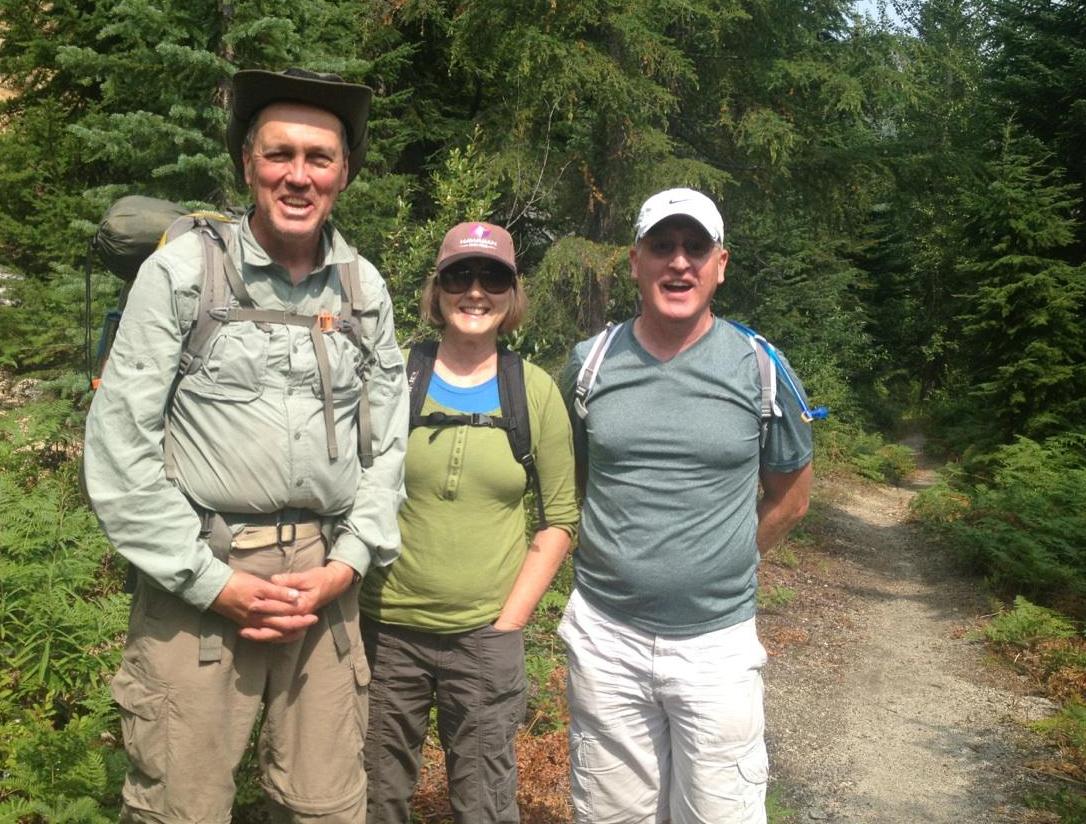
End of the Trail with Kris and Rob

So thankful for my sister Kris, my brother Rob, and my sister Kathleen (taking the picture) who gave me a ride back to Seattle.

Less than a mile from Steven’s Pass, my siblings spotted me and we took a couple of pictures. They still wanted to hike a bit more, so they continued on up the trail while I headed to the car to clean up and change clothes.

In spite of the fall in Sitkum Creek and the lost glasses, I truly enjoyed my trip. The high alpine meadows, the majestic forests, the craggy peaks and the meandering trail all speak to my soul. I felt renewed and refreshed as I drove with my siblings back to Seattle. Though the Psalmist in Psalm 48 was writing about Mt. Zion, I take a much broader perspective, seeing all mountains with such beauty.

Great is the Lord, and greatly to be praised
in the city of our God.
His holy mountain, beautiful in elevation,
is the joy of the whole earth.

I am already pondering my next mountain trip. And yes, in case you are wondering, I will pack an extra pair of glasses and my hiking stick.

Lord Jesus, thank you for your peace that surpasses all human understanding.

Day Five: Pride Goes Before the Fall

IMG_20130818_134449_651Day Five of my backpack started much like day four: the glorious beauty of Glacier Peak surrounded me and I felt tremendous joy as I ambled down the trail. My feet felt as light as my heart. With my lightness of feet I jumped a couple of streams. I thought, “It’s going to be a wonderful day.  Thank you, Lord!”

The Cascade Mountains are a named for the many streams cascading down from the glaciers and snow fields. The Pacific Crest Trail crosses many of these streams. On major rivers, there are often bridges. Some of these have been battered by the spring floods. I wondered how long Kennedy Creek would keep its bridge.

Kennedy Creek Bridge on the PCT

Kennedy Creek Bridge on the PCT

Shortly after crossing Kennedy Creek, I came to Sitkum Creek. Sitkum is rather small and has no bridge. I stopped to consider my options. I noticed several larger stones that could be used to boulder-hop across. I also could easily wade across since it was less than 6″ deep. I did not have trekking poles and my shoes were dry. After a moment’s reflection I decided to try boulder hopping, thus keeping my shoes dry.

Sitkum CreekI loosened my pack and started across. One boulder, two boulders. . .  .

Suddenly my foot slipped and I fell into the stream. Unable to catch myself with my hands, my face slipped below the water and my head hit a rock.

I heard a crunch and felt the sharp blow to my head. I quickly scrambled up to my knees. I felt my forehead and discovered a rising lump above my right eye. I also discovered my glasses were gone, swept away by the stream.

I got to my feet and splashed across to the far side of the stream. I took off my pack and took stock of my situation. Other than the bump on my head, I had no other scrapes or bruises. I went back to look for my glasses in the stream, totally oblivious to how wet my shoes had become. Though I looked and felt all around the area where I fell, no glasses could be found. I suspected that they broke in the fall (the crunch sound I heard). Since I was packing light, I did not have a spare pair of glasses with me.

LumpAfter a fruitless search, I considered my options. I am nearsighted and usually wear glasses, but I am able to see okay without them. I could clearly see the trail, trees, stream, and rocks around me. I had not blacked out in the fall, nor was my vision more blurred than normal. I was at least twenty miles from any trail head and still forty-five miles from Steven’s Pass. So I picked up my pack and marched on.

I must say I was having a small pity-party as I hiked. “Why didn’t I simply wade in water?” “If you had brought your hiking stick, you probably would have regained balance before falling.” “A spare pair of glasses isn’t that heavy.” There is plenty of time for self incrimination walking down the trail.

For a moment I thought, “Why did God let this happen?” Then I remembered what I have so often said to confirmation students and others, “God gives us free will. He does not wrap us in Kevlar bubble wrap that keeps us from experiencing the consequences of our poor choices.” Upon further reflection, I thought it may have been God’s voice telling me to “wade in the water.”

I covered more than sixteen miles and several thousand feet of elevation change that day. I passed several people who could have helped me if I needed it. Even though I was in some of the most scenic alpine country, it was all blurry for me.

I joked to myself that I was hiking through a Monet impressionistic painting.  (Perhaps Monet’s Bridge would fit over Sitkum Creek.)

Late that afternoon, I met a younger man who was hiking in the opposite direction. After I shared with him a bit of my story, he looked at my bruised head and said, “And I was going to complaining about my blistered feet. I am going to stop my complaining right now.” We both agreed that simply being out in the beauty of creation is sufficient.

What I would have seen if I had still had my glasses.

Lord Jesus, thank you for your protection even when I fall.


Day Four: Rejoice and Be Glad

Mica Lake in Glacier Wilderness

My fourth day on the trail was a joyful one. As I climbed up to Firecracker pass, I passed Mica Lake, ice still lingering.  At the top I was treated a spectacular view both south and north. The cutting wind pushed me down to Fire Creek where I stopped for lunch. The wildflowers and blueberries were abundant and I enjoyed the break.

Fire Creek was ablaze with color.

Fire Creek was ablaze with color.

At Fire creek as (I was taking the picture above) a voice startled me with the question, “Is this Pumice Creek?” I turned to see an older woman with a broad hat and friendly face coming from the south. I responded, “I think this is Fire Creek. You already passed Pumice.” We consulted the maps and she agreed.

I quickly learned that her name was Mary and that she was doing the reverse of my hike, starting at Stevens and hiking north to Stehekin. She was hiking alone. In past summers she had hiked often with her husband, but he had died suddenly in the past year. Her voice caught for moment with grief as she described him. Hiking appeared to be part of her healing. She shared that  she would turn 65 in a couple of months and she wanted to see if she could still hike. She obviously could because we were near the half-way point for each of us.

I asked her if in the past her husband did the map reading. “Oh no.” she laughed. “He was as bad as I am. We could be looking at a map of Paris, see the Eiffel tower to our right and the Seine River to our left and still have no idea where we were. But somehow we got where we were going.”

We discussed some of the through-hikers that we had met of the trail. Mary remarked, “I sometimes wonder if in their hurry to cover miles if they see what beauty is around them?” We agreed that our more leisurely pace had value.

We exchanged information about the trail ahead for each of us. She told me where some great campsite were. After filling our water bottles, we lifted our packs and headed in opposite directions, yet holding similar joy.

Later that evening I stopped early at a great campsite Mary had shared and fixed a meal. The day had been filled with joy so I decided to have fun recording my meal prep. Below is a taste of what it is like to camp in the high alpine country.

This is the day the Lord has made let us rejoice and be glad in it. Psalm 118:24  That verse was certainly true for my fourth day.

Little did I know that the fifth day would be a test of my joy.

Day Two: Finding the Holy

The primary lure of backpacking for me is the opportunity to visit isolated high alpine country: where a trail breaks out above the tree line and the vista opens up to snow-capped peaks. There are several place where one can drive to such regions. Hurricane Ridge in the Olympic National Park near my boyhood home of Port Angeles is one such location.

Hurricane Ridge in Olympic National Park

Hurricane Ridge in Olympic National Park

But simply driving to a vista takes away the challenge of the hike. As I started my second day of hiking, I knew that I would be entering my “sacred space” later that morning as I climbed towards Suiattle Pass, at 5800 feet. Shortly after starting, I needed to crossed Agnes Creek which had no foot bridge.

Already I was missing my trusted Leki hiking stick that I had used for years. I had forgotten to place it in my airline duffel when I packed my gear. Still I carefully waded across Agnes Creek without a problem, the ice-cold water reaching above my gaiters. In yesterday’s rain I had hiked in wet shoes; a stream crossing was no different. (Somehow I forgot that lesson three days later.)
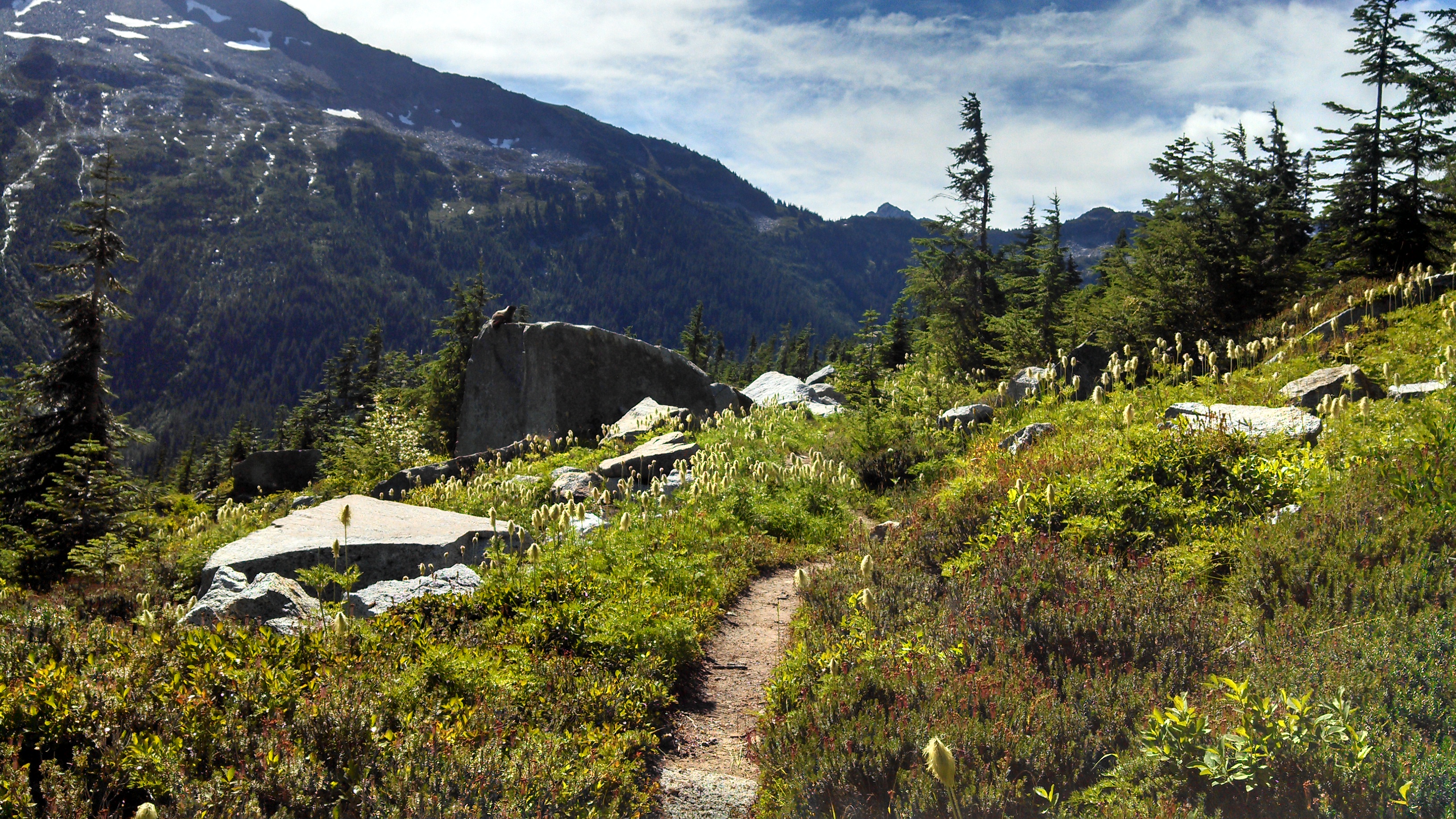
As I climbed up towards the pass, some vistas did open up, especially towards Cloud Pass. I kept climbing towards Suiattle Pass and I looked forward to seeing deeper into Glacier Peak Wilderness. However I soon learned that Suiattle Pass, in spite of its higher elevation, is mostly forest with a few small meadows. The alpine flowers were gorgeous, the views less so.

IMG_20130816_105142_210

As I trekked down the other side of Suiattle Pass towards Miner’s Creek and eventually Suiattle River, I caught my first glimpse of Glacier Peak. Clouds surrounded the peak, but I could see a few of the many glaciers that cover it. Glacier is volcanic like Mount St. Helen’s and Mount Rainer and it is the fourth highest peak in Washington. It would take me two days to hike around it, mostly due to the arduous descents into and tougher climbs out of the deep river canyons that the melting glaciers feed. I was expecting some tough days ahead.

Glacier Peak from SuiattleAs I descended deeper into the forest, the trail became less rocky and more pedestrian. I found my pace quickening as I approached Suiattle River. I had heard stories about the old crossing of this river. In 2003 a rainstorm flooded the river and the bridge was wiped out, leaving fallen log for hikers to traverse.

Until 2011, the only way across the Suiattle River.

In September 2011 a new bridge was opened but it was built two miles downstream at a (hopefully) more secure spot. This added four miles to this section of trail, two miles down one side of the river and two miles up the other. I was anxious to get back to the high country, so I did not look forward to an extra four miles of river-bottom hiking. My disappointment turned to surprise.

After completing eighteen miles, I found a cozy camp site near the river. The next morning, I finished the hike to the new bridge and started back up the river along new trail.

As I trekked, I slowly realized that I was hiking through some old growth forest. Most of western Washington was heavily logged in the last hundred years, but for some reason this section was missed. Huge western red cedars stretched to the sky. I felt like I had stumbled into an ancient temple; the feel of sacred space surrounded and surprised me. I was awed and humbled.

A short video clip from the forest (you may need to “full screen” to see it.)

The trees of the Lord are watered abundantly, the cedars of Lebanon that he planted. Psalm 104:16

What space or place has surprised you with holiness?

Lord God, evoke within us the holiness of your kingdom.