Category Archives: Baptism

Baptism ABC: A is for Adoption

Last evening my grandson, Jack Keller, was baptized. My son and daughter-in-law come from different faith traditions regarding baptism and my son wrote about this on their blog. I plan this week to write on the various perspectives of baptism and how it can be a vital touchstone of faith.  Baptism is a beautiful collage of images and promises that revolve around this gift of God. Each image has value, worthy of reflection.

In baptism, therefore, every Christian has enough to study and practice all his or her life. Christians always have enough to do to believe firmly what baptism promises and brings – victory over death and the devil, forgiveness of sin, God’s grace, the entire Christ, and the Holy Spirit with his gifts. In short, the blessings of baptism are so boundless that if our timid nature considers them, it may well doubt whether they could all be true.” (Martin Luther’s Large Catechism, BOC 461)

In the Lutheran tradition, the focus is on God’s promise and God’s initiative in creating the covenant relationship. I cannot come to God on my own, but the Holy Spirit calls me through the Gospel. Baptism is a tangible expression of the gospel, the good news of Jesus Christ. One baptismal image that expresses God’s initiative is adoption with the gift of the Holy Spirit.

Jesus was baptized by John prior to beginning his ministry.

And when Jesus had been baptized, just as he came up from the water, suddenly the heavens were opened to him and he saw the Spirit of God descending like a dove and alighting on him. And a voice from heaven said, “This is my Son, the Beloved, with whom I am well pleased” (Matthew 3:16-17).

Though Jesus was God incarnate, God the Father sent the Holy Spirit as a sign affirming Jesus’ authority as God’s Son. God did this prior to Jesus starting his ministry, before he preached or healed.  The same Holy Spirit is given in our baptism and we are “adopted” as God’s children.

For all who are led by the Spirit of God are children of God. For you did not receive a spirit of slavery to fall back into fear, but you have received a spirit of adoption. When we cry, “Abba! Father!” it is that very Spirit bearing witness with our spirit that we are children of God (Romans 8:14-16).

One of the ways this is enacted with an infant baptism is that the infant is normally held by the Christian sponsors or the pastor during the baptism. The pastor or sponsor represents God’s claim and blessing upon the child. After the baptism the child is given back to the parents as a gift from God with the understanding that the child will be raised in faith.

Baptism is a powerful reminder of who I am: I am a child of God. I am God’s child, not because of my actions or inactions, but because of God’s tangible grace given to me in baptism.

Next post: B is for Belonging.

Lord Jesus, Thank you for claiming me as your child.

“I am” and Green Algae

Last week-end I participated in our ninth grade confirmation retreat at Camp Wapo.  The sixteen youth will be confirmed in October, affirming their baptismal covenant. This group had a few “energetic” boys who could be distracting at times so we had to find creative ways to teach.

The retreat focused on the “I am” statements in John’s Gospel. At Friday’s campfire we introduced God’s name “I AM WHO I AM;” God gave this name to Moses at the burning bush (Exodus 3:14). The name in Hebrew became so sacred that later generations of Jews would not pronounce it. Yet Jesus utilized the “I am” name to describe himself. For example in John 9 when he healed a man born blind, he said, “I am the light of the world.”

The next morning we explored the other “I am” statements of Jesus. To keep their attention, we walked about the camp as we discussed, thinking about “I am the way” (John 14:6). We walked through the gate of the “Gaga Pit,” for a discussion of “I am the gate for the sheep” (John 10:7).

I am the vine, you are the branches.

As we stopped in a grove of trees, we listen to Jesus’ words, “I am the vine; you are the branches” (John 15:1) and prayed as we grasped the trunk/vine in our hands. For the most part, the students seem to be connecting to Jesus’ words.

As we approached the swimming beach, I had planned to have the student remember their baptism and Jesus’ words, “I am the resurrection and the life” (John 11:25-26). We were to walk down to the lake shore, dip our hands in the water and make the sign of the cross on our forehead. We would say the words, “I am alive in Christ.” The water would connect us to our baptism and our life in Christ.

However I had neglected to scout the beach prior to our approach. It had not been used for a few weeks, since summer camp ended. As I walked to the shore, I discovered that there was at least a half-foot of thick mud at the water’s edge and that the water had become a sickly green. Instead of life, the water reminded me of death. Uncertain what to do, I looked up to see one of the “energetic” boys walking out onto the dock. It stretched beyond the mud and green algae.

So there on the dock, we reached over into the lake water and renewed our baptism, water dripping from our heads and hands.

I hope someday that I can incorporate an actual immersion under the water as a way of remembering our baptism. I am still Lutheran in my embrace of infant baptism as God’s means of grace. God starts the covenant relationship. But I think many of us need experiential rites along the way to affirm and remember this covenant. Being dunked in a lake could help us remember that we are buried with Christ and raised with Christ in the waters of our baptism (Roman 6:3-4).

I will first need to find a lake without green algae.

Lord Jesus, I am alive in you. Thank you

Baptized in the BWCA

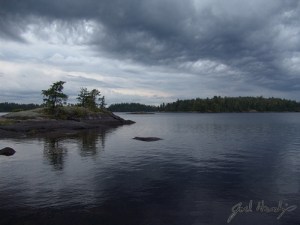
Earlier this spring I wrote about  Andrew Rogness’ book, Crossing Boundary Waters: A Spiritual Journey in Canoe Country. You can read that post here.  I am rereading it in preparation for a canoe trip in the Boundary Water Canoe Area (BWCA) later this summer with men from Resurrection.

Through out the book Rogness is wrestling with his own restless soul, seeking to restore a sense of emotional and spiritual balance in his life.  He describes a dream in which he see himself as a broken Superman who needs repair.  His self-mage has become twisted and distorted, trying to stay in control.  As he canoes alone through the wilderness, he senses a storm brewing inside himself.

In one dramatic scene, a thunderstorm rushes towards his campsite and he decides to keep his clothing and gear dry by stripping everything off and meeting the storm naked.

Now where to stand?  Near the trees isn’t a good spot, with lightning searing the sky. I walk down to the water’s edge, face west, and greet the oncoming rain with arms outstretched.

The rain pelts my skin and streams down my face.  I am surprised not to feel cold.  It is as though the water is cleansing, purifying more than the outer me, and drawing me away from the center of what is happening.  I am in this storm, not just watching it. I am in the world, not apart from it.

Across the bay, I see mist rising from the forest. Even while the rain descends, it also rises to renew itself.   I am whipped by the storm, brought to the ground of my being, and I sense this same kind of transformation rising from within.  I think of what has happened to me in three days, what has been poured out of myself to be cleansed by the wilderness and like the mist now rises to new birth (p. 92).

Rogness takes time to reflect and describe how a wilderness journey can be a spiritual experience in the Christian tradition.  He senses the power of God in storm and within himself.  His canoe trip give him the opportunity to reorient himself as a child of God.  The rainstorm is a kind of baptism in which death and new life become possible.

Do you not know that all of us who have been baptized into Christ Jesus were baptized into his death?  Therefore we have been buried with Jesus by baptism into death, so that just as Christ was raised from the dead by the glory of the Father, so we too might walk in newness of life. (Romans 6:3-4)

Have you ever experience a moment of new birth?

Has time in the wilderness helped you reorient your self-image?

Lord Jesus, create a new center within me.

Ashes and Water

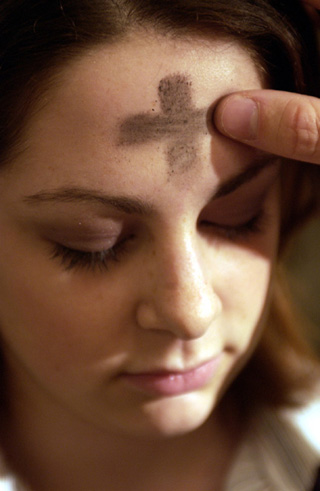
Today, Ash Wednesday, begins the 40 days of Lent. In several Christian traditions, the placement of ashes upon one’s forehead is a reminder of our mortality and our need to repent. As Abraham spoke to Almighty God, “Let me take it upon myself to speak to the Lord, I who am but dust and ashes.” Adam was made from the dust of the ground (Genesis 2:7). We each return to the dust and ash when our bodies die and decompose. We may not like to face that fact, but the truth keeps coming back.

Ashes are also a sign of repentance, our need to turn back to God. The book of Jonah describes how the people of Nineveh responded to Jonah’s message to turn back to God.

And Jonah cried out, “Forty days more, and Nineveh shall be overthrown!” And the people of Nineveh believed God; they proclaimed a fast, and everyone, great and small, put on sackcloth. When the news reached the king of Nineveh, he rose from his throne, removed his robe, covered himself with sackcloth, and sat in ashes. (Jonah 3:4-6).

The imposition of ashes also connects us to our baptism. Many Lutherans and others were baptized with water on their forehead. It was a sign of washing and renewal, of dying with Jesus and rising again to new life. Paul writes how baptism is connected to Jesus crucifixion and resurrection.

But if we have died with Christ, we believe that we will also live with him. We know that Christ, being raised from the dead, will never die again; death no longer has dominion over him. The death he died, he died to sin, once for all; but the life he lives, he lives to God. So you also must consider yourselves dead to sin and alive to God in Christ Jesus. (Romans 6:8-11):

The ashes are thus a reminder that we have already died in our baptism. We died to sin and corruption, and have begun to live the new life in Christ. The ashes we place on our head will eventually wash away; the promise of our baptism is not so easily removed. The Holy Spirit holds us in Christ Jesus.

Lord Jesus, let me die to sin and death that I might live with you now and forever.

Baptism Fire

Teaching confirmation last week, I told our students that Jesus’ baptism by John was not a sign of repentance of sin, but an ordination into ministry. Baptism is a multifaceted experience for Christians that needs to be lifted up in various ways for us to see the beauty and wonder of this gift from God.

Barbara Brown Taylor writes this about baptism connecting all God’s people together, both ordained and laity.

What we have in common is our baptism, that turning point in each of our lives when we were received into the household of God and charged to confess the faith of Christ crucified, proclaim his resurrection, and share in his eternal priesthood. That last phrase is crucial. Our baptism are our ordinations, the moments at which we are set apart as God’s people to share Christ’s ministry, whether or not we wear clerical collars around our necks. The instant we rise dripping from the waters of baptism and the sign of the cross is made upon our foreheads, we are marked as Christ’s own forever. (The Preaching Life, p. 30)

Our baptism is our call into ministry. We all have a place to serve in God’s family and God’s world. Through baptism, the Holy Spirit is placed within us to be a burning ember of power and life.  To discover our place can be a challenge in the free-market society we have. There are so many options from which to choose. Yet God has given the Holy Spirit to guide, nudge, empower, coax and affirm our direction in life. The community of faith and our inner voices become crucial in the discovery process.

Luther Seminary has a process called the Dependable Strengths Articulation Process which helps congregations and individuals discover their calling for daily life.  Resurrection Lutheran will be using this process on Saturday morning to help people discover how they can use their baptism fire for God’s glory.

Holy Spirit, ignite us with a passion to serve Jesus and his people.

“Do I Have To Go?”

Barbara Brown Taylor wrote a helpful book on preaching that extends way beyond preaching. Here is a section that she wrote regarding where we go when we follow Jesus.

Affirming the ministry of every baptized Christians is not an idea that appeals to many lay people today. It sounds like more work, and most of them have all the work they can do. It sounds like more responsibility, while most of them are staggering under loads that are already too heavy. I will never forget the woman who listened to my speech on the ministry of the laity as God’s best hope for the world and said, “I’m sorry, but I don’t want to be that important.”

Like many of those who sit beside her at church, she hears the invitation to ministry as an invitation to do more —to lead the every member canvas, or cook supper for the homeless, or teach vacation church school. Or she hears the invitation to ministry as an invitation to be more—to be more generous, more loving, more religious. No one has ever introduced to the idea that her ministry might involve being just who she already is and doing what she already does, with one difference: namely that she understands herself to be God’s person in and for the world. (The Preaching Life, p.27-28)

I totally agree with Barbara that our ministry is our daily activities and relationships, but lived with the identity of being a child of God. God has placed each of us in our unique settings to be God’s agent, God’s hands, feet, heart and voice in God’s world. We don’t need to travel to a distant land to do “mission” work, we do “mission” work in our homes, offices, schools, and community as we interact with others. A “mission” trip may help us to see the needs of God’s world and to discover our dependable strengths and gifts to meet those needs. It may strengthen our relationship with God and others, but mission can happen wherever we are.

Lord Jesus, let me rediscover my mission in you today.

New Year’s with JB

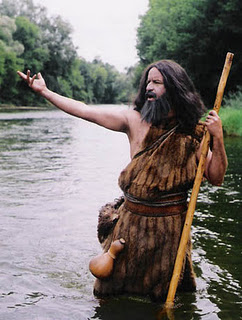
John the Baptist’s message is great for this week between Christmas and New Years.  He calls us back to a simple life-style. After all the feasting we may need repentance.

John the baptizer appeared in the wilderness, proclaiming a baptism of repentance for the forgiveness of sins.  And people from the whole Judean countryside and all the people of Jerusalem were going out to him, and were baptized by him in the river Jordan, confessing their sins.  Now John was clothed with camel’s hair, with a leather belt around his waist, and he ate locusts and wild honey. (Mark 1:4-5)

The wilderness in Scripture was not some beautiful garden-like place where people went on vacation.  Wilderness was wild, uncivilized, stripped of all niceties and refinement.  Israel had spent forty years in the wilderness during the Exodus to purify themselves from all the toxic Egyptian cultural practices. It was a place for spiritual death and rebirth.

John’s clothes of camel’s hair and leather belt, reminded the people of the Old Testament prophet Elijah (2 Kings 1:8).  Sort of like wearing a red cape to remind people of Superman. But John/Elijah had a stronger purpose than Superman, to call the hearts and lives of people back to God.

John called people to recalibrate their vision of life, success, and values.  They were baptized as a cleansing of their sinful ways so that they could begin anew, fresh and clean.

Now as 2011 concludes, we can come to our Lord seeking a fresh beginning, a new start in 2012.  We can confess our sin, knowing that God forgives us our sin and will give us a clean start.

Try this the next time you take a bath or shower.  As you wash the sweat and dirt of the day, say to yourself as you pray to God, “I am cleansed, body, mind and spirit, by the power of the Holy Spirit.”  Then step out into the promise of vibrant new life in Christ. Resolve to act as a child of God, seeking God’s path this day.

Lord Jesus, cleanse me and make me new.

Spying On Our Fears

As Resurrection moves quickly through the Old Testament, many wonderful stories must be skipped. This Sunday we will jump to the book of Deuteronomy which is Moses’ final sermon to the Israelites before they entered the Promised Land (recounted in the book of Joshua).

But this was not Israel’s first attempt to enter Palestine. The book of Numbers recounted a previous attempt to invade the land (chapters 13 and 14). Moses selected twelve spies from the twelve tribes to spy out the land of Canaan. They were selected leaders and instructed to be bold and observant. The spies returned with a huge cluster of grapes suspended on a pole. Their report emphasized a land flowing with milk and honey and with abundant fruit.

However their report also stated that the occupants of the land were many and strong, their towns fortified and very large. Caleb, one of the spies, countered “We can take the land.” The other spies disagreed, saying, “We cannot go up against this people for they are stronger than we.” Their fear overrode their trust in God’s promise. The fear of the leaders/spies also infected the people.

The whole congregation said to Moses, “Would that we had died in the land of Egypt! Or would that we had died in this wilderness! Why is the Lord bringing us into this land to fall by the sword, would it not be better for us to go back to Egypt?” (Exodus 14:2-3)

Fear can destroy a family, a congregation or a nation. We see a potential danger and magnify it beyond reality. We feel threatened and we either seek to fight or flee. The people of Israel wanted to flee.

Caleb spoke again to the people, trying to turn their focus to God.,

The land that we went through as spies is an exceedingly good land. If the Lord is pleased with us, he will bring us into this land and give it to us, a land that flows with milk and honey. Only, do not rebel against the Lord; and do not fear the people of the land, their protection is removed from them, and the Lord is with us; do not fear them.” (Exodus 14:7-9)

The people did not listen to Caleb that day. Their rebellion against God resulted in God’s declaration that this generation which yearned for Egypt must die so that a new generation of hope can arise. The story has a Christian connection: the fearful “old Egyptian” in each of us must die so that the new Christ can rise up within us. Baptism is a reminder of our being joined to Jesus’ death and resurrection.

I have been crucified with Christ, it is no longer I who live, but Christ who lives within me. And the life I now live in the flesh, I live by faith in the Son of God who loved me and gave himself for me. (Galatians 2:19-20

When has fear diverted your trust in God? When has your faith in God overcome fear?

Lord Jesus, today, kill the fear within me and reignite my trust in you.

Names Matter

Oh Lord, our God, how majestic is your name in all the earth.
Psalm 8:1

My parents named me John Vincent KellerJohn comes from the Hebrew name, Jonathan (I Samuel 13), which means gift of God.  My middle name is from my father, Vincent Keller, and comes from the same root as victorious or winner.  So my name gives me a certain amount of pride: I am a gift of God and a winner.  Then to keep me in my proper place my last name, Keller, is the German word for basement or cellar.  I need to remember my humble roots.

Names are significant in the Bible because they are not just tags that differentiate one person from another.  Names carry meaning and significance, essential characteristics of a person.  The Lord God revealed his name to Moses at the burning bush when Moses asked him for it: I am who I am.  (Exodus 3:14).  The Hebrew root of this is YHWH and means to be present or to be encountered.   Another translation of YHWH could be I will be present where I will be present, a reflection of God’s promise to be near us and yet free to be God.  Names reveal character.

Jesus is also given a special name.  In Hebrew his name is Yeshua, which means God saves or rescues.  His father Joseph is told to give this name to Jesus because he will rescue his people from their sin (Matthew 1:21).   Later during his ministry, Jesus will rename Simon, the brother of Andrew, to be Peter or Petra (Greek) which is Rock.  Simon Peter’s confession that Jesus is the Messiah is the rock upon which the church is built (Matthew 16:16-18).  Names matter.

I think of that when I walk into Resurrection Lutheran Church.  This congregation is named for the wondrous historical event, Jesus’ resurrection from the dead. With Jesus’ resurrection comes the promise that we too shall rise.  We begin the resurrected life here on earth when we die and rise with Jesus in our baptism.  Resurrection begins as we trust, live and serve God.  Our congregation’s name matters because it reminds us of the Vibrant Life of Faith in Christ.

In what ways do you call upon “the name of the Lord?”

Lord Jesus, thank you for fulfilling your calling to rescue us from our sin.

Ups and Downs with Voyage of the DT

Eustace from Voyage of the Dawn Treader

This week-end I watched the movie The Voyage of the Dawn Treader which is adapted from the third book in C. S. Lewis’ Chronicle of Narnia series. I was disappointed, even though I think the producers and screenwriters were faithful to the story. Since Lewis’ story is episodic, a string of small encounters, the movie tries to tie the episodes all together by introducing an “evil mist” that must be destroyed.

I struggled with the “evil mist” because for C. S. Lewis, evil was not some nameless vague mist, but actual angelic powers and individuals. Satan and his minions are accountable to God. There was no central person/being/intelligence in the movie’s mist to be held responsible. It was some vague power invading Narnian space, like an environmental contagion.

My real disappointment was the transformation of Eustace Scrubb. In the book this is a pivotal moment when Aslan the Lion encountered Eustace as the dragon. First Eustace tried to cut away the dragon skin and failed after several attempts. Only after the failure did Aslan release him out with one lash of his claw. Finally the restored Eustace is cleansed in the pool of water. The whole scene is a powerful description of baptism. The movie’s version did not fulfill my expectations for the scene and my baptismal perspective. Plus it came so late in the movie, we are unable to witness any transformation in the Eustace’s human character.

Still I enjoyed how the movie captured much of the joy, wonder and strangeness of Narnia. The character development in Edmund, Lucy, Caspian and Eustice was worth seeing as were the majestic sea scenes. It made me want to get my father’s tiny sail boat out and brave the waves of the Puget Sound. But that is a different post.

Do you not know that all of us who have been baptized into Christ Jesus were baptized into his death? Therefore we have been buried with him by baptism into death, so that, just as Christ was raised from the dead by the glory of the Father, so we too might walk in newness of life. Romans 6:3-4

How has a movie or story helped you understand a Christian concept or doctrine?

Lord Jesus, thank you for being my savior and rescuing me from sin and death.