Category Archives: Bible

The Parable of the Lost Door

Simple, wonderful stories happen every day. We just need to keep our eyes and ears open.

For over a year Resurrection Lutheran Church has been missing a door from a cabinet in our conference room. The small room had functioned as an office for a time with the previous pastor. He asked to have the cabinet doors removed so that the open shelves could function as bookshelves. When I was called as pastor, we determined that the “office” should be a conference room once again and the cabinet doors restored.

Our energetic Property Image Team (PIT crew) took up the challenge to re-install the cabinet doors soon after I arrived. The doors had all been stored in the storage room and were easy to re-installed. However one of the eight doors was missing. The PIT crew looked everywhere for the missing door, then the staff and family members turned offices and homes inside out, searching for the missing door. A few of the PIT crew thought it might have been “used” in some church project, but no one could remember. The door remained missing for over a year.

The conference room had a slightly “unfinished” look due to the missing door. Ministry and meetings continued to flourish in spite of the absent door, but still the room did not feel right. Our office coordinator, Sue Guck, continued to remind the PIT crew of this “blemish” and finally they agreed to create a new door.

The congregation has several talented woodworkers, but they all seemed busy with various projects of their own. Barry Van Ornum agreed to take on the task, but wanted to see if any other woodworkers in the congregation could assist him. Someone on the PIT crew remembered a member who had crafted a Bible stand for our worship center several years ago, so Barry decided to contact him. As Barry explained the project, the member interrupted him.

“You know, Pastor Ted was a stickler on details and he wanted me to make sure the Bible stand was stained to the proper color. He went into the storage room and picked up a small board for me to match. Is it possible that I might have the missing cabinet door in my garage?”

Barry Van Ornum

Within three days, Barry Van Ornum had the missing cabinet door and it is now back in the conference room. The unfinished project is now complete.

The PIT crew and staff also have a deeper appreciation of Jesus’ Parable of the Lost Coin.

“Or imagine a woman who has ten coins and loses one. Won’t she light a lamp and scour the house, looking in every nook and cranny until she finds it?  And when she finds it you can be sure she’ll call her friends and neighbors: ‘Celebrate with me! I found my lost coin!’  Count on it – that’s the kind of party God’s angels throw every time one lost soul turns to God.” (Luke 15:8-10 The Messsage).

Anyone want to join us for a party in the “restored” conference room after Easter?

Lord Jesus, thank you for seeking us out even when we are lost or forgotten.

The END Came and Went

Yesterday I wrote on the END OF THE WORLD as expressed in Mark 13. In the chapter Jesus taught his disciples regarding the signs of a new world being birthed. Jesus said, “Truly I tell you, this generation will not pass away until these things have taken place. Heaven and earth will pass away but my words will not pass away” (Mark 13:30).

Like most apocalyptic literature, Mark 13 is written in highly descriptive language that evokes strong emotions, but is often difficult to interpret precisely. The chapter is more like a beautiful mosaic of pictures than a precise timeline of events. Parts of the chapter seem to refer to the destruction of the Jerusalem Temple by the Roman legions in 70 AD (v 2, 4-11, 14-23). Other sections may refer to the persecutions the church faced in its early years. Readers can be challenged to see how it applies to our current life.

Praying at Gethsemane by Artist He Qi

Yet the reader is given a key verse in v. 35. “Therefore, keep awake–for you do not know when the master of the house will come, in the evening, or at midnight, or at cockcrow, or at dawn, or else he may find you asleep when he comes suddenly.”

The four hours of the watch (evening, midnight, cockcrow and dawn) are significant because they become the outline of Mark’s next two chapters: the story of Jesus’ betrayal, prayer,  arrest and trial.

When it was evening, he came with the twelve. And when they had taken their places and were eating, Jesus said, “Truly I tell you, one of you will betray me, one who is eating with me” (Mark 14:17).

Jesus said to Peter, “Truly I tell you, this day, this very night, before the cock crows twice, you will deny me three times” (Mark 14:30).

At that moment the cock crowed for the second time. Then Peter remembered that Jesus had said to him, “Before the cock crows twice, you will deny me three times.” And he broke down and wept (Mark 14:72).

As soon as it was morning, the chief priests held a consultation with the elders and scribes and the whole council. They bound Jesus, led him away, and handed him over to Pilate (Mark 15:1).

The disciples were unable to stay awake in the garden when Jesus prayed (Mark 14:41). They all scattered. Still Jesus remained faithful.  His words from Mark 13 came true. Jesus’ passion became the birth pangs of a new creation. The world as we knew it ended with Jesus’ crucifixion and a new world dawned with his resurrection.

Paul captures this new age in 2 Corinthians 5:17 “If anyone is in Christ, there is a new creation: everything old has passed away; see, everything has become new!” The end of the world is not simple some future event for which we wait. The “end” started with Jesus’ death and the “new” has begun with his resurrection. We live in a new age with Jesus!

Lord Jesus, let my life end and begin again with you.

End of the World?

The end of the world evokes strong emotions. Current books and movies play on the theme that the culture/world/civilization that we know is ending and a new one is replacing it, usually more horrific than our current culture/world/civilization. The roots of the transformation are in our current society and will bear fruit in the coming years. The fear of global nuclear war spurred such writings from 1950s through the 1990s. The book and movie Hunger Games is a contemporary expression of such apocalypses and their aftermath.

Mark 13 is also an expression of apocalyptic literature. Jesus and his disciples were in Jerusalem for the Passover festival. Jesus would be arrested and executed by the Roman officials in a few days. Jesus warned the disciples of coming tribulation and devastation. The magnificent temple that was central to Jewish worship would be destroyed in less than forty years by the Roman Empire. The early Christians would face frequent persecution for their faith. These trials might cause the new church to despair, yet Jesus said, “This is but the beginning of the birth pangs” (Mark 13:8).

Birth pangs, though painful in the moment, result in the beginning of a new life. Jesus was teaching his disciples to persevere, to stay hopeful, in spite of the troubles they face. He then goes on to say that to speculate on the exact day or time of this new birth is wasteful use of time. “But about that day or hour no one knows, neither the angels in heaven, nor the Son of Man, but only the Father” (Mark 13:32). Instead he says to be engaged in our daily tasks with a watchful heart, that God is near. “It is like a man going on a journey, when he leaves home and puts his slaves in charge, each with his work, and commands the doorkeeper to be on watch” (Mark 13:34). God has given us each tasks to do in this world, to love our neighbor in word and deed. We do not abandon those tasks to run and hide on some mountain because we fear the “world” is ending. Rather we continue to serve God and God’s world, knowing that someday the master will return and put things right for all people.

Tomorrow I will explore how the “world” has already ended for Christians (Mark 13:35-36).

Lord Jesus, help me not to slip into despair, but to be faithful in my service.

Penny for Your Prayer

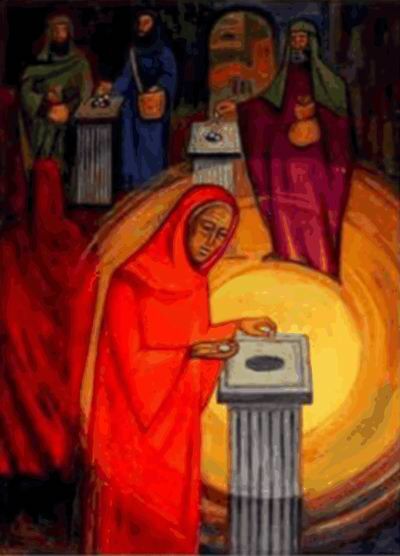
Yesterday, I preached on the story of the widow’s offering in Mark 12:41-44. The main point of my sermon was that Jesus noticed the widow’s offering. He heard her two coins in the offering box and drew attention to her sacrificial gift.

As I wrote last week, scholars may debate whether Jesus lifted her up as a model of Christian generosity or as a victim of the religious Temple institution or both. Whatever the case, he noticed her and asked the disciples to observe her.  Jesus observed and cared.

I want to rest on that observation for a moment and to acknowledge the wonder and joy of that observation. In a crowded, bustling temple courtyard, Jesus noticed a poor widow, someone whom the religious leaders seemed to ignore.

This morning as I walked into our church, I heard the birds singing. The Psalmist wrote about the temple in Jerusalem, “Even the sparrow has found a home, and the swallow a nest for herself, where she may have her young– a place near your altar, O LORD Almighty, my King and my God (Psalm 84:3).” Jesus said, “Look at the birds of the air; they do not sow or reap or store away in barns, and yet your heavenly Father feeds them. Are you not much more valuable than they?” (Matt 6:26).

Jesus observation gives me hope. In our complex, crowded, busy world, Jesus notices individuals, you and me. We are not simply some nameless creature, wandering the planet.  We are not some number in a distant computer.  We are a name, a face, a life to God Almighty. God knows our needs, our situation, the pleas of our hearts.

As part of my sermon, I had the congregation first listen to the sound of a large bag of coins filling a metal offering plate: the sound of the rich people. Then I had them listen to the soft clink of two copper coins. One had to listen carefully to hear the clink. How wonderful that Jesus heard.

I also invited the congregation to take a penny home and use it as a reminder of the Widow’s prayer. The penny reminds us that God is always listening, and that our pleas will be heard by God.  It is not a lucky penny, but a reminder of a loving God.

Lord Jesus, keep me mindful that you are listening.

Racing with St. Patrick

Today we celebrate one of God’s great saints.

There will be a variety of St. Patrick Day celebrations, including road races. Many of the races will feature post-race celebrations, including green alcohol.

It has always been curious to me that a day dedicated to an evangelist and missionary should become the focus of such drinking and carousing. Not that I am against parties, since I can  enjoy post-race celebrations very much. But when people think of St. Patrick they seem to focus on the Patrick and not the Saint.

But that is even more curious, since St. Patrick was born in England, captured by Irish raiders and sold as a slave in Ireland. After serving as a shepherd for six years, he escaped and made his way back to England. During this adventure, he had a conversion to Christianity and he felt the call to preach the faith to (surprise!) the Irish people. He studied for the priesthood in France but was not a very good student. His superiors did not want him to go, but still he went. He preached all over Ireland, making converts and founding monasteries. He became a great hero, not only for Ireland, but for the Christian faith.

In his confession he wrote, “If I am worthy, I am ready also to give up my life, without hesitation, and most willingly, for his name. I want to spend myself in that country, even in death, if the Lord should grant me this favor. I am deeply in his debt, for he gave me the great grace that through me many people would be reborn in God, and then made perfect by confirmation, one people gathered by the Lord.”

St. Patrick reminds me of St. Paul.  St. Paul wrote, “I have fought the good fight, I have finished the race, I have kept the faith” (2 Timothy 4:7). St. Patrick, like St. Paul, ran the good race. Maybe we should try to run like him.

Lord Jesus, teach me to run the race of life with you and your saints.

Widow Problem

The story of the Widow’s Offering in Mark 12:41-44 troubles me. Or more exactly how we interpret it.

(Jesus) sat down opposite the treasury, and watched the crowd putting money into the treasury. Many rich people put in large sums. A poor widow came and put in two small copper coins, which are worth a penny. Then he called his disciples and said to them, “Truly I tell you, this poor widow has put in more than all those who are contributing to the treasury. For all of them have contributed out of their abundance; but she out of her poverty has put in everything she had, all she had to live on.”

I grew up hearing the widow described as a model of Christian giving, a heroine of giving sacrificially. The moral is that we are to give more financially to the church. Yet, I never heard anyone teach or preach that I should give away everything like she had.

However, I rarely read the story in its context. Jesus observed the widow during his final week in Jerusalem. He had been in direct confrontation with the temple leadership and its institution throughout chapter twelve. Immediately preceding the story of the widow’s offering, Jesus warned against the religious officials, “Beware, of the scribes, who . . . have the best seats in the synagogues and places of honor at the banquets! They devour widow’s houses” (Mark 12:40).

Could it be that Jesus’ observation of the widow is a reinforcement of that warning? Could it be that instead of being observed as a heroine of giving, she is rather a living example of how the religious institution has devoured all her property? After all, Jesus observed what she has done, but he does not praise it.

Furthermore, the story is immediately followed by Jesus prediction that the temple will soon be destroyed. “Do you see these great buildings: Not one stone will be left here upon another; all will be thrown down” (Mark 13:2). Would an offering to the temple treasury be such a laudable act if the temple itself will soon be destroyed?

I realize that the widow’s action may be a call to radical discipleship. One of my seminary professors, the late Don Juel, wrote,

She was able to part with her possessions—unlike the young man who came to Jesus and ‘goes away sorrowing’ because he cannot sell what he has. We can recall the promise of Jesus earlier: those who lose their lives will save them. The woman gives ‘her whole life,’ as Jesus will give himself as a ‘ransom for many.’ Donald H. Juel, Augsburg Commentary on Mark, 1990, p. 173

Can the widow be a model and a victim at the same time?

Lord Jesus, show me how to give myself completely to you.

The Blessing of Rain

Rain is falling today in Minnesota. Usually that would be a source of complaint for me. The grey skies and cold rain makes my outdoor runs more challenging. Yet there is a nostalgic quality to rain; I grew up in western Washington where grey clouds and drizzle were a steady part of winter and spring. Delivering newspapers in the rain was a challenge as I pedaled the five-mile route through deep puddles and muddy roads. Now I realize that my paper route built the base and character for long-distance running, even through the rain.

Today’s rain is also a blessing for the farmers of Minnesota. Though too much rain can be a problem, the current soil moisture is below average.  The soil needs water in order to yield crops this summer and fall.

Being the pastor of a suburban church bordered by cornfields, I have grown in awareness how much weather affects the daily life of farmers. Forty years ago, Woodbury was nearly all farms, but they are steadily being turned into housing subdivisions, parks, office buildings and churches. Larry Fredin, a member and farmer, keeps me updated on the weekly activities of local farms and weather. Today’s rain is good.

Part of my Lenten discipline has been reading Luther Seminary daily on-line devotional, called God-Pause. Today’s devotional (3/12/2012)  by Diane Jacobson centered on water for a thirsty land from Isaiah 44:3

For I will pour water on the thirsty land, and streams on the dry ground; I will pour my spirit upon your descendants, and my blessing on your offspring.

Professor Jacobson wrote, “In today’s passage, God’s covenant promise goes beyond our expectations. God’s promise of pouring out real water on a thirsty land is parallel to the divine Spirit being poured out on the people. Water and Spirit are both instruments of blessing. Baptismal promises echo throughout the land and the voices of nature and humanity join in praise to God.”

The weather forecast for tomorrow is sunny and possibly 70 degrees. I know I will enjoy that when I go for my run. But today’s rain is still a blessing. Thanks be to God.

Oh Lord, send your healing and life-giving rains to all the dry land.

Hunger Games and Compassion

Several youth and adults recommended Hunger Games by Suzanne Collins for me to read. Since the movie version is coming out later this month, I downloaded it to my Droid and read it yesterday. Though it has a disturbing theme, the story kept me “flicking” pages. In a postapocalyptic future, a ruling class keeps tight control over its outlying resource districts by holding a televised survival competition. Twenty-four youth between the ages of 12 and 18 are selected from the twelve districts to enter the Hunger Games, which are a fight to the death.

The story is a classic “haves” versus the “have-nots”; the empire versus the colonies; the ruling elite versus the struggling masses. In this fictional future, the districts struggle to have enough food and other resources, while the Capital has superfluous abundance. Food plays a role through-out the book with many descriptions of meals. For example, “The stew’s made with tender chunks of lamb and dried plums today. Perfect on the bed of wild rice.” The lamb stew becomes a symbol of the Capital and it capricious ways, giving gifts when it chooses to the districts’ young competitors.

There is no religious or spiritual component in this fictional world. God is not even mentioned in the book. Yet two Christian themes stand out. One is compassion for the neighbor. Katniss, the narrator, remembers being given two loaves of bread by a baker’s son, Peeta, when her family is near starvation. This incident becomes a major subtheme. I can’t help but be reminded of Jesus’ declaration, “I was hungry and you fed me, thirsty and you gave me something to drink” (Matthew 25:35). Katniss and Peeta both practice compassion at times and seek to do good, yet I wonder where is the source of their compassion in a world that knows so little of it.

The other Christian theme is that of sacrifice. Katniss “volunteers” for the Games when her younger sister’s name is drawn as the “tribute.” Katniss sacrifices her security to save her sister from almost certain death. Jesus speaks of this the night before his crucifixion, “Not one has greater love that this, to lay down one’s life for one’s friends” (John 15:13).

In such an evil and corrupt world as Hunger Games, it makes me wonder where Katniss finds the courage and power to be compassionate.  If it is a natural human quality, why is there so little of it elsewhere in the book? I continue to believe the ultimate source of all compassion and love is God, for we are created in God’s image. Jesus said, “Do not work for the food that perishes, but for the food that endures to eternal life . . . I am the bread of life. Whoever comes to me will never be hungry, and whoever believes in me will never be thirsty”( John 6:27,35.)

Heavenly Father, give us today our daily bread, which is you.

What A Friend We Have

As my mother’s dementia progresses, one deep part of her remains: her love of hymns. She grew up in the Lutheran church and sang in choirs occasionally. She learned hymns as a child and continues to sing them today.

One hymn that we both love is “What a Friend We Have in Jesus.” I like to sing it with her when I visit,

What a Friend we have in Jesus, all our sins and griefs to bear!
What a privilege to carry everything to God in prayer!
O what peace we often forfeit, O what needless pain we bear,
All because we do not carry everything to God in prayer.

The hymn was written around 1855 by Joseph Scriven, a Canadian. He wrote it as poem of comfort and hope to his ailing mother in Ireland. Joseph was a member of the Plymouth Brethren and was known for his compassion and care of the poor and forgotten in his community. He never intended his poem to become a hymn, yet it continues to bring great comfort to those who sing it.

When I sing the hymn, I am reminded of the promise of Hebrews 7:24-25,

Jesus holds his priesthood permanently, because he continues forever. Consequently he is able for all time to save those who approach God through him, since he always lives to make intercession for them.

The book of Hebrews makes the case that Jesus is better than any ancient levitical priest who served in the Jerusalem temple, because Jesus’ sacrifice was pure and sinless.

Since, then, we have a great high priest who has passed through the heavens, Jesus, the Son of God, let us hold fast to our confession. For we do not have a high priest who is unable to sympathize with our weaknesses, but we have one who in every respect has been tested as we are, yet without sin. Let us therefore approach the throne of grace with boldness, so that we may receive mercy and find grace to help in time of need. (Hebrews 4:14-16).

The function of a priest is to give us access to the High and Holy God.  Jesus is our access to God, the one who hears our cries for help and mercy. We truly can take anything to him in prayer, even the love of our aging parents.

Lord Jesus, thank you for bearing all our cares and woes.

Touched by G.R.A.C.E.

Grace is something you can never earn or deserve, because it can only be given. God’s love and forgiveness is a gift of grace given to us in Jesus Christ. My confirmation pastor taught me that G.R.A.C.E. can be defined as God’s Riches At Christ’s Expense. No one can climb the ladder of moral righteousness to achieve God’s favor, rather God has come down the ladder to us in Jesus Christ.  Jesus’ death and resurrection are grace to us.

For by grace you have been saved through faith, and this is not your own doing; it is a gift of God. Ephesian 2:8

However, the word is so heavily use among Lutherans that it becomes common jargon.  Grace can lose its luster and awesome quality. I yearn for a fresh perspective on the gift of God’s grace to me. I yearn to be touched again by G.R.A.C.E.

Then tonight as I preached about God’s grace, it struck me, “This congregation is a gift of God to me.” I don’t deserve or merit their trust in my ministry. God’s grace is manifested in the welcome I have received as their pastor. The “awe” of that gracious gift overwhelmed me as I worshipped, prayed and preached among gracious people. Thanks be to God. And thanks be to Resurrection Lutheran Church.

Lord Jesus, touch us once again with your G.R.A.C.E.