Category Archives: Bible

Adam versus Jesus

If death got the upper hand through one man’s wrongdoing, can you imagine the breathtaking recovery life makes, sovereign life, in those who grasp with both hands this wildly extravagant life-gift, this grand setting-everything-right, that the one man Jesus Christ provides?  (Romans 5:17.The Message)

The story of Adam and Eve is central to the Christian’s understanding of the world and humanity’s place in it. In Genesis chapter two and three, God creates man (Hebrew: Adam) from the dust of the earth (Hebrew: Adama). He places Adam and later Eve, in a garden called Eden to till and keep it. They are given great freedom, with one rule to remind them of their dependence on God, their creator: do not eat from the tree of the knowledge of good and evil.

All goes well until the serpent talks Eve into the fatal bite. Adam joins her in the rebellion against God. When God comes to visit, they hide, ashamed of their nakedness. God give them the opportunity to confess but in turn they blame another. Adam blames Eve. Eve blames the serpent. God casts them out of the garden as the consequence of their rebellion.

The story is way for humans to talk about our in-born tendency to rebel against God. We want to run things our way, to be in charge of our destiny. We all trespass against God’s rule. As Paul write in Romans 5, one man’s trespass shows us the reality of sin and death in each of us.

But humanity’s rebellion is not the end of the story, but rather the beginning. God immediately begins a rescue mission. In Genesis 3:21 God provides garments for Adam and Eve from the skins of animals. Death provides protection to humans, a foreshadowing of the cross.

The rescue is completed in the death and resurrection of Jesus Christ. If death can come through one man, then surely new life can come through one man, Jesus Christ, the son of God. Jesus is so much greater than Adam or you or I. Jesus Christ lavishly dispenses the free gift of God’s mercy and grace. New Vibrant Life flows forth from the cross of Christ. We are sinners, but we are REDEEMED and FORGIVEN sinners. We are sons and daughters of muddy earth, yet we are also Princes and Princesses of God’s Kingdom. Let’s rejoice in that reality.

Lord Jesus, let me live as your forgiven child, trusting always in your grace.
Tempted or Tested?

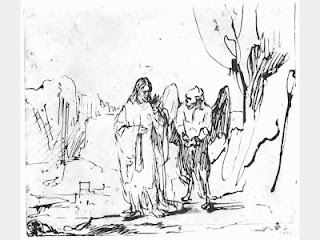
Yesterday many Lutheran churches read Mark 1:14: Jesus tempted in the wilderness.  Jesus was in the wilderness forty days, tempted by Satan; and he was with the wild beasts; and the angels waited on him. A seminary classmate of mine, Bishop Larry Wohlrabe, preached on this text at the installation of a new pastor and posted his sermon on line.  Here is a section that I really appreciated from his sermon.

What does it mean to be tempted? Temptation is about something far, far worse than falling off your diet or reneging on your no-smoking pledge. Temptation is about doubting your God-given, God-claimed identity. Temptation for Jesus in the parched wilderness was about being distracted from his mission, side-tracked on his path to the Cross, for us and for our salvation.

So what we need to picture here is a battle royal out in the wilderness. Satan, whose name means “adversary,” assaults Jesus repeatedly over the course of a forty day period. Mark doesn’t give us a blow-by-blow account, but maybe that’s OK. Mark’s narrative leaves a lot to our imaginations, and perhaps that helps us identify with Jesus all the more.

Because we, too, have our own “good long times” in the wilderness of doubt and despair. You and I also are pressed to the max, pinned to the wall, by all the “wouldas, couldas, shouldas”—all the ways we doubt ourselves and despair of trusting that God is with us.

Bishop Wohlrabe continued by reminding the local pastor of her task as a preacher in her new congregation.

When they are in the wilderness, serve these folks the same life-giving Word of God that sustained our Lord Jesus in the desert. Proclaim to them the nearness of God’s Kingdom, God’s gentle and glorious rule over all things, in Christ Jesus. Amen.

Yes, Amen.  The ministry of God’s Word continues to give life to thirsty, testy, tempted people.  And God’s Word wins.

Lord Jesus, save us from the time of trial and sustain by your saving word.

The US Run

Therefore, since we are surrounded by so great a cloud of witnesses, let us lay aside every weight and sin that clings so closely, and let us run with perseverance the race that is set before us, looking to Jesus the pioneer and perfecter of our faith. Hebrews 12:1-2

The physical exercise of running appeals to many for its solitary nature. Unlike other sports, one can easily do it alone. When I run by myself, I can do some mental reflection and prayer, seeking peace and tranquility in the steady rhythm of breath and footsteps. I run my own pace, walk when necessary, sprint when desired. Alone, I can enjoy many running benefits.

Yet I also know the power of a community run. The group gives me encouragement and incentive, pushing me beyond my normal boundaries. I especially appreciate other runners during the long runs of marathon training. The Saturday morning ritual of gathering with others gets me up early. I feel a certain obligation to be ready for the sake of other runners. The group conversation can keep me going when the miles are long or when I struggle with some bad patches. I have discovered that a good running group is essential for my development as a runner.

The writer of Hebrews seems to have that community focus as well. In chapter eleven, the writer highlights a number of Old Testament heroes who demonstrated faith in God: Noah, Abraham, Moses and Rehab. And at the beginning of chapter twelve, the writer describes these deceased heroes as “a cloud of witness,” rooting and cheering us on in our faith race. We do not run alone, the writer makes clear. He does not write, “Let me run with perseverance the race that is set before me.” Rather, “Let us run with perseverance the race that is set before us.” Our faith, though personal, is never in isolation.

I am so thankful for those friends and companions who have pushed me to become a better runner. I am even more thankful for my brothers and sisters in Christ, who push me to become a more faithful follower of Jesus Christ. Together we can finish the race of faith.

Lord Jesus, connect me to your people that I might look to you, the pioneer and perfecter of our faith.

Young and Rich

I am preparing to preach this Sunday on Jesus’ encounter with a rich man in Mark 10: 17-27. The man kneels at Jesus’ feet and asks what he must do to inherit eternal life. Jesus responds, “Keep the commandments.”

The man responds, “I have kept them all from my youth.”

Jesus responds with words of love, “You lack one thing; go, sell what you own and give it to the poor, and you will have treasure in heaven; then come follow me.”

The man was shocked and went away grieving, because he had many possessions.

I think many of us are shocked by Jesus’ words as well. “You want me to do what? Sell everything?”

Barbara Taylor Brown in wrote in her book, The Preaching Life, about the two ways we mangle this story, “First by acting as if it were not about money, and second, by acting as if it were only about money.”

As far as Jesus is concerned, money is like nuclear power. It may be able to do a lot of good in the world, but only within strongly built and carefully regulated corridors. Most of us do not know how to handle it. We get contaminated by its power, and we contaminate others by wielding it carelessly ourselves – by wanting it too desperately or using it too manipulatively or believing in it too fiercely or defending it too cruelly.

But it is not a story that is only about money, because if it were we could all buy our way into heaven by cashing in our chips right now and you know that is not so. None of us earns eternal life, not matter what we do. We can keep the commandments until we are blue in the face; we can sign our paycheck over to Mother Teresa and rattle tin cups for our supper without earning a place at God’s banquet table. The kingdom of God is not for sale. The poor cannot buy it with their poverty any more than the rich can buy it with their riches. The kingdom of God is God’s consummate gift, to be given to whomever God pleases, for whatever reason please God. (The Preaching Life., p. 124)

Strong words for a great story. God’s grace is even greater than the world, and especially our love of riches.

Lord Jesus, set me free from the love of money and center my heart on you.

Ashes and Water

Today, Ash Wednesday, begins the 40 days of Lent. In several Christian traditions, the placement of ashes upon one’s forehead is a reminder of our mortality and our need to repent. As Abraham spoke to Almighty God, “Let me take it upon myself to speak to the Lord, I who am but dust and ashes.” Adam was made from the dust of the ground (Genesis 2:7). We each return to the dust and ash when our bodies die and decompose. We may not like to face that fact, but the truth keeps coming back.

Ashes are also a sign of repentance, our need to turn back to God. The book of Jonah describes how the people of Nineveh responded to Jonah’s message to turn back to God.

And Jonah cried out, “Forty days more, and Nineveh shall be overthrown!” And the people of Nineveh believed God; they proclaimed a fast, and everyone, great and small, put on sackcloth. When the news reached the king of Nineveh, he rose from his throne, removed his robe, covered himself with sackcloth, and sat in ashes. (Jonah 3:4-6).

The imposition of ashes also connects us to our baptism. Many Lutherans and others were baptized with water on their forehead. It was a sign of washing and renewal, of dying with Jesus and rising again to new life. Paul writes how baptism is connected to Jesus crucifixion and resurrection.

But if we have died with Christ, we believe that we will also live with him. We know that Christ, being raised from the dead, will never die again; death no longer has dominion over him. The death he died, he died to sin, once for all; but the life he lives, he lives to God. So you also must consider yourselves dead to sin and alive to God in Christ Jesus. (Romans 6:8-11):

The ashes are thus a reminder that we have already died in our baptism. We died to sin and corruption, and have begun to live the new life in Christ. The ashes we place on our head will eventually wash away; the promise of our baptism is not so easily removed. The Holy Spirit holds us in Christ Jesus.

Lord Jesus, let me die to sin and death that I might live with you now and forever.

R U Hungry?

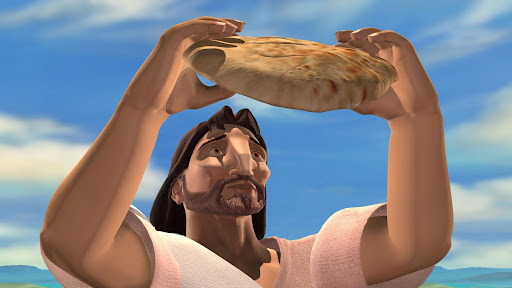
This coming Sunday at Resurrection our Gospel reading will be Mark 6, Jesus’ feeding of the 5000. It is a familiar story that is in all four gospels. On several occasions when food was running low at a church event, people would approach me as pastor to duplicate Jesus multiplying the loaves and fishes. I have failed every time to perform some magic trick. However, I never remember anyone going away hungry. Usually we “s-t-r-e—t – c—h” out the food to feed whomever is needy.

Like many stories in scripture this is open to various interpretations as to how it impacts our lives. I don’t believe the story has only one meaning to it, that once the reader discovers it, the story is finished. Rather the story rubs up against my life, challenging, enlightening, guiding my life.

A primary interpretation is that Jesus is like Moses in the Exodus, providing manna in the wilderness for the people of God. In fact Jesus is God himself, since he did not need to consult God about the people’ need, but simply blessed, broke and gave the bread to the people, a foreshadowing of his “blessing, broke and gave” sequence at the Passover meal (Mark 14:22). Jesus is the one who feeds us. John 6 is a lengthy teaching on Jesus as the bread of life.

But I think a second interpretation is the calling of the disciples to feed the people.

Jesus said to them, “You give them something to eat.” (Mark 6:26)

Jesus gave the loaves to the disciples that they might feed the people. As followers of Jesus we are called to be people who feed others, literally. The church has often been an agency that works to feed the hungry. Whether it is the hungry in the horn of Africa or local hunger of our city streets, we are still called by God to feed the hungry around us.  God has blessed us that we might give to others in Jesus’ name.

Lord Jesus, teach me how to feed the hungry in your name.

Would I Kneel?

Young Man Kneeling by Sam Loggie

Posture can be used to emphasize power and importance. Kings had high, imposing thrones to signify their power over their subjects. Visitors to ancient and medieval courts had to kneel and kiss the ring of their Lord. Even in our democratic society, leaders can be distinguished by their corner office or imposing title. Power demands attention.

In the gospel of Mark, the reader sees people posturing. In chapter five the Gerasene demon-possessed man, the leader of the synagogue (named Jairus), and a woman who suffered from chronic bleeding each knelt before Jesus and begged for his help. They all acknowledged with their kneeling posture that Jesus was Lord, a person with authority and status. They recognized the power of Jesus.

I am not one who kneels easily. I’ve come to realize that I prefer to see Jesus as my friend and guide, who accompanies me, rather than as Lord and Master who commands me. I acknowledge his Lordship verbally, but I wonder if that is more ritual than deep conviction. Am I willing to “beg” Jesus for his assistance, like Jairus (Mark 5:23)?

The question of posture comes into sharper contrast at the end of the chapter. When Jairus heard the news, “Your daughter is dead. Why trouble the teacher (Jesus) any further?” Jesus intervened. He told Jairus not to fear, but to trust in him. Jesus is Lord and has power. When they entered the room of the girl, the scripture says, “He took her by the hand.” I must assume that Jesus knelt down, since all beds were floor level. What an incredible act of tender love!

With love, Jesus knelt to meet the girl’s need. The whole incarnation is a form of God’s kneeling to meet the needs of humanity. Jesus’ birth, ministry, and death was God’s way of kneeling down before us, not to acknowledge our rebellious “power,” but as a way to enter our pain and suffering and lift us up.

As the Philippians hymn states

Jesus who emptied himself, taking the form of a slave, humbled himself and became obedient to the point of death, even death on a cross.

Therefore God highly exalted him and gave him the name above that is above every name, so that at the name of Jesus, every knee should bend, in heaven and on earth and under the earth (Phil 2:7-10)

Lord Jesus, as you knelt to save me, now teach my knees and my heart to bend towards you.

Go Where I Send You

Why would Jesus turn someone away? Someone who begs to follow him?

In Mark 5, Jesus casted out the demon named Legion from a man who lived in Gerasenes, a Gentile region of northern Palestine. When he was restored to his right mind, he sat with Jesus. His neighbors were in an uproar and begged Jesus to leave. As Jesus entered his boat, the man begged to be with Jesus, to be a disciple. Jesus refused.

But his refusal had a purpose. This man was given a very special mission. Jesus said to him,

Go home to your friends, and tell them how much the Lord has done for you, and what mercy he has shown you (Mark 5:19).

This is quite similar to the mission that the apostles are given in the next chapter of Mark. I find it both ironic and hopeful that this Gentile, recently-possessed man is given the mission of proclamation prior to the carefully selected twelve. I also find it highly instructive that he would be given this task to go to his friends and neighbors, not some distant land or foreign culture. Also as one who has recently experienced mercy of Jesus, he is a passionate advocate for Jesus. New converts are often the most passionate and assertive regarding their faith in Christ.

As a Lutheran pastor, I know that some people are specifically called to be pastors and teachers of Jesus’ message. I am thankful for those who answer that specific call. Yet, as this story bears witness, we can all bear witness to what Jesus has done for us, how we have experienced the Lord’s mercy and joy. God may send us to a new location, but the more probable is that he will send us to our friends and neighbors to give witness.

The Gospel of Mark never mentions this man’s name nor reports on his mission, except that all are amazed at the man’s testimony. Let us together rejoice in God’s mercy and amazing grace towards us.

Lord Jesus, help me to be attentive to your voice and to be willing to use my voice to speak of your mercy.

Breaking Free of Chains

No one could restrain him any more, even with a chain. (Mark 5:3)

In Mark 5, Jesus crossed the Sea of Galilee into Gentile territory. He was outside of his native Jewish land and his first encounter is quite symbolic, a demon-possessed man. The encounter with the unclean spirit is described in rich detail. He is living among the tombs (the dead) and totally alone. People had tried to bind him with chains, but failed due to the strength of the demons. The man must have been in great pain, howling at night and bruising himself with stones. He would not be someone I would be excited to meet. My first reaction would be to build a fence to keep him out.

The story may sound bizarre and strange to our ears, but the reality of people caught in destructive behavior is real. To be possessed by Satan should not be restricted to horror movies or distant lands. While I believe in demonic possession and the power of Satan, I also believe that the demonic is more cloaked and hidden in our modern culture.  Addiction, cutting, pornography, and abuse are some of the means that Satan uses today to bind us in chains. Drew Jonell’s photo reminds me that our chains can try to keep us from the light.

As C. S. Lewis once cautioned there are two dangers with a Christian’s understanding of Satan. One is to deny his existence and thereby open the door to his temptations. The other danger is too become overly obsessed with Satan’s affairs.  The Gospel writers see both dangers and steer clear of either. Demons are confronted, but Jesus always wins. The scriptures show us that demons, like death,  may distract us from Jesus, but they will ultimately be defeated. We are to keep our eyes on Jesus.

C. S. Lewis also wrote in Screwtape Letters, “Indeed the safest road to Hell is the gradual one–the gentle slope, soft underfoot, without sudden turnings, without milestones, without signposts.”

The cross and empty tomb are our signposts on the way to God’s kingdom.

Lord Jesus, continue to save us from the time of trial and to deliver us from evil.

The Path of Questions

Winter Wonderland Road by Andrew Young

Often our journey with Christ is like this snowy roadway, uncertain and slippery. We seek certainty and God gives us surprises and questions.

This morning in our Men’s Bible Study as we read Mark 2 and 3 together, I was struck by how many questions Jesus asked:

Which is easier, to say to the paralytic, ‘Your sins are forgiven,’ or to say ‘Stand up and take your mat and walk’? Mark 2:9

The wedding guests cannot fast while the bridegroom is with them, can they? Mark 2:19

Is it lawful to do good or to do harm on the Sabbath, to save life or to kill? Mark 3:4

How can Satan cast out Satan? Mark 3:23

Who are my mother and my brothers? Mark 3:33

I realized that several of these questions are rhetorical in nature. Jesus answered them himself in short order. Still he asked questions to push and to prod his listeners to think about their faith, to consider how their faith in God impacted their lives. The questions are something that we as readers of the gospel should take seriously.

As a pastor I am often asked questions by congregants about current theological issues. Such as, “Must someone confess Jesus Christ as Lord in order to go to heaven?” or “Is the Bible literally true when it says _________________?” I sometime like being the expert, the answer man. It seems to gives me a certain status or recognition. However there is a danger if I answer too quickly. I can possibly cut off the conversation one is having with God, wrestling with the question. The “chewing” on the question can push us to deeper trust and faith in God.

Jesus seemed to recognize this, often answering a question with a question. Clearly he was the “expert” who knew the answer, but he sought a deeper trust relationship with the questioner and also with us, the modern reader.  He showed us that his path is not like a superhighway, but  more often a winding path on a winter’s day.

So pay attention to the questions Jesus asked by asking yourself, “What is Jesus trying to teach me?” 

Lord Jesus, help me not to settle for easy answers, but to trust you to guide my wandering journey.

P.S.  Andy Young is my nephew in Seattle and has a great photo slide show on Facebook.