Category Archives: Bible

Names Matter

Oh Lord, our God, how majestic is your name in all the earth.
Psalm 8:1
My parents named me John Vincent KellerJohn comes from the Hebrew name, Jonathan (I Samuel 13), which means gift of God.  My middle name is from my father, Vincent Keller, and comes from the same root as victorious or winner.  So my name gives me a certain amount of pride: I am a gift of God and a winner.  Then to keep me in my proper place my last name, Keller, is the German word for basement or cellar.  I need to remember my humble roots.

Names are significant in the Bible because they are not just tags that differentiate one person from another.  Names carry meaning and significance, essential characteristics of a person.  The Lord God revealed his name to Moses at the burning bush when Moses asked him for it: I am who I am.  (Exodus 3:14).  The Hebrew root of this is YHWH and means to be present or to be encountered.   Another translation of YHWH could be I will be present where I will be present, a reflection of God’s promise to be near us and yet free to be God.  Names reveal character.

Jesus is also given a special name.  In Hebrew his name is Yeshua, which means God saves or rescues.  His father Joseph is told to give this name to Jesus because he will rescue his people from their sin (Matthew 1:21).   Later during his ministry, Jesus will rename Simon, the brother of Andrew, to be Peter or Petra (Greek) which is Rock.  Simon Peter’s confession that Jesus is the Messiah is the rock upon which the church is built (Matthew 16:16-18).  Names matter.

I think of that when I walk into Resurrection Lutheran Church.  This congregation is named for the wondrous historical event, Jesus’ resurrection from the dead. With Jesus’ resurrection comes the promise that we too shall rise.  We begin the resurrected life here on earth when we die and rise with Jesus in our baptism.  Resurrection begins as we trust, live and serve God.  Our congregation’s name matters because it reminds us of the Vibrant Life of Faith in Christ.

In what ways do you call upon “the name of the Lord?”

Lord Jesus, thank you for fulfilling your calling to rescue us from our sin.

Asleep on a Cushion

Details in Bible stories can fun as well as insightful.  This Sunday I am preaching on Mark 4:35-41, Jesus calms a storm.  The detail that catches my eye is in verse 38. As the storm reaches a climax and begins to swamp the boat, Jesus remains asleep on a cushion in the stern of the boat. As I read this I wondered, Where did the cushion come from?  Did Galilean fishing boats carry them as standard equipment?  Or did a disciple pack a  travel pillow and loan it to Jesus?

On a more serious note is the fact that Jesus is asleep at this critical moment in the storm.  Was this a sign of his confidence in God’s care?  Or a reminder of his humanity and need for sleep? Or was he simply trusting Peter and the others to do their job as fishermen?

A core question that the story stirs in me is, “Jesus, shouldn’t you be awake so you can stir the boat around the storm?”  The ship was a Christian symbol of the church: the people of God as the ship’s crew and Jesus as our captain who guides our voyage.  And do not Christians often pray for such direction?  Do we not ask for God’s protection and guidance so that we do not have a storm to face or a crisis of faith to endure?  Whether the storm is an external crisis, like a death or financial loss, or an internal crisis, such as a broken relationship or sudden illness, do we not sometimes think Jesus could have prevented the “storm” from striking us?

Such questions can help us see the truth of the story for us, because Jesus does still the storm and then confronts the disciples regarding their lack of faith.  A storm or crisis often reveals our shallow trust and our need for Jesus as our savior. When my daughter faced open-heart surgery as an infant, I know that my prayers took on a new depth and clarity.   Without the crisis we would not call out for God’s help and then bear witness to God’s transforming power.  Jesus may be asleep for us, because we have not called out to him from the depths of our souls and asked him to transform our lives.

In what ways is Jesus’ power awake or asleep in your life?

Jesus, awaken me to the power of your love.

Finding Blessing in a Hair Net

Erika Storvick and Jodi Diekmann packing meals

I invested part of my day with twenty youth and adults from Resurrection feeding the hungry.  Under Sarah Storvick competent leadership, we traveled to Feed My Starving Children’s warehouse to assemble meals.  After donning our hair nets, we poured soy, rice, dried vegetables and chicken/vitamin powder into sturdy plastic bags that are shipped all around the world to children in poverty.  Each bag can feed six children a one cup meal.  We assembled over 3,600 meal bags during our two-hour shift.

Garth and his friends just getting started

What I so appreciate about Feed My Starving Children is how it takes a global problem like children’s hunger and breaks it into simple yet significant steps of Christian compassion.  We had a number of children and youth working today and they were able to serve others in a global way.  It made hunger real and Christian service significant.

Feed My Starving Children is not the whole or final answer to world hunger.  Leaders and families in distant lands will need to find ways to feed their children in a more comprehensive and lasting ways.  But it is still a significant way to reach many malnourished and starving children while making American Christians more aware of the needs of their brothers and sisters in Christ. 

Proverbs 22:9 states that a generous man will himself be blessed, for he shares his food with the poor.  Jesus’ parable of the final judgment in Matthew 25 teaches that what we do for the least of God’s children, we do for him. “For I was hungry and you gave me food, I was thirsty and you gave me something to drink, I was a stranger and you welcomed me.”  Matthew 25:35

In what ways have you served Jesus or his people in the past week?

Lord Jesus, make me mindful of how my hands, feet, voice and wallet can be used for your kingdom this week.  I seek to do your will.


Surprise Ending or Not?

Feeding of the 500 by artist Justino Magalona

About five thousand were fed. As soon as the meal was finished, Jesus insisted that the disciples get in the boat and go on ahead to the other side while he dismissed the people. Matthew 14:21-22

The surprise finish to the feeding of the five thousand story is how the crowd reacted.  Or more accurately did not react.  After most miracles the crowd or disciples or religious officials reacted verbally to what they have seen. For example in Matthew 12 when Jesus healed a blind and mute man two reactions came forth:

 All the crowds were amazed and said, “Can this be the Son of David?” But when the Pharisees heard it, they said, “It is only by Beelzebul, the ruler of the demons, that this fellow casts out the demons.”  Matthew 12:23-24.

 Yet there is no exclamation after feeding five thousand.  Is this because the disciples did the work of distributing the loaves and fishes and the people didn’t recognize Jesus’ participation?  Or is it because they didn’t see the wonder, assuming the disciples simply had access to lots of food? Or is bread and fish something that people just took for granted?

 I don’t know the answer, but it creates in me the desire to be more grateful for the food I eat and to look for opportunities to help feed others.  This Wednesday at noon  a group of us are going to help pack food for Feed My Starving Children in Eagan, MN.  And the Evangelical Lutheran Church in America recently sent me an e-mail regarding the famine in the Horn of Africa.  Jesus still needs our hands and dollars to feed our hungry neighbor. 

 Maybe that is why there is no reaction; the story is not finished.  Only when all the people are feed will we stand in amazement at what God has done through his people.

 Lord Jesus, there are still hungry people in our world.  May you use my loaves and gifts, my dollars and cents, to feed those who need help.  And teach me the art of being grateful and gracious with the bountiful food you have given me.

Will it be Platter or Basket?

So often we read short sections of the Bible and thereby miss some of the obvious connections between the sections.  For example, I am preparing to preach on Matthew 14:13-21 in which Jesus feeds five thousand.   The story is in all four Gospels and is quite familiar to many Jesus followers.  What I had not really noticed before is the connection to the story prior to it in which John the Baptist is beheaded by King Herod (Matthew 14: 1-12).

"Salome asks for St. Johns' Head" by artist Bernardino Luini, 1510

John had ticked off King Herod when John confronted Herod’s of sin of marrying his brother’s wife, Herodias.  Herod had tried to spare John’s life while he was a “guest” in his prison. But when Herod held a huge birthday bash for himself, Herodias’ dancing daughter coerced the king into serving John’s head on a dining room platter.  How appetizing was that?  The lavish birthday party ends in blood and death.

Then we shift scenes to Jesus and his surprise party.   Instead of a palace feast, it is a deserted lake shore and the only dancing comes when the disciples try to find food for the crowd.  What started as an impromptu healing service turns into a glorious feast with food for all.  “And all ate and were filled” (Matthew 14:20). 

The Basket of Bread by Salvador Dali 1929

Twelve baskets of leftovers for the guests to carry home!  What a sharp contrast to Pilate’s party that ended with a burial and an empty platter.

Yet my guess is, if you or I had received an invitation to attend either the Celebrity Birthday Banquet or the uncertain camp out, we would have chosen the Banquet.   It is only with hind sight that we discover where the real party breaks out.  

How do we, as followers of Jesus, prepare the way for Jesus’ Spirit to break out in a fresh way among us?  How do we take what we have and fill the hungry with good things? Do we expect God’s miracles to be at work among us?

Lord Jesus, show us how to feast with you daily while feeding the hungry around us.

Jonah the Gardener

Pure speculation but I think Jonah was a gardener prior to his call as a prophet. 

"Sower with Setting Sun" by Vincent Van Gogh, 1888

How else can the reader understand his roller coaster of emotions in chapter four?  When God is merciful and does not punish Nineveh, Jonah plunges into despair and wants to die.   He pouts outside the city.  God causes a “bush” to grow up rapidly.  Its shade provides Jonah comfort; “so Jonah was very happy about the bush” (v.7).  The next day God sends a tiny worm to attack the bush so that it withered.   Without the bush, the hot sun and sultry east wind hit Jonah so that he wants to die (v.8).  Jonah’s passion for a plant reminds me of a gardener’s deep identity with her garden.

Castor Bean Plant

Scholars speculate as to what kind of bush it was.   The Hebrew word here is qiqayon which is used nowhere else in the Bible.   Some think it was castor bean plant which can grow very quickly, up to ten feet in a few months (but not overnight, which is God’s doing in the story). Whatever kind it was, Jonah immediately sees its value.  He has it for a day and then it is gone.

After the bush dies, God confronts Jonah again, “Is it right for you to be angry about the bush?”Clearly Jonah valued the bush and its comfort and he makes the judgment that he is angry enough to die.  God challenges Jonah’s perspective and judgment.

God said, “What’s this? How is it that you can change your feelings from pleasure to anger overnight about a mere shade tree that you did nothing to get? You neither planted nor watered it. It grew up one night and died the next night.  So, why can’t I likewise change what I feel about Nineveh from anger to pleasure, this big city of more than a hundred and twenty thousand childlike people who don’t yet know right from wrong, to say nothing of all the innocent animals?”   Jonah 4:10-11 The Message

The book of Jonah ends with this question.  The tension between God and Jonah is left unresolved.  It is as if God is now the gardener, planting a seed of compassion and mercy in the reader’s heart to see if it will grow.  Will it grow in you?

Lord Jesus, Master Gardener, plant and water the seeds of compassion and grace in my life.

Is it right to be angry?

Last night we wrapped up the study of Jonah for Summer Lite Worship.   Most remember Jonah’s attempt to escape from God’s mission to Nineveh and how God sends his pet whale to retrieve him.  What happens next is even more fantastic, because when Jonah finally reaches Nineveh, a city renown for sin, he preaches a one-sentence sermon and the ENTIRE CITY REPENTS, including the cattle, sheep, dogs and cats.   It is a marvelous scene with everyone wearing ashes and gunnysacks, seeking the mercy of a God they did not know prior to Jonah’s arrival.    And wonder of wonders, “God changed his mind about the calamity that he had said he would bring upon them and he did not do it.”  Jonah 3:10

The reader would think that Jonah would rejoice.  After all, what preacher has ever had 100% positive response to her sermon?   But not Jonah; he despairs!   He wants Nineveh to be punished for what it had done to Israel.   Jonah starts to argue with God,

“O Lord! Is not this what I said while I was still in my own country? That is why I fled to Tarshish at the beginning; for I knew that you are a gracious God and merciful, slow to anger, and abounding in steadfast love, and ready to relent from punishing.  And now, O Lord, please take my life from me, for it is better for me to die than to live.” Jonah 4:2-3  

The mercy of God causes Jonah pain because he sees others getting away with “murder.” Even though he received mercy when the great fish rescued him from the depths of the sea, he cannot stomach others receiving mercy.  God’s mercy irks him so much that he wants to die.

So God asked Jonah a fateful question, “Is it right for you to be angry?”

Almost all emotions involve some kind of judgment.   We are sad when we are deprived of something that we valued.  We are happy when we receive something we value.  A Garmin Forerunner 410 as a birthday present could give joy to an avid runner and disappointment to a six-year-old.  

God asks Jonah if his anger towards God’s compassion is right.  Should God be merciful to all sinners, even the most horrendous ones? Should God be gracious towards those who have hurt you?

Lord Jesus, wash me in mercy, that I might be merciful.

Try A Little Kindness

I am guessing that many think kindness is a great virtue. It is listed as a fruit of the Holy Spirit in Galatians 5:22. Stories about stopping to help a stranded motorist or ailing neighbor pull at our heart-strings. Frequently when we read about a natural disaster hitting a community, we also read how members of the community reach out in kindness to one another, providing meals, shelter, and cleanup activities. Kindness is something we value, but we often neglect. Why?

I think there are at least two things that stop me from being kind. One is my busyness. To express an act of kindness to an individual in need means that I need to suspend my agenda for a time and focus on the concerns of someone else. Jesus’ parable of the Good Samaritan in Luke 10 is a prime example. The traveling Samaritan gave up his agenda to help the person wounded and bleeding at the side of the road.

The second thing that holds me back is that I am unsure what to do. In a natural disaster, there are clearly identifiable needs, but with my co-worker who is having a bad day I’m not sure what kindness looks like. Perhaps it is just a listening ear, a kind word of encouragement, a cup of cold water? Perhaps the simplest way to act is to do unto others as I would like them to treat me.

Kindness is not so very hard, yet I struggle with it every day. I pray that God will make my heart and my schedule open to acts of kindness for others. For in acts of kindness we see the heart of God. “Whoever gives even a cup of cold water (or lemonade) to one of my children will not lose their reward.” Matthew 10:42.

When has an act of kindness touched your life deeply?

Lord Jesus, help me to perform at least one act of kindness this week-end.

Elijah and the Fireman

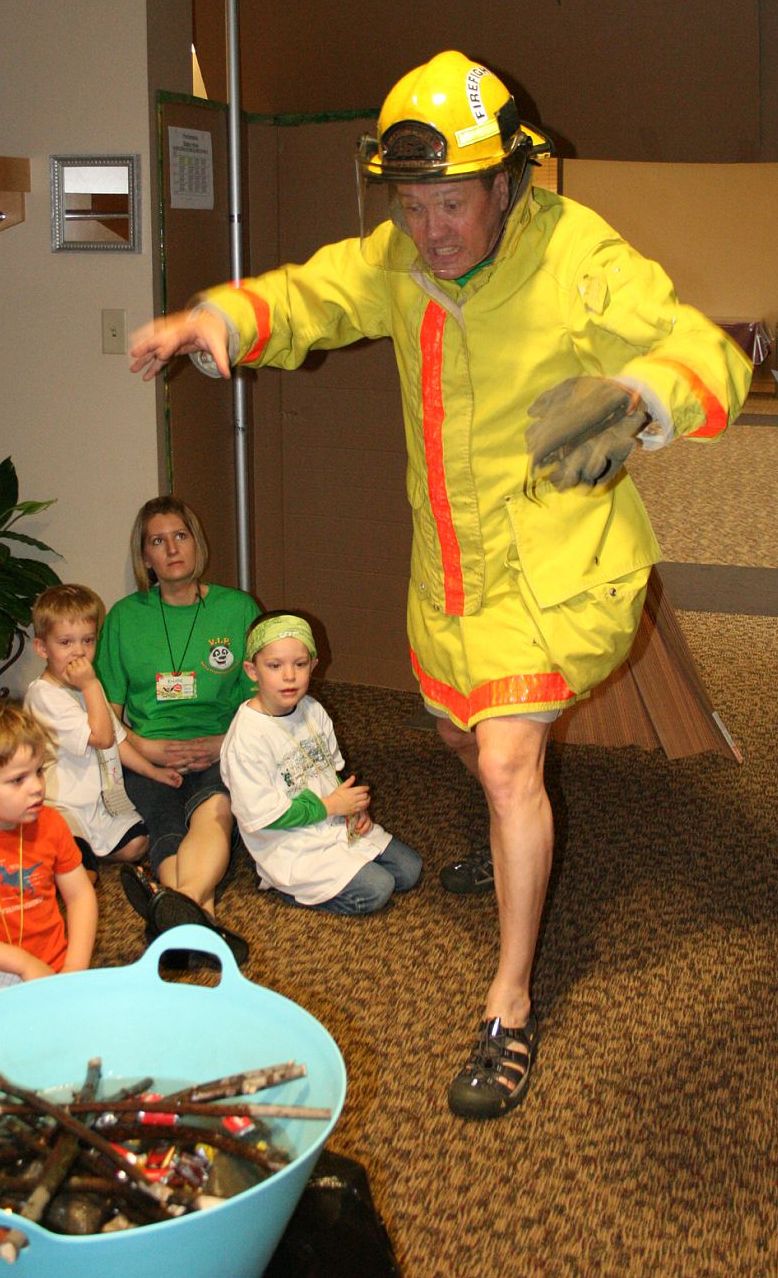
The joy and excitement of last week’s Vacation Bible Adventure still resonates in my soul.  It was a great week of singing songs, making crafts, playing games and telling Bible stories.  The coordinators, Laura Holtmeier and Tonya Bushard, asked me to be the storyteller and I was able to tap some of my passion for the dramatic.  With the help of Adam Behnken,  we relived stories from the Old and New Testament.  The children were called to imagine God’s great acts of power and compassion.

One day we retold the story of Elijah confronting the 450 prophets of Baal from I Kings 18.  We had the children build an altar in a plastic tub with stone and wood. They prepared a sacrifice of chocolate as we reimaged the story.  We even had the children drench the “altar” with pitchers of water, like Elijah.  Then, prior to calling for the LORD God to send down fire, I had to intervene as a fireman.  I warned them because when Elijah called down the fire, it consumed not just the sacrifice, but the wood, stones and water.  I had to prevent the children “from burning down the church.”  Unfortunately, the chocolate was still lost due to the pitchers of water.

Our story telling may not be “historically accurate,” but it does place us in the story, participants in God’s great story.  One of my criticisms of modern Biblical studies is that we can get so bogged down in the historical analysis that we forget the story is meant to engage us as readers.  Scholarship can sometimes place us “over” the text, as a kind of superior critic, when actually God wants to place us “under” the text or “within” the story, so that our hearts, minds, imaginations can be reshaped in God’s image.

As I read the story of Elijah, and visualize the people watching this confrontation, I wonder which side I would be rooting for.  After all, Baal is the ancient version of our own idols and false gods that we give allegiance to: popularity, success, wealth and status.  Baal was the popular god of Israel at the time, that is why 450 prophets stood against Elijah.  As I enter the story, sometimes I am Elijah, but often I am one of bystanders or a prophet of Baal. Through the story, I encounter the call of God to be faithful in my time and place.

How has a Biblical story confronted you and your life?

Lord Jesus, help me to read your Word so that your Word enters into my life.

How Long, oh Lord?

Yesterday in worship I was struck by the cry of Psalm 13.

How long, O Lord? Will you forget me forever?
How long will you hide your face from me?
How long must I bear pain in my soul?
How long shall my enemy be exalted over me?

Like many, I am naturally drawn to the psalms of trust and praise.  I seek to be an upbeat, positive person who sees the cup half-filled.  I prefer the happy psalms that shout praise to God.  Bless the Lord, o my soul, and forget not all his benefits. Psalm 103:2  So when I hear the psalms of complaint and lament, it seems to grate upon my ears and rub against my soul.  Shouldn’t we rejoice and avoid lamentations?

However the book of psalms has almost an equal number of lament psalms as praise psalms.  The book reflects God’s desire to hear our tears and anguish as well as our joys and thanksgiving.  All of life is God’s territory. 

One of the wonders of Psalm 13 is how the psalmist addresses God, even when God seems hidden and aloof.  These questions are not for casual conversation with friends, but a deep cry of the soul to God. Four times the psalmist cries out to God, “How long?”, not knowing when the answer will come, but trusting it will be heard.

Kathy was a parishioner who was wrestling with a potentially terminal illness.  She wanted to live, yet unsure if she had the strength to continue the journey.  When she came to my office, I listened to her complaint and then together we prayed Psalm 13.  The words touched a deep part of her soul, giving her permission to express the throttle cries of her heart, “how long, oh Lord?”

Psalm 13 has a marvelous ending of hope, common to many psalms of lament.

But I trusted in your steadfast love;
m
y heart shall rejoice in your salvation.
I will sing to the Lord,
Because he has dealt bountifully with me.

The psalmist still trusted God, even in the sorrow. God has been faithful in the past and will be faithful in the future, so sing to the Lord.  Weeping may linger for the night, but joy comes in the morning. Psalm 30:5

When was a time you cried out in complaint to God?  How did God respond?

Lord Jesus, teach us to trust in your steadfast love.