Category Archives: Bible

Holy Week Story – Monday

"A Woman Anoints Jesus" by Floridian artist Jan Richardson, 2006.

For the next five days I will be reflecting on parts of Holy Week Story.

Today’s reading is Matthew 16:1-16.

Jesus said to his disciples, “You know that after two days the Passover is coming, and the Son of Man will be handed over to be crucified.” (Matt 16:2)

Plans and plots abound. The climax of God’s plan to rescue and restore humanity is near.  Jesus knows this and has tried his best to prepare his disciples.   The chief priest and religious officials are also planning their own intervention to arrest Jesus by stealth and kill him.  They think that now they must take control of the situation, but they do not realize that only Jesus is truly writing the story.  Even Judas, Jesus’ friend and betrayer, is not working in total independence.  He is part of a bigger plot.   This does not excuse his betrayal, but rather demonstrates God’s power to weave a new thing from our human foibles and sin.

The only person, besides Jesus, who acts with compassion and understanding, is the woman who anoints Jesus with costly perfume (Matt 16:6-13).  Her name is never given, but she prepares Jesus for his tomb. The disciples object to her apparent extravagant waste of money, but Jesus defends her.  By pouring this ointment on my body she has prepared me for burial. (Matt 16:12).

 I think, at times, I am like every character in the story.  I can be the religious official that tries to control how and when God will act.   I can be the disciples, misunderstanding how a brother or sister in Christ is serving God’s kingdom.   I can even be Judas, betraying a friend in little acts of bitterness or disappoint, whether in thought, word or deed.   And then, by the grace of God, I can also experience the woman’s joy of generosity in giving God a special gift.    The Holy Spirit can use .

 Prayer starter: Lord Jesus, turn my heart away from control, betrayal or manipulation to being generous towards You and Your people.
Nurturing Encouragement

This morning Seth Godin, a marketing guru and writer, wrote on his blog about “Turning the habit of self-criticism upside down.”   In it he wrote,

  When reviewing just about anything you’ve done with yourself (in your head), the instinct is to be brutal, relentlessly critical and filled with doubt and self-blame.

When talking to ourselves, what if we were a little more supportive?

I identify with this self-criticism habit and know others who do so as well.   It is so easy to find fault with one’s self. 

One habit that helps me turn off that “critical inner voice” is to provide encouragement and support to others.   To turn from inward to outward, to turn from self-criticism to praising others.

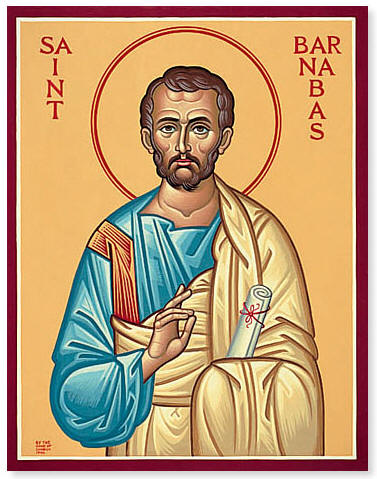
St. Barnabas the day after he split with St. Paul

My Biblical model for this is Barnabas, a little known early church leader.  He is first mentioned in Acts 4:36.  His original name was Joseph; he was Jewish religious official from the island of Cyprus.  On his conversion to faith in Jesus he sold a piece of property that he owned and gave it to the church.   He was quickly renamed Barnabas, which means “son of encouragement” because he so freely support others.   He supported Paul after his rocky conversion.  Paul had first persecuted the church and the early leaders were skeptical of Paul’s conversion.   Barnabas stood by him as a kind of sponsor/mentor.  Barnabas accompanied Paul during their first missionary journey (Acts 13:2) and the great council in Jerusalem (Acts 15).  Then Barnabas was willing to split with Paul when Barnabas wanted to encourage and support John Mark in spite of John Mark’s spotty record.   Barnabas lived a vibrant life of encouragement and exhortation.

I have discovered my own need to have several “Barnabas” in my life.  My colleague and friend, Pastor John Straiton, has always given me passionate support during my ministry, both by prayer and encouraging words.  My friend Tim has kept my running and biking in spite of injuries and struggles.  And many members and friends of Resurrection have given me words of encouragement and support in my first months here. I am so thankful for these gifts.

How do you give encouragement to others or yourself?

Our Part in the Fifth Act

N. T. Wright, the New Testament scholar, helps me understand the Biblical story as a drama with five acts.  The first act is creation, beautiful and good, Genesis 1-2.  The second act is the human rebellion against God (also known as the Fall), Genesis 3-11.  The third act is the entire story of Israel, from Abraham to the Messiah (Paul sketches this out in Galatians 3 or Romans 4).  The story of Jesus’ life, death and resurrection is the climatic fourth act of the drama, the hinge on which everything turns.  The fifth act is the story of the church beginning with the book of Acts, and this is where we live today.

Wright goes on to explain,   

When we read the story of Jesus, we are confronted with the decisive and climatic fourth act, which is not where we ourselves live – we are not following Jesus around Palestine, watching him heal, preach and feast with the outcasts, and puzzling over his plans for a final trip to Jerusalem – but which, of course, remains the foundation upon which our present (fifth) act is based.    Indeed, telling the story of Jesus as the climax of the story of Israel and the focal point of the story of the creator’s redemptive drama with his world is itself a major task of the fifth act. (The Last Word, N. T. Wright, p. 124)

This story structure is central to our understanding of scripture, how we read and interpret it.  We are still in the story and it has not been completely written, but the main outline is known.  Jesus’ death and resurrection is now our assurance that evil and death has been defeated.    We live in confidence that God has won the war.  There may be individual battles and struggles ahead, times we feel discouraged or in grief.   Yet God’s victory is assured.  The centrality of Jesus’ death/resurrection is why we retell over and over the Good Friday/Easter story every year.

That is also why we can read the story of John 11, the raising of Lazarus, as our story, thinking at times like Martha and Mary that death has won the day.  But we know that Jesus’ resurrection has happened and we live in that new reality.   A new creation is present now and will be fully realized in the future.

How has the story of Jesus become your story?

Weather or Not to Live

Mount Rainier on a clear day

This morning waking up to warm sunshine and blue skies gave my heart a real lift.  I know that  the weather should not determine my mood, especially when one lives in Minnesota year round!   Still God created me as a physical creature that relishes sunshine and abhors long stretches of frigid, grey days.   I am not a robot who has not feelings, but a being that has passion, joy, love, pain and sorrow.

Jesus was one who embraced all of life.  He changed gallons of water into wine at a wedding feast (John 2:6-10).  He enjoyed eating at lavish meals (Luke 5:29-34).  He provided food for the hungry and healing for the sick.  Jesus was not a spiritual ascetic who rejected the simple good pleasures God give to us.  He spent some time in the wilderness, but  even more time with people in the villages and towns of Galilee, Samaria and Judea.  He came from heaven to live among us. 

Jesus gathered friends around him and enjoyed their company.  He wept when his friend Lazarus died (John 11:34).  He rejoiced when his disciples return from their short mission trip (Luke 10:21).  Jesus grew tired on his journey to Galilee (John 4:6). He became angry at the money changers in the Temple (Mark 11:15).   Jesus did not pull away from life, but showed us how to enter it completely.

Growing up in western Washington state, I remember many weeks of grey cold rain.  Though mountains surrounded us to the east and west, we did not regularly see them.   When finally the clouds lifted and Mount Rainier was visible, everyone felt a lift in emotions, a lightness of heart.  Our context had changed, and so did we.  

The vibrant life of faith in Jesus will always be lived in context, in relationship to the culture, community, family and even the weather.   We are physical creatures as well as spiritual.  Let us be passionate in our embracing the vibrant life.  

How have you experienced the Vibrant Life of Faith in Christ lately?

Martha Thompson Story

Disappointed Martha

Martha Thompson faced a family crisis.  Her brother was gravely ill, near death, and she turned to someone she trusted.  She asked for her pastor to come, to pray with them.  Martha really loved her pastor and thought he was someone very special, very close to God.  His prayers for the family had always worked in the past and his ministry would be critical for her brother’s healing. 

 Unfortunately, the pastor was out-of-town.  Being the resourceful person that Martha was, she found out where he was vacationing and sent word that he should come right away.

This pastor loved Martha and her family.  He had spent time at their home, eaten at their table and laughed at their jokes.  But after he got the message, he did not come back to town right away.  He deliberately delayed two days before coming.

And by the time he arrived, Martha’s brother had died, a neighboring pastor had done the funeral and the brother’s body had been in the grave for four days.  Needless to say, Martha and her sister Mary were a bit ticked with their pastor.  When they heard he was in town, Martha marched right up to him said,

Jesus, if you had been here, my brother Lazarus would not have died.” John 11:21

This is the point where our lives intersects with the Biblical story.  When we face disappointments, trials or set backs, we wonder where God is.   What happened to Jesus?  Isn’t Jesus suppose to protect us from such pain and grief?

What amazes me is Jesus’ response.  He reminds her of the resurrection, the hope of eternal life.   Martha responds that such a hope is in the distant future, not much comfort now.  Jesus then gives an incredible promise, a fantastic promise: I am the resurrection and the life (John 11:25).   Not in the future, “I will be the resurrection,” but right now, in the middle of disappointment, pain and sorrow.  I am the resurrection and the life.

Then to demonstrate the power of his promise, he raised Lazarus from the dead.  

Jesus makes the same promise to everyone who believes in him.  Either this is the promise of a crazy man, or the Son of God.

I get goosebumps when I read this story, especially now that I am serving Resurrection Lutheran Church.  

How have you experienced Jesus’ promise of resurrection and life?

Stories, Butler Bulldogs and Lazarus

As shown in my recent posts, I am a big fan of stories, especially how the Biblical story intersects with our own individual and community stories.   I am an advocate of narrative theology, the idea that the heart of the Bible is not an instruction book of regulations and rules, but a story of God’s creative and redeeming that we live into.   Yes, there are commandment and rules to follow; all stories have those.  The commandments guide and shape the story but they are not the essence of the story.   Stories have surprises, twists and turns, which the story actors discover along the way.

Bulter Bulldog Prior to Game

Last night NCAA championship basketball game had its own story.  Butler University, a non-major University from Indiana, was playing for title against an established powerhouse, the University of Connecticut.  The Butler Bulldogs was poised to write a new chapter in the “David versus Goliath” motif.  I confess my own fascination in the developing storyline.  

Then the game was played.  Butler could not buy a basket, and the expected story fell apart.  Now the Butler team and fans will have to adapt to a different conclusion to their story.  

Stories have a way of doing that, not following the established plot line.  Lives have that trajectory as well.   One can follow all the rules, do all the hard work, follow the established norms and still not achieve the desired outcome.  Or a surprise or twist of grace can intervene and a new story begins.

This Sunday the gospel text is John 11, the story of Lazarus.   Lazarus was sick and his sisters, Mary and Martha, sent for their friend, Jesus, to come quickly that Jesus might heal their brother.  One would expect that Jesus would have honored their request.  The story explicitly states: “Jesus loved Martha and her sister and Lazarus.” (John 11:5).

The story, however, takes a strange twist.  “Yet when he heard that Jesus that Lazarus was sick, he stayed where he was two more days.”  Jesus deliberately chose not to rush to Lazarus’ aid. The story catches us off guard.   That twist opens us up to a new perspective on Jesus and life.   Jesus is not a magician who serves our needs.  Jesus is like an author shaping the stories we live. 

More on Jesus’ part in our story tomorrow.

Who are active writers in your life story?

Love to Tell the Story

One of my favorite hymns is “I Love to Tell the Story.”  

 The second stanza is
I love to tell the story: How pleasant to repeat
What seems, each time I tell it,
More wonderfully sweet! 
I love to tell the story, For some have never heard
The message of salvation
From God’s own Holy Word.”

In Acts 10:34-43, Peter tells Jesus’ story to Cornelius and his household with a similar joy.  Peter is delighted to tell them about Jesus Christ and is amazed at how open and receptive they are.  Too often in our culture we have this perception that bearing witness to Jesus Christ is stressful and difficult.  Peter demonstrates that as we follow the Spirit’s prompting, it can be a joyous, amazing event that the Spirit can bless. 

Samaritan Woman meets Jesus at the Well

Tomorrow I am preaching on another story-teller, the Samaritan woman at the well (John 4).  Her encounter with Jesus leads to her spontaneous testimony about Jesus to others in her village.  It is as if a well of joy and excitement has bubbled up inside her.  She is the one of the first evangelist or story tellers in the Gospel of John.   She loves to tell the story!    

My prayer today is simple: 
Lord Jesus, grant me the joyous opportunity to bear witness to your life story.  Your life has changed my life in so many ways; may I bear witness to you today in some special way. Amen.

What story in scripture excites you?

Stories Shape Us

The Story of Coke

This morning Rolf Jacobson told a story.  His sixth-grade daughter had a science project in which she tested people’s taste and perceptions.  First she had people do a blind taste test of three cola drinks: Coke, Pepsi and a generic supermarket brand.   Not knowing which cola was which, they split pretty evenly, but the generic was the winner.  Then she had the taste testers go into a second room and try the same three drinks but this time they knew which drink was the Coke, Pepsi and generic.  Coke and Pepsi were the easy winners.   Rolf  saw this as the victory of American brand marketing, a kind of story telling.  We believe in the Coke’s (or Pepsi) story and identify with their products.  Their story has shaped us.

Rolf, a Luther Seminary professor, connected that successful story-telling to the church’s failure to tell the Biblical story in as convincing fashion.  For many the Bible has become a dusty ancient book about some strange people, events and ideas that are jumbled together with God and Jesus.  We recognize bits and pieces of the story, but it rarely has connection to our daily lives.  Though most Lutheran pastors use a Biblical text in their preaching, the over-arching story of the Bible has been lost or never known. 

Rolf has proposed a new worship schedule of Bible readings that would guide a congregation through the Old and New Tesatment story in nine months. More information is at narrative lectionary.

Stories shape us.  Today I had lunch with two running buddies and I realized that running has been one of the stories that has shaped my life for the past ten years.  Because of injury, I miss not being able to run, but I also miss my story/identity as a runner.  I continue my physical therapy in hopes of restoring that activity and identity.   

Still a deeper story is at work.  It’s a story I have heard over and over in worship and study.   My truest identity is as not as a runner, but as a child of God.  Jesus lived, died and rose again to give me that identity and I can not run away from his story.

How does your life story connect with the Biblical story?  Has worship and preaching helped make those connections?

Questions about God and Prayer

At Resurrection, confirmation students complete sermon notes.  I enjoy reading the questions they write after the sermon is done.  Normally they offer just one, but this past Wednesday one student was truly inspired.  I had preached on Moses and his encounter with God at the burning bush in Exodus 3.   I started the sermon with the verses that come immediately prior:

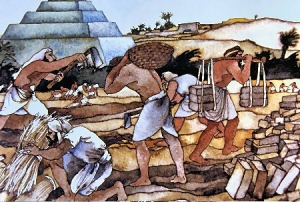
Hebrew Slaves Cry Out

The Israelites groaned under their slavery, and cried out.  Out of the slavery their cry for help rose up to God.  God heard their groaning, and God remembered his covenant with Abraham, Isaac and Jacob.  God looked upon the Israelites, and God took notice of them. Exodus 2:23ff

The cry of the Israelites created all kinds of questions for the student:

While God’s people were slaves, many died.  Why did He not save them? Why did he wait?  Were they the “bait”/sacrificed for us to grow closer to God? How do you know if God is listening? (you don’t feel he is there.)  Why did God “then” hear their “cries?”

Great questions!    

Though the Israelites had been slaves in Egypt for generations (Exodus 1:8), this is the first record of their calling out to God for help.  They may have called out before, but we have no record of it.   God knew their struggle and was preparing a way out of Egypt through his preparation of Moses for leadership.   The cry of the people and God’s call for Moses to lead the people are linked here in Exodus.  God waited both for the people’s desire to leave and for the right leader to be ready.

As to the question of whether we know God is listening, the point is the Israelites did not know at first.   They cried out to God and God chose Moses, even though Moses has no desire to be God’s leader.   Moses was God’s answer to the Israelites cry for help, but they did not know it at first.  In fact, when Moses first arrives they reject him, Exodus 5:21!

The story demonstrates that God’s answers prayers, but not always in the time and way we choose.  We are called to trust God even as we wait.  It also demonstrates that we might become the answer to someone else’s prayers.

When was a time that you had to wait for God’s answer to your cries for help?

Images of Heaven

Is this a Scriptural Image of Heaven?

Since it is still snowing in Minnesota, I need a brief glimpse of “paradise” to give me hope.  Many of us tend to recreate the new heaven and earth in our own favorite images and struggle with the images that scriptures uses.   Rob Bell in Love Wins has a comical reference to this:

Think of the cultural images that are associated with heaven: harps and cloud and streets of gold, everybody dressed in white robes. (Does anybody look good in white robes? Can you play sports in white robes? How could it be heaven without sports? What about swimming? What if you spill food on the robe?)

All of our images of heaven are somewhat speculative since they are describing something beyond our present ability to comprehend.  All language is symbolic, especially when it comes to God.  C. S. Lewis wrote a wise sermon, called The Weight of Glory.  In it he categorizes the Scriptural images of heaven:

The promise of Scripture may very roughly be reduced to five heads.  It is promised, firstly, that we shall be with Christ; secondly that we shall be like Him; thirdly, with an enormous wealth of imagery, that we shall have “glory”; fourthly that we shall, in some sense, be fed or feasted or entertained; and, finally, that we shall have some sort of official position in the universe — ruling cities, judging angels, being pillars in God’s temple.  The first question I ask about these promises is: “Why any of them except the first?”  Can anything be added to the conception of being with Christ?  . . . . I think the answer turns again on the nature of symbols.

Lewis goes on to describe how we each turn our perception of “being with Christ,” into our own version of what friendship or camaraderie or human love is like here on earth.  Lewis concludes,  

The variation of the promises does not mean that anything other than God will be our ultimate bliss; but because God is more than a Person, and lest we should imagine the joy of His presence too exclusively in terms of our poor experience of personal love, with all its narrowness and strain and monotony, a dozen changing images, correcting and relieving each other, are supplied. 

What image of heaven most surprises or unsettles you?  What could that say about you?