Category Archives: Bible

Holy Saturday

garden tomb

    There was a man by the name of Joseph, a member of the Jewish High Council, a man of good heart and good character.  He had not gone along with the plans and actions of the council. His hometown was the Jewish village of Arimathea.  He lived in alert expectation of the kingdom of God. He went to Pilate and asked for the body of Jesus.  Taking him down, he wrapped him in a linen shroud and placed him in a tomb chiseled into the rock, a tomb never yet used.  It was the day before Sabbath, the Sabbath just about to begin (Luke 23:50-54, The Message).

On Saturday, the Sabbath, Jesus’ body rested in the tomb.  The Sabbath was created by God as a day for humanity to rest and reflect on God’s goodness and blessings.  Today the church rests in the story of Jesus’ passion.

Waiting.

Waiting.

Waiting for the new creation, the eighth day to dawn.   The stone will be rolled away and the world will never be the same.

Lord Jesus, I wait with you today.

Good Friday’s Promise

Jesus crucified outside the city walls of Jerusalem.

Roman did not conduct quiet executions. They wanted maximum public disgrace when they executed an outlaw. The marched the convicts out through the public crowds to demonstrate their power over the population. They stripped the criminals of all clothing and possession.

And they chose a public place where all who passed by could see their display of power. To show that Jesus was no one special, they crucified him with two other criminals.  And to mock Jesus they printed a sign over his head, “King of the Jews.” The sign reminded all that any rebellion against Roman was futile.

If you want to be king, this is the kind of throne you will have, a throne of nails with a crown of thorns. Here is the kind of royal court you deserve, two criminals who share in your crucifixion. It will be your total humiliation and the complete demonstration of Rome’s power.

But the Romans were not alone. The temple priest and others joined in scoffing Jesus. They threw back at him his words of healing and hope. “He saved others, let him save himself.” Three times the word “save” is thrown at Jesus. But no saving angels came to rescue him.

Here was the miracle worker, who at his most desperate hour, had no miracle. Here was the great teacher, who from his bloody pulpit had no word for the crowd. From all outward appearances, Jesus was defeated, destroyed and dead.

From the outside all was darkness and pain. Jesus was utterly abandoned by his disciples, his friends, his powerful deeds and words. As the crowd stared at the cross, they did not see a Godly messiah, only a miserable joke.

But something else was going on behind the scenes. And only those who come with the eyes of faith will see it.

As the soldiers, priests and others mock Jesus, one of the criminal, for reasons unknown, spoke up to defend Jesus. He reminded the other criminal that they are being executed for just reasons, but Jesus had done nothing wrong. “Have you no fear of God?” he asks.

He turns to Jesus and says “Jesus, remember me, when you come into your kingdom” (Luke 23:42).

Whether this criminal fully understood the words he spoke or not, we do not know. But Jesus had once said, “If you have the faith of a mustard seed, God will hear and act”(Luke 17:6). In many ways, this criminal echoes our prayer as we watch this battle between the powers of darkness and destruction and the power of God’s love. We ask that Jesus will remember us.

Jesus, remember me, when you come into your kingdom.

Jesus responds, “Today you will be with me in paradise.”

Lord Jesus, lock your promise in my heart today.


The Cup of Choice

This is the Kidron Valley looking to the North. To the left is the Temple Mount. To the right is the Mount of Olives.

On Maundy Thursday, as they ate the Passover meal, Jesus confronted the disciples with the harsh reality that one of the disciples would betray him. Jesus was not surprised or stunned that one of his twelve companions, Judas, would turn against him. Jesus seemed to be reading off a script, part of an unfolding story. It seemed as if Jesus had no choice, no freedom, all the options are closing in upon him.

As if to seal his intention, he picked up the cup and said to his disciple, “This cup is that is poured out for you is the new covenant in my blood” (Luke 22:20).  He was ready to go to the cross, to pour out his blood, to be the lamb of God.

Jesus and the disciples then went off to the garden of Gethsemane to pray. As they walked towards the garden, Jesus told them that they would all desert him that night. Peter said, “Lord, I am ready to go with you to prison and to death.”

Jesus responded to Peter with the fateful warning, “Before the cock crows, you will deny me three times” (Luke 22:34).

Again it seems as if everything is fixed. The relentless march, a constant drum beat, continued towards Jesus’ suffering and death.

He asked the disciples to stay awake and pray, because he was deeply grieved, even unto death.  Jesus went a little farther and threw himself on the ground. “Abba, Father, if you are willing, remove this cup from me; yet not my will but yours be done” (Luke 22:42).

Here for a moment the relentless drum beats stops. Jesus is not some mere actor, reciting the lines of a play.

He is a flesh-and-blood human being who sees the horrendous suffering he is about to undergo. He is not some robot who is oblivious to human pain and suffering. No, he is a human being who relishes life, the joys and blessings of life.

Jesus does not want to die. Here he is like you and me. Here his humanity is on full display.

Jesus now comes back to the disciples to discover they are all asleep. Are they worth Jesus’ effort? Can’t they stay awake an hour with him? Are they worth the pain and suffering?

Jesus goes to the cross NOT to die for the worthy, for the great, for the valued disciples.

He dies for the weak and vulnerable.

He goes to the cross precisely because we are too weak, too sleepy, too self-absorbed, too sinful to go ourselves.  He pours out his life because we are weak and sinful and need to be rescued.

His love for the disciples, for you and me, overcomes any fear or temptation he faced.

Jesus, thank you for drinking the cup for us.

Stone Rejected

Stones from the Temple that were cast down by the Romans

Stones play a prominent role in the Holy Week story.

On Palm Sunday Jesus stated that if the crowd was quieted the stone would shout out (Luke 19:40).

Later when some of Jesus’ followers were admiring the Temple adorned with beautiful stones, Jesus responded, “As for these things you see, the days will come when not one stone will be left upon another; all will be thrown down” (Luke 21:5-6).   Less than forty years after Jesus’ death, the Roman army destroyed Jerusalem and the Temple.

On Easter Sunday the stone covering Jesus’ tomb was rolled away to show how empty it was (Luke 24:2).

All this gives special meaning to Jesus’ comment to the scribes and chief priests during Holy Week.

The stone the builders rejected has become the cornerstone (Luke 20:17)

Jesus was rejected by humanity on the cross, but becomes our assurance of God’s love and grace.  While our trust shifts like sand, his love for us remains rock-steady.

In what ways have you rejected Jesus this week?
In what ways has Jesus become your cornerstone?

Lord Jesus, be my rock and fortress this day and always.

Redemption Draws Near

The Kidron Valley outside of Jerusalem.

Adam Hamilton, a well-known Methodist pastor, took this picture and writes concerning it.

To the right you can see the temple mount and beyond it the old city of Jerusalem. To the left, out of frame, is the Mount of Olives and the Garden of Gethsemane. In the foreground is a Christian burial ground. On the Mount of Olives is the largest Jewish cemetery in the world. To the right, just beneath the walls of the temple mount, is a Muslim cemetery. It was thought, based upon several scriptures, that when the Messiah came for the Last Judgment he would come here, hence the cemeteries. Jesus passed across this valley twice each day during Holy Week.

On Tuesday of Holy Week Jesus taught in the Temple and told the crowds that his ministry was not some isolated historical event, but rather part of God’s great cosmic plan to redeem the world.

Jesus said, “There will be signs in the sun, the moon, and the stars, and on the earth distress among nations confused by the roaring of the sea and the waves. People will faint from fear and foreboding of what is coming upon the world, for the powers of the heavens will be shaken. Then they will see “the Son of Man coming in a cloud’ with power and great glory. Now when these things begin to take place, stand up and raise your heads, because your redemption is drawing near” (Luke 21:25-28).

As you walk with Jesus this week, remember you are a participant in God’s great plan. God is redeeming the entire world, including you. Your redemption is drawing near.

What part is God calling you to play in this cosmic event?

Lord Jesus, grant me courage and strength to trust in your plan of redemption

Cleansing of the Temple

Monday of Holy Week is often remembered for Jesus cleansing the temple of the money changers.

Then he entered the temple and began to drive out those who were selling things there. Luke 19:45

Muslim Dome of the Rock

Since the seventh century, the Dome of the Rock shrine stands where the Temple once stood. Jesus came to the Temple to chastise the religious leaders for turning God’s house from a house of prayer into a den of robbers (Mark 11:17).

Since Paul reminds us that we are God’s Temple and that the Spirit of God  dwells in us (I Corinthians 3:16)  Jesus’ actions in the Temple challenges each of us to reflect on how we use our own bodies and lives for God’s kingdom.

On Friday of this past week, I sprained my ankle and must use crutches for it to heal.  In one way I see this as a reminder to slow down and patiently follow Jesus, leaning into his grace and mercy.

How are you remembering that you are God’s temple?  What cleansing is Jesus doing?

Lord Jesus, cleanse me of my sin and renew a right spirit within me.

Palm Sunday

The Mount of Olives outside of Jerusalem

As Jesus was now approaching the path down from the Mount of Olives, the whole multitude of the disciples began to praise God joyfully with a loud voice for all the deeds of power that they had seen, saying, “Blessed is the king who comes in the name of the Lord! Peace in heaven, and glory in the highest heaven!” Some of the Pharisees in the crowd said to him, “Teacher, order your disciples to stop.” He answered, “I tell you, if these were silent, the stones would shout out.” As he came near and saw the city, he wept over it, saying, “If you, even you, had only recognized on this day the things that make for peace! But now they are hidden from your eyes.” (Luke 19:37-41)

Are you a follower who shouts Hosanna or a stone-cold skeptic that keeps your mouth shut? Or a stone that longs to sing?

Lord Jesus, open our eyes to see you as your truly are, the Prince of Peace.

The Journey

Next week is central to my identity. My life changes as I enter it. It is the annual pilgrimage of Christians worldwide.

Holy week is more than a seminar on how to improve my life skills.

A popular way to read scripture, preach sermons or write devotionals is to seek life application. The goal is to find specific practices or concepts on how to improve my life. For example, how I might be a better parent or a better spouse, how I can worry less or trust God more. There is a place for life application, but I don’t see the final days of Jesus’ life as serving that primary function.

I want to use a metaphor to explain this. Our lives can be compared to a home where we live. We have our spaces, our furniture, and our routines that shape daily lives. “Life applications” help us do minor rearrangements and some remodeling to our home, but we still manage how the day-to-day routine flows in our home.

( )

( ) (Photo credit: Wikipedia)

But Holy Week actually forces me out of my home. I am on a pilgrimage to ancient Jerusalem in my imagination. I am part of the crowd that shouts “hosanna” as Jesus enters Jerusalem on a donkey. I join with the disciples in eating with Jesus the upper room. With the crowd outside of Pilate’s court, I shout,  “Crucify him.” Finally I hurry to the tomb with the women, full of wonder.

I gather with the people of Resurrection Lutheran to worship, pray, sing and sit in silence. I will seek no specific application or wisdom other than to be with Jesus.

Through this journey my daily story is rewritten, reworked. Like the hobbit Frodo Baggins, I am on a journey far from my comfortable Shire. And when I return to my home, I have been changed by the journey.

Are you ready to enter the story of Christ’s passion this year?

Lord Jesus, let me truly walk with you this week.

First and Last Communion


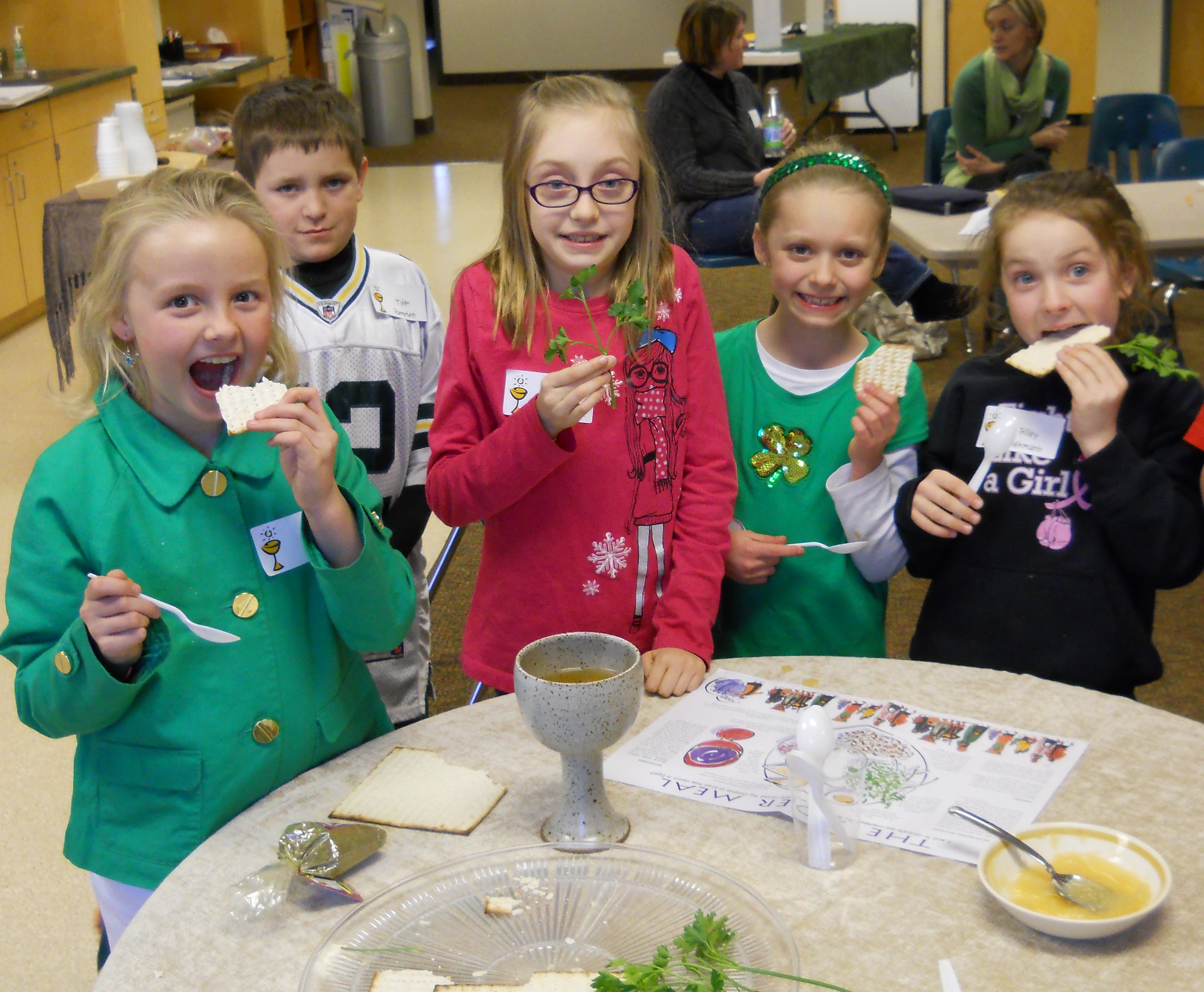
??????????I enjoy teaching first communion classes for families. The children are often excited and eager to learn about this mystery meal. We bake bread, tell stories, and taste foods.  I love connecting the meal to the story of Jesus’ life, death and resurrection. We walk through the story of the passion: Palm Sunday parade, the last supper, the trial, crucifixion, and burial.

Waiting.

Waiting.

Then the surprise of Jesus’ resurrection, (which is the name of our congregation I remind the children).

But first communion is just the first step. I like having the parents there since they are rediscovering what the meal is for them. Communion grows in meaning and joy as we participate in it.  There may be times we take it for granted, but God never takes us for granted.  It is always his gift of grace for us.

Though the focus is on preparing for their first communion, I often ask the question, “do any of you know when your last communion will be?”  Together we wonder about the uncertainties of life, yet the constant promise of God to be with us in the Lord’s Supper.  I tell them the story of taking communion to people in hospice as they prepare to die. The meal become an appetizer for the feast that is yet to come. When we will all feast with Jesus and drink the new wine.

Jesus said, “I tell you, I will never again drink of this fruit of the vine until that day when I drink it new with you in my Father’s kingdom” (Matthew 26:29)

Lord Jesus, let me taste again the power of your grace and love.

Forgiveness Can Be Tough

forgiveness log 2

Forgiveness can be tough. Even though we pray in the Lord’s Prayer, “Forgive us our sins, as we forgive those who sin against us,” and know that Christ forgives us, we can often struggle to forgive those who wrong us.

I was in college, near the end of my freshman year. A friend and I applied to be resident assistants together in the freshman dorm. We were interviewed for the position by some upper classmates. My friend and I thought the interview had gone well. We both had good references as compassionate, helpful students and since there were only a few applicants, we thought we would both be chosen.

A few days later, I discovered that I had been rejected.

The reason given was that I was too vocal about my Christian faith. The student leaders thought I would be constantly “evangelizing” the freshman on my floor, even though this behavior had not been discussed in the interview. I felt that I had been unfairly rejected and was both disappointed and angry.

I wrestled with how to be forgiving towards the student leaders. I believed they had jumped to a conclusion without ever asking the question. I had helped start a Christian fellowship on the campus where none had existed before, but I was not some “outspoken” evangelist.  In fact, I was often too quiet about my faith in public settings. After the rejection, I wrestled with my resentment towards my fellow students and whether I could forgive them.

Fortunately this wrestling match ended quickly. The Dean of Students (who had written one of my recommendations) heard about this unfair decision and reversed it. I was thankful for his intervention and had a good year as a resident assistant. Still I wonder what I would have done if the Dean had not intervened. How long would I have carried resentments?

Jesus carried no such resentments.  Even as he was nailed to the cross, he said, “Father, forgive them, for they do not know what they are doing” (Luke 23:34).

Have you ever struggled with forgiving someone?

Lord Jesus, forgive us our sins as we forgive those who sin against us.