Category Archives: Bible

The Rock in the Storm

The Book of Psalms has been the topic of our Men’s Bible Study this month. The Psalms were the worship songs of the ancient Israelites and they reflect both the tremendous joy and extreme sorrow the people experienced in their relationship with God and their neighbors. One frequent theme is that in life’s struggles, God is our rock and refuge. The rock image has been a favorite of mine throughout my life.

The Lord is my rock, my fortress, and my deliverer, my God, my rock in whom I take refuge. Psalm 18:2

You are indeed my rock and my fortress; for your name’s sake lead me and guide me Psalm 31:3

For God alone my soul waits in silence; from him comes my salvation. He alone is my rock and my salvation, my fortress; I shall never be shaken. Psalm 62:1-2

Among the ancient Israelites, the sea was a symbol of chaos and catastrophe. The rock was the opposite symbol, a sign of continuity and steadfast devotion. The picture above captures some of the energy and wildness of the sea as it crashes against the rock. In that moment, the sea seems victorious, but the wave recedes and the rock remains.

In our life, we are often hit with waves of wild chaotic energy that threatens to destroy us. It can be moments of grief when we remember a loved one who has died. It can be the sudden change in the marketplace when our job or career takes a beating. Or the wave might be a diagnosis of some health issue that causes our life to spin. Or it can be a relationship that suddenly shifts in a difficult, unexpected way.

Or sometime it is the chaos we created within ourselves by the bad choices we made.

In the moment we seem overwhelmed; but we need to remember that God remains our rock, our fortress in the midst of the challenges. God is steadfast.

For God alone my soul waits in silence, for my hope is from him. He alone is my rock and my salvation, my fortress; I shall not be shaken. On God rests my deliverance and my honor; my mighty rock, my refuge is in God. Psalm 62:5-7

God remains the ultimate source of peace, calm and hope.

Lord Jesus, be my rock and fortress today and always.

Pilgrims, Property and Piety

During my daily commute I have been listening to Nathaniel Philbrick’s Mayflower, a history of the Pilgrim’s first decades in New England . One episode caught my ear.

During the first years of the settlement at Plymouth, the colony struggled to produce enough food for the harsh winters. They were a pious refugees who were seeking a more perfect Christian community.  They decided at first to have a communal farm and share both the labor and the harvest equally. However their harvests were so meager that the Governor Bradford decided in 1623 to stop communal farming and allowed each family to grow and keep their own corn crop. After this decision the colony rarely struggled for food.

The failure of the communal farm reminded me of a short passage in the book of Acts. (Resurrection LC has been reading the book of Acts in worship as part of the Narrative Lectionary.)

Now the whole group of those who believed were of one heart and soul, and no one claimed private ownership of any possessions, but everything they owned was held in common. (Acts 4:32)

This early vision of communal living seemed to be short-lived in the church as well. Paul does not refer to it in any of his letters directly. Rather he practiced his own tent-making vocation and funded his own missionary journeys (Acts 18:3, 2 Cor. 11:7-9). The early church met in people’s houses, which means that someone must have owned the homes. Private property was never abolished by the church.

There have been some successful versions of communal living in church history, the monastic communities being the best example. Yet the vast majority of Christians continue to own private property and prosper from a free market society.

The Acts 4:32 experiment still has a purpose for all Christians: the call to be good and generous stewards of our possessions. Like the early pilgrims, we may be more industrious when we directly benefit from our labor. Still Christ calls us to be compassionate neighbors, one to another. Our new relationship with God calls us into compassionate service towards others.  Generosity will always be part of a mature Christian piety.

Lord Jesus, teach me to be generous as you are generous towards me.

Acting Out

Yesterday I was excited as I taught the children to “leap” with praise.  In worship we read Acts 3, the story in which Peter and John healed a crippled beggar outside the temple gate and the man entered the temple with them, “walking and leaping and praising God.” The children and I enjoyed leaping up to give God’s praise. Their energy got me ready to preach.

The original healing and leaping gave Peter the opportunity to preach as well. The miracle caused such a commotion that Peter had to address the crowd to direct the crowd’s attention away from John and himself and back to Jesus Christ. He called the crowd to repent and turn to God (Acts 3:19).

This is Peter’s second sermon in the book of Acts. After the first, on the day of Pentecost, the crowd asked what they needed to do. Peter respond, “Repent and be baptized;” three thousand were baptized that day (Acts 2:38,41). Marvelous fruit for one sermon.

Peter’s second sermon had a different effect: the priest and officials of the temple arrestted them because they were proclaiming that in Jesus there is the resurrection of the dead (Acts 4:1-2). Peter and John were “acting out” against the norms of their temple religion and had to be quieted in some way. So the leaders questioned Peter and John by whose authority they were teaching and healing. Peter, by the Holy Spirit declared to these religious officials,

Let it be known to all of you and to all the people of Israel, that this man is standing before you in good health by the name of Jesus Christ of Nazareth, whom you crucified, whom God raised from the dead (Acts 2:10).

Nothing is keeping Peter from proclaiming Jesus with all boldness, even to the gang that had Jesus executed.

May we each have such boldness to proclaim Jesus Christ.

Lord Jesus, give me courage to speak your name, even to act out when needed.

Doubt and Faith

“Doubting Thomas” will be focus of many sermons this Sunday in congregations that use the Revised Common Lectionary.  The story of Thomas in John 20:24-31 is assigned every year because it occurs the week after Jesus resurrection. In the story the other ten disciples tell Thomas, “We have seen the Lord,” after he missed the first resurrected appearance of Jesus on Easter Sunday. Thomas responds with skepticism, “Unless I see the mark of the nails in his hands, and put my finger in the mark of the nails and my hand in his side, I will not believe” (John 20:25).

"Still Doubting" by artist John Granville Gregory

Today I read a helpful blog post on the challenges of being selective in our skepticism from TE Hanna. He points out that one cannot be semi-skeptical as one looks at the data of faith. Either you look at all or none of the evidence. I am not a philosopher, but his reasoning helped me think about faith and Thomas.

A certain amount of skepticism or doubt is needed in daily life. So much information assaults our senses every day that we have to filter what is valid and helpful. Not everything I see on the internet, read in a book, or watch on television is true. We are not to be gullible to everything someone says.

Of course part of our skepticism is based on the character of the witness. Last week I was with a group of pastors for our weekly text study when one began to tell us the story of his upcoming trip to Rome. He and his wife had been planning it for several months. He had told a Catholic priest, a friend, and the priest had told, “I think I can arrange an audience with the Pope while you are there.” My pastor friend went on for a few more minutes about his excitement about the upcoming audience while I and others peppered him with curious questions and exclamations about how wonderful his audience with the pope will be. Finally, with a big grin, my pastor friend said, “April Fools.” The papal audience was a joke that he played on us, though the trip to Rome is real. The whole group had believed his story, in large part because he rarely tells such fables. He had always been a reliable witness.

That is part of the struggle in the Thomas story. When confronted by his ten friends, he is sure they must be bearing false witness. As I wrote about this last year, I wonder what the week between appearances was like for Thomas and the other disciples.

Which pushes me to deeper reflection, is my life congruent with my testimony of Jesus’ resurrection? Do people believe in Jesus because my life and my words bear witness to his resurrection? I pray that this is so for each of us.

Lord Jesus, may my words and my deeds bring deeper faith in you to others.

Walk by faith or by sight?

Women Arriving at the Tomb by He Qi

The glory of Easter worship still rings in my ears and heart. The Gospel of Mark’s bold message announced to the women and to us, “You are looking for Jesus of Nazareth, who was crucified. He has been raised” (Mark 16:6). The resurrection is what sets Christ apart from all other prophets and religious teachers. It is central to our Christian faith, yet seems so beyond our personal experience.

Perhaps that is one of the reason so many people become uncomfortable with how Mark’s Gospel ends. Reliable scholarship points to the final verse being verse 8:

So they (women) went out and fled from the tomb, for terror and amazement had seized them; and they said nothing to anyone, for they were afraid.

The gospel writer provides both the empty tomb and the young man’s witness that Jesus is raised and believes that is sufficient for the reader. This seems inadequate and unsettling at first. Where are the appearances of the risen Jesus as described by Paul (I Corinthians 15) or Matthew (28:16-20) or Luke (24:13-53) or John (20-21)? Where are the final instructions from Jesus to his disciples? Verse eight has an unfinished feel to it. In fact, early in the church’s history, additional endings were added to Mark to give a more “comfortable” and “respectable” ending.

As I preached on this yesterday, I think Mark’s ending makes sense at verse eight, if we see it as the challenge to us and our faith that it is. The writer wants us to wrestle with the message of resurrection and the promise that he is going ahead of us.  Stories of Jesus’ appearances may give some comfort but none of us have actually seen the resurrected Jesus. We have only the written reports of the Gospels, such as the young man at the tomb. Ultimately we will have to judge the validity of the witnesses. Paul makes this case in I Corinthians 15.

I continue to think that the most valid testimony of Christ’s resurrection is the transformed lives of his followers. They had trusted him to be the Messiah, but he had been crucified. Their hope was crushed that day. The were like the frightened women, tongued-tied.  Only the actual resurrection of Jesus could have changed them from frightened ex-followers into courageous ambassadors of Jesus. And I have seen such transformation in people’s lives today as they trust in Christ.

The end of Mark’s gospel pushes the reader to trust in the message of the young man.

It is only fitting that just at the tomb will not contain Jesus, neither can Mark’s story. Jesus is not bound by its ending; he continues into the future God has in store for the creation. In the meantime there is only the Word, the bread, and the wine, and the promise that “you will see him.” We walk by faith and not by sight. We can only trust that God will one day finish the story, as God has promised. (Donald Juel, Mark, Augsburg Commentary on the New Testament. p. 235.)

Lord Jesus, help me to walk by faith and not by my own narrow vision.

Prepare the Way of the Lord

Maundy Thursday is about preparation.

Jesus’ disciples said to him, “Where do you want us to go and make the preparations for you to eat the Passover?” Mark 14:12

The Passover Festival was a big deal in Jesus’ time; the festival centered on a meal that remembered God’s liberation of the Hebrew slaves from bondage in Egypt as told in the book of Exodus. Throughout the meal, Jews remembered God’s intervention and prayed for God’s continued activity in their lives. Jesus’ disciples needed to prepare for this meal with wine, bread and lamb.

According to Mark’s Gospel, Jesus gives elaborate instructions , “Go into the city, and a man carrying a jar of water will meet you; follow him, and wherever he enters, say to the owner, “The Teacher asks, Where is the guest room where I may eat the Passover with my disciples?” (Mark14:13-14) One wonders how Jesus knew that they would meet a man with a water jug? Had there been some secretive pre-planning by Jesus so as to avoid the temple officials? Or was this Jesus showing his “magical” powers?

Throughout the Holy Week story, Jesus sees the future unfolding in a specific way. He knows how to find a donkey’s colt for his entrance on Palm Sunday. He knows that the great temple will be destroyed. He knows that one of his disciples will betray him. He knows that Peter will deny him. Jesus knows.

I don’t think the Gospel writer is trying to answer great philosophical questions with telling the story in this way. Mark is not concern with pre-destination versus free-will. What matters for Mark is that Jesus understands and accepts his role in the story and especially his role to die and rise again.  Jesus is LORD.

Three time prior to his coming to Jerusalem, Jesus had foretold that the Son of Man must suffer, be rejected, die and on the third day rise from the dead (Mark 8:31, 9:31 and 10:33-34). Even as Jesus and the disciples walk towards the Garden after the Passover meal, Jesus reminds them that he will be raised from the dead (Mark 14:28). Like the disciples, we may struggle to grasp the significance of the Jesus’ crucifixion and resurrection. We may not fully comprehend all that Jesus says and does. Events swirl beyond the control of his disciple, his enemies, or us. Yet Jesus continues to trust in God’s unfolding plan, even as he walks towards the cross and tomb.

Just as Jesus made preparations for the Passover Meal, he prepares his disciples and the readers of the Gospel for his death and for his resurrection. The meal becomes our place not only to remember his death, but also to claim the promise that he will drink the new wine with us in Kingdom of God (Mark 14:25). Jesus keeps his promises, including rising from the dead. Though we may scatter (like the disciples), he will gather us together as his children. He has prepared the way for us.

Lord Jesus, as you prepared to eat Passover with your disciples, so prepare us to eat with you at your table now and in the Kingdom to come. Amen.

Who me? Betrayer?

For I received from the Lord what I also handed on to you, that the Lord Jesus on the night when he was betrayed. . . (I Corinthian 11:23)

In the Catholic church the Wednesday of Holy Week is often called Spy Wednesday, because it is the day we remember that Judas betrayed Jesus and spied upon him. Judas had been one of the twelve disciples, trusted by Jesus. But he arranged with the chief priests to turn Jesus over to them at an opportune time, when there would be no fawning crowd to interfere.  In the Garden of Gethsemane, Judas betrayed his master with a kiss.

People often wonder what motivated Judas to betray Jesus. Was it only the money? Or was he trying to force Jesus’ hand so that he would call down God’s angels to overthrow the Romans? Or did he simply lose faith in Jesus, choked by the worries and concerns of the world?

The scriptures are unclear. That non-clarity may be intentional because it can push us to think about the ways we may have betrayed Jesus. Probably not as openly as Judas, but we all betray, deny, run from, or avoid Jesus and his call upon us. We all fall short of his command to love one another. The story of Judas betrayal is both a warning but also a description of our own wandering hearts.

Yet the words of Paul in I Corinthian 11 are the opening words of Holy Communion, the supper Jesus gave to his disciples and to us. The meal holds the promise of forgiveness and grace. “This is my blood, shed for you for the forgiveness of sins.” Even in the midst of betrayal, Jesus gives us mercy and grace.

Though we be faithless, he is faithful. Praise be to God.

Lord Jesus, renew a right heart within me.

Jesus Clears the Temple

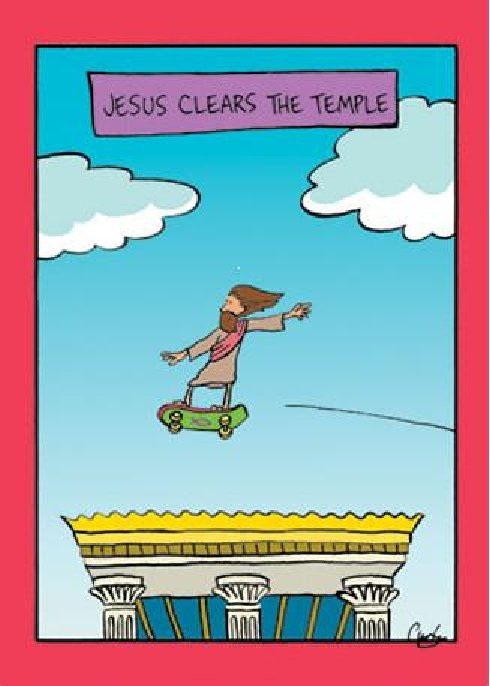
A member of Resurrection sent me this cartoon today: “Jesus clears the temple.”* The cartoon got me thinking about the story in Jesus’ ministry (Mark 11:15-18). For many of us, the fact that Jesus cleared the temple of money changers is not significant or  meaningful. We don’t realize how upsetting and radical  Jesus’ action was for the ruling religious council in Jerusalem. We often see Jesus’ angry expression as some sort of deviation from the nice, kind Jesus we adore.  It was sort of “bizarre,” like someone “clearing” the temple on a skateboard.

But the Temple Cleansing was central piece of his Messianic vocation.  N. T. Wright helps to clarify this from the historical perspective of first century Judaism (the full essay is here):

Jesus believed he was Israel’s messiah, the one through whom God would restore the fortunes of his people. . . .  Anyone doing and saying what Jesus did and said must have faced the question “Will I be the one through whom the liberation will come?” All of the evidence—not least the Temple-action and the title on the cross—suggests that Jesus answered, “Yes.”

Second, Jesus’ radical and counter-cultural agenda, subverting both the political status quo and the movements of violent revolution, was focused in his awareness, of vocation.  John the Baptist re-enacted the Exodus in the wilderness; Jesus would do so in Jerusalem. Jesus’ gospel message constantly invokes Isaiah 40-55, in which God returns to Zion (Jerusalem), defeats Babylon, and liberates Israel from her exile. At the heart of that great passage there stands a job description. This would be the victory over evil; this would be the redefined messianic task. Jesus had warned that Israel’s national ideology, focused then upon the revolutionary movements, would lead to ruthless Roman suppression; as Israel’s representative he deliberately went to the place where that suppression found its symbolic focus. He drew his counter-Temple movement to a climax in Passover week, believing that as he went to his death Israel’s God was doing for Israel (and hence for the world) what Israel as a whole could not do.

Third, Jesus believed something else, I submit, that makes sense (albeit radical and shocking sense) within precisely that cultural, political, and theological setting of which I have been speaking. Jesus evoked, as the overtones of his own work, symbols that spoke of Israel’s God present with God’s people. He acted and spoke as if he were in some way a one-man, counter-Temple movement. He acted and spoke as if he were gathering and defining Israel at this eschatological moment—the job normally associated with Torah. He acted and spoke as the spokesperson of Wisdom. Temple, Torah, and Wisdom, however, were powerful symbols of central Jewish belief: that the transcendent creator and covenant God would dwell within Israel and order Israel’s life. Jesus used precisely those symbols as models for his own work. In particular, he not only told stories whose natural meaning was that YHWH (God) was returning to Zion, but he acted—dramatically and symbolically—as if it were his vocation to embody that event in himself.

Jesus saw himself as the means of salvation, no longer the Temple as the means. He became the sacrifice for our sins. He cleansed not only the Temple, but our hearts so that God can live in us. Amen.

Lord Jesus, continue to cleanse us.

*The cartoon is by Cuyler Black and you can find more of his cartoons here

He is Dangerous!

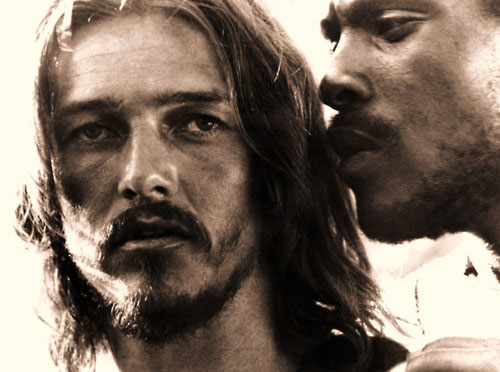
Thirty years ago I was asked to perform in a production of Jesus Christ Superstar. I was type-casted, not as Jesus, but as one of the priests who plotted to have Jesus executed. I and the other priests were place on a scaffold above the stage, looking down with condemnation on Jesus and his disciples as they entered Jerusalem. Like the movie, we sang “This Jesus Must Die.” The refrain in the Weber and Rice song still rings in my head, “He is dangerous.”

The 1973 movie captured the mood of this scene.

The high priests and Pharisees called a meeting of the Jewish ruling body. “What do we do now?” they asked. “This man keeps on doing things, creating God-signs. If we let him go on, pretty soon everyone will be believing in him and the Romans will come and remove what little power and privilege we still have.” Then one of them – it was Caiaphas, the designated Chief Priest that year – spoke up, “Don’t you know anything? Can’t you see that it’s to our advantage that one man dies for the people rather than the whole nation be destroyed?” He didn’t say this of his own accord, but as Chief Priest that year he unwittingly prophesied that Jesus was about to die sacrificially for the nation. (John 12:47-51)

Jesus continues to be dangerous, even though people have tried to domesticate and soften the image of Jesus over the centuries. He is not some quaint moral teacher who loved children and stray cats. He was the Son of God who came to challenge our self-righteous lives and to call us into a transformed way of life.

I fear that society has made Jesus meek and mild and that we have forgotten how dangerous he truly is. It is deadly to follow Jesus. Like Bonhoeffer wrote in The Cost of Discipleship, ““When Christ calls a man, he bids him come and die.”

Are you willing to die with Jesus?

Lord Jesus, call me out of my complacent tomb into the Vibrant Life of Faith.

Enter the Holy Week Story

Stories shape our lives. The story of our family, our nation and our world gives meaning to our lives. My own story of being raised in western Washington, going east to college and then coming to Minnesota for seminary shaped my life. The simple story of how we met our spouse or how we chose our career has profound implications on our life. Do we simply drift along from one day to the next, or are we active participants?

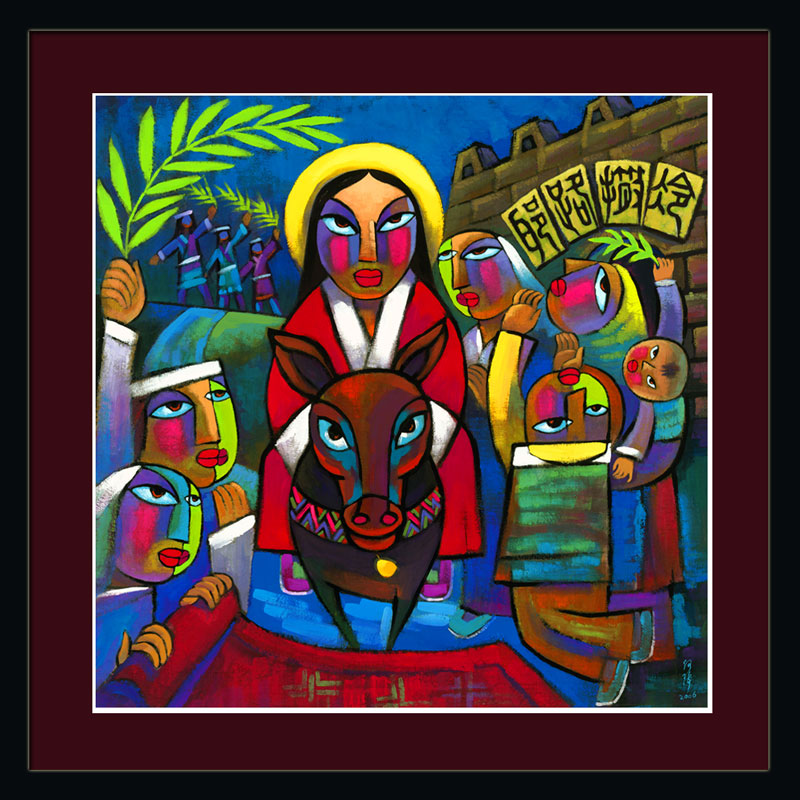
Triumphant Entry into Jerusalem by artist He Qi

As followers of Jesus Christ, we are molded by the story of Jesus, especially his last days. As we prepare to enter Holy Week, we have an opportunity to walk with Jesus from Palm Sunday to Easter, to enter his story. We can be with the crowd that cheered his entrance into Jerusalem, shouting our praise to our king. We can ask ourselves, “How do I allow Jesus to be ruler in my life? Am I simply following the crowd? Or do I fully seek to follow Jesus this week?”

On Maundy Thursday, we can enter the upper room with Jesus and watch him humbly wash the feet of his disciples. Are we willing to be servants like him? We can share in his meal of Holy Communion, remembering his steadfast, nurturing love for us. We can walk with him to the Garden of Gethsemane and pray with him as he seeks the Father’s strength and courage for his coming suffering. Will we stay close to him, when all the other disciples run away?

On Good Friday, we can stay in the crowd as they shout to Pilate, “Crucify Him! Crucify Him!” Do we hear our own voices mingled in the crowd? As the soldiers nail him to the tree, do we hear his words, “Father, forgive them, for they know not what they do,” and wonder if he is speaking to us? As he dies, do we feel the sorrow of Mary, his mother? Does something in us die as he is laid in the tomb?

Such a walk through the story of Holy Week prepares us for the ultimate story of Jesus’ resurrection on Easter.

Lord Jesus, keep my life in your story this week.