
Category Archives: Body Mind Spirit

Water Thoughts

Elwah River in Olympic National Park

Water images have dominated my thoughts this week.  Gary Bailey’s funeral (see 1/5 post), the Life of Pi,  and my Sunday sermon all have strong water themes.   The Life of Pi centers on a sea survival story; my sermon will be on Jesus’ baptism.   Water evokes both fear and hope, death and life.

Growing up in the Pacific Northwest, I saw a lot of water.  On a clear day my family home had a view of the Puget Sound, but I also experienced plenty of clouds and rain.   The abundant rain kept everything green and alive, but when I had to deliver the afternoon newspaper, rain could make the load and route miserable.  While backpacking in the  mountains I would marvel at how glaciers of ice carved such spectacular landscape.   Yet when it became necessary to cross glacier-fed rivers, I realized that with one wrong step I could easily become one of boulders tumbling towards the sea.

In the Bible water is a symbol of the chaos and destruction as well as life.  In Genesis 1:2, the water is part of the dark void before God’s creative Word is spoken.  In Exodus the Red Sea destroys the Egyptian army while providing a means of escape for the Israelites.   In I Kings  17-18, a drought is a sign of God’s displeasure with King Ahab, but later Elijah demonstrates God’s power to bring healing rain.  Jesus calms the stormy sea that threatens life in Mark 4 while in John 4 Jesus offers the Samaritan woman living water.  Water can destroy or give life.

What water image brings you life or hope?
“I am a Runner” video

Grandma's Marathon with Son

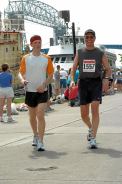
Today a running buddy sent me a hilarious YouTube video that captures some of the zany conversations I have during my preparation to run a marathon.  http://youtu.be/Cw5MHsO-JI8   Some people see addicted runners as simply crazy.   Perhaps it is fortunate that I have been injured this winter, so the members of Resurrection Lutheran, my new congregation, have not been subjected to this conversation.  But come spring?!

On a more serious note,  I also wonder if conversations about spiritual matters can have a similar effect on the non-believer.  Can someone with a passionate faith in Jesus Christ come across as so weird, that it repels rather than attracts?   Especially if the conversation is so one-sided as this one.  On the other hand, it was the vitality and joy that I saw in so many runners that drew me into the fold.  Isn’t that true for the faithful as well?

Questions to ponder

River Prayer

St. Croix River

Yesterday I preached at Gary Bailey’s memorial service and I was struck with his love of rivers.  He grew up on the Mississippi River, went to school in Winona, MN and often recreated  on the St. Croix.  His daughter remembered a shared St. Croix canoe trip in the rain.   A friend told a story about camping on a St. Croix Island and how Gary tried to share a sleeping bag with him (by mistake!).  Rivers flowed through Gary’s life.

The psalmist writes, there is a river whose streams make glad the city of God, the holy habitation of the Most High (Psalm 46:4).  God delights in rivers and the scripture is full of river images, from the Garden of Eden in Genesis to the river of life in Revelation 22.  I often visualize God’s grace and love as a river that flows all around us.  As a result rivers have flowed into my prayer life.

 My prayer has become, “Lord, lead me in your river of life.  Teach me to trust in your stream of grace and to work towards what you are doing.  I don’t want to fight your current, but rather flow with you.”  The Lord’s Prayer states, “your kingdom come, your will be done,” which means that I want to align my will and my activities with God’s will and activities.  Prayer is getting into God’s flow.  

Have you ever experience God’s grace flowing in your prayers?  Or had times of drought?

Shepherd or Magi?

I was struck today on the similar yet distinctive reactions of the shepherds and the magi to Jesus’ birth.  While both are notified by heavenly objects – angels for the shepherds, a star for the magi – and both respond with joy by searching for the baby, their response has some sharp contrasts. The shepherds leave their flock that very night and immediately go in search of the baby (Luke 2:15-17).  Of course, Jesus is in their local community and they share the news with all.  Meanwhile it takes the magi up to two years to plan and accomplish their journey to Bethlehem (Matthew 2: 1-12).

Shepherd?

I think the two reactions help us understand how many of us respond to the good news of Jesus Christ.  Some of us respond immediately to the message of God’s love and embrace it with all joy at the outset.  We see Jesus in our neighborhood and we respond right away.  We always sense that Jesus is close by.   I would place myself in this camp.  I grew up knowing Jesus as my Lord.

Or Magi?

Others need more time, more thought, and the journey is much longer.   In a metaphorical way, they have to leave their own country to find Jesus in a new land.   But when they do, they embrace him fully as their King.  The journey and the encounter has changed them.  The author Frederick Buechner describes such a spiritual odyssey in his book, The Sacred Journey (1982).   

Neither the response of the shepherds nor the response of the magi is better or preferred.  God uses a vast array of messengers, visions, experiences, relationships and ideas to call us to himself.  I delight in the wonder of each path and journey.

Would you describe yourself as a shepherd, a magi or some other character in the Christmas story?

Finding Jesus in Jamaica

Working Together to Meet Jesus

I am still thinking about the magi’s journey to Bethlehem to see baby Jesus. Preaching on a text sometimes hammers it deep into one’s psyche.   What strikes me is the investment the magi made.  They gave not only the gifts of gold, frankincense and myrrh, but also the time and energy for the trip itself.   They entered a foreign culture to pay homage to an infant king who was not immediately their own. 

I see so many connections in this story to the value of short-term mission trips, especially to different cultures.   As one who has lead over a dozen mission trips to Jamaica, I see the investment and hopes that people make when they go on a “vacation with a purpose.”   A key element of that preparation is to recognize that they go to discover Jesus in that place, more than to bring Jesus to that place.   The Christian service or actions that the missionaries perform are important, but the relationships, conversations, and participation with the people of that new culture are what become holy and blessed.

Too often I can become fixated on the physical accomplishments of a trip.  When I have worked with Habitat for Humanity it brings me satisfaction that we have constructed a safe, secure, simple structure for a family in need.   And when a team runs out of building materials or out of time, I feel frustrated and disappointed.  

Still the bigger accomplishment in any trip is the network of relationships that develop in the community.  Worship, meals, conversations and play are just as significant as the work done on the house; we often meet Jesus, hidden in the smile of a child or in the song of an impromptu choir.  Those encounters with Jesus change and enlighten us, if we give them “homage.”    Time for reflection and prayer have been a key element in my mission journeys because they help us bring Jesus home after the trip.

I look forward to leading mission trips in the future.  I sense that Jesus is waiting.

Have you ever encountered Jesus in a different culture than your own?

New Year Beginnings?

Each Day Counts

As a child I remember waking up on New Year’s Day and walking around the house, looking for something new.   I asked my parents to show me something that was new and they would simply point to the calendar.   I was not convinced until I found a penny or nickel that had the new year printed on it.  Naturally that would take several weeks or months.

Perhaps that is why I have never been good at New Year’s resolutions.  Part of my reason is that our New Year’s celebration comes at such an odd time, in the middle of winter.  I would rather start a new resolution in the spring, when everything is budding and alive.   My physical exercise always seems to pick up a notch when I can run in just shorts and a fleece top: no mittens, hat, tights, or jacket.    And my devotional life seems to shift by the seasons as well.  In the spring and summer, I want to be more active, serving God in tangible, concrete ways.  In the late fall and winter, I become more introspective, contemplative, spending time in study and prayer  By New Year’s Day, Minnesota has already been locked into winter for more than a month.  

Plus church life rarely revolves around January 1st (with the exception of budgets).  The school year of September to June has a much bigger impact on the weekly rhythms of life in a congregation.  Christmas and New Year’s are a wonderful break, but immediately following New Year’s, it is back to the school year flow.  Furthermore, the church year of Advent, Christmas, Epiphany and Lent have grown into a significant part of my walk with Jesus.  The people of God have always focused on the birth of Jesus, not the start of a new calendar.   

So what do I do with New Years?  Treat it with the respect and joy that every day deserves.  The psalmist declares: “This is the day the Lord has made, let us rejoice and be glad in it.”    May each day of 2011 be filled with the joy of the Lord.

How does the New Year change your life?

Getting Into It — Part III

The rain today drove me inside.  My friend Tim and I have been trying to get together all week, so finally I suggested that we meet for a spinning class this morning at the Woodbury YMCA.  I had attended only two previous classes, each time with Tim as my guide.   Naturally I was late getting out of the house, but I still minded the speed-limit as I drove to Woodbury.  I rushed into the locker room expecting to see Tim ready to go.  But there was no Tim, not in the locker room or the hallway or Studio 1.  

Tim's bike during the workout

As people pulled out cycles for the class, I pulled out two, expecting Tim to show any moment.  I tried to remember the instructions Tim gave me on how to set up my cycle for the best workout.  I kept looking at the door, expecting Tim to show.  But as the instructor began to start the class, I shifted my attention from Tim’s absence to my participation.  Soon I was “getting into it,” pushing my heart rate into my aerobic workout zone.  It was a good class.

As I reflected after the class, I think my experience is similar to newcomers at a church or Bible Study or prayer group.   We have an interest or curiosity, but we often need an invitation or guide to help us enter the new experience.   A friend, co-worker or neighbor invites us to worship and we sit with them during our first visit.  We closely watch their behavior, not wanting to do something embarrassing or upsetting.   If we enjoy it, then we are open to going back, perhaps with our guide.   Eventually we go on our own, comfortable in our knowledge that we can fully engage in the workout or the worship without our guide.  

As I walked out from the spinning class, I felt energized and also thankful that I can do the class by myself.  I called Tim to find out what had happened.  He misread the e-mail and thought the class was this afternoon.  We still need to get together for our weekly conversation.

Romans 14:1 Welcome those who are weak in faith, but not for the purpose of quarreling over opinions.

Have you ever been a guide for someone’s new experience?

Getting into It – Part II

Yesterday I posted about my decision to get into winter and enjoy cross-country skiing as an alternative to my running.  Yesterday afternoon I drove to a nearby county park, Cottage Grove Ravine Park, anticipating excellent snow and groomed trails.  I was a bit rushed because the sun was low in the sky and I was unfamiliar with the park.   I missed the entrance for the parking lot, so I started a quick turn around.  In my haste I slid off the road and into a snow bank.  

At first I thought I could simply drive out.   The spin of the front tires told me otherwise.  I tried to clear the snow from the front of the car.   It was too compacted and I had no shovel.   Sheepishly I asked a couple of skiers to assist me.   Though we pushed and pulled, the car was stuck.  Finally I had to admit I was truly trapped in the snow and called AAA for assistance. 

A car like mine waiting for help

While I was calling AAA on my cell phone, a second call came through.   I soon discovered I had a pastoral emergency with one of my parishioners!    With some embarrassment, I called the family and explained my predicament.   I would come as soon as the tow truck pulled me out, which was further delayed because the truck driver got lost.

As I sat in the car, waiting for the tow truck, I ruminated about my plans.  I had wanted to “get into it” by doing some skiing.   Instead I literally “got into it” with my car in the snow.  I was frustrated, but also reflective.   My haste had put me in this predicament and I could blame no one but myself.   There will be future opportunities for skiing and exploring.  I was thankful that my slide had cause no damage to car or myself.    Finally I decided once again to practice what I often preach to others,  patience and thanksgiving.    I could “get into it” by seeing the mercy of God in my own foolishness.

Getting Into It

Getting Into Winter

This fall and winter has been frustrating for me as a runner.  I continue to deal with various muscle spasms that primarily stem from an SI joint problem in my pelvis.  In summary my pelvis is twisted and needs special manipulation to become untwisted.  I have been to my physical therapist several times for this manipulation, but I cannot seem to hold the proper alignment for very long. I try to run a couple of miles and my muscle spasms are back. 

So I am going to try a different route.   Instead of whining about “not running,”  I will try to embrace winter and the sport of cross-country skiing.   I remember a quote from Parker Palmer’s Let Your Life Speak.   He was participating in an Outward Bound adventure course when he found himself paralyzed with fear during a rope-rappel down a cliff face.  He was certain that he was going to die.  The instructor asked if anything was wrong. 

 He responded, “I don’t want to talk about it.”

“Then,” said the instructor, “it’s time you learned the Outward Bound motto.”

“Oh keen,” Parker thought.  “I’m about to die, and she’s going to give me a motto.”

But then she shouted ten words that reshaped Parker’s life, words whose impact and meaning he can still feel. “If you can’t get out of it, get into it!”

Parker wrote, “I had long believed in the concept of ‘the word made flesh,’ but until that moment, I had not experienced it.  My teacher spoke words so compelling that they bypassed my mind, went into my flesh, and animated my legs and feet. No helicopter would come to rescue me; there was no parachute in my backpack to float me to the ground.  There was no way out of my dilemma except to get into it — so my feet started to move, and in a few minutes I made it safely down.”

I plan to “get into it” with cross-country skiing and see what happens.  I will keep you posted.

Have you ever experienced a time when you had to “get into it?”

Life of Pi


Life o Pi

Yesterday I wrote about a visit to a church in the novel Still Alice.  That scene stands in sharp contrast to the church visit  described in Life of Pi by Yann Martel, the other novel I am reading.  Whereas Alice receives little spiritual comfort from her short visit , Piscine (Pi) takes a much more patient approach to his visit.  He is a young teenager, who is on a spiritual quest in his native India.  While his family is on vacation, he climbs a hill to a Christian church and walks around it, afraid at first to enter.  Behind the church he discovers the rectory and from a hiding place, he secretly observes the parish priest inside.   After a period of observation Pi states,

“I was filled with a sense of peace.  But more than the setting, what arrested me was my intuitive understanding that he was there -open, patient – in case someone, anyone, should want to talk with him; a problem of the soul, a heaviness of the heart, a darkness of the conscience, he would listen with love.  He as a man whose profession it was to love, and he would offer comfort and guidance as best he could.” p. 52

Pi eventually walks into the rectory and has several long conversations with the priest.   Those conversation may be worthy of other posts, but the main point today is how does one prepare such an open, receptive setting for those who come on spiritual quests?  Would those seeking even come to a church today?  How do we practice true hospitality?