Category Archives: spiritual exercise

New Year’s Run and Devotional

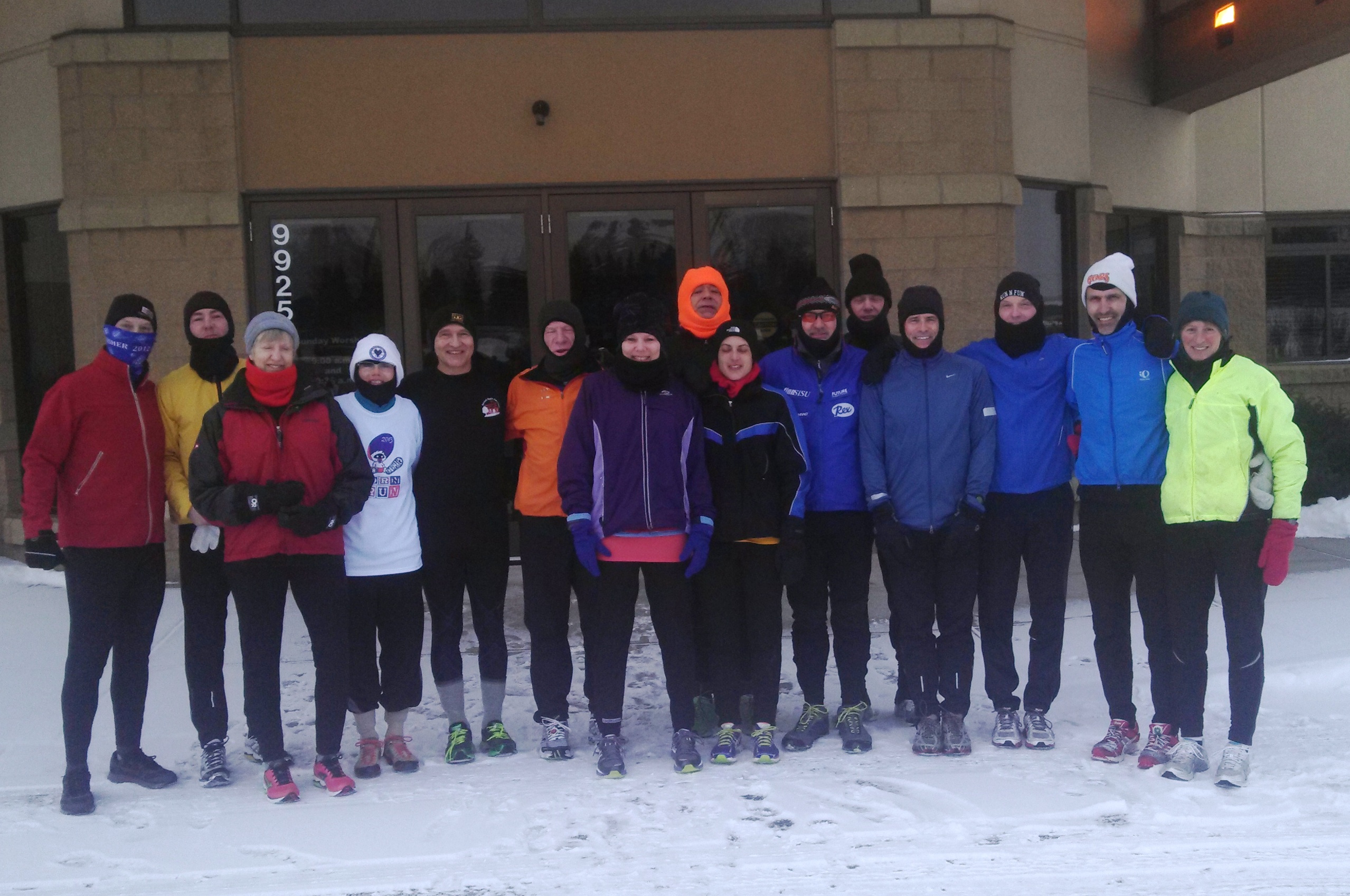
My running group had a New Year’s Day run, even though the temperature was -5 degrees at the start.

Bundled Warm for a 4 mile run

Bundled Warm for a 4 mile run

Here is the devotional we shared together prior to our run.

Mark 1:1  The beginning of the good news of Jesus Christ, the Son of God.

Today is the beginning of a new year.   Recently I was reading in Mark’s gospel and I was struck by this opening sentence.  It is the Beginning of the good news of Jesus Christ.  Now that may not be so profound, because it is the start of the gospel.  But on the other hand, there is no final statement in the book that says, the End of the gospel.   Only the beginning is mentioned.  This reflects our relationship as a reader of the Gospel and as a disciple of Jesus Christ.  We have a beginning in our relationship with Jesus, but we don’t have a finish line.  We are continually growing, running, moving, becoming the person Jesus created us to be.  God is not finished with me yet.  And that is truly Good News.  

Prayer:   Lord Jesus, in our relationship with you, we are closer to the starting line than the finish line.  Throughout 2014 increase our trust in you, so that we can run, and leap and rejoice in your love for us.  May our spirits hunger for you each day and may we find ways to serve you as we serve one another.  Guide us as we run today, in Jesus name. AMEN

Afterwards, we enjoyed some pancakes and conversation. 

Enjoying the warmth inside Resurrection Lutheran Church

Enjoying the warmth inside Resurrection Lutheran Church

How are you starting your New Year?

Four Lessons for Joyful Habits

Today I reached 100.

100 days of consecutive running.

Grandma's 06 smile

During this streak I learned four lessons about healthy habits.

Turn disappointment towards joy

I used as motivation the disappointment I felt last September when I was unable to register for the Boston Marathon. (Read more here. )

My disappointment was the initial start to my running streak, but I knew that such motivation could only take me so far. I knew that I had to have an interior attitude of joy and thanksgiving towards running and NOT simply a “I should do this” attitude. Almost anyone can start a healthy habit or discipline; it is staying the course when the mind/body/spirit begins to resist the habit for a variety of reasons: “I am too busy with work” or “I don’t feel like running today” or “The weather outside is too cold.”

Focus on joy of the habit

527355_10150757438158830_723953829_9331133_942278610_nFor me, running has been a source of joy, especially when I am dealing with stress or disappointment. I enjoy the movement through space (especially if it is outdoors along a scenic trail) or the camaraderie I experience running with friends. I know that not all runs will be filled with joy or endorphins, but many will be.  I need to lace up my shoes and start running to discover if it will happen.

Keep the habit simple and flexible

My running streak did not require me to run huge miles every day. I needed to do at least a mile, but once I got started I usually did more. I averaged 4.1 miles per day.

I also kept it flexible. I originally thought I would do all my running outdoors, but in early December we had some nasty ice and cold so I joined a local gym and did my running on a treadmill. It was not my first choice, but I prefer to be safe and steady.  I still go outdoors when the weather permits.

The joy flows into other areas.

Learning to Pray Anew

Rolling into Prayer

I have discovered that my best time to run is early in the morning. Then afterwards, I allow the joy to flow into my time of prayer and meditation. I have created a small holy space in my home where I have my Bible and devotional reading so that I can easily shift gears and focus my mind on my life of faith in Christ. I am learning to be silent and still, listening for God’s still quiet voice (I Kings 19:12).

I recognize that someday this running streak will end, but for now it has been a healthy habit that bring joy to my body/mind/spirit.

What habit brings you joy?

Lord Jesus, guide me into habits that honor you.

The Forgiveness Blessing

In my last post, The Forgiveness Challenge, I wrote about the misunderstandings regarding our ability to forgive others. Forgiveness is not condoning what someone has done to us. In fact part of forgiveness is to acknowledge how I have been hurt by the actions of another.

Forgiveness does not mean that trust, love or friendship will automatically be restored. I can forgive someone and still avoid situations where the person who harmed me might repeat the action. An example is a wife whose husband is abusive to her and her children. She can for forgive his actions, but needs to physically remove herself from the relationship to avoid future abuse.

God's Hand of Blessing

God’s Hand of Blessing

So then, what is forgiveness and its blessing?

The blessing is that the one forgiving is able to let go of the heavy burden of resentment, anger and desire for retribution. She releases the anger and resentment toward the person who wronged her  so that she can continue a vibrant life of faith and love. Forgiveness frees the person who forgives, regardless of what happens to the person forgiven.

The opposite of forgiveness is to bear a grudge, to carry an ongoing memory of the hurt/wrong and to seek some form of retribution. “I have been hurt and I want someone to pay for it!”  The grudge may come from a tragic one time incident (like a horrible automobile accident) or from countless encounters (such as a co-worker who is constantly using verbal put-downs). The grudge becomes a burden that weighs on our hearts and minds. It grows as we feed it more resentments and negative thoughts and in time the grudge can absorb our whole life. What a blessing to lay that burden down.

heavy-burdenThe best way to lay that burden down is a three-fold path.

First, recognize that the resentment and anger has become a toxic burden that is destroying your life.

Second, pray that God will give you the ability to forgive and give up the burden. Jesus promised, “Come to me, all you that are weary and are carrying heavy burdens, and I will give you rest.” (Matthew 11:28)

Third, pray for the one who hurt you and for God’s power and love to surround them. Visualize them as a child of God, broken and flawed, but still loved. Jesus said, “But I say to you, Love your enemies and pray for those who persecute you,” (Matt 5:44).

This is a process that takes time. Rarely is it one fervent prayer and all resentment is gone. Rather forgiveness is like a muscle that needs to be activated and exercised regularly. No wonder Jesus place it in the center of the Lord’s Prayer, “Forgive us our sins, as we forgive the sins of others” (Luke 11:4).

When and how has forgiveness been a blessing to you?

Lord Jesus, continually teach us to forgive one another.

The Forgiveness Challenge

Earlier this spring I wrote on the difficulty one can face in forgiving others. In the Lord’s Prayer we ask God to forgive us as we forgive the sins of others. Jesus’ parable of the Unforgiving Servant in Matthew 18: 23-35 sharply contrast the forgiving heart of a king (God) and the unforgiving servant (us?).

forgiveness log 2Prior to the parable Peter asked Jesus, “If my brother sins against me, how often should I forgive? As many as seven times?” Peter probably thought he was being generous with offering seven times. Jesus blows Peter’s generosity out of the water when he responds, “Not seven times, but seventy times seven.” Forgiveness is not a transaction that one tracks but a lifestyle to embrace.

Still there is much misunderstanding around the concept of forgiveness. I want to highlight three of them.

First, forgiveness does not condone a wrong action as being “okay” or good. If a co-worker steals your idea and takes credit for it, that action is wrong. Forgiving the person does not mean that what the person did is now okay. In fact, it may be necessary to confront the person and tell him or her that you were hurt by the behavior and that your trust is broken. To forgive such an act means that you will not continue to hold a grudge or resentment towards them.

Second, forgiveness does not mean that you will automatically trust the person again. If a coworker has a history of stealing ideas means that you will probably not be sharing new creative ideas with them, even if you forgive them. This is particularly true in family settings where a spouse has been abusive (emotionally, verbally or physically). You may forgive your spouse, but you may also need to separate from your spouse if the behavior has not changed.

Third, forgiveness often requires the spirit of courageous love. I live in Minnesota where we promote a culture of “being nice.” “Minnesota Nice” has many advantages ( who wants to be cooped up over a long winter with argumentative, disrespectful coworkers or family members). However Minnesota Nice can often lead to situations where people are smiling on the outside, but holding all kinds of grudges and resentments on the inside. They often discuss these resentments with everyone but the offending party. Healthy Christians will not let the resentment build and build, but rather acknowledge their internal conflict and confront the issue and/or person as needed.

Such confrontations can be done in love and mercy. The resurrected Jesus confronted Peter after his three denials when they met on the beach in John 21. I remember when a good friend confronted me over some selfish behavior that I once exhibited on a road trip. He made sure to do it in private and to give me space and time to respond.

In my next post I will explore the blessings of forgiveness.

How has forgiveness challenged or changed your life?

Lord Jesus, teach me to forgive as you forgive.

Unplugged Friday

Lent emphasizes spiritual disciplines. For example, Christians are encouraged to “give something up” for Lent as a way to make room for God. Fasting has been a spiritual practice for centuries. People forsake food (either totally or some favorite like chocolate or coffee) for a period of time so that they can more intentionally focus on loving God and loving the neighbor.

This Lent I am modifying the practice of fasting to being  “unplugged.” I plan to disconnect from all forms of computerized information on Fridays during Lent. No e-mail, no Facebook, no blog, no texting on Friday, my normal day off.  I plan to use the time for prayer, reading and reflection. A colleague of mine, Rich Melheim, is recommending a techfast  breakfast, staying unplugged each morning.  Such practices could also strengthen our creativity.

Jon Burg wrote on his blog regarding our need to unplug,

You, me and everyone else in the room knows that when you are answering emails on your mobile you aren’t really present. Your kids know it. Your co-workers know it. Your clients know it. Your spouse knows it. You know it. I’ve come to terms with this in my own life.

But I recently had a deeper insight. When I am always plugged-in to a device, I am not really present in my own life. I don’t enjoy my life as much when I live in the half-present. Not only does constant connectivity lessen my enjoyment of life, it distracts me from achieving the creative goals I set out for myself. The brain needs mindless time to reflect. This is why we come up with our best ideas in the shower.

A Bad Idea?

A Bad Idea?

I guarantee that if there were a tv screen in the shower, we would draw less inspiration from the shower experience. Who knows what major works of art, creativity and innovation would be lost.

You can read his whole article here

Part of the Lenten tradition of 40 day is based on Jesus’ 40 days in the wilderness, a time of fasting and prayer, (Luke 4:1-2). I am pretty sure Jesus was also “unplugged” the whole time.

What spiritual practices are you embracing this Lent?

Lord Jesus, guide me into deeper devotion to you.

Mountain Light and Dark

Sunday is Transfiguration Sunday, the conclusion to the church season of Epiphany. (I wrote about the light of Epiphany here). The story of Jesus’ transfiguration fascinates me on several levels. Partly it is the description of Jesus (“the appearance of his face changed, and his clothes became dazzling white” Luke 9:29). Partly it is the sudden arrival of Moses and Elijah, long-dead prophets whose ministries foreshadowed Jesus’ own mission. Partly it is God’s command, “Listen!”  A big part is the location, a mountain.

The Wonder of God's Creation

Mountains have always been spiritual place. Humans have climbed peaks to seek the heaven throughout our history. Moses climbed Mt. Sinai to receive the ten commandments directly from God (Exodus 20). Elijah ran away to Mount Horeb, the mount of God, where he encountered God in the sound of sheer silence (I Kings 19:11-13). Solomon’s temple was built on Mount Zion and the psalmist sang about its beauty,

His holy mountain, beautiful in elevation, is the joy of all the earth, Mount Zion (Psalm 48:1-2).

So when Jesus took his closest disciples, Peter, James and John, up the mountain to pray, they should not have been surprised that God met them there in a special way.

I enjoy climbing mountains (I wrote about one here).  On occasion I have used an ice axe and rope, but mostly I climb mountains that anyone in decent physical shape can scramble up.  A climb becomes both a physical and spiritual challenge.  I gain a sense of perspective sitting on top of a peak: how very large the world is and how very small I am. As I gaze across the surrounding peaks, I realize that God is in charge. The glory of his creation surrounds me and uplifts me.

But mountains have a darker side as well. The first significant mountain story in the Bible is when God ordered Abraham to take his son Isaac up on a mountain in order to sacrifice him (Genesis 22). The Israelite often created shrines to the Canaanite fertility gods on the mountain tops.

O mortal, set your face toward the mountains of Israel, and prophesy against them, and say, You mountains of Israel, hear the word of the Lord God! . . . , I myself will bring a sword upon you, and I will destroy your high places. Your altars shall become desolate, and your incense stands shall be broken; and I will throw down your slain in front of your idols (Ezekiel 6:2-4).

The darkest mountain of all is Mount Calvary or Golgotha where Jesus was crucified. Not much more than a hilltop outside of Jerusalem, yet the darkness of human sin caused the sky to turn black as Jesus cried, “My God, My God, why have you forsaken me?” (Matthew 27:46). Mountains can be places of terrifying death as well as peaks of glorious enlightenment.

My boyhood home had a view of Mt. Rainier

My boyhood home had a view of Mt. Rainier

Yet whether hidden in darkness or bathed in sunlight, God’s glorious love is the bedrock of each peak. Mountains call us to trust in God in all circumstances.  Jesus came to bring all creation back into full spectrum of God’s love, including you and me.

Shine, Jesus, shine in me today.

Compartments and Foundation

I confess that I tend to compartmentalize my life. I have my calling as a pastor in which I serve the congregation of Resurrection Lutheran Church. I have my family in which I relate to my wife, grown children, grandchild, scattered siblings and aging mother. I have my hobbies of running and backpacking in which I engage some of my passions and share friendships. These arenas of my life overlap, but they also have separate time, energy and focus. Not all my friends or family worship at Resurrection. Only a few in my family share my passion for running and backpacking. My life has compartments.

I think most people I know have similar compartments. As Americans we no longer live in a small town where everyone worships in the same church or eats at the same restaurant. Our work life is often disengaged from our home life; our family life can be disengaged from our community life. When my children were active in high school sports, several parents of their teammates became my friends. Now our paths rarely cross. My life compartments have changed.

One factor that remains consistent within all these compartments is that I am God’s child. God is the foundation upon which my life is built. I don’t always remember that when relationships shift and the walls of my life compartments move. I sometimes think my value and worth are determined by my status with a certain compartment. For example, how well my last race went or my last church project or my last visit with my mom. The truth is my value and worth is determined not by the shifting compartments, but by my foundation, being grounded on the Rock of Jesus Christ.

Jesus said, “I will show you what someone is like who comes to me, hears my words and acts on them. That one is like a man building a house, who dug deeply and laid the foundation on rock.” Luke 6:48

The Lord is my rock, my fortress, and my deliverer, my God, my rock in whom I take refuge. Psalm 18:2

Weekly worship reminds me that God is my rock. Prayer also helps me stay grounded to this reality. When I pray, “Our Father in Heaven,” I am no longer rooted to my shifting compartments, but going deeper to the foundation of my life. I need to stay tethered to this spiritual realm even as I move through the various components of my life.

Lord Jesus, thank you for being the foundation of my life.

Prayer Basic Practices

Jesus Praying at Gethsemane by Artist He Qi

Jesus Praying at Gethsemane by Artist He Qi

Last week I posted about starting an intentional prayer streak of daily prayer. Yesterday I challenged members of Resurrection to become more intentional in praying for our congregation and the world. (You can listen to the sermon here until January 14).  Today I want to provide some basic prayer practices that can enhance your prayer life.

Intentional: most habits are formed when we make it a priority and intentionally schedule time and energy for it. If we want our prayer life to deepen we need to  schedule an intentional time and place to pray. Many people find the first thing in the morning best; others prefer the evening. I know one person who made sure to leave for work early so he could have fifteen minutes to pray in his office parking lot. I  pray just after my morning run. I have my Bible and prayers placed near my prayer chair so I am ready when I return.

Written versus Spontaneous. Most of my prayers for Sunday morning worship are spontaneous with a basic mental framework to guide me. However my daily prayers are now a mixture of written prayers and silence for more spontaneous prayers. Having both allows me to stay focused and keeps my mind from wandering as much. I also plan to change some of the written prayers on monthly basis so as to give it some variety and freshness. This month I am using Psalm 130 and the refrain, I wait for the Lord, my soul waits, and in his word I hope.  I wrote more about using written prayers here.

Relaxed: My goal in prayer is not to finish the liturgy as quickly as possible but rather to spend time with God. Be still and know that I am God! Psalm 46:10. During the moments of silence, I simply imagine God being close to me, His breath matching mine own. If my mind wanders I acknowledge the wandering thought and bring it back to prayer and being with God.

Consistent: We certainly can pray at any time. Paul calls us to pray without ceasing (I Thess. 5:17). People often practice” bullet prayers”, asking for God’s guidance, strength, or intervention in quick snippets of prayer throughout the day. Such prayers are not wrong, but should not be confused with developing a deeper intentional prayer life. As an analogy, bullet prayers are like calling yourself a runner, when the only running you do is to sprint from the parking lot to the office door during rain storm. To become an honest runner you need to consistently take time to lace up your running shoes and run. To become a disciple of prayer you consistently need to take time to step off the daily treadmill and be in prayer. Fifteen minutes on a daily basis will do wonders for your soul.

What other prayer practices have worked for you?

What time or place have you found most helpful?

Lord Jesus, teach me to pray.

Streaks

This past Thanksgiving I started my first running streak. It came from a challenge at Runner’s World. The goal of the streak was to run at least a mile every day between Thanksgiving and New Years. I normally run 3-5 days a week, giving my body plenty of time to rest and recover from any muscle damage during runs. Since my marathon in October, my running has been rather sporadic, lacking a goal or passion. So I decided to embrace a new challenge.

The key for me was to keep my normal rest days easy, just a slow-pace mile or two. I wear a heart rate monitor so it was easy to check my pulse and see if I was pushing too hard. I have discovered that doing an easy mile was both relaxing and a great way to start the day.

Yaktrax RunnersI added to the challenge by making every run an outdoor run. Treadmills and indoor tracks have their place, but I wanted fresh air. This became more challenging when our first Minnesota snow fell in mid-December. Fortunately I had a pair of Yaktrax that gave me good footing. Still, for an outdoor run I often took twenty minutes to dress for a ten minute jog.

I did get a short break when I traveled to Austin, Texas, for a memorial service after Christmas. A ten-mile run in warm sunshine and shorts lifted my spirit and confidence.

SA runners 122212 small

Some of my running buddies on Saturday morning.

I am not sure how long the streak will continue into the New Year. My legs are feeling strong and injury free. I have developed a habit that I enjoy and that promotes health. I suspect sometime in the next month a cold or tight schedule will end the streak. I don’t plan to be obsessive about it. I am confident that my running friends will be both encouragers as well as wise advisors.

It has got me wondering about my own spiritual practices. I pray daily, but my devotions have become sporadic and unfocused. The memorial service I attended was at an Episcopal church and it had more liturgy than I normally used. I found the prayers helpful and healing. So I have decided to use a written liturgy to guide my prayers during the month of January. You can see a copy of it here.

Thus, I am committing myself to new streak, a prayer streak.  My first goal is to use the daily liturgical prayer format each morning for the month of January.   Care to join me?

Lord Jesus, thank you for your tender mercies in 2012. Guide me deeper into your love in 2013

Thanksgiving Practice

Tomorrow our nation stops for Thanksgiving. It is good and right to do so but among all the feasting, family, football, and frivolity, how much time will be given to thanks? May I recommend a simple spiritual exercise that you do early in the morning, prior to the feasting, family, football and frivolity.

  • Take a simple sheet of paper and pen.
  • Number it  1-12

1)
2)
3)
. . .
12)

  • Beside each number write the name of someone for whom you are thankful.
  • Pause for a moment to thank God for that person and to ask God to bless him or her.

Carry the sheet through the day and during the short pauses in the feasting, family, football and frivolity, remember the people and thank God again.

Let us actually practice Thanksgiving this year.

I thank my God every time I remember you. (Phil 1:3)

Lord Jesus, thank you for remembering me.