Category Archives: Holy Spirit

The Blessing of Rain

Rain is falling today in Minnesota. Usually that would be a source of complaint for me. The grey skies and cold rain makes my outdoor runs more challenging. Yet there is a nostalgic quality to rain; I grew up in western Washington where grey clouds and drizzle were a steady part of winter and spring. Delivering newspapers in the rain was a challenge as I pedaled the five-mile route through deep puddles and muddy roads. Now I realize that my paper route built the base and character for long-distance running, even through the rain.

Today’s rain is also a blessing for the farmers of Minnesota. Though too much rain can be a problem, the current soil moisture is below average.  The soil needs water in order to yield crops this summer and fall.
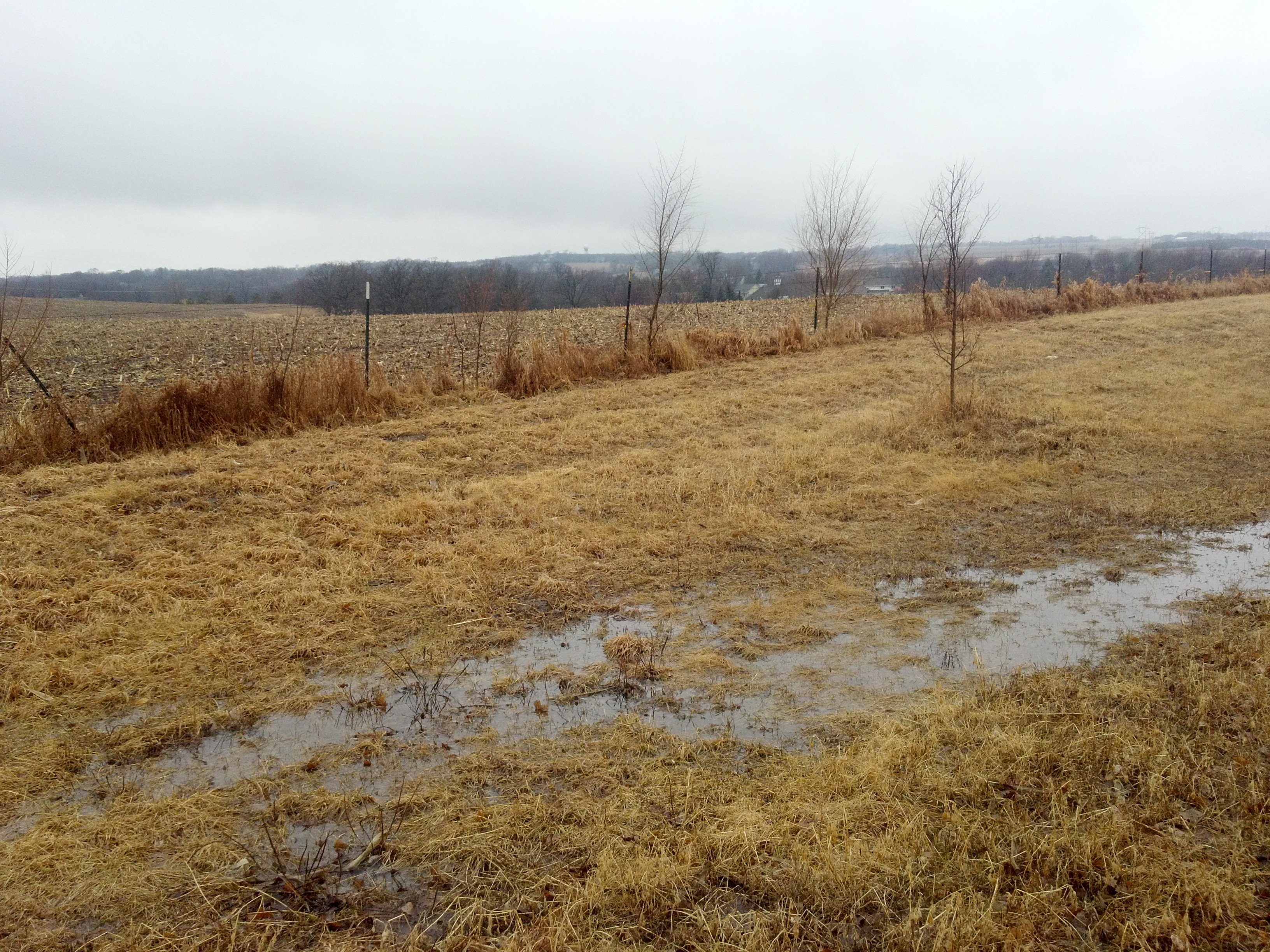
Being the pastor of a suburban church bordered by cornfields, I have grown in awareness how much weather affects the daily life of farmers. Forty years ago, Woodbury was nearly all farms, but they are steadily being turned into housing subdivisions, parks, office buildings and churches. Larry Fredin, a member and farmer, keeps me updated on the weekly activities of local farms and weather. Today’s rain is good.

Part of my Lenten discipline has been reading Luther Seminary daily on-line devotional, called God-Pause. Today’s devotional (3/12/2012)  by Diane Jacobson centered on water for a thirsty land from Isaiah 44:3

For I will pour water on the thirsty land, and streams on the dry ground; I will pour my spirit upon your descendants, and my blessing on your offspring.

Professor Jacobson wrote, “In today’s passage, God’s covenant promise goes beyond our expectations. God’s promise of pouring out real water on a thirsty land is parallel to the divine Spirit being poured out on the people. Water and Spirit are both instruments of blessing. Baptismal promises echo throughout the land and the voices of nature and humanity join in praise to God.”

The weather forecast for tomorrow is sunny and possibly 70 degrees. I know I will enjoy that when I go for my run. But today’s rain is still a blessing. Thanks be to God.

Oh Lord, send your healing and life-giving rains to all the dry land.

Seeds that Bear Fruit

Yesterday was a great day of worship at Resurrection. The youth lead us in prayer, preaching and song. All did a great job, from the sound and video team to the ushers and greeters.  I am especially grateful for our three preachers, Cooper Dillon, Garth Natwick and Ryan Garbe. All three have been active in the congregation for years and they each expressed their appreciation for how the congregation and pastors have shaped their faith. Each declared their faith in Jesus as a dynamic, growing relationship that has grown over many years of participation.

Being the newcomer at Resurrection, I need reminding that a solid foundation has been laid prior to my coming. I tend to live my life in episodes and seasons, seeing only the immediate events around me. I forget that God is weaving a much bigger narrative through the life of this congregation and through the history of the global church. The Holy Spirit has been shaping the lives of the youth and families long before I began my ministry here. It is joy to witness the seeds that were planted bear fruit for God’s Kingdom.

Paul wrote about this in his first letter to the Corinthians as the congregation argued over which pastor had the more lasting spiritual impact,

What then is Apollos? What is Paul? Servants through whom you came to believe, as the Lord assigned to each. I planted, Apollos watered, but God gave the growth. I Corinthians 3:5-6

The good news of yesterday was highlighted in the generous response of the congregation for our Youth Scholarship Fund. Over $3500 was donated so that eight of our High School Youth can attend the ELCA Youth Gathering in New Orleans this summer. Thanks be to God!

How has your church community shaped your faith?

Lord Jesus, continue to call me back into deeper relationships with all your children, young and old.

Baptism Fire

Teaching confirmation last week, I told our students that Jesus’ baptism by John was not a sign of repentance of sin, but an ordination into ministry. Baptism is a multifaceted experience for Christians that needs to be lifted up in various ways for us to see the beauty and wonder of this gift from God.

Barbara Brown Taylor writes this about baptism connecting all God’s people together, both ordained and laity.

What we have in common is our baptism, that turning point in each of our lives when we were received into the household of God and charged to confess the faith of Christ crucified, proclaim his resurrection, and share in his eternal priesthood. That last phrase is crucial. Our baptism are our ordinations, the moments at which we are set apart as God’s people to share Christ’s ministry, whether or not we wear clerical collars around our necks. The instant we rise dripping from the waters of baptism and the sign of the cross is made upon our foreheads, we are marked as Christ’s own forever. (The Preaching Life, p. 30)

Our baptism is our call into ministry. We all have a place to serve in God’s family and God’s world. Through baptism, the Holy Spirit is placed within us to be a burning ember of power and life.  To discover our place can be a challenge in the free-market society we have. There are so many options from which to choose. Yet God has given the Holy Spirit to guide, nudge, empower, coax and affirm our direction in life. The community of faith and our inner voices become crucial in the discovery process.

Luther Seminary has a process called the Dependable Strengths Articulation Process which helps congregations and individuals discover their calling for daily life.  Resurrection Lutheran will be using this process on Saturday morning to help people discover how they can use their baptism fire for God’s glory.

Holy Spirit, ignite us with a passion to serve Jesus and his people.

New Wineskins

C. S. Lewis wrote an excellent book on literary criticism, An Experiment in Criticism, that is applicable to how one reads scripture. Lewis argues that a critic should not take preconceived opinions into the reading of a book, but remain open to receive what the writer brings. Our culture too quickly labels a book as good or bad and that judgment is often based on some arbitrary taste. Lewis argues that a book would be better judged by what kind of response it elicits from the reader. Does the reader cherish the book and want to read it over and over, reflecting on its meaning, prose and insights?

An open stance towards the reading of scripture is even more important. We need to allow our mind to hear the text. We cannot simply make our own quick evaluation of it nor rely on the comments of a biblical commentary. We need to read Luke as Luke and distinguish it from the perspective of Matthew, Mark and John. We need to keep our own evaluation process out of the reading and allow the text to speak to us, on its own terms. In other words, let the text shape and critique me and not the other way around.

This can be challenging since so much of my reading of scripture has been shaped by what others may have taught or preached. I bring my biases and cultural norms that are hard to place aside so that the text can speak. I struggle to be quiet and receptive to what God may say through the Word. Yet as I open myself, trusting the Holy Spirit to work through the text, I discover the life giving Word.

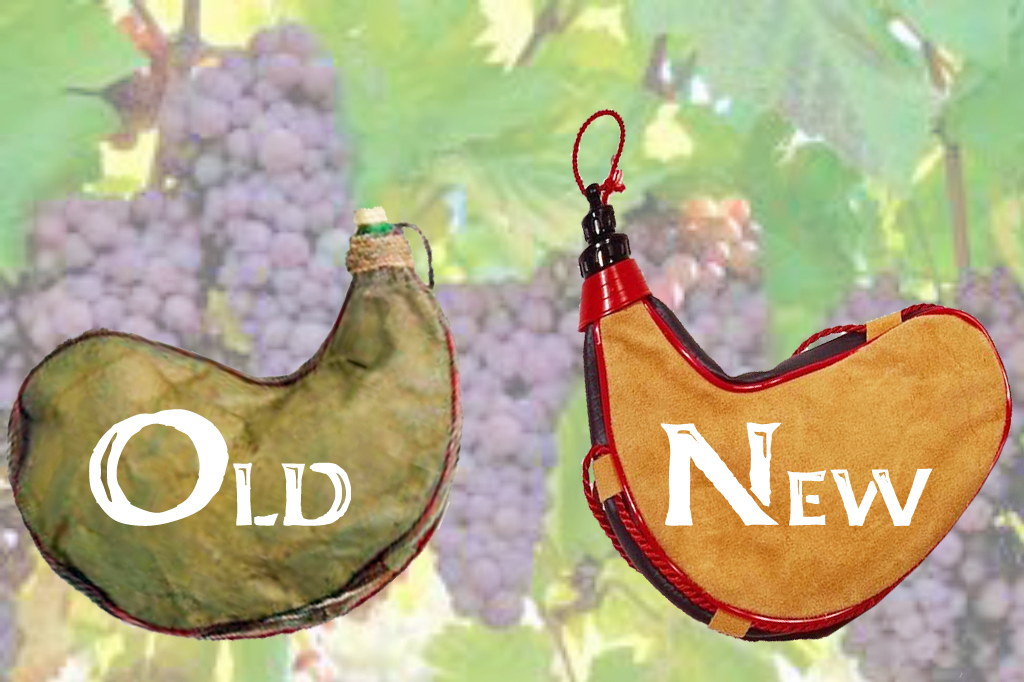
It sort of like Jesus’ teaching that one put new wine into new wineskins, so that as the wine ferments and expands, the wineskin has the flexibility to expand and adapt (Mark 2:22). Old wineskins lack the flexibility to expand and instead burst.  My openness to God’s Spirit allows the wine of the Spirit to expand and shape my wineskin of thought and action. I want to be a new wineskin, receptive to the transforming power of God’s Word. And I pray that my congregation and national church would be new wineskins as well.

How do you stay open and receptive to God’s Word?

Lord Jesus, fill me again with your new wine.

New Year’s with JB

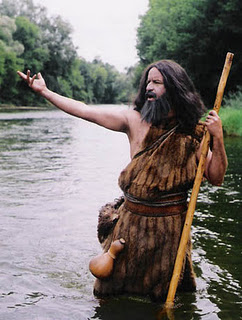
John the Baptist’s message is great for this week between Christmas and New Years.  He calls us back to a simple life-style. After all the feasting we may need repentance.

John the baptizer appeared in the wilderness, proclaiming a baptism of repentance for the forgiveness of sins.  And people from the whole Judean countryside and all the people of Jerusalem were going out to him, and were baptized by him in the river Jordan, confessing their sins.  Now John was clothed with camel’s hair, with a leather belt around his waist, and he ate locusts and wild honey. (Mark 1:4-5)

The wilderness in Scripture was not some beautiful garden-like place where people went on vacation.  Wilderness was wild, uncivilized, stripped of all niceties and refinement.  Israel had spent forty years in the wilderness during the Exodus to purify themselves from all the toxic Egyptian cultural practices. It was a place for spiritual death and rebirth.

John’s clothes of camel’s hair and leather belt, reminded the people of the Old Testament prophet Elijah (2 Kings 1:8).  Sort of like wearing a red cape to remind people of Superman. But John/Elijah had a stronger purpose than Superman, to call the hearts and lives of people back to God.

John called people to recalibrate their vision of life, success, and values.  They were baptized as a cleansing of their sinful ways so that they could begin anew, fresh and clean.

Now as 2011 concludes, we can come to our Lord seeking a fresh beginning, a new start in 2012.  We can confess our sin, knowing that God forgives us our sin and will give us a clean start.

Try this the next time you take a bath or shower.  As you wash the sweat and dirt of the day, say to yourself as you pray to God, “I am cleansed, body, mind and spirit, by the power of the Holy Spirit.”  Then step out into the promise of vibrant new life in Christ. Resolve to act as a child of God, seeking God’s path this day.

Lord Jesus, cleanse me and make me new.

Jesus and the Temple in John

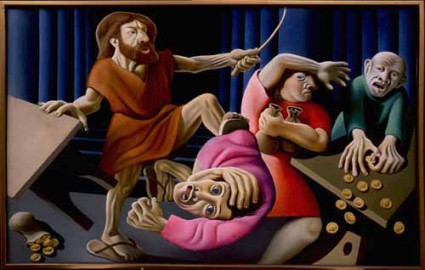
Christ Driving the Money Changers from the Temple by Michael Smithers

With my recent posts on Isaiah and the Temple in Jerusalem, I am reminded that Jesus had some harsh words about the Temple. Solomon’s temple had been destroyed in 587 BC by the Babylonians. The temple was rebuilt in 515 BC but it was not as grand as the previous temple. King Herod had started a major rebuilt of the temple prior to Jesus’ birth.

Early in John’s Gospel, Jesus had a confrontation with the Temple leaders. After driving the money changers from the courtyard with a whip, he was asked, “What sign can you show us for doing this?”

Jesus answered them, “Destroy this temple, and in three days I will raise it up.” The Jews then said, “This temple has been under construction for forty-six years, and will you raise it up in three days?” But he was speaking of the temple of his body.  (John 2:19-21)

Jesus and the Samaritan Woman by He Qi

Later in the gospel, Jesus had a conversation with a Samaritan woman regarding the proper place of worship. Samaritans worshipped on Mt. Gerizim while Jews claimed Mount Zion as the one true place to honor God. Jesus responded,

“Woman, believe me, the hour is coming when you will worship the Father neither on this mountain nor in Jerusalem. The hour is coming, and is now here, when the true worshipers will worship the Father in spirit and truth, for the Father seeks such as these to worship him. God is spirit, and those who worship him must worship in spirit and truth.” (John 4:21-24)

Jesus redirected our understanding of worship away from rituals and places to the essence of worship, a transformed heart or spirit. When our spirit aligns with God’s Spirit worship becomes true and real.

Finally in John’s Gospel, after Jesus’ crucifixion and resurrection, he appeared to the disciples in the locked upper room. Clearly this is not the Temple. But Jesus breathed on them and said to them, “Receive the Holy Spirit.” (John 20:22) The Spirit of God no longer resided in a building of stone, but in gathered human community. You are God’s Temple now. The temple of God has become the portable tabernacle again. Anyone have a tent?

Lord Jesus, send your Holy Spirit into my life today! Transform me into one who worships you in spirit and in truth.

Port-a-Temple

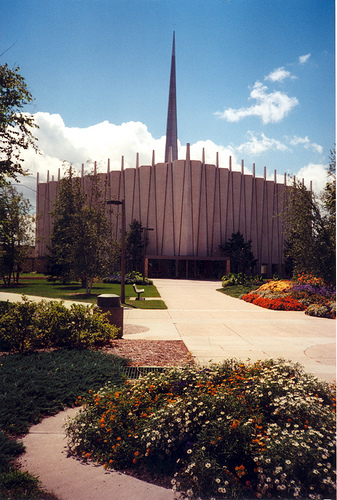
Thirty years ago, I completed an internship at Gustavus Adolphus College. Though my office was in a neighboring building, I walked by or through Christ’s Chapel several time a day. The chapel’s simple, yet provocative architecture often stimulated spiritual reflection.

For example, the chapel is situated in the center of the campus where its high steeple bears witness to God’s central place in the mission of the college. It has clear windows on all four sides, so that worshippers can visually interact with the other college functions. You could see the science center, the library, or the dining hall from your pew. Some saw this as a distraction but also it reminded me that God does not cut me off from the world, but rather prepares me to re-enter it as God’s servant.

Christ’s Chapel also had a unique outer “shell” or wall. The wall panels are long triangular pieces with stain glass separating each panel. The “wavy walls” shimmered in the sunlight. One day after worship Professor Robert Esbjornson explained that the shimmering walls served as a representation of the ancient Israelites’ tabernacle or tent of meeting. When the Israelites left Egypt, they needed a symbolic reminder of God’s presence in their midst. So they were instructed to build a fabric tent of meeting. God said to Moses, “And have them make me a sanctuary so that I may dwell among them” (Exodus 25:8). Christ Chapel was a re-imagined tabernacle in a contemporary setting, .

The tabernacle became  a visual reminder of God’s presence and power in Israel’s midst. “Then the cloud covered the tent of meeting and the glory of the Lord filled the tabernacle” (Exodus 40:34).  In the time of King Solomon the portable tabernacle was replaced with a permanent stone temple.

The portability of the tabernacle continues to challenge me. Too often we want to restrict God to church building or temples. We compartmentalize our space and time. Perhaps we need tabernacles today that can be placed on Wall Street or in front of the Capital, in our homes and our workplaces, to remind us that God travels with us. Of course, at Pentecost God’s Spirit filled the people of God creating a portable sanctuary in each of us. “Do you not know that you are God’s temple and that God’s Spirit dwells in you?” (I Corinthian 3:16).  How are you carrying God?

Lord Jesus, make me mindful of your presence in my life.

Send Someone Else!

The book of Exodus is rich in stories: Hebrew mid-wives protecting the newborn children, Moses drawn out of the Nile River by Pharaoh’s daughter, the cry of the Hebrew slaves for God’s mercy. The central story is the exodus itself as God battles Pharaoh for the freedom of the Hebrew slaves until Pharaoh’s army drowns in the Red Sea. What a spectacular victory, worthy of song and dance (Exodus 15:20-21).

Art Prints
Yet my favorite story is the call of Moses at the burning bush (Exodus 3). God calls out of the bush to Moses by name. He tells Moses to remove his sandals because he stands on holy ground. God continues, “I am the God of your father, the God of Abraham, the God of Isaac and the God of Jacob. I have heard the cries and know the suffering of my people in Egypt. I will bring them to a good land flowing with milk and honey. I will send you to Pharaoh to bring my people out of Egypt.”

One can hear Moses cheering through the first part of God’s speech. “Yes, Lord, it’s about time you set your people free.” But then Moses’ cheering stops when he hears God’s plan includes him. Immediately Moses interjects, “Who am I that I should go to Pharaoh and bring the Israelites out of Egypt?” Moses then puts forward five different complaints as to why he should not be the one. My favorite comes at the very end, “Oh my Lord, please send someone else” (Exodus 4:13).

I confess that I see myself in Moses’ response. Like Moses, I know that there is mistrust, injustice and need in the world. Like Moses, I know that God needs pioneers who will prepare the way of God and lead God’s people to freedom. Like Moses, I know God is pulling at my heart, mind and soul to be a leader. But like Moses, I too often say, “Lord, send someone else!

The good news in this story is that Moses, after complaining long and hard, went to Egypt and confronted Pharaoh. Moses caught fire and blazed with God’s Spirit. God is trustworthy to give us each the strength and courage to do his will.

To what adventures is God calling you?

Lord Jesus, give me ears to hear and feet to follow.

Wild Life Encounters

Wild life abounds in Rocky Mountain National Park.  In the high country I enjoyed the fat marmots sunning themselves on exposed boulders while small pikas scurried around beneath them.  There were some large falcons circling on the heat thermals each afternoon and one trail was closed due to an aggressive raptor in the area.  On my recent trip, two wild life encounters stand out.

Estes Park Elk

First was an elk.  I was bicycling an Estes Park city trail one evening when I  was surprised to spot an elk only a few feet from the trail.  He was enjoying an evening meal and had no problem with me stopping and taking his picture.   Later I learned that elk are prevalent in Estes Park as fall approaches.  The residents consider them a sign of the changing season.

My second encounter was late at night.  I had placed all my campsite food inside my car, except for my ice cooler.   I figured that no chipmunk or squirrel would be able to open my cooler.  At 11:30 pm I was awaken from a sound sleep by a crash outside my tent.  I quickly grabbed my flashlight and poked my head from the tent.  The cooler was on the ground, its contents strewn across the campsite.  I stepped outside the tent and then spotted the two yellow orbs and the big brown shape staring back at me about 10 feet from the cooler.  A bear had entered my campsite.

For nearly a minute we stared at each other.  He (or she) made no moves towards the cooler or me.  I stepped back to my car and open the car door for a quick exit, but the bear still did not move.  I slammed the car door in hopes of frightening the bear.   The sound startled the bear and it took a few steps back. After a second, louder car door slam, the bear turned and dashed off into the woods.  After waiting a few minutes, I gathered up all the food from the cooler and repacked it before placing it inside the car trunk.  I did take some deep breaths and contemplated calm images prior to falling asleep again.   The next morning I discovered an empty tortilla wrapper; the bear had found something to eat.

The two encounters started me thinking about how people might encounter God.  On the one hand we might think of God as a sign of the season, a kind of wild pet that comes and goes as it pleases, of which we occasionally make sightings. Such encounters seem safe and calming, but they rarely change our behavior or lifestyle.  The second encounter was more disruptive, more awe-some.  It reminded me that God is GOD ALMIGHTY, and that awe and fear can be  appropriate responses to a God-encounter.   Such encounters can change our behavior. I kept the cooler locked in the trunk after that night.

God is the Almighty, Ruler of heaven and earth.  When the Israelites confronted God on Mt. Sinai, they were terrified and thought they would die.  “For who is there of all flesh that has heard the voice of God speaking out of fire as we have, and remained alive?”  (Deut. 5:26)  I fear that we might have turned God into our manageable pet, rather than seeing God as the awesome Creator of the Universe.  Perhaps we need a crash at midnight to wake us from our spiritual slumber.

In what ways is God “wild” to you?

Almighty God, break into my life with all your power and glory that I might see you as you truly are.

Miami Heat and Pentecost

Wade, Bosh and James of the Heat

I have been watching the NBA Finals this week: Miami Heat and Dallas Mavericks.  The Heat made news last summer when they brought together superstars LeBron James, Dwayne Wade and Chris Bosh.  With such individual firepower the Heat was expected to walk away with the championship.  But individual superstars do not make a team so right now Dallas is ahead in the series three games to two.  Even though Miami has more talent, they are not playing together well, especially in the fourth quarter. 

The Finals have me thinking about the TEAM of Pentecost.  One of the amazing things about Pentecost is that the Holy Spirit came mightily to the assembled disciples as a team.  The Spirit did not just “zap” Peter and have him preach.  The tongues of fire were on the whole group, anointing them to be the Body of Christ together. In the Old Testament God’s Spirit anointed individuals like Moses or Elijah.  Now the whole church has the power.

 I think as Americans we struggle with the significance of community.  My college history professor contrasted the colonies in New England with those of Virginia.  The New England colonies were community-based with people living in town together. The Virginia colonists were scattered on large plantation where the individual made his way in the new land.  After contrasting the two models my professor emphasized that the Virginia model became our American ideal of the rugged individualist who makes it through the world by him or herself.

Even in matters of faith we often disparage community. As Americans, we tend to focus on our individual faith and commitment, how our personal faith is a private matter of the heart.  Organized religion is suspect for being “organized.”

Yet we all live in community and our faith is rarely a total individual experience.  We learn from others: parents, teachers, pastors, and spiritual leaders.  We read books written by others, sing songs written by others, and reflect upon questions asked by others.  Our faith can be deeply personal, but needs a community to thrive and live.  The Holy Spirit does not leave us isolated but calls us to trust, live and serve together as the Christ’s body in the world.

How are you living your faith in community with others?

Lord Jesus, keep the Holy Spirit active in us so we can be the Body of Christ together.