Category Archives: Jesus

Holy Week Story – Monday

"A Woman Anoints Jesus" by Floridian artist Jan Richardson, 2006.

For the next five days I will be reflecting on parts of Holy Week Story.

Today’s reading is Matthew 16:1-16.

Jesus said to his disciples, “You know that after two days the Passover is coming, and the Son of Man will be handed over to be crucified.” (Matt 16:2)

Plans and plots abound. The climax of God’s plan to rescue and restore humanity is near.  Jesus knows this and has tried his best to prepare his disciples.   The chief priest and religious officials are also planning their own intervention to arrest Jesus by stealth and kill him.  They think that now they must take control of the situation, but they do not realize that only Jesus is truly writing the story.  Even Judas, Jesus’ friend and betrayer, is not working in total independence.  He is part of a bigger plot.   This does not excuse his betrayal, but rather demonstrates God’s power to weave a new thing from our human foibles and sin.

The only person, besides Jesus, who acts with compassion and understanding, is the woman who anoints Jesus with costly perfume (Matt 16:6-13).  Her name is never given, but she prepares Jesus for his tomb. The disciples object to her apparent extravagant waste of money, but Jesus defends her.  By pouring this ointment on my body she has prepared me for burial. (Matt 16:12).

 I think, at times, I am like every character in the story.  I can be the religious official that tries to control how and when God will act.   I can be the disciples, misunderstanding how a brother or sister in Christ is serving God’s kingdom.   I can even be Judas, betraying a friend in little acts of bitterness or disappoint, whether in thought, word or deed.   And then, by the grace of God, I can also experience the woman’s joy of generosity in giving God a special gift.    The Holy Spirit can use .

 Prayer starter: Lord Jesus, turn my heart away from control, betrayal or manipulation to being generous towards You and Your people.

Crowd Power

Catalyst had Crowd Power

This morning’s Palm Sunday worship reminded me once again of the power of a crowd.  As American I don’t think we reflect on the dynamic power of mass audiences because we tend to think we are all independent individuals.  Yet we experience the power of a crowd when we go to a crowded athletic venue, and the spectators begin to chant, holler and scream as the score becomes close.  Or when we go to a music concert and the performer is very good at stirring up the audience during the performance.   We say that the performer feeds off the energy in the room.

This crowd power can be a positive influence.  Last fall I attended a large Christian Conference in Atlanta called the Catalyst Conference. This home-made video captures just a bit of the energy I experienced in that auditorium with 12,000 other Christians.  I strongly encourage people to experience a large gathering of fellow believers in worship, prayer and praise together.  The power of the Holy Spirit can be magnified in such settings.

As one reads the story of Jesus’ entrance into Jerusalem, one has the feeling that there is incredible crowd power in that parade with palms and cloaks, shouts and songs.   The crowd truly believed the King was in their midst and they could not hold back.  Jesus does not chastise them but rather the religious officials who try to stop the celebration.  Jesus said to them, “If they keep quiet the stones will cry out.” Luke 19:40.

The problem with crowd power is not their enthusiasm but their fickle character.   In a sport’s arena, one play can suddenly change the game and the crowd becomes deflated, even hostile.   In politics, Hitler was able to utilize mass rallies to gather and solidify support for his totalitarian regime.  The crowd is not always right.

Friday morning we will read again the Gospel story of the crowd as it gathered outside Governor Pilate’s court.   Their cries will have turned from “Hosanna!” to “Crucify him.”

How have you experience crowd power in a positive or negative way?

Does crowd power have a place in our contemporary life with Jesus?

Our Part in the Fifth Act

N. T. Wright, the New Testament scholar, helps me understand the Biblical story as a drama with five acts.  The first act is creation, beautiful and good, Genesis 1-2.  The second act is the human rebellion against God (also known as the Fall), Genesis 3-11.  The third act is the entire story of Israel, from Abraham to the Messiah (Paul sketches this out in Galatians 3 or Romans 4).  The story of Jesus’ life, death and resurrection is the climatic fourth act of the drama, the hinge on which everything turns.  The fifth act is the story of the church beginning with the book of Acts, and this is where we live today.

Wright goes on to explain,   

When we read the story of Jesus, we are confronted with the decisive and climatic fourth act, which is not where we ourselves live – we are not following Jesus around Palestine, watching him heal, preach and feast with the outcasts, and puzzling over his plans for a final trip to Jerusalem – but which, of course, remains the foundation upon which our present (fifth) act is based.    Indeed, telling the story of Jesus as the climax of the story of Israel and the focal point of the story of the creator’s redemptive drama with his world is itself a major task of the fifth act. (The Last Word, N. T. Wright, p. 124)

This story structure is central to our understanding of scripture, how we read and interpret it.  We are still in the story and it has not been completely written, but the main outline is known.  Jesus’ death and resurrection is now our assurance that evil and death has been defeated.    We live in confidence that God has won the war.  There may be individual battles and struggles ahead, times we feel discouraged or in grief.   Yet God’s victory is assured.  The centrality of Jesus’ death/resurrection is why we retell over and over the Good Friday/Easter story every year.

That is also why we can read the story of John 11, the raising of Lazarus, as our story, thinking at times like Martha and Mary that death has won the day.  But we know that Jesus’ resurrection has happened and we live in that new reality.   A new creation is present now and will be fully realized in the future.

How has the story of Jesus become your story?

Weather or Not to Live

Mount Rainier on a clear day

This morning waking up to warm sunshine and blue skies gave my heart a real lift.  I know that  the weather should not determine my mood, especially when one lives in Minnesota year round!   Still God created me as a physical creature that relishes sunshine and abhors long stretches of frigid, grey days.   I am not a robot who has not feelings, but a being that has passion, joy, love, pain and sorrow.

Jesus was one who embraced all of life.  He changed gallons of water into wine at a wedding feast (John 2:6-10).  He enjoyed eating at lavish meals (Luke 5:29-34).  He provided food for the hungry and healing for the sick.  Jesus was not a spiritual ascetic who rejected the simple good pleasures God give to us.  He spent some time in the wilderness, but  even more time with people in the villages and towns of Galilee, Samaria and Judea.  He came from heaven to live among us. 

Jesus gathered friends around him and enjoyed their company.  He wept when his friend Lazarus died (John 11:34).  He rejoiced when his disciples return from their short mission trip (Luke 10:21).  Jesus grew tired on his journey to Galilee (John 4:6). He became angry at the money changers in the Temple (Mark 11:15).   Jesus did not pull away from life, but showed us how to enter it completely.

Growing up in western Washington state, I remember many weeks of grey cold rain.  Though mountains surrounded us to the east and west, we did not regularly see them.   When finally the clouds lifted and Mount Rainier was visible, everyone felt a lift in emotions, a lightness of heart.  Our context had changed, and so did we.  

The vibrant life of faith in Jesus will always be lived in context, in relationship to the culture, community, family and even the weather.   We are physical creatures as well as spiritual.  Let us be passionate in our embracing the vibrant life.  

How have you experienced the Vibrant Life of Faith in Christ lately?

Stories, Butler Bulldogs and Lazarus

As shown in my recent posts, I am a big fan of stories, especially how the Biblical story intersects with our own individual and community stories.   I am an advocate of narrative theology, the idea that the heart of the Bible is not an instruction book of regulations and rules, but a story of God’s creative and redeeming that we live into.   Yes, there are commandment and rules to follow; all stories have those.  The commandments guide and shape the story but they are not the essence of the story.   Stories have surprises, twists and turns, which the story actors discover along the way.

Bulter Bulldog Prior to Game

Last night NCAA championship basketball game had its own story.  Butler University, a non-major University from Indiana, was playing for title against an established powerhouse, the University of Connecticut.  The Butler Bulldogs was poised to write a new chapter in the “David versus Goliath” motif.  I confess my own fascination in the developing storyline.  

Then the game was played.  Butler could not buy a basket, and the expected story fell apart.  Now the Butler team and fans will have to adapt to a different conclusion to their story.  

Stories have a way of doing that, not following the established plot line.  Lives have that trajectory as well.   One can follow all the rules, do all the hard work, follow the established norms and still not achieve the desired outcome.  Or a surprise or twist of grace can intervene and a new story begins.

This Sunday the gospel text is John 11, the story of Lazarus.   Lazarus was sick and his sisters, Mary and Martha, sent for their friend, Jesus, to come quickly that Jesus might heal their brother.  One would expect that Jesus would have honored their request.  The story explicitly states: “Jesus loved Martha and her sister and Lazarus.” (John 11:5).

The story, however, takes a strange twist.  “Yet when he heard that Jesus that Lazarus was sick, he stayed where he was two more days.”  Jesus deliberately chose not to rush to Lazarus’ aid. The story catches us off guard.   That twist opens us up to a new perspective on Jesus and life.   Jesus is not a magician who serves our needs.  Jesus is like an author shaping the stories we live. 

More on Jesus’ part in our story tomorrow.

Who are active writers in your life story?

Love to Tell the Story

One of my favorite hymns is “I Love to Tell the Story.”  

 The second stanza is
I love to tell the story: How pleasant to repeat
What seems, each time I tell it,
More wonderfully sweet! 
I love to tell the story, For some have never heard
The message of salvation
From God’s own Holy Word.”

In Acts 10:34-43, Peter tells Jesus’ story to Cornelius and his household with a similar joy.  Peter is delighted to tell them about Jesus Christ and is amazed at how open and receptive they are.  Too often in our culture we have this perception that bearing witness to Jesus Christ is stressful and difficult.  Peter demonstrates that as we follow the Spirit’s prompting, it can be a joyous, amazing event that the Spirit can bless. 

Samaritan Woman meets Jesus at the Well

Tomorrow I am preaching on another story-teller, the Samaritan woman at the well (John 4).  Her encounter with Jesus leads to her spontaneous testimony about Jesus to others in her village.  It is as if a well of joy and excitement has bubbled up inside her.  She is the one of the first evangelist or story tellers in the Gospel of John.   She loves to tell the story!    

My prayer today is simple: 
Lord Jesus, grant me the joyous opportunity to bear witness to your life story.  Your life has changed my life in so many ways; may I bear witness to you today in some special way. Amen.

What story in scripture excites you?

Stories Shape Us

The Story of Coke

This morning Rolf Jacobson told a story.  His sixth-grade daughter had a science project in which she tested people’s taste and perceptions.  First she had people do a blind taste test of three cola drinks: Coke, Pepsi and a generic supermarket brand.   Not knowing which cola was which, they split pretty evenly, but the generic was the winner.  Then she had the taste testers go into a second room and try the same three drinks but this time they knew which drink was the Coke, Pepsi and generic.  Coke and Pepsi were the easy winners.   Rolf  saw this as the victory of American brand marketing, a kind of story telling.  We believe in the Coke’s (or Pepsi) story and identify with their products.  Their story has shaped us.

Rolf, a Luther Seminary professor, connected that successful story-telling to the church’s failure to tell the Biblical story in as convincing fashion.  For many the Bible has become a dusty ancient book about some strange people, events and ideas that are jumbled together with God and Jesus.  We recognize bits and pieces of the story, but it rarely has connection to our daily lives.  Though most Lutheran pastors use a Biblical text in their preaching, the over-arching story of the Bible has been lost or never known. 

Rolf has proposed a new worship schedule of Bible readings that would guide a congregation through the Old and New Tesatment story in nine months. More information is at narrative lectionary.

Stories shape us.  Today I had lunch with two running buddies and I realized that running has been one of the stories that has shaped my life for the past ten years.  Because of injury, I miss not being able to run, but I also miss my story/identity as a runner.  I continue my physical therapy in hopes of restoring that activity and identity.   

Still a deeper story is at work.  It’s a story I have heard over and over in worship and study.   My truest identity is as not as a runner, but as a child of God.  Jesus lived, died and rose again to give me that identity and I can not run away from his story.

How does your life story connect with the Biblical story?  Has worship and preaching helped make those connections?

Love Wins or the Great Divorce?

C. S. Lewis's Great Divorce

Yesterday I finished Rob Bell’s book, Love Wins.  I understand how evangelical can be upset with him, but as a Lutheran I don’t feel such judgement.   If I could use one word to describe God it would be Gracious.   God’s grace is infinite and total and I see it extending beyond this life.   Like Bell, I don’t understand how God can condemn someone to eternal, infinite punishment if they never had the opportunity to hear the gospel of Jesus Christ.  I remember conversations I had with fellow students at Fuller Seminary where some thought that the church had the obligation to proclaim the Gospel to keep people from going to hell.  They believed that we HAD to preach it or else unbelievers would burn, even those in distant lands.

I do believe in proclaiming the Good News of Jesus Christ, but not as some cosmic obligation to keep people from hell.   I preach the good news because I am in love with Jesus, the creator of the universe and I am excited to have others experience that liberating love as well.  I am a participant in the new creation with Jesus and I am humbled that God can use someone like me to accomplish God’s will.  

Rob Bell does a great job of describing the incredible, awesome, overwhelming love of God for us.  However I do have qualms with him, such as how he misquotes Martin Luther as if Luther was a closet universalist.  Carl Trueman, Departmental Chair of Church History at Westminster Theological Seminary in Philadelphia, has written a length blog post on this very subject. See http://www.reformation21.org/articles/easy-virtues-and-cruel-mistresses.php.  Then again I disagree with Carl Trueman’s comparison of Love Wins with Dan Brown’s Da Vinci Code.  But disagreements are part of  a healthy theological conversation.

In an earlier post, I wrote that I have been rereading parts of C. S. Lewis.  When I finished Bell’s book, I discovered that he had a section for further reading.  His second reference is this: “On hell, see C. S. Lewis’s The Great Divorce.”  Later in the acknowledgments he thanks his parents for suggesting that while in high school he read C. S. Lewis.   I must agree.  I appreciate both writers, but the better IMHO is C. S. Lewis.  Next week I will move on to other topics.

What writer or artists has best help you see the magnificent love of God?

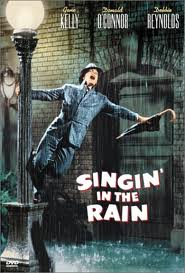
Singin’ in the Rain

To Sing and Dance with Joy? Put down the umbrella!

Su Sorenson, a member of Resurrection, wrote a devotional that I neglected to place in our congregation’s Lenten devotional.  I truly appreciated her image of taking down our umbrellas.

For I am convinced that neither death nor life, neither angels nor demons, neither the present nor the future, nor any powers, neither height nor depth, nor anything else in all creation, will be able to separate us from the love of God that is in Christ Jesus our Lord.”  Roman 8:38-39

These verses have strengthened me and carried me through tragedies, suffering, and loss.  I have been assured that whatever is happening to me, to those I love, or even to this world, God is still present.  God is still showering me and the world with His love. 

However, there are still times when I am separated from the love of God.  Those times when I build a wall around myself and don’t let God in.  Those times when I put up my umbrella and don’t allow the rain of God’s love and grace to shower me.  I might put up my umbrella when I get busy with my own “to-do list” or begin to feel self-important (how will the place run without me?)  I put up the umbrella when I am exhausted, in times of self-pity, in loneliness.  Yet, God’s love is still there. 

To live in God’s grace I need to step out from the umbrella.  I need to stand in the rain, to be washed each and every day with God’s love and power.  Nothing will be able to separate us from the love of God when we take down our umbrellas.  Will you take your’s down too?  Enjoy the shower.

Dear God, continue to tug at my umbrella so I may be fully washed in your love and grace, each and every day.  Amen

St. Patrick’s Day and the Vibrant Life


Vibrant Life is at the heart of Resurrection Lutheran’s mission.  We are called to live in Christ, to vibrate on Christ’s frequency.  St. Patrick is someone who vibrated to Christ within him.  Born in Roman Britain ca 389, he became a slave in Ireland as a child when  captured by Irish raiders.  After escaping back to Britain, he felt God’s call to preach the faith to the Irish people.   He became an evangelist to his captors.

Are you ready for the True Parade?

Now his Saint Day is celebrated with parades, parties and green beer, and the Protestant pietist in me grates at the excess of desire and appetite.   But I recently read a short section by another Irishman, C. S. Lewis, in his sermon, The Weight of Glory, that gives a different perspective on such desires,

If there lurks in most modern minds the notion that to desire our own good and earnestly to hope for the enjoyment of it is a bad thing, I submit that this notion crept in from Kant and the Stoics and is no part of the Christian faith.  Indeed, if we consider the unblushing promises of reward and the staggering nature of the rewards promised in the Gospels, it would seem that Our Lord finds our desires, not too strong, but too weak. We are half-hearted creatures, fooling around with drink and sex and ambition when inifinite joy is offered us, like an ignorant child who wants to go on making mud pies in a slum because he cannot imagine what is meant by the offer of a holiday at the sea.   We are too easily pleased.

The phrase, We are half-hearted creatures, fooling around with drink and sex and ambition when inifinite joy is offered us, strikes me hard today.   St. Patrick Day celebrations are not a bad thing, but even at their best they are pale imitation of what God has prepared for God’s children.  God created us with a “God-shaped vacuum” that we long to fill.  Alcohol, sex, wealth, and ambition can not fill the vacuum.  We have a thirst, a desire, for God’s joy that we only partially fill in this life.   Heaven is where we will be fully what God created us to be and our celebration will have no end.  In heaven all life will be vibrant.

How have you experienced Vibrant Life?