Category Archives: Jesus

Who Is In the Ditch?

A common interpretation of Jesus’ parable on the Good Samaritan (Luke 10:25-37) is to think it is moral story. The moral objective is for us to do good for our neighbors. If you see someone stranded by the side of the road, you should stop and help them in some way. There is nothing wrong with this moralistic interpretation of the parable. At the end Jesus says, “Go and do likewise.”

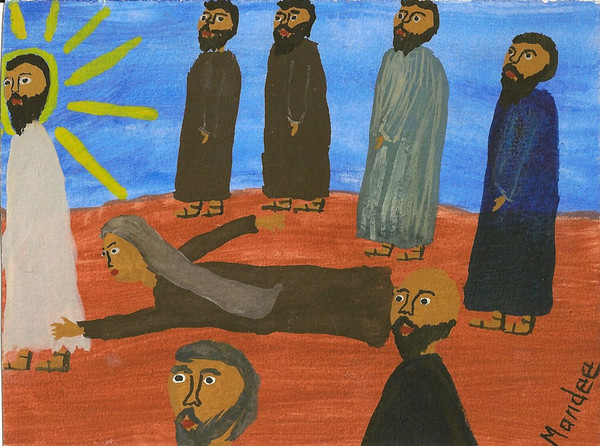
Good Samaritan by He Qi

Good Samaritan by He Qi

Yet such a moral interpretation is not the only way to read this story. Jesus’ parables nearly always contain a surprise that trips us up. The Good Samaritan has such a surprise. This was the focus of yesterday’s sermon which you can hear here.

Jesus told the story in order to answer a religious lawyer’s question about loving our neighbor. The lawyer asked, “Who is my neighbor?” Jesus answered the question with the parable:

A man was going down from Jerusalem to Jericho and fell into the hands of robbers, who stripped him, beat him and left him half dead. (This not a big surprise since that road was an isolated one.) Now, by chance, a priest was coming down the road and when he saw him, he passed by on the other side of the road. (Minor surprise here, a priest might be one who would see the religious obligation to help, but does not.) Likewise a Levite, when he came to the place and saw him, passed by on the other side. (The Levite, another religious person who should help him, does not.)

Now in classic storytelling fashion, Jesus has set up the third person to break the pattern of passing by and thereby demonstrate what loving the neighbor means. Since he is speaking to a religious lawyer and wants him to learn what love is, one might expect the third person to be a religious lawyer who stops to aid the beaten man. This would make the moral point very explicit.

Instead, Jesus surprised the lawyer (and us) by introducing a Samaritan into the parable. Samaritans and Jews had a great deal of religious hatred with one another since they disagreed on where God’s temple should be (see John 4:20). The Samaritan is the one who goes out of his way to care for the beaten man; the Samaritan is a totally unexpected hero.

But where is the lawyer in the parable? For that matter where are we in this story? He (or we) might identify with the priest or Levite or possible the Samaritan. But there is another possibility. Perhaps Jesus is inviting lawyer (and the reader as well) to see oneself as the man beaten and thrown in the ditch.

Many of us have a hard time accepting the love and compassion of others. We prefer being the one in control, dispensing the compassion. We keep our wounds (emotional, spiritual, relational, and vocational) hidden. Perhaps Jesus is calling us to receive compassion and care from others and not be so stoic. There are risks to such vulnerability. Yet Jesus took such risks when he was beaten, stripped and died for us. (More later on this later in the week).

Lord Jesus, help me to receive compassion for others.

Unplugged Friday

Lent emphasizes spiritual disciplines. For example, Christians are encouraged to “give something up” for Lent as a way to make room for God. Fasting has been a spiritual practice for centuries. People forsake food (either totally or some favorite like chocolate or coffee) for a period of time so that they can more intentionally focus on loving God and loving the neighbor.

This Lent I am modifying the practice of fasting to being  “unplugged.” I plan to disconnect from all forms of computerized information on Fridays during Lent. No e-mail, no Facebook, no blog, no texting on Friday, my normal day off.  I plan to use the time for prayer, reading and reflection. A colleague of mine, Rich Melheim, is recommending a techfast  breakfast, staying unplugged each morning.  Such practices could also strengthen our creativity.

Jon Burg wrote on his blog regarding our need to unplug,

You, me and everyone else in the room knows that when you are answering emails on your mobile you aren’t really present. Your kids know it. Your co-workers know it. Your clients know it. Your spouse knows it. You know it. I’ve come to terms with this in my own life.

But I recently had a deeper insight. When I am always plugged-in to a device, I am not really present in my own life. I don’t enjoy my life as much when I live in the half-present. Not only does constant connectivity lessen my enjoyment of life, it distracts me from achieving the creative goals I set out for myself. The brain needs mindless time to reflect. This is why we come up with our best ideas in the shower.

A Bad Idea?

A Bad Idea?

I guarantee that if there were a tv screen in the shower, we would draw less inspiration from the shower experience. Who knows what major works of art, creativity and innovation would be lost.

You can read his whole article here

Part of the Lenten tradition of 40 day is based on Jesus’ 40 days in the wilderness, a time of fasting and prayer, (Luke 4:1-2). I am pretty sure Jesus was also “unplugged” the whole time.

What spiritual practices are you embracing this Lent?

Lord Jesus, guide me into deeper devotion to you.

Slow Lent Revisted

Slow Lent Movement

Slow Lent Movement

In two days, Lent begins. Lent is a church season of preparation, looking towards Jesus’ passion. I have written about Lent before and as I stopped to reread it, I realize that I need to learn once again to slow down, to realign my life.

Two years ago I wrote about Bishop Margaret Payne’s passion for a Slow Lent Movement. A brief section of what I wrote then,

She spoke on how pastors have bought into the seduction of our culture’s three A’s: Accomplishment, Adrenalin, and Affirmation. As pastors we think our worth is based on how much we accomplish in our congregations and we enjoy the adrenalin rush that comes from having much to do and being needed by many people. And we relish the public affirmation that often comes from having our hands in many programs and ministries. I found myself nodding my head several time, recognizing my own self-delusions being exposed by her words.

But I don’t think her words are limited to pastors. In spite our professed trust in God’s grace, so many of us who are Christians still seek our self-worth based on our accomplishments. We rush about trying to fulfill the many “shoulds” we carry inside our heads. We seek public affirmation even as we feign humility. We have bought into the prevailing culture without seeing our need for a new way of life.

I confess that I continue to find my primary worth in my accomplishments, rather than my identity as God’s child. This Lent our congregation will be focused on the Lord’s Prayer and the opening phrase always give me pause, “Our Father in heaven.” Jesus instructs us to approach God as a loving father who seek us out.

I pray for you that the season of Lent will provide be a time of slow, reflective prayer, of simply being with God.

Yes, there is much to do.

Yes, our neighbor needs love.

But in our anxious hurry, you and I forget who we are. We need to slow down and be with our loving papa in heaven.

Lord Jesus, remind me once again to slow down in you.

Prayer Challenge

Title: The Prayer of Jesus (St John Passion - ...

Title: The Prayer of Jesus (St John Passion – 3) Painter: Jacek Andrzej Rossakiewicz (b.1956) Year: 1990 Characteristics: Oil on canvas, 245 x 137 cm (Photo credit: Wikipedia)

Jesus made radical promises regarding prayer.

  Ask, and it will be given you; search, and you will find; knock, and the door will be opened for you. (Matthew 7:7)

If you abide in me, and my words abide in you, ask for whatever you wish, and it will be done for you. (John 15:7)

Jesus promised that his disciples could “ask whatever they wish” and God would make it so. Such bold promises challenge my observation of the church and the world. So many prayers seem to go unanswered or forgotten.

I am not talking about what I consider “childish” prayers, like winning the lottery or finding a parking spot at the shopping mall. I am thinking about those real prayers of the heart, when day-after-day you pray for the healing of a loved one. A friend is afflicted with cancer or an addiction, a spouse is battling depression or a child is traveling in the wrong crowd and we pray. We pray asking God to bring healing and peace to this person believing that this is God’s will for God’s people. Jesus certainly brought healing to those in need; healing and wholeness is what God desires for all of creation, especially his children.

Naturally if the person resists God’s healing, God will not force mercy. Often a person wrestling with addiction has to hit bottom before they can see how powerless they are in their addiction. God does not force healing.

Still many of us pray daily for God’s healing and we do not experience it. Oh, there are those occasions when miraculous healings occur. Thanks be to God! I have participated in prayer services where God’s power has restored the sick to health. Yet such answers seem almost arbitrary because others have not had the same prayers answered even when their faith was strong and their prayers persistent.

I do not know the answer to my own question, other than to look to Jesus. In the Garden of Gethsemane he prayed for his own cup of suffering to be taken away, yet the next day he walked to the cross and death. His prayer was real and deep. And though he did drink the cup, his prayers gave him the strength and power to walk to Golgotha . . . . and three days later, the empty tomb.

And that is what we each need: the strength and courage to walk the path God has given us. So, like Jesus, we pray, “your will be done.”  The final answer to all prayers comes in Jesus’ resurrection and the promise of new life in him.

Lord Jesus, your will be done in my life.

Mountain Light and Dark

Sunday is Transfiguration Sunday, the conclusion to the church season of Epiphany. (I wrote about the light of Epiphany here). The story of Jesus’ transfiguration fascinates me on several levels. Partly it is the description of Jesus (“the appearance of his face changed, and his clothes became dazzling white” Luke 9:29). Partly it is the sudden arrival of Moses and Elijah, long-dead prophets whose ministries foreshadowed Jesus’ own mission. Partly it is God’s command, “Listen!”  A big part is the location, a mountain.

The Wonder of God's Creation

Mountains have always been spiritual place. Humans have climbed peaks to seek the heaven throughout our history. Moses climbed Mt. Sinai to receive the ten commandments directly from God (Exodus 20). Elijah ran away to Mount Horeb, the mount of God, where he encountered God in the sound of sheer silence (I Kings 19:11-13). Solomon’s temple was built on Mount Zion and the psalmist sang about its beauty,

His holy mountain, beautiful in elevation, is the joy of all the earth, Mount Zion (Psalm 48:1-2).

So when Jesus took his closest disciples, Peter, James and John, up the mountain to pray, they should not have been surprised that God met them there in a special way.

I enjoy climbing mountains (I wrote about one here).  On occasion I have used an ice axe and rope, but mostly I climb mountains that anyone in decent physical shape can scramble up.  A climb becomes both a physical and spiritual challenge.  I gain a sense of perspective sitting on top of a peak: how very large the world is and how very small I am. As I gaze across the surrounding peaks, I realize that God is in charge. The glory of his creation surrounds me and uplifts me.

But mountains have a darker side as well. The first significant mountain story in the Bible is when God ordered Abraham to take his son Isaac up on a mountain in order to sacrifice him (Genesis 22). The Israelite often created shrines to the Canaanite fertility gods on the mountain tops.

O mortal, set your face toward the mountains of Israel, and prophesy against them, and say, You mountains of Israel, hear the word of the Lord God! . . . , I myself will bring a sword upon you, and I will destroy your high places. Your altars shall become desolate, and your incense stands shall be broken; and I will throw down your slain in front of your idols (Ezekiel 6:2-4).

The darkest mountain of all is Mount Calvary or Golgotha where Jesus was crucified. Not much more than a hilltop outside of Jerusalem, yet the darkness of human sin caused the sky to turn black as Jesus cried, “My God, My God, why have you forsaken me?” (Matthew 27:46). Mountains can be places of terrifying death as well as peaks of glorious enlightenment.

My boyhood home had a view of Mt. Rainier

My boyhood home had a view of Mt. Rainier

Yet whether hidden in darkness or bathed in sunlight, God’s glorious love is the bedrock of each peak. Mountains call us to trust in God in all circumstances.  Jesus came to bring all creation back into full spectrum of God’s love, including you and me.

Shine, Jesus, shine in me today.

Mystery of Prayer

Prayer can often be a challenge to my rational mind. I like to have concrete, explicit answers to my requests of God. But the very act of conversing with an unseen, often silent, Being challenges all my rational expectations. Yet I would not want a god whom I can easily fit into my own limited understanding. That god would be too small if it could fit into my mind. To truly pray is to enter into the mystery of God, the creator of heaven and earth.  In a way prayer is our attempt to touch the hem of God’s robe.

Touch the Hem of his Garment by artist Amanda Retana

Touch the Hem of his Garment by artist Amanda Retana

Ted Loder writes about the mystery of God in his book Guerillas of Grace: Prayers for the Battle.

Mystery means that, in spite of all our efforts, all our insights, discoveries, and experiences, we will never do much more than touch the hem of God’s robe. It is enough that such touching brings healing. It is too much, idolatrously too much, to claim more than a very little information about the wearer of the robe. And even that little information we can claim only with enormous humility. However, humility is the twin of trust.

It has been said, referring to the temptation to which biblical literalists often succumb, that we should never confuse the love letter with the lover. We all have our version of such literalism, our dogmaticisms, our exaggerated (if unadmitted) claims of knowledge. Humble acknowledgment of mystery delivers us from the imprisonment of such certainties into the awesome dimensions of possibilities. Trust begins here. So, in some primitive way, does prayer. (p. 17)

I will never be able to fully comprehend how or why prayer “works,” but I continue to pray, trusting in God’s grace and love. Through out his life Jesus prayed to his Father; I follow in his example.

To use Ted Loder’s own prayer Calm Me into a Quietness,

Now, O Lord,
Calm me into a quietness that heals and listens,
And molds my longings and passions,
my wounds and wonderings,
Into a more holy and human shape (p.27)

Compartments and Foundation

I confess that I tend to compartmentalize my life. I have my calling as a pastor in which I serve the congregation of Resurrection Lutheran Church. I have my family in which I relate to my wife, grown children, grandchild, scattered siblings and aging mother. I have my hobbies of running and backpacking in which I engage some of my passions and share friendships. These arenas of my life overlap, but they also have separate time, energy and focus. Not all my friends or family worship at Resurrection. Only a few in my family share my passion for running and backpacking. My life has compartments.

I think most people I know have similar compartments. As Americans we no longer live in a small town where everyone worships in the same church or eats at the same restaurant. Our work life is often disengaged from our home life; our family life can be disengaged from our community life. When my children were active in high school sports, several parents of their teammates became my friends. Now our paths rarely cross. My life compartments have changed.

One factor that remains consistent within all these compartments is that I am God’s child. God is the foundation upon which my life is built. I don’t always remember that when relationships shift and the walls of my life compartments move. I sometimes think my value and worth are determined by my status with a certain compartment. For example, how well my last race went or my last church project or my last visit with my mom. The truth is my value and worth is determined not by the shifting compartments, but by my foundation, being grounded on the Rock of Jesus Christ.

Jesus said, “I will show you what someone is like who comes to me, hears my words and acts on them. That one is like a man building a house, who dug deeply and laid the foundation on rock.” Luke 6:48

The Lord is my rock, my fortress, and my deliverer, my God, my rock in whom I take refuge. Psalm 18:2

Weekly worship reminds me that God is my rock. Prayer also helps me stay grounded to this reality. When I pray, “Our Father in Heaven,” I am no longer rooted to my shifting compartments, but going deeper to the foundation of my life. I need to stay tethered to this spiritual realm even as I move through the various components of my life.

Lord Jesus, thank you for being the foundation of my life.

Celebration Tension


Martin-Luther-King-Jr-Famous-QuotesToday is both Dr. Martin Luther King day and the second inauguration of President Obama. Each are worthy of deeper reflection, but as Lutheran pastor in mid-west America, I don’t have much to give other than I am thankful and yet yearning.

I am thankful for a nation that can honor one of its slain civil rights leaders, who spoke out against the injustices of racism and poverty in our nation. Thankful that Dr. King’s dream of equality is now woven into our national ethos. His life’s work still inspires me.

I am also thankful that we can celebrate our nation’s ability to transition power peacefully.  President Obama is starting his second term, but I am quite confident that in four years our nation will elect a new leader and continue the process of handing the presidential authority to that leader. I may or may not have voted for that person, but still he or she will be my president.

Yet I continue to yearn. Yearn for the day that King’s dream of a true equality and prosperity is our nation’s (and even world’s) reality. Yearn for the day that our leaders can lead us with unity, strength and harmony.  Yearn for the day our nation can truly be the beacon of hope for the world.

I know that part of that yearning comes from my faith in Jesus Christ, and the promised of God’s kingdom. We live in the “already” of God’s victory in the death and resurrection of Jesus Christ, but we yearn for the “not yet” of the new heaven and new earth.

 Already: This is written so that you may come to believe that Jesus is the Messiah, the Son of God, and that through believing you may have life in his name (John 20:31).

Not yet: See the home of God is among mortals, He will dwell with them; and they will be his people, and God himself will be with them. He will wipe every tear from their eyes. Death will be no more; mourning and crying and pain will be no more, for the first things have passed away (Rev. 21:3-4).

Today’s celebration lives in that tension. I am thankful for the many wonderful blessing that our nation has experienced, while recognizing there is much work to be done and that God’s kingdom has not fully arrived. I do not want to confuse the United States of America with God’s kingdom, yet I remain very thankful that I am an American citizen.

How do you respond to this day’s celebrations?

Lord Jesus, your kingdom come, your will be done, on earth as in heaven.

Marathon Challenge

12 medals from 12 races

12 medals from 12 races

This morning I ran with my friend, Mike Johnson. He recently completed a significant challenge: to run twelve marathons in twelve months. He started with the Houston Marathon on January 15, 2012 and finished with same marathon on January 13, 2013. Mike had been an all-American in cross-country at St. Thomas in 1980’s, but marathons had been a struggle for him. He wanted something that would be a challenge physically, mentally and spiritually plus become a way to raise funds for Camp Wapogasset where he works and serves.

What Mike discovered in the process of running is that challenges are not always fun. His first marathon was fast and fun, but then the constant grind of preparing, running and recovering from each marathon wore him down. Several times he thought about quitting, casting the whole challenge aside. But some internal voice kept pushing him to do one more training run, one more marathon, and one more recovery jog.   He had an internal drive to finish what he started.

I would not have criticized Mike if he had stopped the challenge early on. After all many people thinking running 26.2 miles once is crazy, let alone a dozen in a year. Yet I marvel at his perseverance and tenacity.

Perseverance is one of the spiritual values highlighted in the New Testament.

let us run with perseverance the race that is set before us, Hebrews 12:2.

In a culture that seeks instant gratification, the Christian life is counter-cultural, valuing perseverance and patience. Jesus persevered through his suffering and crucifixion. Paul persevered in his missionary travels.

Mike’s challenge was pretty mild compared Jesus and Paul.  But Mike’s example showed me the constant challenge to persevere in my calling. I doubt that I will ever run 12 in 12, but I know that running my “race with Jesus” is going to call me to persevere through difficult and challenging times.

The good thing that both Mike and I know, Jesus runs with us all the way.

Lord Jesus, thank you for giving me the strength to persevere.

A Child’s Christmas

Christmas is often associated with children. Santa Claus, flying reindeer and elves combine to make it a child’s fantasy. Like many children I grew up with many deep memories and traditions surrounding the holidays, from staring at the Sear’s toy catalogs to rushing down the hall to open presents. Even as an adult, I catch myself trying to recapture some of the magic of my childhood Christmas’ memories.

ChristmasPageant2011Of course the Biblical story of Christmas adds to that child focus. Though most of the characters are adults (Joseph, shepherds, wise men) the two central characters are Mary, a young adolescent peasant girl, and Jesus, her new born infant. And the unique setting of his birth, a cowshed, provides a wonderful setting for a pageant.

I grew up participating in many Christmas church pageants. I read the lines of Gabriel, the angel, and in my father’s bathrobe I walked with Mary to the manger. In later years, as a pastor, I wrote and preformed Christmas plays that incorporated my own children in the story.  A favorite Christmas memory of mine was when my three children dressed up on Christmas morning to retell the story in their own words.

My daughter this morning shared a link of YouTube Video that retells the Christmas story from a child’s perspective. It has plenty of Biblical inaccuracies, but it captures the joy and wonder of Christmas.

You can watch the video here:  http://youtu.be/zduwusyip8M

Remember, it was Jesus who told his disciples, “Let the little children come to me; do not stop them; for it is to such as these that the kingdom of God belongs.” Mark 10:14.

Lord Jesus, restore within me a child-like trust in you.