Category Archives: love

Thankful Lips

Lips will be active this week. Smiles will break out as distant families reunite for Thanksgiving.  A big part of the day is the feast that we enjoy with our lips, tongues, mouth and stomachs. Yet it is also a time for us to speak words of thanks to God and others using our lips as the means for such expressions.

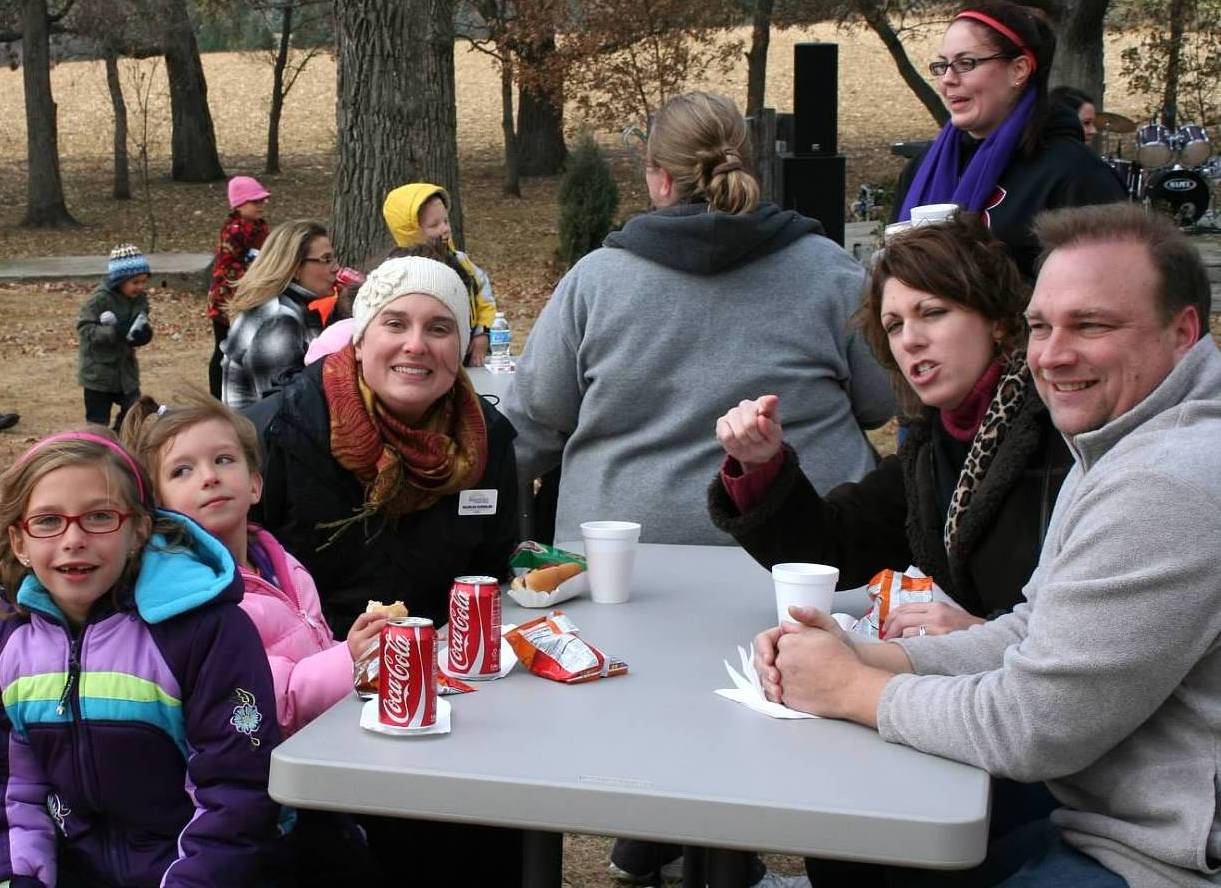
All Smiling Lips at the Harvest Festival

The reason “Lips” are my focus is the scripture text that we had in worship yesterday. In Isaiah six, the prophet Isaiah had a vision of God, gloriously enthroned in the heavens. The prophets heard angelic beings rock the temple with their thunderous song, “Holy, Holy, Holy is the Lord of hosts; the whole earth is full of his glory.” As the prophet experienced this vision, he realized his own sinfulness and cried, “Woe is me! I am lost, for I am a man of unclean lips, and I live among a people of unclean lips” (Isaiah 6:5).

I am struck that Isaiah focused on his “unclean lips.” He might have said “unclean heart,” if his will and emotions were sinful. Or he might have said “unclean hands,” if his actions were the center of his sin. But he centers on the lips and thus the words he and his people have used to betray and deny God. I think of my own “unclean lips” when I profess my utter trust in God in worship but then walk into the world and deny him by the words I use at home or the office. Like Isaiah, I am guilty of “unclean lips” that do not express God’s love and faithfulness on a consistent, daily basis.

Yet the good news in Isaiah six is that our lips can be cleansed. An angelic seraph used a live coal from the altar to touch Isaiah’s lips, cleansing him of sin and guilt. The coal symbolizes the burning love of God that cleans, forgives and restores us. With God’s forgiveness, our lips can become trumpets to declare God’s faithfulness and love.

Yesterday at worship, I showed a short humourous video from Igniter Media that captured how our lips can be changed this Thanksgiving. A preview of the video is here.  As we gather for thanksgiving, may we truly give thanks to God and listen to each other.

How will you use your lips this week?

Lord Jesus, may my lips declare your praise.

Family Value

The word “family” can evoke a spectrum of emotions. For many, family means intimacy and love, hugs and kisses. For others it means consistency and routine, the “same old , same old.” For others, family means animosity and detachment, arguments and conflict. Though we live in a society that declares the intrinsic value of family, we are not always sure how that is lived in our own lives.

I am the second of five children. My parents moved from Minnesota to Washington State when I was a year old. Our family had no close relatives within five hundred miles for the first ten years of my life. Our family holidays were simply mom, dad and my four siblings. We had some good neighbors and church friends but they were not true “family.”

Mom, David, Kathleen, Rob, me, Kris

My childhood memories are a mixed bag. I remember many wonderful meals at holidays and camping trips to the ocean. Dad coached my soft-ball team and mom came to my grade school basketball games and school plays.  We attended church together and prepared for Christmas with family advent candle devotions.

I also remember “running away” from home because I did not get my way. Mom even helped me pack a snack for my small bicycle. I pedaled down the street, only to return by 4PM so I could watch my favorite childhood TV show. I probably caused more trouble at home than any of my siblings, creating fights and arguments over trivial matters. After college, I married and moved back to Minnesota to attend seminary. Like my parent before me, I was a thousand miles from any “family” except for my wife and three children.

Kathleen, David, Kris, Mom, and Rob

This week my childhood “family” is reunited. My brother from Atlanta, my sister and brother from the Seattle area and my sister from Kodiak Island, Alaska are visiting Minnesota to celebrate my mother’s 87th birthday. She moved back to Minnesota a couple of years ago due to her increasing dementia; her recent falls now means she is in a skilled nursing care facility near my church. Prior to their coming, I wondered how my siblings and I would interact without the “social lubricant” of children or vacation activities that normally fill our brief times together. What would we do when mom was napping or asleep?

I have been pleasantly surprised at how we quickly we have become “family” again. We listen as we talk around the dinner table, laugh as we play a board game together, cheer for the Seattle Seahawks football team, and enjoy the latest James Bond movie. We are discussing how best to handle mom’s future and preparing to enter new stages of life as grandparents or retirees. I have not felt any need to “run away” during their visit. After all we are family.

What does family mean for you?

Lord Jesus, continue to teach me how to love those closest to me.

Lobby Love

In our men’s Bible Study this morning we were discussing 2 Peter 1:5-7 and the characteristics that support our faith. Peter strings together a long list:

For this very reason, you must make every effort to support your faith with goodness, and goodness with knowledge, and knowledge with self-control, and self-control with endurance, and endurance with godliness, and godliness with mutual affection, and mutual affection with love.

The list moves from faith to love.  The Greek language of the New Testament had several different words for love: phileo, eros, storge, agape. In this list the last two characteristics both center on love: phileo and agape.

Phileo was a more common word for mutual affection.(Philadelphia, city of brotherly love, is named for this virtue). I imagine two friends working side-by-side to accomplish a task. An example might be offensive linemen on a football team, striving together in protect their quarterback. A strong team has a sense of phileo.

Agape was not a word used as much in Greek, prior to the New Testament. When 1 John 4:7 states “God is love,” the Greek word used is agape. C. S. Lewis in his book, The Four Loves, describes agape as Gift-love and is the unique domain of God. For God so loved that he gave, (John 3:16). The other loves (phileo, eros, storge) are Need-loves which are expressions of our human need for affection, friendship and intimacy. Lewis puts priority on agape, but sees the value in all the other loves as well.

After Bible Study I had a brief discussion with one of the men in the church lobby. He shared how he missed being at church last Sunday. I responded, “I bet you missed both what happened in there (pointing to the worship space) as well as what happen here (indicating the church lobby).” He nodded his head.

Lobby Love is not restricted to the church lobby but was a key part of our Harvest Festival

I have discovered (somewhat begrudgingly) that what draws many people into the congregation is not simply “great worship,” but also “great fellowship.” The opportunity to visit, talk, converse with friends and family after worship is as significant to them as what happens in the worship service itself. The mutual affection (phileo) is a critical part of Christian faith today. In other words, Lobby Love (phileo) can support Worship Love (agape).

This does not mean that Lobby Love can stand on its own. People would not come for the coffee fellowship alone. Church coffee is not as good as Starbucks. Good worship is a key component to good fellowship. It reminds us once again that we are God’s children, cherished by God and that reminder flows into the lobby after worship. We may not speak directly about the Bible text we read that morning, but our kindness towards one another can be a reflection of the loving kindness experienced in worship.

How vital is mutual affection to your faith and love?

Lord Jesus, guide me into deeper fellowship with my brothers and sisters

Today’s Wedding Anniversary

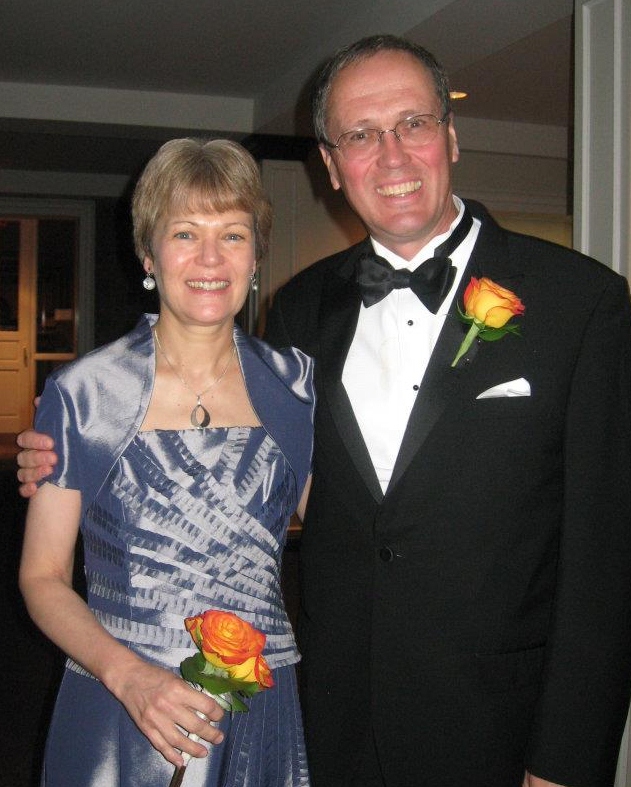
Carolyn and I at our son’s wedding in 2011.

Today is the 35th anniversary of my marriage to Carolyn McCrary Keller. We met in college, at the Haverford-Bryn Mawr Christian Fellowship, near Philadelphia. I always joked that she came from “Tea” with the President of Bryn Mawr, dressed to the nines, and I showed up in overalls and a backwards baseball cap. I was a senior bouncing around in my manic way greeting all the newcomers. Carolyn was with four or five other first year women from Bryn Mawr.

When Carolyn said that she was from Kansas City, MO, I told her a story about a prayer experience I had traveling through Kansas City. The story was short and not particularly profound, but Carolyn later wrote about it in her journal. The story had given her spiritual comfort as she was missing her Bible study group in Kansas City and wrote that my way of praying was similar to hers. The friendship and then the romance grew from there.

We were married by Carolyn’s father, a Presbyterian minister. His only premarital advice to us was, “You can walk down the aisle on your wedding day, fall flat on your face, and still pick yourself up and have a good marriage.” However he made sure Carolyn did not fall by proudly walking his oldest daughter doing the aisle of his Kansas City church and then turning around to preformed the wedding. It was all a blur to me, except for gazing at his beautiful daughter.

Robert C. Roberts thinks the best example of the spiritual virtue called perseverance or steadfastness is marriage:

When two people marry, they make an extraordinary commitment, a promise not just to stick together until death do them part (that in itself would be bold enough) but to love one another than long.

The marriage service warns that some of the bumps this love may encounter along the way: for richer, for poorer, in sickness and in health, forsaking all others . . . . But these words are only slender indicatory beams of light pricking the darkness of the future. When we commit ourselves to married love, we have only the dimmest intimations of what will threaten to break commitment down—boredom, disappointment, inattention, work, sick children, changes in personality and interests of one or both parties—and the list could go on.

Like every married couple, Carolyn and I have our list. I have never embraced her love of opera; she has never backpacked in the mountains with me. We disagree on where to live in our metropolitan area. Still we remain steadfast in our love for one another, trusting in God’s grace and power to keep us together.

Last night we celebrated by going to the Guthrie Theater for the production of Roman Holiday. It is a romantic story of a princess who escapes her royal confines for 24 hours to experience Rome as a private citizen. She meets an American reporter who first tries to turn their budding friendship into an exclusive news story. As the day progresses the friendship turns towards romance, but the duties and obligations of the princess pulls them apart. It is a bitter-sweet ending.

What a contrast to decades of marriage. Yes, there can be many moments of Holiday bliss, but marriages persevere because husbands and wives stick to the duties and obligations of marriage even when bliss is hard to find. I am thankful that Carolyn has persevered in her love for me and pray that together we will experience many more years of marital joy.  I still like holding her hand when we pray together in our own way.

Lord Jesus, thank you for the gift of marriage and for your steadfast love.

Learning From Others

I read a great blog post from the longest-running Lutheran blog.  Pastor Clint Schnekloth (who serve in Arkansas) wrote Mid-life Lesson #20: Accepting help is a spiritual gift.  I encourage you to check it out.  I think many Americans have a hard time receiving assistance from others because we place such a strong emphasis on self-reliance.   The reality is that we are all interdependent and we need one another.  God created us to love our neighbor, and sometime loving the neighbor means receiving love from our neighbor.

Lord Jesus, help me to be able to accept help from others.

“If I were you. . .” Repost

Compassion and empathy are Christian virtues that Jesus taught us to cultivate. Jesus’ command “love our neighbor as ourselves” (Matthew 22:38) is a central to our Christian faith. We cannot love unless we empathize with our neighbor and seek to understand his or her situation. As St. Paul wrote, “Rejoice with those who rejoice, weep with those who weep” (Romans 12:15).

Now empathy and compassion are not restricted to the church. Seth Godin is a respected author on marketing and business. He wrote in his blog yesterday about the need for empathy in customer service.

“If I were you…”

But of course, you’re not.

And this is the most important component of strategic marketing: we’re not our customer.

Empathy isn’t dictated to us by a focus group or a statistical analysis. Empathy is the powerful (and rare) ability to imagine what motivates someone else to act. . .

When a teacher can’t see why a student is stuck, or when an interface designer dismisses the 12% of the users who can’t find the ‘off’ switch… we’re seeing a failure of empathy, not a flaw in the user base.

When we call a prospect stupid for not choosing us, when we resort to blunt promotional tactics to get attention we could have earned with a more graceful approach–these are the symptoms that we’ve forgotten how to be empathetic.

You don’t have to wear panty hose to be a great brand manager at L’eggs, nor do you need to be unemployed to work on a task force on getting people back to work. What is required, though, is a persistent effort to understand how other people see the world, and to care about it.

Seth’s last point, “to care about it” is part of what it means to have spiritual emotions such as compassion and empathy. Our faith can impact our daily lives, even at work.

Lord Jesus, teach me to care about the people and thing for which you are passionate.

Myths about Emotions Part One

I am preparing for a sermon series this summer that I have titled Spiritual Emotions: Turning our Hearts to God. I have been reading various books and articles regarding how our emotions and spirit interact.

I recently posted on Robert Roberts works here.

I have wrestled with various myths in regards to our emotions.

The first myth is that emotions are wildly disruptive and irrational, something we cannot control. An emotion like anger seems to grab hold of me and I am unable to think or act rationally. The emotion takes control and bad things happen, sort of like the comic book hero The Incredible Hulk who is the alter ego of Dr. Bruce Banner. Whenever Dr. Banner becomes angry, he is transformed in monster/superhero The Hulk and things get smashed.

I still remember the day when I was driving my family to the store and as I approached a parking spot someone cut in front of me and took the parking spot. I immediately felt this wave of anger push up inside me, “This not fair,” and I jumped out of the car to confront the other driver. He was startled by the vehemence of my indignation (as was my family). In my anger, I told him to get back into his car and move it. He just looked at me strangely and then walked away. I was still fuming as I returned to my car and found a new parking spot. My wife chastised me for letting my anger become so wild.

Now my anger in that situation was irrational and I did some foolish things. But it is a myth to say that my anger “made” me do it. I made choices in my actions that I controlled. I now confess that I was “wrong” to confront the driver in such a angry manner.

In Genesis 4, God warns Cain about his anger towards his brother Able.

The Lord said to Cain, “Why are you angry, why has your countenance fallen? If you do well, will you not be accepted? And if you do not do well, sin is lurking at the door; its desire is for you, but you must master it.” (Genesis 4:6-7)

Though feelings of anger rose within me, when what I was thought of as “my” parking spot was taken, I had choices.  I could choose to see the perspective of the other driver. Perhaps he did not see me waiting; perhaps he had some urgent matter. I did not need to jump out and confront the other driver. I could have chosen to “count to ten” or pray for him or ask for God’s grace to aid my emotions. I may not always be able to avoid the emotion of anger, but I can learn how to direct and manage my actions around it.

Tomorrow I will post on the myth that emotions are either good or bad, positive or negative.

Lord Jesus, rule in my heart so my heart and body can reflect you.

Spiritual Emotions?

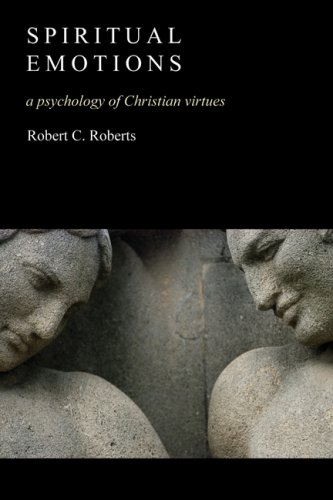
I am reading Spiritual Emotions: A Psychology of Christian Virtues by Robert C. Roberts, preparing for a preaching series this summer. Twenty years ago I read his book, The Strengths of a Christian, which continues to shape how I look at the virtues of self-control, patience and perseverance. I posted on Strengths previously.

In Spiritual Emotions, Roberts asks the questions, can Christians shape or tend to our emotions? Or are they simply electro-chemical reactions in our brains that we have no control over? Can emotions be something that we cultivate and link to our Spiritual lives?

Roberts proposes that emotions are concern-based construals, a framework for interpreting a situation and responding  to it. I am reminded of an example of this in Stephen Covey’s classic, Seven Habits of Highly Effective People. In the book, Covey described riding on a subway car and becoming very irritated with a father whose young children were acting out. The children’s behavior was loud and disruptive and Covey became more and more irritated, even angry, with the father for not intervening. Finally Covey confronted the father about the obnoxious behavior of his children. The father, who seemed preoccupied, looked over at his children and then responded, “Yes, I guess they are being unruly. You see, we just came from the hospital where their mother, my wife, died today.”

Suddenly Stephen Covey’s understanding (construal) changed from one of anger to one of compassionate understanding. At first he interpreted the situation one way, “an inattentive father,” that fostered anger within him. But his interpretation or construal changed when he realized that the father was inattentive due to grief, fostering compassion.

Now, according to Roberts, Stephen Covey had some choice in how to respond to the new information. He might have stayed angry, thinking that his subway ride was still being interrupted by these disruptive children and that it did not matter what the reason was. Most of us would see such a construal or interpretative framework as being selfish and un-Christian. Or Covey might have become embarrassed and upset, again focusing more on his own needs. Instead Covey made a choice (perhaps out of habit) to respond with compassion and offer assistance.

Emotions are not just feeling that arbitrarily hit us and we have no control over them. Neither can we automatically dictate what emotions we will have. They are fruit of the Holy Spirit, which we help cultivate and grow over time, practice and attentiveness.  I believe Robert’s book will help me in this practice.

Lord Jesus, shape my heart to be a harbor of love and not fear.

Hunger Games and Compassion

Several youth and adults recommended Hunger Games by Suzanne Collins for me to read. Since the movie version is coming out later this month, I downloaded it to my Droid and read it yesterday. Though it has a disturbing theme, the story kept me “flicking” pages. In a postapocalyptic future, a ruling class keeps tight control over its outlying resource districts by holding a televised survival competition. Twenty-four youth between the ages of 12 and 18 are selected from the twelve districts to enter the Hunger Games, which are a fight to the death.

The story is a classic “haves” versus the “have-nots”; the empire versus the colonies; the ruling elite versus the struggling masses. In this fictional future, the districts struggle to have enough food and other resources, while the Capital has superfluous abundance. Food plays a role through-out the book with many descriptions of meals. For example, “The stew’s made with tender chunks of lamb and dried plums today. Perfect on the bed of wild rice.” The lamb stew becomes a symbol of the Capital and it capricious ways, giving gifts when it chooses to the districts’ young competitors.

There is no religious or spiritual component in this fictional world. God is not even mentioned in the book. Yet two Christian themes stand out. One is compassion for the neighbor. Katniss, the narrator, remembers being given two loaves of bread by a baker’s son, Peeta, when her family is near starvation. This incident becomes a major subtheme. I can’t help but be reminded of Jesus’ declaration, “I was hungry and you fed me, thirsty and you gave me something to drink” (Matthew 25:35). Katniss and Peeta both practice compassion at times and seek to do good, yet I wonder where is the source of their compassion in a world that knows so little of it.

The other Christian theme is that of sacrifice. Katniss “volunteers” for the Games when her younger sister’s name is drawn as the “tribute.” Katniss sacrifices her security to save her sister from almost certain death. Jesus speaks of this the night before his crucifixion, “Not one has greater love that this, to lay down one’s life for one’s friends” (John 15:13).

In such an evil and corrupt world as Hunger Games, it makes me wonder where Katniss finds the courage and power to be compassionate.  If it is a natural human quality, why is there so little of it elsewhere in the book? I continue to believe the ultimate source of all compassion and love is God, for we are created in God’s image. Jesus said, “Do not work for the food that perishes, but for the food that endures to eternal life . . . I am the bread of life. Whoever comes to me will never be hungry, and whoever believes in me will never be thirsty”( John 6:27,35.)

Heavenly Father, give us today our daily bread, which is you.

Zeal Gone Too Far?

Temple of Baal in Shamin Syria

Having preached Sunday on King Josiah’s renewal of God’s covenant in 2 Kings 22, I am fascinated with his reforms afterwards. According to the book of 2 Kings, Josiah was one of the few kings who followed in the path of God. Despite being raised in a palace where the fertility idols of Asherah and Baal were preferred, Josiah placed his trust in the God of Abraham, Isaac, Jacob and David. And when he heard the Book of the Law for the first time, he became zealous to reform the religion of Jerusalem and surrounding Judah.

First he cleaned out the temple of Solomon, the house of the Lord, removing all the foreign idols (2 Kings 23:4). He burned them outside of Jerusalem and scattered their ashes on public graves, which desecrated these ancient cultic objects. He marched out into the countryside to destroy the “high places” or non-Temple worship sites. He also expelled any foreign priests.

Such “zealous” action may sound excessive to our tolerant ears. Living in our pluralistic culture, we may read such harsh actions as bigotry and intolerance. Yet Josiah and the people of Judah had been given a very specific mission from God: to trust in the Lord God alone. Without this radical obedience their mission could easily be diluted into cultural irrelevance by the neighboring nations. No one would be following God’s covenant. Still, I doubt that we are called to burn or destroy the temples of other religions today. Such a brutal attack would not be honoring Jesus command to love our neighbor (Matt 22:39).

There is a second part to Josiah’s reforms that speaks more directly to our day and culture. It was a revitalization of worship towards the Lord God. He reintroduced the celebration of Passover in Jerusalem, a celebration of God’s victory in releasing the Hebrew slaves in Egypt. (2 Kings 23:21-23). The same holds true today. As Christians we need to more completely understand and celebrate our heritage as God’s people. The narrative lectionary has helped our congregation rediscover some of the Vibrant Life of Faith that can be found in the Old Testament. We don’t need to burn “high places,” but we can certainly burn with the light of faith in God. Our light can beckon our neighbor to a Vibrant Life of Faith in Christ.

How do you bear witness to faith in God in our pluralistic society?

Lord Jesus, may I be faithful as you are faithful.