Category Archives: Resurrection

Doubt and Faith

“Doubting Thomas” will be focus of many sermons this Sunday in congregations that use the Revised Common Lectionary.  The story of Thomas in John 20:24-31 is assigned every year because it occurs the week after Jesus resurrection. In the story the other ten disciples tell Thomas, “We have seen the Lord,” after he missed the first resurrected appearance of Jesus on Easter Sunday. Thomas responds with skepticism, “Unless I see the mark of the nails in his hands, and put my finger in the mark of the nails and my hand in his side, I will not believe” (John 20:25).

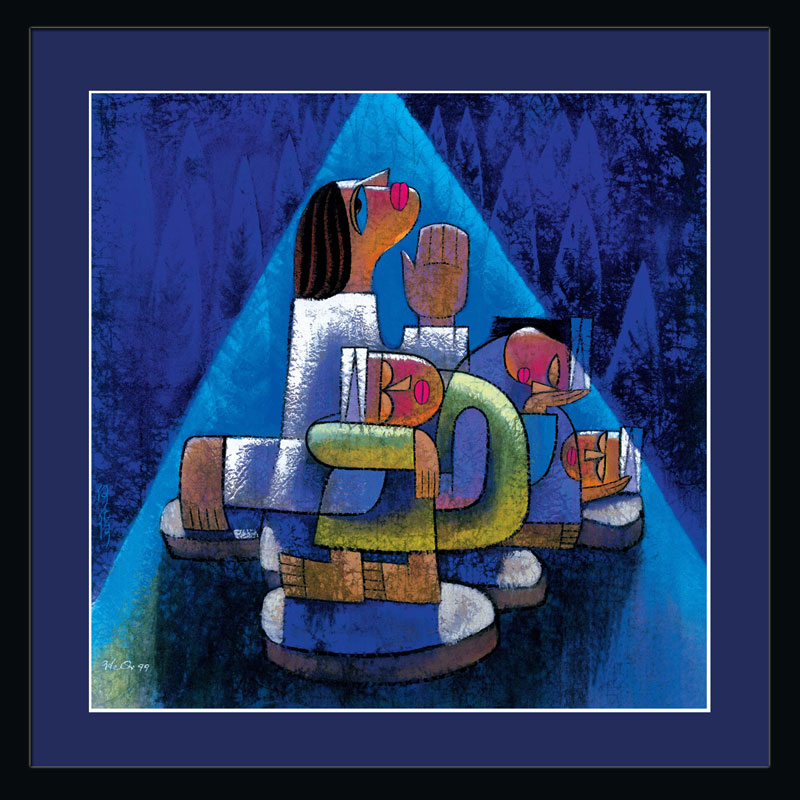
"Still Doubting" by artist John Granville Gregory

Today I read a helpful blog post on the challenges of being selective in our skepticism from TE Hanna. He points out that one cannot be semi-skeptical as one looks at the data of faith. Either you look at all or none of the evidence. I am not a philosopher, but his reasoning helped me think about faith and Thomas.

A certain amount of skepticism or doubt is needed in daily life. So much information assaults our senses every day that we have to filter what is valid and helpful. Not everything I see on the internet, read in a book, or watch on television is true. We are not to be gullible to everything someone says.

Of course part of our skepticism is based on the character of the witness. Last week I was with a group of pastors for our weekly text study when one began to tell us the story of his upcoming trip to Rome. He and his wife had been planning it for several months. He had told a Catholic priest, a friend, and the priest had told, “I think I can arrange an audience with the Pope while you are there.” My pastor friend went on for a few more minutes about his excitement about the upcoming audience while I and others peppered him with curious questions and exclamations about how wonderful his audience with the pope will be. Finally, with a big grin, my pastor friend said, “April Fools.” The papal audience was a joke that he played on us, though the trip to Rome is real. The whole group had believed his story, in large part because he rarely tells such fables. He had always been a reliable witness.

That is part of the struggle in the Thomas story. When confronted by his ten friends, he is sure they must be bearing false witness. As I wrote about this last year, I wonder what the week between appearances was like for Thomas and the other disciples.

Which pushes me to deeper reflection, is my life congruent with my testimony of Jesus’ resurrection? Do people believe in Jesus because my life and my words bear witness to his resurrection? I pray that this is so for each of us.

Lord Jesus, may my words and my deeds bring deeper faith in you to others.

Walk by faith or by sight?

Women Arriving at the Tomb by He Qi

The glory of Easter worship still rings in my ears and heart. The Gospel of Mark’s bold message announced to the women and to us, “You are looking for Jesus of Nazareth, who was crucified. He has been raised” (Mark 16:6). The resurrection is what sets Christ apart from all other prophets and religious teachers. It is central to our Christian faith, yet seems so beyond our personal experience.

Perhaps that is one of the reason so many people become uncomfortable with how Mark’s Gospel ends. Reliable scholarship points to the final verse being verse 8:

So they (women) went out and fled from the tomb, for terror and amazement had seized them; and they said nothing to anyone, for they were afraid.

The gospel writer provides both the empty tomb and the young man’s witness that Jesus is raised and believes that is sufficient for the reader. This seems inadequate and unsettling at first. Where are the appearances of the risen Jesus as described by Paul (I Corinthians 15) or Matthew (28:16-20) or Luke (24:13-53) or John (20-21)? Where are the final instructions from Jesus to his disciples? Verse eight has an unfinished feel to it. In fact, early in the church’s history, additional endings were added to Mark to give a more “comfortable” and “respectable” ending.

As I preached on this yesterday, I think Mark’s ending makes sense at verse eight, if we see it as the challenge to us and our faith that it is. The writer wants us to wrestle with the message of resurrection and the promise that he is going ahead of us.  Stories of Jesus’ appearances may give some comfort but none of us have actually seen the resurrected Jesus. We have only the written reports of the Gospels, such as the young man at the tomb. Ultimately we will have to judge the validity of the witnesses. Paul makes this case in I Corinthians 15.

I continue to think that the most valid testimony of Christ’s resurrection is the transformed lives of his followers. They had trusted him to be the Messiah, but he had been crucified. Their hope was crushed that day. The were like the frightened women, tongued-tied.  Only the actual resurrection of Jesus could have changed them from frightened ex-followers into courageous ambassadors of Jesus. And I have seen such transformation in people’s lives today as they trust in Christ.

The end of Mark’s gospel pushes the reader to trust in the message of the young man.

It is only fitting that just at the tomb will not contain Jesus, neither can Mark’s story. Jesus is not bound by its ending; he continues into the future God has in store for the creation. In the meantime there is only the Word, the bread, and the wine, and the promise that “you will see him.” We walk by faith and not by sight. We can only trust that God will one day finish the story, as God has promised. (Donald Juel, Mark, Augsburg Commentary on the New Testament. p. 235.)

Lord Jesus, help me to walk by faith and not by my own narrow vision.

Prepare the Way of the Lord

Maundy Thursday is about preparation.

Jesus’ disciples said to him, “Where do you want us to go and make the preparations for you to eat the Passover?” Mark 14:12

The Passover Festival was a big deal in Jesus’ time; the festival centered on a meal that remembered God’s liberation of the Hebrew slaves from bondage in Egypt as told in the book of Exodus. Throughout the meal, Jews remembered God’s intervention and prayed for God’s continued activity in their lives. Jesus’ disciples needed to prepare for this meal with wine, bread and lamb.

According to Mark’s Gospel, Jesus gives elaborate instructions , “Go into the city, and a man carrying a jar of water will meet you; follow him, and wherever he enters, say to the owner, “The Teacher asks, Where is the guest room where I may eat the Passover with my disciples?” (Mark14:13-14) One wonders how Jesus knew that they would meet a man with a water jug? Had there been some secretive pre-planning by Jesus so as to avoid the temple officials? Or was this Jesus showing his “magical” powers?

Throughout the Holy Week story, Jesus sees the future unfolding in a specific way. He knows how to find a donkey’s colt for his entrance on Palm Sunday. He knows that the great temple will be destroyed. He knows that one of his disciples will betray him. He knows that Peter will deny him. Jesus knows.

I don’t think the Gospel writer is trying to answer great philosophical questions with telling the story in this way. Mark is not concern with pre-destination versus free-will. What matters for Mark is that Jesus understands and accepts his role in the story and especially his role to die and rise again.  Jesus is LORD.

Three time prior to his coming to Jerusalem, Jesus had foretold that the Son of Man must suffer, be rejected, die and on the third day rise from the dead (Mark 8:31, 9:31 and 10:33-34). Even as Jesus and the disciples walk towards the Garden after the Passover meal, Jesus reminds them that he will be raised from the dead (Mark 14:28). Like the disciples, we may struggle to grasp the significance of the Jesus’ crucifixion and resurrection. We may not fully comprehend all that Jesus says and does. Events swirl beyond the control of his disciple, his enemies, or us. Yet Jesus continues to trust in God’s unfolding plan, even as he walks towards the cross and tomb.

Just as Jesus made preparations for the Passover Meal, he prepares his disciples and the readers of the Gospel for his death and for his resurrection. The meal becomes our place not only to remember his death, but also to claim the promise that he will drink the new wine with us in Kingdom of God (Mark 14:25). Jesus keeps his promises, including rising from the dead. Though we may scatter (like the disciples), he will gather us together as his children. He has prepared the way for us.

Lord Jesus, as you prepared to eat Passover with your disciples, so prepare us to eat with you at your table now and in the Kingdom to come. Amen.

The END Came and Went

Yesterday I wrote on the END OF THE WORLD as expressed in Mark 13. In the chapter Jesus taught his disciples regarding the signs of a new world being birthed. Jesus said, “Truly I tell you, this generation will not pass away until these things have taken place. Heaven and earth will pass away but my words will not pass away” (Mark 13:30).

Like most apocalyptic literature, Mark 13 is written in highly descriptive language that evokes strong emotions, but is often difficult to interpret precisely. The chapter is more like a beautiful mosaic of pictures than a precise timeline of events. Parts of the chapter seem to refer to the destruction of the Jerusalem Temple by the Roman legions in 70 AD (v 2, 4-11, 14-23). Other sections may refer to the persecutions the church faced in its early years. Readers can be challenged to see how it applies to our current life.

Praying at Gethsemane by Artist He Qi

Yet the reader is given a key verse in v. 35. “Therefore, keep awake–for you do not know when the master of the house will come, in the evening, or at midnight, or at cockcrow, or at dawn, or else he may find you asleep when he comes suddenly.”

The four hours of the watch (evening, midnight, cockcrow and dawn) are significant because they become the outline of Mark’s next two chapters: the story of Jesus’ betrayal, prayer,  arrest and trial.

When it was evening, he came with the twelve. And when they had taken their places and were eating, Jesus said, “Truly I tell you, one of you will betray me, one who is eating with me” (Mark 14:17).

Jesus said to Peter, “Truly I tell you, this day, this very night, before the cock crows twice, you will deny me three times” (Mark 14:30).

At that moment the cock crowed for the second time. Then Peter remembered that Jesus had said to him, “Before the cock crows twice, you will deny me three times.” And he broke down and wept (Mark 14:72).

As soon as it was morning, the chief priests held a consultation with the elders and scribes and the whole council. They bound Jesus, led him away, and handed him over to Pilate (Mark 15:1).

The disciples were unable to stay awake in the garden when Jesus prayed (Mark 14:41). They all scattered. Still Jesus remained faithful.  His words from Mark 13 came true. Jesus’ passion became the birth pangs of a new creation. The world as we knew it ended with Jesus’ crucifixion and a new world dawned with his resurrection.

Paul captures this new age in 2 Corinthians 5:17 “If anyone is in Christ, there is a new creation: everything old has passed away; see, everything has become new!” The end of the world is not simple some future event for which we wait. The “end” started with Jesus’ death and the “new” has begun with his resurrection. We live in a new age with Jesus!

Lord Jesus, let my life end and begin again with you.

Ashes and Water

Today, Ash Wednesday, begins the 40 days of Lent. In several Christian traditions, the placement of ashes upon one’s forehead is a reminder of our mortality and our need to repent. As Abraham spoke to Almighty God, “Let me take it upon myself to speak to the Lord, I who am but dust and ashes.” Adam was made from the dust of the ground (Genesis 2:7). We each return to the dust and ash when our bodies die and decompose. We may not like to face that fact, but the truth keeps coming back.

Ashes are also a sign of repentance, our need to turn back to God. The book of Jonah describes how the people of Nineveh responded to Jonah’s message to turn back to God.

And Jonah cried out, “Forty days more, and Nineveh shall be overthrown!” And the people of Nineveh believed God; they proclaimed a fast, and everyone, great and small, put on sackcloth. When the news reached the king of Nineveh, he rose from his throne, removed his robe, covered himself with sackcloth, and sat in ashes. (Jonah 3:4-6).

The imposition of ashes also connects us to our baptism. Many Lutherans and others were baptized with water on their forehead. It was a sign of washing and renewal, of dying with Jesus and rising again to new life. Paul writes how baptism is connected to Jesus crucifixion and resurrection.

But if we have died with Christ, we believe that we will also live with him. We know that Christ, being raised from the dead, will never die again; death no longer has dominion over him. The death he died, he died to sin, once for all; but the life he lives, he lives to God. So you also must consider yourselves dead to sin and alive to God in Christ Jesus. (Romans 6:8-11):

The ashes are thus a reminder that we have already died in our baptism. We died to sin and corruption, and have begun to live the new life in Christ. The ashes we place on our head will eventually wash away; the promise of our baptism is not so easily removed. The Holy Spirit holds us in Christ Jesus.

Lord Jesus, let me die to sin and death that I might live with you now and forever.

The Mask of Mardi Gras

Today is Mardi Gras, the day of celebration prior to Ash Wednesday.  Tomorrow we begin Lent. As a pastor I am more mindful of Ash Wednesday, but I understand the attraction of Mardi Gras. Most of us like a good party, a reason to celebrate. Since Lent is a time of spiritual discipline, which can involve fasting or personal denial, at Mardi Gras one can “excuse” oneself from the anticipated denial by celebrating in wine and song.

One piece of Mardi Gras captured my attention this year, the use of masks. My guess is that you still do not want to be recognized during the celebration. You fear that you might do something so embarrassing that you prefer to be anonymous. But most masks are very superficial and do not truly cover your identity. It may be more of a psychological mask that allows you to behave in a way you wouldn’t otherwise.

Masks are something that come off on Ash Wednesday. The central theme of Ash Wednesday is our mortality. Adam was told after his rebellion against God, “From dust you come and to dust you shall return” (Genesis 3:19).  The imposition of ashes marks us as mortal sinners.  We may party hard today, but eventually the party ends. The grave will “unmasks” us all.

The season of Lent marches towards the cross of Jesus, where the Son of God is executed. The human rebellion against God is fully revealed. No masked will be allowed on that day.

But then God turns everything around with Easter Sunday. It is no longer masks we wear, but a new resurrected body. The shining reality of God’s mercy and love shines in every hue and color. That celebration is even bigger than Mardi Gras.

Lord Jesus, show me how to find my joy in you.

Words of Death and Life

The Old Testament prophets were poets and strong words were their tools. The prophet Hosea used offensive language to stir up the people and to call them back to God. The graphic words were to be a shock to the community in hope that they would repent.

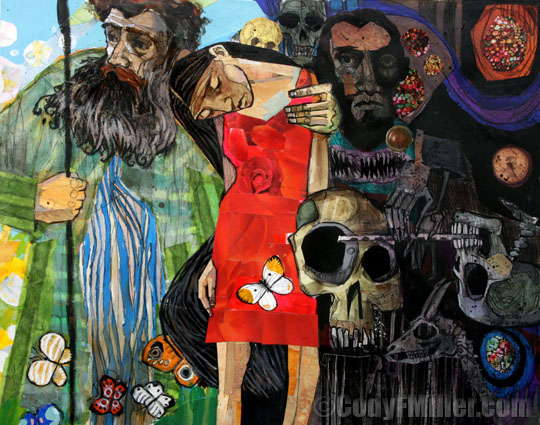
Hosea and Gomer by Artist Cody F. Miller

In the first chapter, Hosea was directed by God to marry an unconventional wife.

The Lord said to Hosea, “Go, take for yourself a wife of whoredom and have children of whoredom, for the land commits great whoredom by forsaking the Lord.” (Hosea 1:2)

His chosen wife, Gomer, may have been a temple prostitute from one of the fertility cults or a simple street prostitute of the city. She bore children to Hosea to whom Hosea gave symbolic names, No-Pity and Not-My-Children, demonstrating God’s strong disfavor with the fickle people of Israel. Afterwards Hosea spoke an extremely harsh word to the people.

Plead with your mother, plead— for she is not my wife, and I am not her husband— that she put away her whoring from her face, and her adultery from between her breasts, or I will strip her naked and expose her as in the day she was born, and make her like a wilderness, and turn her into a parched land, and kill her with thirst. Upon her children also I will have no pity, because they are children of whoredom.

God was angry with Israel’s infatuation with other religions. Instead of being a shining beacon of the Lord God for other nations, they had embraced the gods of other nations, forsaking their unique covenant with God. They had become like a spouse caught in adultery.

The harsh violent language of Hosea can be a shock to our spiritual sensibilities. How can God speak in such cruel severe words?

Perhaps the words are so harsh, because the people’s hearts were so hard. Or perhaps they are so cruel because our hearts are so hard. The words of the prophet “killed” the people (including us the reader), so that God can create a new heart, a new life: a kind of resurrection.

Therefore I will now allure her and speak tenderly to her, . . . I will take you for my wife forever; I will take you for my wife in righteousness and in justice, in steadfast love and in mercy. (Hosea 2:14,19)

Finally the Lord declared, “I will have pity on No-Pity, and I will say to Not-My-Children, ‘You are my people’” (Hosea 2:23). I cling to these words of hope and restoration.

Lord Jesus, the Word of God, you absorbed our sin in your death on the cross. Speak to us again the Word of Life.

Names Matter

Oh Lord, our God, how majestic is your name in all the earth.
Psalm 8:1

My parents named me John Vincent KellerJohn comes from the Hebrew name, Jonathan (I Samuel 13), which means gift of God.  My middle name is from my father, Vincent Keller, and comes from the same root as victorious or winner.  So my name gives me a certain amount of pride: I am a gift of God and a winner.  Then to keep me in my proper place my last name, Keller, is the German word for basement or cellar.  I need to remember my humble roots.

Names are significant in the Bible because they are not just tags that differentiate one person from another.  Names carry meaning and significance, essential characteristics of a person.  The Lord God revealed his name to Moses at the burning bush when Moses asked him for it: I am who I am.  (Exodus 3:14).  The Hebrew root of this is YHWH and means to be present or to be encountered.   Another translation of YHWH could be I will be present where I will be present, a reflection of God’s promise to be near us and yet free to be God.  Names reveal character.

Jesus is also given a special name.  In Hebrew his name is Yeshua, which means God saves or rescues.  His father Joseph is told to give this name to Jesus because he will rescue his people from their sin (Matthew 1:21).   Later during his ministry, Jesus will rename Simon, the brother of Andrew, to be Peter or Petra (Greek) which is Rock.  Simon Peter’s confession that Jesus is the Messiah is the rock upon which the church is built (Matthew 16:16-18).  Names matter.

I think of that when I walk into Resurrection Lutheran Church.  This congregation is named for the wondrous historical event, Jesus’ resurrection from the dead. With Jesus’ resurrection comes the promise that we too shall rise.  We begin the resurrected life here on earth when we die and rise with Jesus in our baptism.  Resurrection begins as we trust, live and serve God.  Our congregation’s name matters because it reminds us of the Vibrant Life of Faith in Christ.

In what ways do you call upon “the name of the Lord?”

Lord Jesus, thank you for fulfilling your calling to rescue us from our sin.

A Locked Door in Grief

On this Memorial Day week-end, I have been reflecting on my last post and how C. S. Lewis was so joyous in his description of heaven in The Last Battle. However his writing took a very different tone a few years later when Lewis described his own grief. In A Grief Observed, Lewis held back nothing as he wrestled with his faith in God after the death of his beloved wife, Joy.

Meanwhile, where is God? This is one of the most disquieting symptoms. When you are happy, so happy that you have no sense of needing Him, so happy that you are tempted to feel His claims upon you as an interruption, if you remember yourself and turn to Him with gratitude and praise, you will be — or so it feels — welcomed with open arms.

 But go to Him when your need is desperate, when all other help is vain, and what do you find? A door slammed in your face, and a sound of bolting and double bolting on the inside. After that, silence. You may as well turn away. The longer you wait, the more emphatic the silence will become. There are no lights in the windows.  What can this mean? Why is He so present a commander in our time of prosperity and so very absent a help in time of trouble?” p.4

Later in the book he comes to some reconciliation with his grief and unanswered prayers

When I lay these questions before God I get no answer. But a rather special sort of ‘No answer.’ It is not the locked door. It is more like a silent, certainly not uncompassionate, gaze. As though He shook His head not in refusal but waiving the question. Like, ‘Peace, child; you don’t understand.’ p.80

This is one reason why in caring for a grieving friend it is better to be a silent companion rather than a “glib answer man.” Lewis, ever the philosopher, has one more observation that gave me a smile as I think about my attempts to ask the great theological questions.

Can a mortal ask questions which God finds unanswerable? Quite easily, I should think. All nonsense questions are unaswerable. How many hours are there in a mile? Is yellow square or round? Probably half the questions we ask – half our great theological and metaphysical problems – are like that. p.81

How have you experienced grief and what support helped you the most?

Lord Jesus, grant us hope in the midst of whatever questions we may ask of you.

The Door of Death

In reflecting on the deadly tornadoes this week, one spiritual question arises about which I am hesitant to write. The question has an answer that has caused harm to grieving people. “Is death always a tragedy?”

A Door into Deeper Joy

In C. S. Lewis’ The Last Battle, the last book of his Chronicles of Narnia, all the children* who once visited Narnia are reunited in a new, wonderful land that resembles Narnia. They wonder how this is possible since the great lion Aslan had told them that they would not return to Narnia. Yet this new land is more spectacular and more real than the old Narnia they had known. Slowly the children come to realize that their last memory of our world had been a terrible train wreck. Unlike previous stories, Aslan had not transported them from our world to the world of Narnia. Instead they have walked through the door of death and entered the outskirts of heaven itself.

Lewis does something incredible in this story. Certainly he could have written about their deaths from the tragic perspective of the survivors still on earth: friends and relative who grieved the children’s sudden absence from life on earth. But instead Lewis gives an imaginative description of their homecoming in heaven, where the joy and delight of heaven grows deeper and more profound each moment.

As Christians we believe in the promise of God that whether we live or die we belong to Christ. In Philippians 1:21, Paul writes, “For to me, living is Christ and dying is gain.” The gain in dying is to gain more of Christ and his joy. Death is not something to be feared, but rather embrace as the door to God’s good presence.

So what is the harm in telling a grieving person, “Your loved one is in a better place?” The harm comes from the fact that a grieving person does not want the person “in a better place” like heaven. The grieving person wants the loved one in this life, sharing in the joys and sorrows of their mutual love. In time the grieving person may embrace the truth of “a better place,” yet in the aftermath of death, such words can be biting and harmful. Compassionate silence is better than quick answers.

What perspective do you have on death?

Lord Jesus, help me to see death as the door way into the resurrected life and to be gracious towards those who grieve.

*Susan is not included, but that is a different posting.