Category Archives: Resurrection

Cleopas the unknown apostle

Cleopas is mentioned once in the Bible.  In Luke 24 two disciples leave Jerusalem on Easter evening and walk to Emmaus, a village seven miles away.  They are distraught that their leader has been executed.  They are joined in their walk by a stranger who is the resurrected Jesus, but they do not recognize him. (This is a common experience for Jesus after his resurrection; I think it still happens today.)   As they walk along the stranger (Jesus) asks what they are discussing about Jerusalem. 

Then one of them, whose name was Cleopas, answered him, “Are you the only stranger in Jerusalem who does not know the things that have taken place there in these days?” (Luke 24:18). 

Jesus Revealed During The Meal in Emmaus - Rembrandt
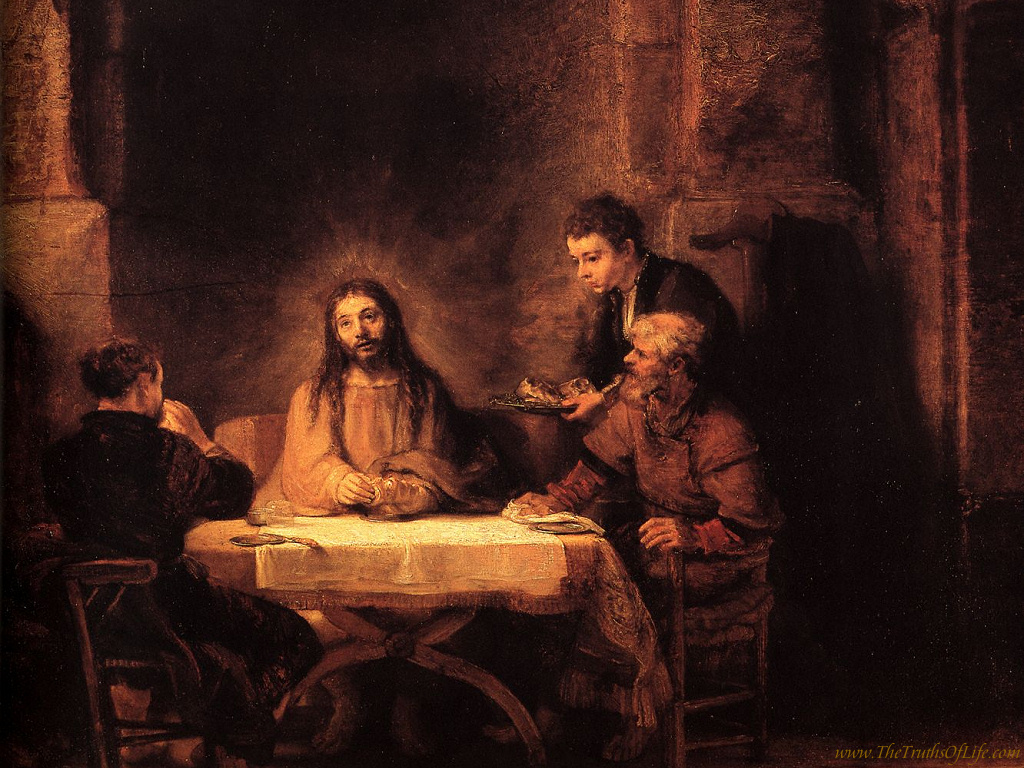
Cleopas is not listed in Luke 6 with the other apostles.  We do not know how deep his commitment was to Jesus.  Yet Jesus chose to reveal himself to Cleopas and his unnamed companion when they stopped for a meal together.  Cleopas, in turn, had the opportunity to race back to Jerusalem and tell the other disciples what he had seen and heard. 

He did not care whether he got future credit.  He simply had to tell someone.   

I think ministry is often like that today.  God does not always choose the most committed or gifted or wisest person to be the messenger.   God chooses the one who is willing to speak her mind and who is willing to share the good news that God is at work. 

Cleopas was willing to hurry back to Jerusalem and to testify to the truth.  He ended up where he started, but everything changed in the journey to Emmaus and back. 

What journey are you on?  Are you open to God speaking through a stranger?

Prayer: Lord Jesus, open my heart, soul, and mind to hear your voice and to do your will.

Friends Between Stories

Friendship by Nova Scotia artist Karen Morrison

In John 20: 19-29 two stories are told.  The first is Jesus’ initial appearance to the disciples in a locked room.  He appears, not as a ghost, but in a resurrected body, and gives them the blessings of peace and the Holy Spirit.  The encounter is quick yet vibrant.   Afterwards the disciples are excited to tell Thomas, their friend and colleague.

For some unreported reason, Thomas was not present during Jesus initial appearance.   Perhaps he was the only disciple who had courage to go out and pick up some fish and bread for supper.  Perhaps he went out to get a stiff drink or wanted some time alone to think.  Whatever the reason, Thomas was gone and missed all the excitement.

Then he ruins the disciple’s excitement with his skeptical response, “Unless I see the marks, touch the wounds, I will not believe.”   I suspect that such honest skepticism threw cold water on the disciples.  How were they to tell other about Jesus’ resurrection when their own friend immediately rejected the claim?  I wonder if an argument between Thomas and the others ensued; there is no report of one.   Did the disciples’ faith simply wilt under the harsh, cold logic of Thomas, or did they continue to believe with burning hearts? 

It was a week before Jesus showed up and turned doubting Thomas to confessing Thomas.   A week of wonder, questions, and some dis-ease.  I wonder how Thomas and the others got along during that time.  It is a powerful witness to their lasting friendship that he is still hanging out with the guys when Jesus briefly appears again. 

I remember my friend, Jerry Zimler, in college.  Raised a secular Jew in New York, he came to a faith in Jesus while in college.  He and I would disagree on many matters of faith, like worship, prayer, and ethics.  Still he invited me home over Thanksgiving break to experience the love (and chaotic vitality) of his family.   I still cherish that visit even though Jerry died some twenty-five years ago.

How do you handle those who disagree with you?  Do all your friends have to think like you?

Prayer: Lord Jesus, teach me to listen to my friends and neighbors and to learn from them.

Seeing and Believing

Are Your Eyes Open to See?

In the Gospel of John one central thread is “Seeing.”  In chapter one, two disciples begin to follow Jesus and he asks, “What are you looking for?”   They ask where are he is staying. He responds, “Come and See.”   It is as if Jesus is also addressing you and me, the readers of the Gospel, “Come and See.”  As we read the Gospel we begin to “see” Jesus.

In Chapter four, after her encounter at the well of Jacob, the woman runs and invites the town (and the reader as well), “Come and see a man who told me everything I have ever done!”  In chapter nine, Jesus heals a blind man and later Jesus asks him, “Do you believe in the Son of Man.”  When the blind man responds, “Tell me, so I may believe in him,” to which Jesus says, You have seen him, the one speaking with you. ” In chapter twelve some Greeks approach one of Jesus’ disciples and ask, “we wish to see Jesus.”  In chapter fourteen, Jesus tells the disciples that they will know the Father, “From now on you do know him and have seen him.” Jesus is the tangible, visible expression of God, the Father.

The theme of seeing culminates in chapter twenty, when Thomas makes his fateful comment about Jesus’ resurrection, “Unless I see the mark of nails in his hands, I will not believe.”  When Jesus reveals himself to Thomas and says, “Put your fingers here and see my hands. Do not doubt but believe,” Thomas confesses his faith, “My Lord and My God.”   Jesus then speaks as if to you and me, the readers, “Have you believed because you have seen me.  Blessed are those who have not seen and yet have come to believe.”

We may not have visions of Jesus, but we see him in the story of the Gospel and in the lives of God’s children.   Thomas was not the first skeptic nor the last.  At times, I have similar doubts.  Yet as I study God’s word with God’s people, I see Jesus.  We bear witness to one another.

How have you seen Jesus today?

Prayer: Open the eyes of my heart, Lord, that I might see and believe.

Easter – The Morning After

Jesus Resurrected

Easter is not celebrated the same as Christmas.  Our culture embraces the Christmas story and the pageantry around it.  The story of the Mary, Joseph,  shepherd, angels, stable and baby Jesus is one that many understand and embrace.  Easter morning with the empty tomb and the various accounts in the Gospel as to who was where when can be most confusing.  A humble birth makes sense; a resurrection does not.

Frederick Buechner has written a helpful word on Easter in his book Beyond Words.

Easter is not a major production at all and the minor attractions we have created around it — the bunnies and baskets and bonnets, the dyed eggs — have so little to do with what it’s all about that they neither add to it nor subtract from it.  It’s not really even much of a story when you come right down to it, and that is of course the power of it. It doesn’t have the ring of great drama. It has the ring of truth. If the Gospel writers had wanted to tell it in a way to convince the world that Jesus indeed rose from the dead, they would presumably have done it with all the skill and fanfare they could muster.  Here there is no skill, no fanfare. They seem to be telling it simply the way it was. The narrative is as fragmented, shadowy, incomplete as life itself.  When it comes to just what happened, there can be no certainty.  That something unimaginable happened, there can be no doubt. (p. 91)

The unimaginable has happened.  Jesus has risen from the dead.  We may never fully comprehend all that this means, but we can be messengers of this truth for the world.  Like the women at the tomb, we may be confused, unsure, even afraid.   Yet we continue to have the same task, to go and tell, even on the morning after. 

How has the message of Easter changed your perspective or life?  How do you life in the light of the empty tomb?

Prayer: Lord God, though my mind may never fully comprehend the depth and height of the resurrection, continue to fill my heart with the joy and power of Easter.

Easter Sunday

Our Name Celebrates Easter Every Sunday

The story of Easter seem unbelievable, yet it shakes the world.  The video link below is from Luther Seminary’s workingpreacher.org and bears witness in a creative way to how our perspective can change with Jesus’ Resurrection.  He has risen!

Easter is coming