Category Archives: Resurrection Lutheran Church

First and Last Communion


??????????I enjoy teaching first communion classes for families. The children are often excited and eager to learn about this mystery meal. We bake bread, tell stories, and taste foods.  I love connecting the meal to the story of Jesus’ life, death and resurrection. We walk through the story of the passion: Palm Sunday parade, the last supper, the trial, crucifixion, and burial.

Waiting.

Waiting.

Then the surprise of Jesus’ resurrection, (which is the name of our congregation I remind the children).

But first communion is just the first step. I like having the parents there since they are rediscovering what the meal is for them. Communion grows in meaning and joy as we participate in it.  There may be times we take it for granted, but God never takes us for granted.  It is always his gift of grace for us.

Though the focus is on preparing for their first communion, I often ask the question, “do any of you know when your last communion will be?”  Together we wonder about the uncertainties of life, yet the constant promise of God to be with us in the Lord’s Supper.  I tell them the story of taking communion to people in hospice as they prepare to die. The meal become an appetizer for the feast that is yet to come. When we will all feast with Jesus and drink the new wine.

Jesus said, “I tell you, I will never again drink of this fruit of the vine until that day when I drink it new with you in my Father’s kingdom” (Matthew 26:29)

Lord Jesus, let me taste again the power of your grace and love.

The Day I Killed a Pastor

Yesterday I preached on Jesus’ parable of the rich man and Lazarus (Luke 16:19-31). In my sermon I stated that the rich man had not “died” spiritually because he still wanted to order Lazarus to serve his needs. The rich man still acted as if he was in charge. He had not died to himself.

Afterwards I remembered when such a death became real for me.

mark_web

Pastor Mark Wickstrom

I have always felt comfortable about my ability to pray extemporaneously in front of large groups. Years ago I served on the staff of a large congregation with four other pastors. One Sunday morning I was preparing to lead prayers during worship when a pastoral colleague, Mark Wickstrom, handed me a prayer request. He asked that we pray for a former staff person who had died the previous week. Mark was not participating in this specific worship service so he wrote out the name of the person on a prayer request card with his stereotypical scribbled handwriting. I glanced at the card, recognized the name as a former custodian who had health issues and continued the preparation for congregational prayer.

As I lead prayer, we prayed for many written requests. When it came time to pray for those who are grieving, I glanced down at Mark Wickstrom’s scribbled note and prayed, “Lord comfort all who grieve the death of   (pause)   Mark Wickstrom.”

An audible gasp came from the congregation. Mark was a much-loved pastor whose death would be devastating. I immediately knew that I had made a huge gaffe and felt the red crimson of embarrassment rising in my face.

The next words out of my mouth must have been a gift of the Holy Spirit, because after a brief pause I continued, “And Lord, we thank you that you have raised Mark up and that he is alive and well, serving you in a different part of this building right now. (pause)  But we do pray for those who grieve the death of Mark Webinger, our former custodian.”

There was an audible sigh of relief from the congregation as well as a few chuckles. After worship during the coffee fellowship, Mark received many affirmations for being alive, while I endured some ribbing for “killing a pastor.” But what happened that day was not simply a prayer faux pa, but also my trust in myself as a pastoral leader. I realized that I can become too self-assured in my abilities, even in prayer, and that I need to ‘die’ to myself and rise to newness of life in Christ, even as I pray for others. In a way two pastors “died” that morning. Thankfully, also two “resurrections.”

I have been crucified with Christ and it is no longer I who live, but Christ who lives within me. And the life I now live in the flesh I live by faith in the Son of God who loved me and gave himself for me (Galatians 2:19b-20).

Lord Jesus, let me die to self and live for you.

P.S.  Dr. Mark Wickstrom continues to live and serve as lead pastor of Community Lutheran Church in Las Vegas, Nevada.

Snow Days and Daily Bread

sleddingsnowblastwebYesterday was a snow day for many school districts in the Twin Cities area. The foot of snow was a fun excuse for many families to be outdoors, sledding on hills and building snow forts. Afterwards they could warm up with hot cocoa or bake fresh cookies.

But the school districts in Saint Paul and Minneapolis did not have snow day. Instead the buses took their time delivering these urban children to their school. I don’t know all the reasons they stayed open, but one of them was probably hunger. For many children in poverty, school is the one place where they are assured of getting a nutritious meal. According to Bread for the World, 16.2 million children struggle with hunger every day. You can learn more about hunger through the new documentary, “A Place at the Table.”

BreadAs a Christian I pray the Lord’s prayer daily. In it I pray, “Give us today our daily bread.” I am not simply praying, “Give me today my daily bread,” but for OUR daily bread. I am praying for my brothers and sister in Christ who need food today. After all the book of James cautions,

What good is it, my brothers and sisters, if you say you have faith but do not have works? Can faith save you? If a brother or sister is naked and lacks daily food, and one of you says to them, “Go in peace; keep warm and eat your fill,” and yet you do not supply their bodily needs, what is the good of that? (James 2:14-17)

I am thankful for the efforts my congregation (and many congregations) who work to fed others. Efforts like the Cure Ministry that serves meals at East Emmanuel Lutheran in St. Paul and the Christian Cupboard that provides food to many families in the Woodbury area. But I sense that more can be done. What do you think?

Lord Jesus, give us today our daily bread, especially for the hungry children in our midst.

Compartments and Foundation

I confess that I tend to compartmentalize my life. I have my calling as a pastor in which I serve the congregation of Resurrection Lutheran Church. I have my family in which I relate to my wife, grown children, grandchild, scattered siblings and aging mother. I have my hobbies of running and backpacking in which I engage some of my passions and share friendships. These arenas of my life overlap, but they also have separate time, energy and focus. Not all my friends or family worship at Resurrection. Only a few in my family share my passion for running and backpacking. My life has compartments.

I think most people I know have similar compartments. As Americans we no longer live in a small town where everyone worships in the same church or eats at the same restaurant. Our work life is often disengaged from our home life; our family life can be disengaged from our community life. When my children were active in high school sports, several parents of their teammates became my friends. Now our paths rarely cross. My life compartments have changed.

One factor that remains consistent within all these compartments is that I am God’s child. God is the foundation upon which my life is built. I don’t always remember that when relationships shift and the walls of my life compartments move. I sometimes think my value and worth are determined by my status with a certain compartment. For example, how well my last race went or my last church project or my last visit with my mom. The truth is my value and worth is determined not by the shifting compartments, but by my foundation, being grounded on the Rock of Jesus Christ.

Jesus said, “I will show you what someone is like who comes to me, hears my words and acts on them. That one is like a man building a house, who dug deeply and laid the foundation on rock.” Luke 6:48

The Lord is my rock, my fortress, and my deliverer, my God, my rock in whom I take refuge. Psalm 18:2

Weekly worship reminds me that God is my rock. Prayer also helps me stay grounded to this reality. When I pray, “Our Father in Heaven,” I am no longer rooted to my shifting compartments, but going deeper to the foundation of my life. I need to stay tethered to this spiritual realm even as I move through the various components of my life.

Lord Jesus, thank you for being the foundation of my life.

Cry Out!

Out of the depths I cry to you, oh Lord (Psalm 130).

Yelling!I try not to be a complainer. My preference is to simmer on the inside, while smiling on the outside. However there are times when things don’t go my way and I get frustrated and complain. No, more accurately, I yell.
Last week as I prepared for confirmation, I had three you-tube videos I wanted to show the students. I tested my laptop and projector in our class room the afternoon prior to the class. The set-up needed some minor adjustments but I thought I had all the tech “gremlins” worked out so that I could easily show the video clips that evening. I was psyched to teach.

I came back early to reset the laptop and projector for the actual class and two tech gremlins attacked my system. First my laptop kept “freezing” during the video and the projector refused to power up. Neither of these happened during the afternoon test run. The students were restless, ready to start, and my whole lesson plan had gone out the window. I could feel the frustration and anger rising up within me and I confess it came out sideways. I “yelled” at the students to be quiet. It actually was my “crying out to the Lord,” since I thought he had abandoned me. After the outburst I attempted to teach my first lesson on the Apostle’s Creed from scratch.

Yet as I stumbled along, God heard my cry. Or at least two of God’s servants did. Two adults who are tech savvy, started working on the laptop and projector. Within ten minutes they had the projector and laptop working and the video clips cued. Our confirmation class could continue.  (And later I apologized to the students for my outburst.)

Not every cry of the heart is heard so quickly. Some cries come from much deeper within us.  In hospital rooms,  I have joined others in crying out to the Lord, asking for healing from Almighty God.  After worship, I have cried out to the Lord with members who need real guidance and strength.  After a counseling appointment, we cry to the Lord for mercy and grace.  At times our cries seem to be lost in the heavens. Yet like the Psalmist, we continue to cry out. God does not promise how or when he will answer our prayers. He simply commands us to pray. Or to cry out!

We know that the whole creation has been groaning in labor pains until now; and not only the creation, but we ourselves who have the first fruits of the Spirit, groan inwardly while we wait for adoption, the redemption of our bodies (Roman 8:22-23).

How do you cry out to the Lord?

Lord Jesus, hear my cry and rescue me.

Party Afterthoughts

Xmas White Elephant 2012Last evening, my wife and I hosted our annual staff and spouses Christmas party (it could have been called the Epiphany party since Epiphany is tomorrow, January 6th). As we broke bread together and enjoyed a wonderful time of opening strange and bizarre” White Elephant” gifts, I felt a surge of pride and joy. How blessed I am to work with such talented, committed and compassionate people.

Many members of a congregation have an imperfect view of what working at a church is like. Some have a very pious view, that a church staff is engaged in Bible study and prayer all the time. Others may think that we are only really working on Sunday during worship and maybe also on Wednesdays when we have confirmation and music practice. A few may think we simply sit around and “shoot the breeze.”

First off, most of the staff at Resurrection is part-time, less than twenty hours a week. They are hard-working, trying to capitalize on their few hours for the sake of our mission. They recruit volunteers, plan events, communicate with members, organize activities. They plan budgets and try to do creative ministry with limited resources. They also see the “sinful” side of life as well. They often have to deal with the disappointments, stress and complaints that come in any human organization. As Paul states in Romans 12:15, we rejoice with those who rejoice, but we also weep with those who weep.

The staff also meets as a team to plan how we can be effective in the mission of Resurrection Lutheran Church: to call all people to a Vibrant Life of Faith in Christ. At our staff meetings we do study the Bible and pray for our members. This year the staff has embraced a team goal. Our team goal for 2013 is to creatively boost our Sunday average worship attendance from our present average of 286 to 309, a rise of 8 percent next year.

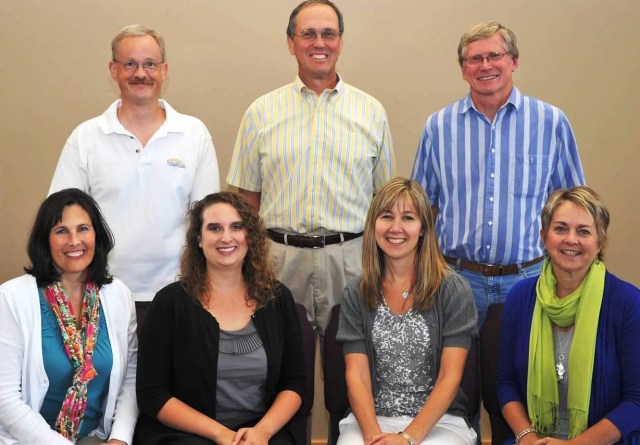
Staff photo

Back row: Brad Kolstad, John Keller, Larry Fredin; Front row: Betsy Hickey, Hannah Koehler, Sue Guck, Sarah Storvick. Missing: Diana Cammack and Becky Bennett

I am so thankful for the staff with whom I work. Like most church staff, they are not doing it for the “big bucks” (no one goes into non-profit work for huge salaries) but they feel called and honored to serve among God’s people at Resurrection. They know that much of their work will not be recognized or thanked, but still they give and give and give.

For those of you who read this blog and are part of Resurrection, I encourage you to discover specific ways you can say “thank you” to your staff. As pastor I receive many affirmations that rightfully belong to my co-workers. If you are a member of a different congregation, I encourage you as well to give affirmation and encouragement to the staff who serve in whatever congregation you worship. As Paul also wrote, Therefore encourage one another and build up each other, as indeed you are doing (I Thessalonians 5:11).

Lord Jesus, thank you for those who labor for the sake of your kingdom.

Streaks

This past Thanksgiving I started my first running streak. It came from a challenge at Runner’s World. The goal of the streak was to run at least a mile every day between Thanksgiving and New Years. I normally run 3-5 days a week, giving my body plenty of time to rest and recover from any muscle damage during runs. Since my marathon in October, my running has been rather sporadic, lacking a goal or passion. So I decided to embrace a new challenge.

The key for me was to keep my normal rest days easy, just a slow-pace mile or two. I wear a heart rate monitor so it was easy to check my pulse and see if I was pushing too hard. I have discovered that doing an easy mile was both relaxing and a great way to start the day.

Yaktrax RunnersI added to the challenge by making every run an outdoor run. Treadmills and indoor tracks have their place, but I wanted fresh air. This became more challenging when our first Minnesota snow fell in mid-December. Fortunately I had a pair of Yaktrax that gave me good footing. Still, for an outdoor run I often took twenty minutes to dress for a ten minute jog.

I did get a short break when I traveled to Austin, Texas, for a memorial service after Christmas. A ten-mile run in warm sunshine and shorts lifted my spirit and confidence.

SA runners 122212 small

Some of my running buddies on Saturday morning.

I am not sure how long the streak will continue into the New Year. My legs are feeling strong and injury free. I have developed a habit that I enjoy and that promotes health. I suspect sometime in the next month a cold or tight schedule will end the streak. I don’t plan to be obsessive about it. I am confident that my running friends will be both encouragers as well as wise advisors.

It has got me wondering about my own spiritual practices. I pray daily, but my devotions have become sporadic and unfocused. The memorial service I attended was at an Episcopal church and it had more liturgy than I normally used. I found the prayers helpful and healing. So I have decided to use a written liturgy to guide my prayers during the month of January. You can see a copy of it here.

Thus, I am committing myself to new streak, a prayer streak.  My first goal is to use the daily liturgical prayer format each morning for the month of January.   Care to join me?

Lord Jesus, thank you for your tender mercies in 2012. Guide me deeper into your love in 2013

Where Do You Find God?

Door of the Duomo (cathedral) in Siena, Italy

A recent post by Opreach asked the question, “Where do you find God?” Many of us might first think of churches and cathedrals, places dedicated to God and utilized as gathering spaces to worship God. Over years these buildings can grow in holy significance as we baptize, confirm, marry and bury members of our family and community inside these structures. Candlelight Christmas Eve worship, Easter celebrations and numerous Sunday gatherings add to their spiritual aura.

But the danger of such concentrated focus on a building is that the building can become a box in which to contain or limit God. One must go to church to meet God. Sure, we may believe that God is not limited to the building, but our behavior and practice seems to limit our interaction with God to such spaces. How many of us have other places and practices for prayer, scripture reading or meditation? Do we behave as if God is with us wherever we go?

Tomorrow I will be preaching on King David’s desire to build God a temple.

The king said to the prophet Nathan, “See now, I am living in a house of cedar, but the ark of God stays in a tent” (2 Samuel 7:2).

Prior to David, God’s presence had been linked to the tent of meeting, first used by Moses and the Israelites when they wandered in the desert for 40 years.  Now at David’s request Nathan gives him his blessing to build God a house, but that night the Lord God redirects Nathan,

Go and tell my servant David: Thus says the Lord: Are you the one to build me a house to live in? I have not lived in a house since the day I brought up the people of Israel from Egypt to this day, but I have been moving about in a tent and a tabernacle. Wherever I have moved about among all the people of Israel, did I ever speak a word with any of the tribal leaders of Israel, whom I commanded to shepherd my people Israel, saying, “Why have you not built me a house of cedar?” (2 Samuel 7:4-7)

Friend Dave celebrating as he ran Twin Cities Marathon

The key phrase in the text is “whenever I have moved about among all the people of Israel.” God tells Nathan, David and us that God will not be restricted. God is on the move among us, whether we are running a marathon, buying groceries, finishing a spreadsheet or washing dishes. Is it possible to create behaviors and practices that help us recognize God’s presence in our daily lives?

Lord Jesus, thank you for the safe harbor of my church, but be my pilot as I sail out to sea each day.

Lobby Love

In our men’s Bible Study this morning we were discussing 2 Peter 1:5-7 and the characteristics that support our faith. Peter strings together a long list:

For this very reason, you must make every effort to support your faith with goodness, and goodness with knowledge, and knowledge with self-control, and self-control with endurance, and endurance with godliness, and godliness with mutual affection, and mutual affection with love.

The list moves from faith to love.  The Greek language of the New Testament had several different words for love: phileo, eros, storge, agape. In this list the last two characteristics both center on love: phileo and agape.

Phileo was a more common word for mutual affection.(Philadelphia, city of brotherly love, is named for this virtue). I imagine two friends working side-by-side to accomplish a task. An example might be offensive linemen on a football team, striving together in protect their quarterback. A strong team has a sense of phileo.

Agape was not a word used as much in Greek, prior to the New Testament. When 1 John 4:7 states “God is love,” the Greek word used is agape. C. S. Lewis in his book, The Four Loves, describes agape as Gift-love and is the unique domain of God. For God so loved that he gave, (John 3:16). The other loves (phileo, eros, storge) are Need-loves which are expressions of our human need for affection, friendship and intimacy. Lewis puts priority on agape, but sees the value in all the other loves as well.

After Bible Study I had a brief discussion with one of the men in the church lobby. He shared how he missed being at church last Sunday. I responded, “I bet you missed both what happened in there (pointing to the worship space) as well as what happen here (indicating the church lobby).” He nodded his head.

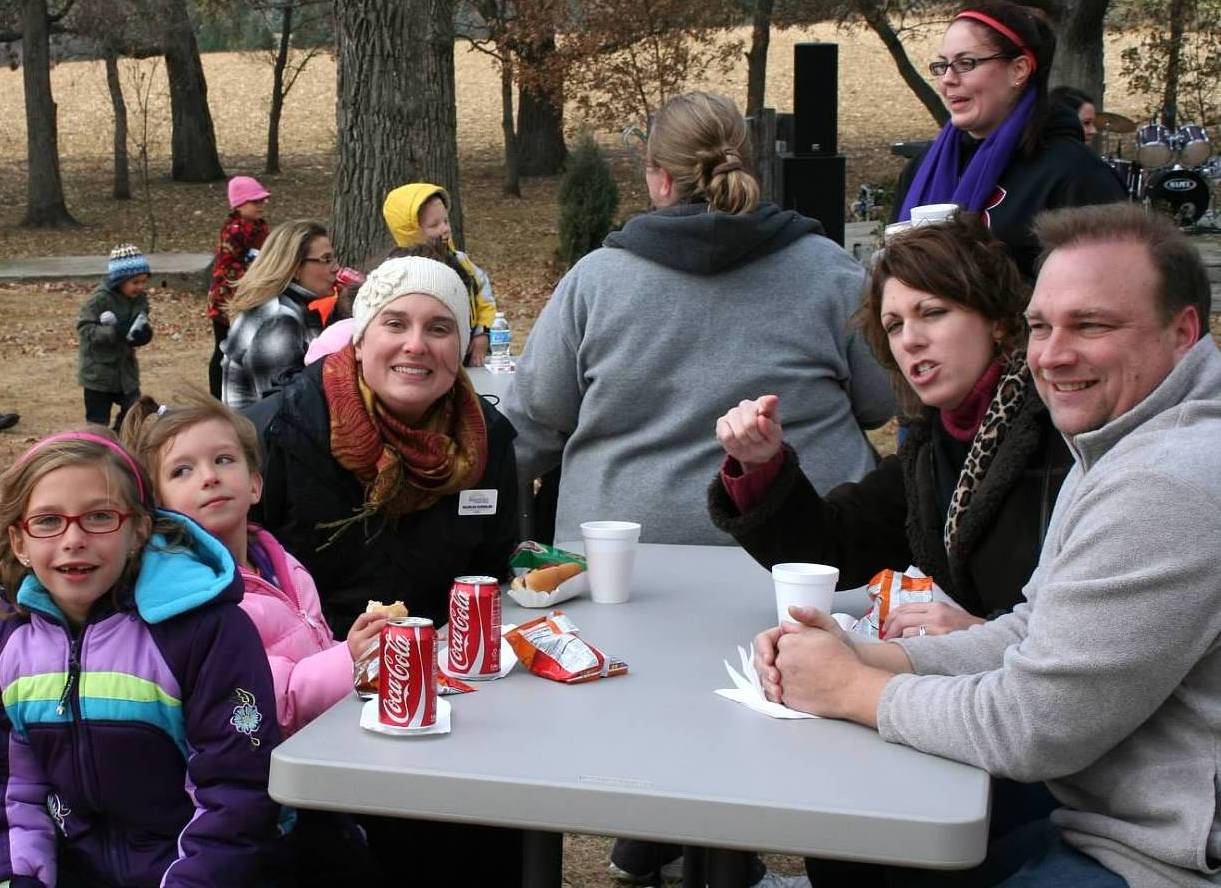
Lobby Love is not restricted to the church lobby but was a key part of our Harvest Festival

I have discovered (somewhat begrudgingly) that what draws many people into the congregation is not simply “great worship,” but also “great fellowship.” The opportunity to visit, talk, converse with friends and family after worship is as significant to them as what happens in the worship service itself. The mutual affection (phileo) is a critical part of Christian faith today. In other words, Lobby Love (phileo) can support Worship Love (agape).

This does not mean that Lobby Love can stand on its own. People would not come for the coffee fellowship alone. Church coffee is not as good as Starbucks. Good worship is a key component to good fellowship. It reminds us once again that we are God’s children, cherished by God and that reminder flows into the lobby after worship. We may not speak directly about the Bible text we read that morning, but our kindness towards one another can be a reflection of the loving kindness experienced in worship.

How vital is mutual affection to your faith and love?

Lord Jesus, guide me into deeper fellowship with my brothers and sisters

Praying the Lord’s Prayer (Part One)

Jesus instructed his disciples to pray. He modeled a life of prayer, taking time to pray early in the morning (Mark 1:35). After a time of prayer, his disciples asked him to teach them to pray and he taught them the familiar words of the Lord’s Prayer, “Our Father who art in heaven. . .”

I grew up in a traditional Lutheran home and memorized the familiar words of the prayer at a young age. My confirmation instructor, Pastor Crawford, unpacked the meaning of each petition. I learned about God’s kingdom, daily bread, forgiving trespasses and deliverance from evil. Every Sunday during worship, the congregation would recite the familiar words that seemed to become stronger as we finished, “For thine is the kingdom, and the power, and the glory forever and ever. AMEN!”

The traditional words and phrases stayed with me into adulthood. I found great comfort with it, but I also noticed that I often recited the prayer rather than consciously praying it. I would catch my mind starting to drift and realized that though my lips were saying the sacred words, my heart was not in synch. Partly it was the speed at which we “prayed” it, partly it was my own inattentiveness.

In seminary I was introduced to some of the newer translations of the prayer. The replacement of “thy” and “thine” with “your,” made perfect sense to me. Prayer need not be some formal exercise of old language. Prayer is conversation with God.  At the same time I knew that switching to the new language/translation would be very difficult. The Lord’s Prayer was deeply imprinted in our minds and souls, a kind of rock in the chaotic sea of spirituality.

My first twenty-five years of ministry was in a congregation whose worship stripped away several liturgical practices of traditional Lutheran worship: the Kyrie, the Great Thanksgiving, but we continued to use the traditional wording of the Lord’s Prayer. Intellectually I believed that someday the words would need to change, but emotionally I liked being able to guide a family at a graveside service in praying the familiar words, “Our Father who art in heaven. . .”

When I came to Resurrection I immediately discovered that in worship, the congregation had embraced the new translation, “Our Father in heaven, hallowed be your name.”  I embraced the change intellectually, but found myself stumbling over the new wording as my heart and soul tried to catch up. The deep imprint of memorization would not quickly adapt.

Now two years later, I can recite the words without too much difficulty, but I also discovered something else. I sense that I am more often “praying” the prayer, truly connecting with the words. I am more conscious that I am asking God to save me from the time of trial and to protect me from the evil one. The bumpy transition and the new translation has pushed me out of my rut into a deeper appreciation of what Jesus is teaching us.

Lord Jesus, teach us to pray.