Category Archives: story

Do Pets Go to Heaven?

Like many pastors, I have members ask me questions about God and Jesus, heaven and hell. I don’t always have an answer, but I try to help the person reflect on God’s grace and love as reflected in scripture.

long-coated-german-shepherd-maleThe question whether our pets will be in heaven is one such question. The Bible and Christian tradition gives no explicit answer. Revelation 21 describes a new heaven and new earth, but no reference to pets. My basic answer is that God loves you and if God determines that you need your pet in heaven then God will provide. But the promise of heaven revolves around God and not our pets.

Dietrich BonhoefferDietrich Bonhoeffer had an intriguing pastoral conversation when he was a newly ordained pastor serving a small German congregation in Barcelona, Spain. He writes about it in a letter to his brother-in-law.

At 11:00am there was a knock at my door and a ten-year-old boy came into my room. I noticed that something was amiss with the boy, who is usually cheerfulness personified. And soon it came out: He broke down into tear, completely beside himself, and I could hear only the words, “Herr Wolf ist tot” [Mr. Wolf is dead], and then he cried and cried. As it turns out, Herr Wolf is a young German shepherd dog that was sick for eight days and had just died a half-hour ago. So the boy, inconsolable, sat down on my knee and could hardly regain his composure; he told me how the dog died and how everything is lost now. What could I say? So he talked to me about it for quite a while. Then suddenly his wrenching crying became very quiet and he said, “But I know he’s not dead at all.” “What do you mean?” “His spirit is now in heaven, where it is happy. Once in class a boy asked the religion teacher what heaven was like, and she said she had not been there yet; but tell me now, will I see Herr Wolf again?”

So there I stood and was supposed to answer him yes or no. If I said, “no, we don’t know” that would have meant “no” . . . . . So I quickly made up my mind and said to him. “Look, God created human beings and also animals, and I’m sure he loves animals. And I believe that with God it is such that all who loved each other on earth—genuinely loved each other—will remain together with God, for to love is part of God. Just how that happens, though, we admittedly don’t know.”

You should have seen the happy face on this boy; he completely stopped crying. . . he was ecstatic. I repeated to him a couple of times that we don’t really know how this happens. He, however, knew, and knew it quite definitely in thought. . . . And there I stood— I who was supposed to “know the answer”— feeling quite small next to him; and I cannot forget the confident expression he had on his face when he left. (Bonhoeffer, Pastor, Martyr, Prophet, Spy by Eric Metaxas. p.87)

I take comfort that even Bonhoeffer struggled to answer this pastoral question. I also am thankful he landed on God’s love as the best answer for a boy in pain.

What do you think about the question, “Do Pets Go To Heaven?”

Lord Jesus, thank you for the love you lavish upon us in so many ways.

Lost and Found at World’s Fair

Fifty years ago this summer my family visited the World’s Fair in Seattle. We camped on Bainbridge Island and took the ferry to Seattle.  The Space Needle was brand new and there were many world exhibits. The crowds were large so my father had cautioned my brothers and sisters to stay close as we walked the fair grounds. If they did get separated, our rendezvous place was a magnificent fountain in the center of the fair.

I knew that I would not get lost. I prided myself on being able to read the fair map and to direct our family to each stop along the way. Everything went smoothly until one afternoon. As our family walked toward the Science Pavilion, I looked to my left to see may family walking along beside me. “Yep, still where they should be.”

Then it happened. I looked up to my left and my parents were gone! My brothers were gone.  Even my sisters were gone. They all were not where they should be. My family was LOST! Before I had a chance to rescue them, a vendor saw my confusion and whisked me away. How was I going to find my family with a big security guard taking me to some hidden place?

As he pulled me along, I came to the stark realization that I would never see my family again. Among the millions of people at the World’s Fair, how could we find each other? I was now an orphan. My family was probably already on the ferry to Bainbridge Island. The security guard took me to a room for “lost children.” I gave up all hope and began to wail. I was certain that I would never see my family again.

I don’t know how long I remained in the room, but I was both surprised and relieved when my father walked into the room. I was found.  I later learned that my father had first gone to the fountain, but then discovered that the fair had a video feed into the “lost children” room.  He spot his wayward son and quickly came to my rescue.

Jesus said, “Which one of you, having a hundred sheep and losing one of them, does not leave the ninety-nine in the wilderness and go after the one that is lost until he finds it? When he has found it, he lays it on his shoulders and rejoices. And when he comes home, he calls together his friends and neighbors, saying to them, “Rejoice with me, for I have found my sheep that was lost.” Luke 15.

Lord Jesus, seek and save me once again.

Snow Making Machine

Yesterday I realized that I have a “regional snow making device.” As I was taking down the heated roof cable from my roof, I thought,

The past fifteen years I have placed this cable on my roof and each year we have had minimal amount of snow, except last winter. The winter of 2010-2011 we had lots of snow, and for several reason, I did not put up the roof cable that winter.

If I take the time and effort to put it up, we receive minimum snow. If I do not put it up, we receive lots of snow. So obviously, my roof cable MUST be the cause of minimal or maximal snow fall.

I realize this is crazy thinking, a kind of magical thinking, but many of us practice it. We have lucky shoes for races, or lucky golf club, or favorite fishing shirts. At the root of such thinking is the desire to have some control over things that are beyond our control. Whether it is the amount of snow that falls, or the fish we catch, we wish to have influence and power.

Naturally there are things we can control. If I become a practiced fisherman, I can learn where and when to fish a particular lake, what bait to use, what depth to try. Still the elusive walleye will not be magically summoned by the shirt or hat I wear.

Yet many things remain far outside my control. As I wrapped up my roof heater coil, I enjoyed the gift of sunshine on my back and the budding trees. I do not control the weather, but I know the one who does and trust in God’s mercy and kindness. I know that God sends the rain for all humanity to enjoy. As Paul preached to the non-Christians at Lystra,

God has not left himself without a witness in doing good—giving you rains from heaven and fruitful seasons, and filling you with food and your hearts with joy (Acts 14:17).

Still, as I packed the roof cable away I wondered, “Would any of my friends who love cross-country skiing and snowshoeing be willing to make a donation to Resurrection Lutheran so that I would not put up my roof cable next fall.” Just wondering.

Lord Jesus, thank you for the gift of this day and its myriad of blessings. I trust you to be Lord.

Walk by faith or by sight?

Women Arriving at the Tomb by He Qi

The glory of Easter worship still rings in my ears and heart. The Gospel of Mark’s bold message announced to the women and to us, “You are looking for Jesus of Nazareth, who was crucified. He has been raised” (Mark 16:6). The resurrection is what sets Christ apart from all other prophets and religious teachers. It is central to our Christian faith, yet seems so beyond our personal experience.

Perhaps that is one of the reason so many people become uncomfortable with how Mark’s Gospel ends. Reliable scholarship points to the final verse being verse 8:

So they (women) went out and fled from the tomb, for terror and amazement had seized them; and they said nothing to anyone, for they were afraid.

The gospel writer provides both the empty tomb and the young man’s witness that Jesus is raised and believes that is sufficient for the reader. This seems inadequate and unsettling at first. Where are the appearances of the risen Jesus as described by Paul (I Corinthians 15) or Matthew (28:16-20) or Luke (24:13-53) or John (20-21)? Where are the final instructions from Jesus to his disciples? Verse eight has an unfinished feel to it. In fact, early in the church’s history, additional endings were added to Mark to give a more “comfortable” and “respectable” ending.

As I preached on this yesterday, I think Mark’s ending makes sense at verse eight, if we see it as the challenge to us and our faith that it is. The writer wants us to wrestle with the message of resurrection and the promise that he is going ahead of us.  Stories of Jesus’ appearances may give some comfort but none of us have actually seen the resurrected Jesus. We have only the written reports of the Gospels, such as the young man at the tomb. Ultimately we will have to judge the validity of the witnesses. Paul makes this case in I Corinthians 15.

I continue to think that the most valid testimony of Christ’s resurrection is the transformed lives of his followers. They had trusted him to be the Messiah, but he had been crucified. Their hope was crushed that day. The were like the frightened women, tongued-tied.  Only the actual resurrection of Jesus could have changed them from frightened ex-followers into courageous ambassadors of Jesus. And I have seen such transformation in people’s lives today as they trust in Christ.

The end of Mark’s gospel pushes the reader to trust in the message of the young man.

It is only fitting that just at the tomb will not contain Jesus, neither can Mark’s story. Jesus is not bound by its ending; he continues into the future God has in store for the creation. In the meantime there is only the Word, the bread, and the wine, and the promise that “you will see him.” We walk by faith and not by sight. We can only trust that God will one day finish the story, as God has promised. (Donald Juel, Mark, Augsburg Commentary on the New Testament. p. 235.)

Lord Jesus, help me to walk by faith and not by my own narrow vision.

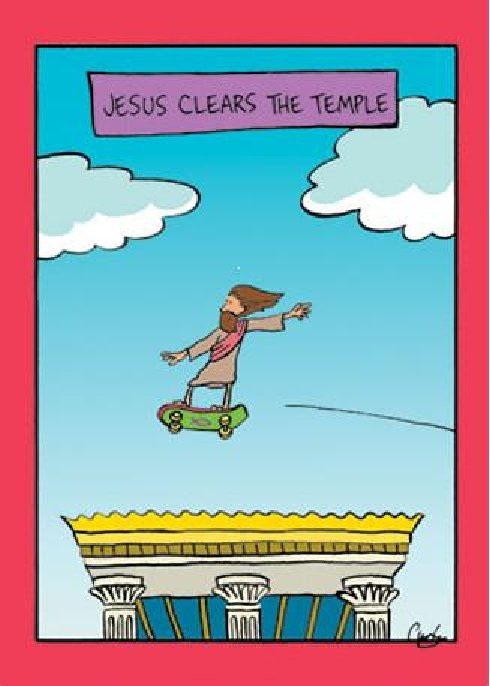
Jesus Clears the Temple

A member of Resurrection sent me this cartoon today: “Jesus clears the temple.”* The cartoon got me thinking about the story in Jesus’ ministry (Mark 11:15-18). For many of us, the fact that Jesus cleared the temple of money changers is not significant or  meaningful. We don’t realize how upsetting and radical  Jesus’ action was for the ruling religious council in Jerusalem. We often see Jesus’ angry expression as some sort of deviation from the nice, kind Jesus we adore.  It was sort of “bizarre,” like someone “clearing” the temple on a skateboard.

But the Temple Cleansing was central piece of his Messianic vocation.  N. T. Wright helps to clarify this from the historical perspective of first century Judaism (the full essay is here):

Jesus believed he was Israel’s messiah, the one through whom God would restore the fortunes of his people. . . .  Anyone doing and saying what Jesus did and said must have faced the question “Will I be the one through whom the liberation will come?” All of the evidence—not least the Temple-action and the title on the cross—suggests that Jesus answered, “Yes.”

Second, Jesus’ radical and counter-cultural agenda, subverting both the political status quo and the movements of violent revolution, was focused in his awareness, of vocation.  John the Baptist re-enacted the Exodus in the wilderness; Jesus would do so in Jerusalem. Jesus’ gospel message constantly invokes Isaiah 40-55, in which God returns to Zion (Jerusalem), defeats Babylon, and liberates Israel from her exile. At the heart of that great passage there stands a job description. This would be the victory over evil; this would be the redefined messianic task. Jesus had warned that Israel’s national ideology, focused then upon the revolutionary movements, would lead to ruthless Roman suppression; as Israel’s representative he deliberately went to the place where that suppression found its symbolic focus. He drew his counter-Temple movement to a climax in Passover week, believing that as he went to his death Israel’s God was doing for Israel (and hence for the world) what Israel as a whole could not do.

Third, Jesus believed something else, I submit, that makes sense (albeit radical and shocking sense) within precisely that cultural, political, and theological setting of which I have been speaking. Jesus evoked, as the overtones of his own work, symbols that spoke of Israel’s God present with God’s people. He acted and spoke as if he were in some way a one-man, counter-Temple movement. He acted and spoke as if he were gathering and defining Israel at this eschatological moment—the job normally associated with Torah. He acted and spoke as the spokesperson of Wisdom. Temple, Torah, and Wisdom, however, were powerful symbols of central Jewish belief: that the transcendent creator and covenant God would dwell within Israel and order Israel’s life. Jesus used precisely those symbols as models for his own work. In particular, he not only told stories whose natural meaning was that YHWH (God) was returning to Zion, but he acted—dramatically and symbolically—as if it were his vocation to embody that event in himself.

Jesus saw himself as the means of salvation, no longer the Temple as the means. He became the sacrifice for our sins. He cleansed not only the Temple, but our hearts so that God can live in us. Amen.

Lord Jesus, continue to cleanse us.

*The cartoon is by Cuyler Black and you can find more of his cartoons here

He is Dangerous!

Thirty years ago I was asked to perform in a production of Jesus Christ Superstar. I was type-casted, not as Jesus, but as one of the priests who plotted to have Jesus executed. I and the other priests were place on a scaffold above the stage, looking down with condemnation on Jesus and his disciples as they entered Jerusalem. Like the movie, we sang “This Jesus Must Die.” The refrain in the Weber and Rice song still rings in my head, “He is dangerous.”

The 1973 movie captured the mood of this scene.

The high priests and Pharisees called a meeting of the Jewish ruling body. “What do we do now?” they asked. “This man keeps on doing things, creating God-signs. If we let him go on, pretty soon everyone will be believing in him and the Romans will come and remove what little power and privilege we still have.” Then one of them – it was Caiaphas, the designated Chief Priest that year – spoke up, “Don’t you know anything? Can’t you see that it’s to our advantage that one man dies for the people rather than the whole nation be destroyed?” He didn’t say this of his own accord, but as Chief Priest that year he unwittingly prophesied that Jesus was about to die sacrificially for the nation. (John 12:47-51)

Jesus continues to be dangerous, even though people have tried to domesticate and soften the image of Jesus over the centuries. He is not some quaint moral teacher who loved children and stray cats. He was the Son of God who came to challenge our self-righteous lives and to call us into a transformed way of life.

I fear that society has made Jesus meek and mild and that we have forgotten how dangerous he truly is. It is deadly to follow Jesus. Like Bonhoeffer wrote in The Cost of Discipleship, ““When Christ calls a man, he bids him come and die.”

Are you willing to die with Jesus?

Lord Jesus, call me out of my complacent tomb into the Vibrant Life of Faith.

Enter the Holy Week Story

Stories shape our lives. The story of our family, our nation and our world gives meaning to our lives. My own story of being raised in western Washington, going east to college and then coming to Minnesota for seminary shaped my life. The simple story of how we met our spouse or how we chose our career has profound implications on our life. Do we simply drift along from one day to the next, or are we active participants?

Triumphant Entry into Jerusalem by artist He Qi

As followers of Jesus Christ, we are molded by the story of Jesus, especially his last days. As we prepare to enter Holy Week, we have an opportunity to walk with Jesus from Palm Sunday to Easter, to enter his story. We can be with the crowd that cheered his entrance into Jerusalem, shouting our praise to our king. We can ask ourselves, “How do I allow Jesus to be ruler in my life? Am I simply following the crowd? Or do I fully seek to follow Jesus this week?”

On Maundy Thursday, we can enter the upper room with Jesus and watch him humbly wash the feet of his disciples. Are we willing to be servants like him? We can share in his meal of Holy Communion, remembering his steadfast, nurturing love for us. We can walk with him to the Garden of Gethsemane and pray with him as he seeks the Father’s strength and courage for his coming suffering. Will we stay close to him, when all the other disciples run away?

On Good Friday, we can stay in the crowd as they shout to Pilate, “Crucify Him! Crucify Him!” Do we hear our own voices mingled in the crowd? As the soldiers nail him to the tree, do we hear his words, “Father, forgive them, for they know not what they do,” and wonder if he is speaking to us? As he dies, do we feel the sorrow of Mary, his mother? Does something in us die as he is laid in the tomb?

Such a walk through the story of Holy Week prepares us for the ultimate story of Jesus’ resurrection on Easter.

Lord Jesus, keep my life in your story this week.

The Parable of the Lost Door

Simple, wonderful stories happen every day. We just need to keep our eyes and ears open.

For over a year Resurrection Lutheran Church has been missing a door from a cabinet in our conference room. The small room had functioned as an office for a time with the previous pastor. He asked to have the cabinet doors removed so that the open shelves could function as bookshelves. When I was called as pastor, we determined that the “office” should be a conference room once again and the cabinet doors restored.

Our energetic Property Image Team (PIT crew) took up the challenge to re-install the cabinet doors soon after I arrived. The doors had all been stored in the storage room and were easy to re-installed. However one of the eight doors was missing. The PIT crew looked everywhere for the missing door, then the staff and family members turned offices and homes inside out, searching for the missing door. A few of the PIT crew thought it might have been “used” in some church project, but no one could remember. The door remained missing for over a year.

The conference room had a slightly “unfinished” look due to the missing door. Ministry and meetings continued to flourish in spite of the absent door, but still the room did not feel right. Our office coordinator, Sue Guck, continued to remind the PIT crew of this “blemish” and finally they agreed to create a new door.

The congregation has several talented woodworkers, but they all seemed busy with various projects of their own. Barry Van Ornum agreed to take on the task, but wanted to see if any other woodworkers in the congregation could assist him. Someone on the PIT crew remembered a member who had crafted a Bible stand for our worship center several years ago, so Barry decided to contact him. As Barry explained the project, the member interrupted him.

“You know, Pastor Ted was a stickler on details and he wanted me to make sure the Bible stand was stained to the proper color. He went into the storage room and picked up a small board for me to match. Is it possible that I might have the missing cabinet door in my garage?”

Barry Van Ornum

Within three days, Barry Van Ornum had the missing cabinet door and it is now back in the conference room. The unfinished project is now complete.

The PIT crew and staff also have a deeper appreciation of Jesus’ Parable of the Lost Coin.

“Or imagine a woman who has ten coins and loses one. Won’t she light a lamp and scour the house, looking in every nook and cranny until she finds it?  And when she finds it you can be sure she’ll call her friends and neighbors: ‘Celebrate with me! I found my lost coin!’  Count on it – that’s the kind of party God’s angels throw every time one lost soul turns to God.” (Luke 15:8-10 The Messsage).

Anyone want to join us for a party in the “restored” conference room after Easter?

Lord Jesus, thank you for seeking us out even when we are lost or forgotten.

Hunger Games and Compassion

Several youth and adults recommended Hunger Games by Suzanne Collins for me to read. Since the movie version is coming out later this month, I downloaded it to my Droid and read it yesterday. Though it has a disturbing theme, the story kept me “flicking” pages. In a postapocalyptic future, a ruling class keeps tight control over its outlying resource districts by holding a televised survival competition. Twenty-four youth between the ages of 12 and 18 are selected from the twelve districts to enter the Hunger Games, which are a fight to the death.

The story is a classic “haves” versus the “have-nots”; the empire versus the colonies; the ruling elite versus the struggling masses. In this fictional future, the districts struggle to have enough food and other resources, while the Capital has superfluous abundance. Food plays a role through-out the book with many descriptions of meals. For example, “The stew’s made with tender chunks of lamb and dried plums today. Perfect on the bed of wild rice.” The lamb stew becomes a symbol of the Capital and it capricious ways, giving gifts when it chooses to the districts’ young competitors.

There is no religious or spiritual component in this fictional world. God is not even mentioned in the book. Yet two Christian themes stand out. One is compassion for the neighbor. Katniss, the narrator, remembers being given two loaves of bread by a baker’s son, Peeta, when her family is near starvation. This incident becomes a major subtheme. I can’t help but be reminded of Jesus’ declaration, “I was hungry and you fed me, thirsty and you gave me something to drink” (Matthew 25:35). Katniss and Peeta both practice compassion at times and seek to do good, yet I wonder where is the source of their compassion in a world that knows so little of it.

The other Christian theme is that of sacrifice. Katniss “volunteers” for the Games when her younger sister’s name is drawn as the “tribute.” Katniss sacrifices her security to save her sister from almost certain death. Jesus speaks of this the night before his crucifixion, “Not one has greater love that this, to lay down one’s life for one’s friends” (John 15:13).

In such an evil and corrupt world as Hunger Games, it makes me wonder where Katniss finds the courage and power to be compassionate.  If it is a natural human quality, why is there so little of it elsewhere in the book? I continue to believe the ultimate source of all compassion and love is God, for we are created in God’s image. Jesus said, “Do not work for the food that perishes, but for the food that endures to eternal life . . . I am the bread of life. Whoever comes to me will never be hungry, and whoever believes in me will never be thirsty”( John 6:27,35.)

Heavenly Father, give us today our daily bread, which is you.

Adam versus Jesus

If death got the upper hand through one man’s wrongdoing, can you imagine the breathtaking recovery life makes, sovereign life, in those who grasp with both hands this wildly extravagant life-gift, this grand setting-everything-right, that the one man Jesus Christ provides?  (Romans 5:17.The Message)

The story of Adam and Eve is central to the Christian’s understanding of the world and humanity’s place in it. In Genesis chapter two and three, God creates man (Hebrew: Adam) from the dust of the earth (Hebrew: Adama). He places Adam and later Eve, in a garden called Eden to till and keep it. They are given great freedom, with one rule to remind them of their dependence on God, their creator: do not eat from the tree of the knowledge of good and evil.

All goes well until the serpent talks Eve into the fatal bite. Adam joins her in the rebellion against God. When God comes to visit, they hide, ashamed of their nakedness. God give them the opportunity to confess but in turn they blame another. Adam blames Eve. Eve blames the serpent. God casts them out of the garden as the consequence of their rebellion.

The story is way for humans to talk about our in-born tendency to rebel against God. We want to run things our way, to be in charge of our destiny. We all trespass against God’s rule. As Paul write in Romans 5, one man’s trespass shows us the reality of sin and death in each of us.

But humanity’s rebellion is not the end of the story, but rather the beginning. God immediately begins a rescue mission. In Genesis 3:21 God provides garments for Adam and Eve from the skins of animals. Death provides protection to humans, a foreshadowing of the cross.

The rescue is completed in the death and resurrection of Jesus Christ. If death can come through one man, then surely new life can come through one man, Jesus Christ, the son of God. Jesus is so much greater than Adam or you or I. Jesus Christ lavishly dispenses the free gift of God’s mercy and grace. New Vibrant Life flows forth from the cross of Christ. We are sinners, but we are REDEEMED and FORGIVEN sinners. We are sons and daughters of muddy earth, yet we are also Princes and Princesses of God’s Kingdom. Let’s rejoice in that reality.

Lord Jesus, let me live as your forgiven child, trusting always in your grace.