Category Archives: story

Impulsive Trust

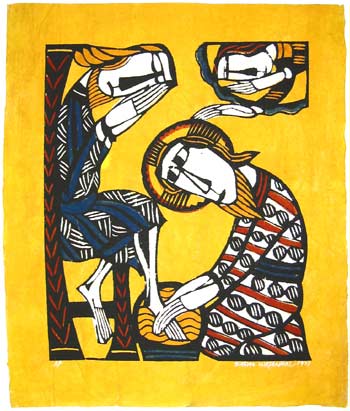
Even after preaching yesterday on Peter’s slippery stroll across the Sea of Galilee, I am still contemplating whether the story paints Peter as a model disciple or a counter-example to avoid.  Certainly Peter’s character of being impulsive is frequently mentioned in the Bible.  For example, when Jesus washed the disciples’ feet, Peter at first refused to have his feet washed, then asked to have his entire body (John 13:6-10).  Pete seemed to speak first and think later.

In the boat, I think Simon Peter blurted out his request without really taking time to think about it.  His mouth was engaged before his brain.  Jesus had given him his nickname of Cephas, which is Aramaic for Petra or Peter, which is the Greek word for “Rock.”  Rocks can be fairly dense and do not usually float.  Peter discovered this when he walked towards Jesus.  His mind caught up with his impulses and he sank.  Still he knew the author of his life, so as he sank like a rock, he called out to the Jesus, “Lord, save me.”   That impulsive cry was the right one, for Jesus lifted him out of the chaos of the sea and into the lifeboat of faith.

Peter’s impulsive behavior is something with which I can identify.  Yesterday, after outdoor worship was finished and people were greeting one another, I impulsively raised my voice and asked all to sing, “Happy Birthday” to my future daughter-in-law, Maggie Thomas, who was visiting.   Only afterwards did I stop to think whether this was something she might appreciate.   I have been known to shout, “Amen!” during a colleague’s sermon or to impulsively drag a confirmation student to help with a lesson.  Sometimes the impulses are great; other times an embarrassment.  

Shortly after his walk on the water, Jesus quizzed the disciples as to his identity.  He asked them first what the word on the street was.  The disciples responded, “Some people think you are John the Baptist returned from the dead, others think you are one of the Old Testament prophets like Jeremiah or Elijah.”  Then Jesus asked, “Who do you think I am?”  Peter responded, “You are the Christ, the Son of the Living God.” (Matt 17:13-16)  There is the model of impulsive trust that I want to follow.

Have you ever experienced an impulsive expression of faith?

Lord Jesus, rule the impulses of our hearts as well as the reflections of our minds.

Walkin’ on Water

Even Kids Like Peter's Walk

Jesus walking on the water is a familiar miracle (Matthew 14, Mark 6 and John 6).   In Matthew’s version not only Jesus walks on the waves, but Peter asks to join him.   Many Christian pastors and authors see Peter’s actions as a Christian model of what discipleship and trust means.  John Ortberg wrote a book called, If You Want to Walk on Water, You’ve Got to Get Out of the Boat.  He writes,

Deep within you lies the same faith and longing that sent Peter walking across the wind-swept Sea of Galilee towards Jesus.  In what ways is the Lord telling you, as he did Peter, “Come”?  Out on the risky water of faith, Jesus is waiting to meet you in ways that will change you forever, deepening your character and your trust in God.

I remember preaching an ordination sermon that basically said the same thing.  I preached about our need to take risks, climb out of our comfort zone and step in the liquid uncertainty of life.  But I am beginning to have second thoughts about that being the sole interpretation of the story. The great thing about scripture is its ability to call forth new insights and wisdom.

After all, Peter sinks beneath the waves and needs to be rescued by Jesus.  Peter is chastised for his doubts, not the disciples who stayed in the boat.   And when Jesus and Peter step into the boat, the wind stops and all is calm.

The ship was an ancient symbol of the church, the community of faith.  At the beginning of the story, Jesus compelled the disciples to enter the boat and head to the other side (Matthew 14:22).   At the end of the story those in the boat worshipped him, saying “Truly you are the Son of God” (Matthew 14:33).   I am beginning to wonder, “Should Peter simply have stayed in the boat?”   What do you think?

Do you think Peter’s actions are a model of discipleship or a distraction from Jesus?

Lord Jesus, thank you that you are always ready to rescue me whenever I begin to slip beneath the waves.

Witnessing to God’s Power

Clif Christopher’s book “Whose Offer Plate is It?” offers challenging insight into what motivates people to give to their local congregation.  In the chapter titled, “Do we really have to compete?”  Clif examines how churches need to consider the competition for people’s charitable giving.   People no longer give automatically to the church.  We are all inundated with opportunities to give to good, meaningful charities and nonprofits.  Clif argues that church member and friends need a convincing case that their money will affect lives in and through their congregation.  He writes,


People need to hear our life-changing stories and be helped to understand how their dollars are creating positive change in the lives of people in ways that other institutions could not do.  If we want to argue that we are a great place for people to feed the hungry, then World Vision or Oxfam will beat us every day because they are experts at feeding the underprivileged.  We, however, are the one place whose mission it is to bring people into the life-changing relationships with Jesus Christ. Share with people how this place helps bring the power of the Holy Spirit into broken and grief-stricken lives.  Point out how those who were without direction came to find direction and a new life through the church.  Compete on that field and you will be chosen.  

WE ARE THE ONE PLACE
whose mission is to bring people
into life-changing relationships with
Jesus Christ.
 

The people in our pew (or chair) are asking “Why should I choose the church over World Vision or Oxfam or Boy Scouts or the university or the hospital?”  We must be prepared on a daily basis to boldly answer the question, and if we cannot easily do it, then we must get busy changing our church. 

I am thankful that Resurrection has such stories of personal transformation.  We need to discover ways to share these stories with the wider community.

Jesus said, “You shall be my witnesses” Acts 1:8.

Do you have a story that bears witness to Jesus’ power and love

Lord Jesus, thank you for my congregation that bears witness to your grace and mercy. 

Asleep on a Cushion

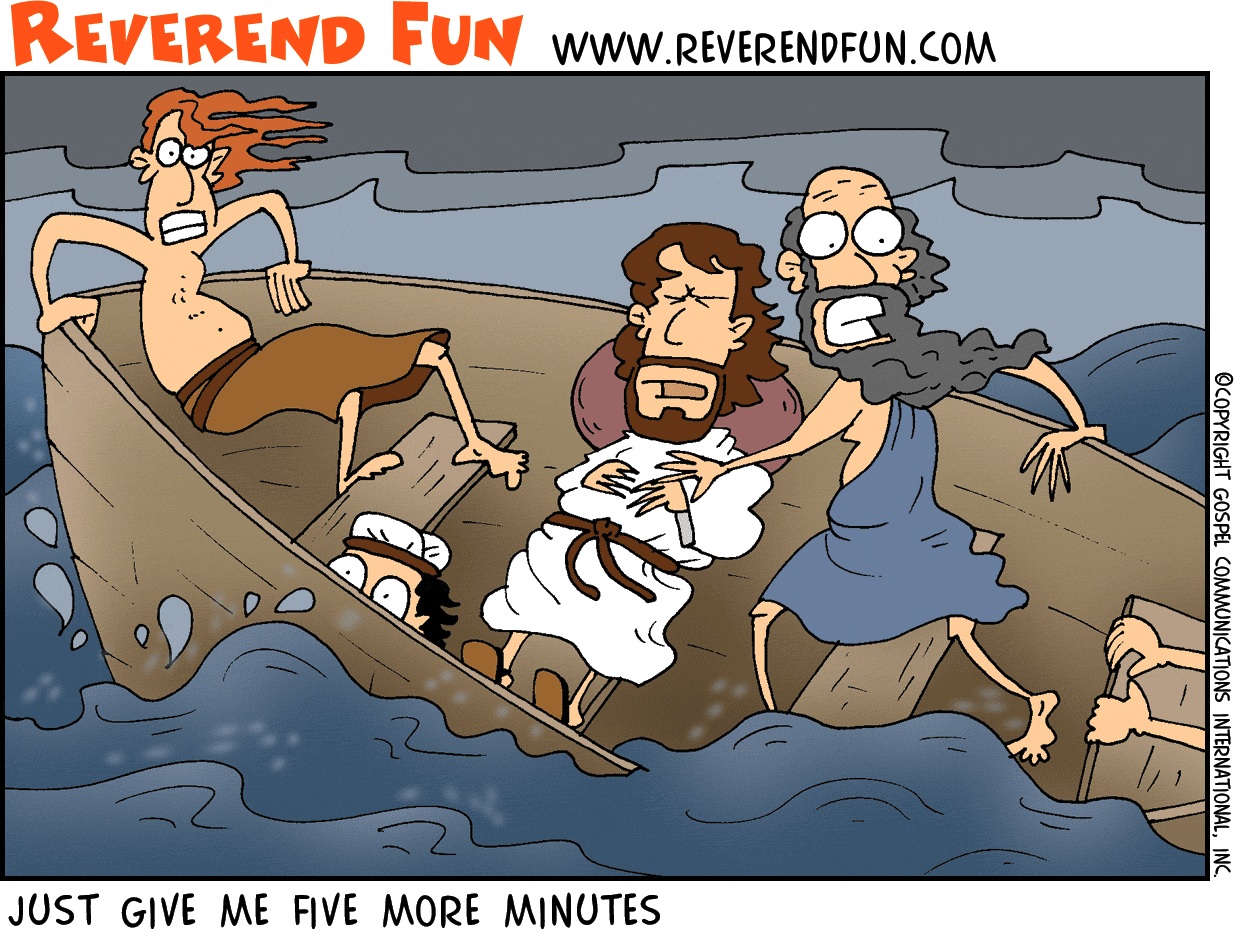
Details in Bible stories can fun as well as insightful.  This Sunday I am preaching on Mark 4:35-41, Jesus calms a storm.  The detail that catches my eye is in verse 38. As the storm reaches a climax and begins to swamp the boat, Jesus remains asleep on a cushion in the stern of the boat. As I read this I wondered, Where did the cushion come from?  Did Galilean fishing boats carry them as standard equipment?  Or did a disciple pack a  travel pillow and loan it to Jesus?

On a more serious note is the fact that Jesus is asleep at this critical moment in the storm.  Was this a sign of his confidence in God’s care?  Or a reminder of his humanity and need for sleep? Or was he simply trusting Peter and the others to do their job as fishermen?

A core question that the story stirs in me is, “Jesus, shouldn’t you be awake so you can stir the boat around the storm?”  The ship was a Christian symbol of the church: the people of God as the ship’s crew and Jesus as our captain who guides our voyage.  And do not Christians often pray for such direction?  Do we not ask for God’s protection and guidance so that we do not have a storm to face or a crisis of faith to endure?  Whether the storm is an external crisis, like a death or financial loss, or an internal crisis, such as a broken relationship or sudden illness, do we not sometimes think Jesus could have prevented the “storm” from striking us?

Such questions can help us see the truth of the story for us, because Jesus does still the storm and then confronts the disciples regarding their lack of faith.  A storm or crisis often reveals our shallow trust and our need for Jesus as our savior. When my daughter faced open-heart surgery as an infant, I know that my prayers took on a new depth and clarity.   Without the crisis we would not call out for God’s help and then bear witness to God’s transforming power.  Jesus may be asleep for us, because we have not called out to him from the depths of our souls and asked him to transform our lives.

In what ways is Jesus’ power awake or asleep in your life?

Jesus, awaken me to the power of your love.

Surprise Ending or Not?

Feeding of the 500 by artist Justino Magalona

About five thousand were fed. As soon as the meal was finished, Jesus insisted that the disciples get in the boat and go on ahead to the other side while he dismissed the people. Matthew 14:21-22

The surprise finish to the feeding of the five thousand story is how the crowd reacted.  Or more accurately did not react.  After most miracles the crowd or disciples or religious officials reacted verbally to what they have seen. For example in Matthew 12 when Jesus healed a blind and mute man two reactions came forth:

 All the crowds were amazed and said, “Can this be the Son of David?” But when the Pharisees heard it, they said, “It is only by Beelzebul, the ruler of the demons, that this fellow casts out the demons.”  Matthew 12:23-24.

 Yet there is no exclamation after feeding five thousand.  Is this because the disciples did the work of distributing the loaves and fishes and the people didn’t recognize Jesus’ participation?  Or is it because they didn’t see the wonder, assuming the disciples simply had access to lots of food? Or is bread and fish something that people just took for granted?

 I don’t know the answer, but it creates in me the desire to be more grateful for the food I eat and to look for opportunities to help feed others.  This Wednesday at noon  a group of us are going to help pack food for Feed My Starving Children in Eagan, MN.  And the Evangelical Lutheran Church in America recently sent me an e-mail regarding the famine in the Horn of Africa.  Jesus still needs our hands and dollars to feed our hungry neighbor. 

 Maybe that is why there is no reaction; the story is not finished.  Only when all the people are feed will we stand in amazement at what God has done through his people.

 Lord Jesus, there are still hungry people in our world.  May you use my loaves and gifts, my dollars and cents, to feed those who need help.  And teach me the art of being grateful and gracious with the bountiful food you have given me.

Will it be Platter or Basket?

So often we read short sections of the Bible and thereby miss some of the obvious connections between the sections.  For example, I am preparing to preach on Matthew 14:13-21 in which Jesus feeds five thousand.   The story is in all four Gospels and is quite familiar to many Jesus followers.  What I had not really noticed before is the connection to the story prior to it in which John the Baptist is beheaded by King Herod (Matthew 14: 1-12).

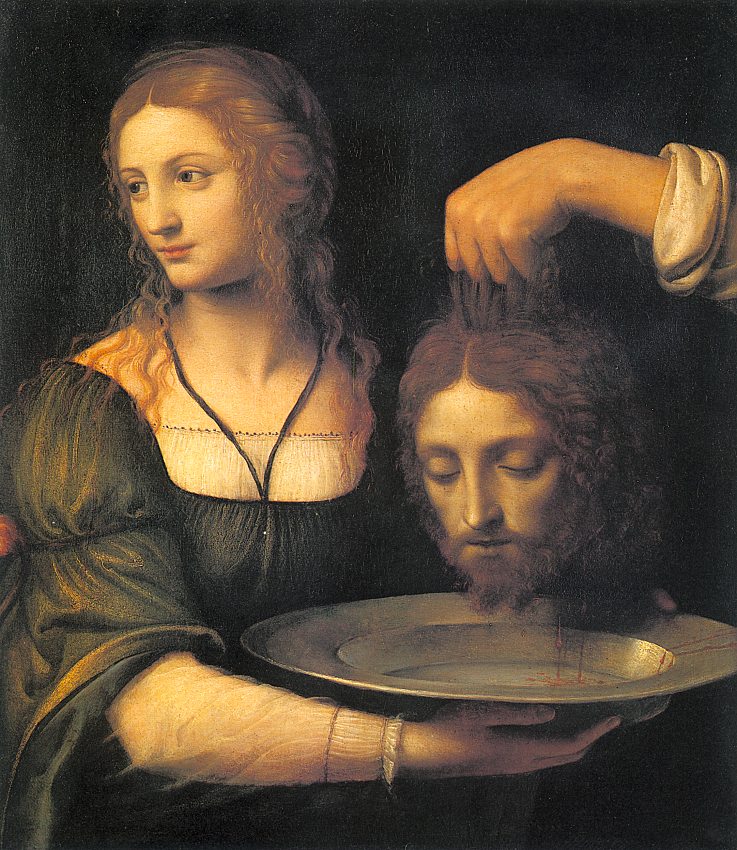
"Salome asks for St. Johns' Head" by artist Bernardino Luini, 1510

John had ticked off King Herod when John confronted Herod’s of sin of marrying his brother’s wife, Herodias.  Herod had tried to spare John’s life while he was a “guest” in his prison. But when Herod held a huge birthday bash for himself, Herodias’ dancing daughter coerced the king into serving John’s head on a dining room platter.  How appetizing was that?  The lavish birthday party ends in blood and death.

Then we shift scenes to Jesus and his surprise party.   Instead of a palace feast, it is a deserted lake shore and the only dancing comes when the disciples try to find food for the crowd.  What started as an impromptu healing service turns into a glorious feast with food for all.  “And all ate and were filled” (Matthew 14:20). 

The Basket of Bread by Salvador Dali 1929

Twelve baskets of leftovers for the guests to carry home!  What a sharp contrast to Pilate’s party that ended with a burial and an empty platter.

Yet my guess is, if you or I had received an invitation to attend either the Celebrity Birthday Banquet or the uncertain camp out, we would have chosen the Banquet.   It is only with hind sight that we discover where the real party breaks out.  

How do we, as followers of Jesus, prepare the way for Jesus’ Spirit to break out in a fresh way among us?  How do we take what we have and fill the hungry with good things? Do we expect God’s miracles to be at work among us?

Lord Jesus, show us how to feast with you daily while feeding the hungry around us.

Jonah the Gardener

Pure speculation but I think Jonah was a gardener prior to his call as a prophet. 

"Sower with Setting Sun" by Vincent Van Gogh, 1888

How else can the reader understand his roller coaster of emotions in chapter four?  When God is merciful and does not punish Nineveh, Jonah plunges into despair and wants to die.   He pouts outside the city.  God causes a “bush” to grow up rapidly.  Its shade provides Jonah comfort; “so Jonah was very happy about the bush” (v.7).  The next day God sends a tiny worm to attack the bush so that it withered.   Without the bush, the hot sun and sultry east wind hit Jonah so that he wants to die (v.8).  Jonah’s passion for a plant reminds me of a gardener’s deep identity with her garden.

Castor Bean Plant

Scholars speculate as to what kind of bush it was.   The Hebrew word here is qiqayon which is used nowhere else in the Bible.   Some think it was castor bean plant which can grow very quickly, up to ten feet in a few months (but not overnight, which is God’s doing in the story). Whatever kind it was, Jonah immediately sees its value.  He has it for a day and then it is gone.

After the bush dies, God confronts Jonah again, “Is it right for you to be angry about the bush?”Clearly Jonah valued the bush and its comfort and he makes the judgment that he is angry enough to die.  God challenges Jonah’s perspective and judgment.

God said, “What’s this? How is it that you can change your feelings from pleasure to anger overnight about a mere shade tree that you did nothing to get? You neither planted nor watered it. It grew up one night and died the next night.  So, why can’t I likewise change what I feel about Nineveh from anger to pleasure, this big city of more than a hundred and twenty thousand childlike people who don’t yet know right from wrong, to say nothing of all the innocent animals?”   Jonah 4:10-11 The Message

The book of Jonah ends with this question.  The tension between God and Jonah is left unresolved.  It is as if God is now the gardener, planting a seed of compassion and mercy in the reader’s heart to see if it will grow.  Will it grow in you?

Lord Jesus, Master Gardener, plant and water the seeds of compassion and grace in my life.

Elijah and the Fireman

The joy and excitement of last week’s Vacation Bible Adventure still resonates in my soul.  It was a great week of singing songs, making crafts, playing games and telling Bible stories.  The coordinators, Laura Holtmeier and Tonya Bushard, asked me to be the storyteller and I was able to tap some of my passion for the dramatic.  With the help of Adam Behnken,  we relived stories from the Old and New Testament.  The children were called to imagine God’s great acts of power and compassion.

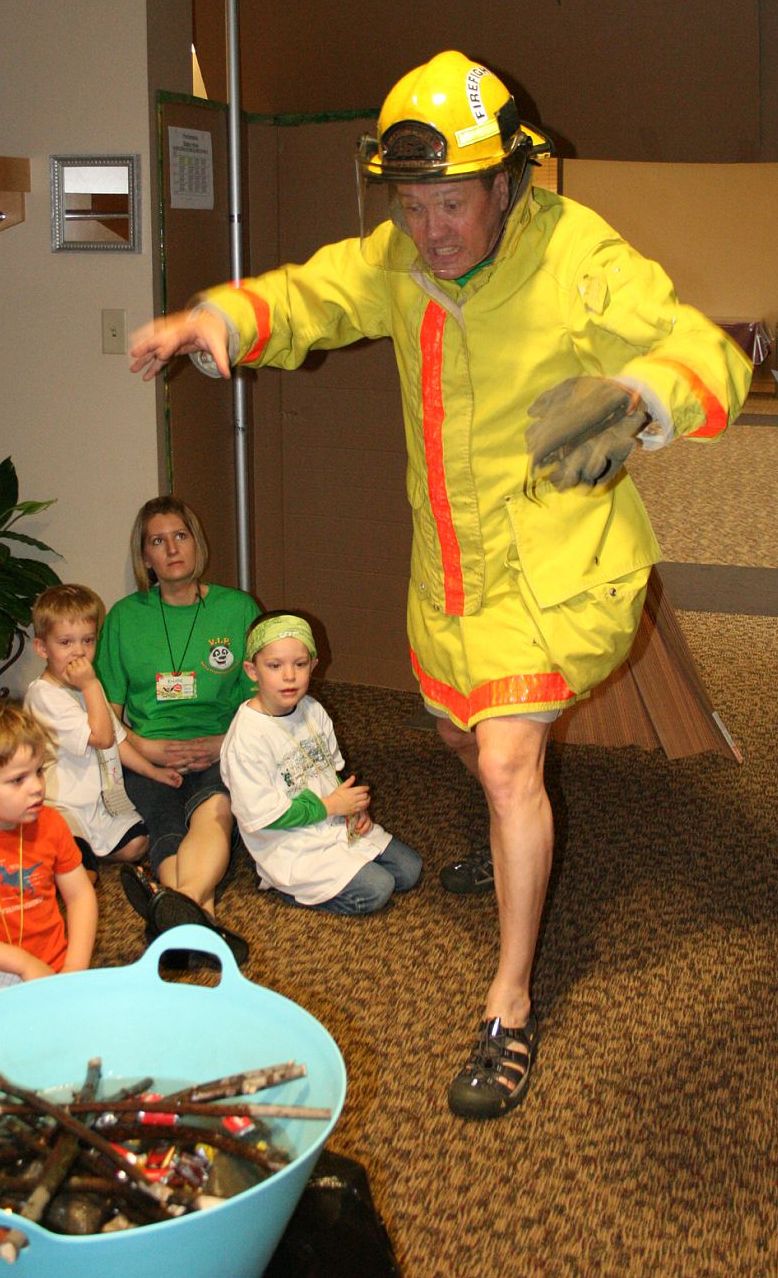
One day we retold the story of Elijah confronting the 450 prophets of Baal from I Kings 18.  We had the children build an altar in a plastic tub with stone and wood. They prepared a sacrifice of chocolate as we reimaged the story.  We even had the children drench the “altar” with pitchers of water, like Elijah.  Then, prior to calling for the LORD God to send down fire, I had to intervene as a fireman.  I warned them because when Elijah called down the fire, it consumed not just the sacrifice, but the wood, stones and water.  I had to prevent the children “from burning down the church.”  Unfortunately, the chocolate was still lost due to the pitchers of water.

Our story telling may not be “historically accurate,” but it does place us in the story, participants in God’s great story.  One of my criticisms of modern Biblical studies is that we can get so bogged down in the historical analysis that we forget the story is meant to engage us as readers.  Scholarship can sometimes place us “over” the text, as a kind of superior critic, when actually God wants to place us “under” the text or “within” the story, so that our hearts, minds, imaginations can be reshaped in God’s image.

As I read the story of Elijah, and visualize the people watching this confrontation, I wonder which side I would be rooting for.  After all, Baal is the ancient version of our own idols and false gods that we give allegiance to: popularity, success, wealth and status.  Baal was the popular god of Israel at the time, that is why 450 prophets stood against Elijah.  As I enter the story, sometimes I am Elijah, but often I am one of bystanders or a prophet of Baal. Through the story, I encounter the call of God to be faithful in my time and place.

How has a Biblical story confronted you and your life?

Lord Jesus, help me to read your Word so that your Word enters into my life.

The Contest at Vacation Bible Adventure

Singing out "God is wild about us!"

This week my blogging is down but energy is up as Resurrection hosts Vacation Bible Adventure.  I am so excited with all the volunteers who add their passion, gifts and strengths to transform Resurrection into a Pandamania Jungle as together we learn about God’s creation, Elijah’s contest, Jonah’s trip, and Peter’s denial.  I am working with a talented seventh grader Adam Behnken and creative Micki Fredin to tell the Bible stories each day. 

This morning we retold Elijah’s contest with the 450 prophets of Baal (see I Kings 18). The people of Israel were waffling in their allegiance to the God of Abraham, Isaac, Jacob and Elijah.  So Elijah challenges the prophets of Baal to a contest. Each would prepare an altar with sacrifice, but neither would bring fire.  They would each call upon their god to light the sacrificial fire. 

First the prophets of Baal tried to coax their god to send fire upon their altar.  Like those ancient prophets, the children and I shouted, danced and called for the fire, but nothing happened. Then the children imitated Elijah and prepared an altar with stones, wood and a sacrifice of “chocolate.”  They even doused the altar three times with water, just like Elijah.  But just before they called down God’s fire, a firefighter (with the initials JVK) entered to stop any fire from happening.  We did not want to burn the church down with it.  Instead we retold  the ending of I Kings 18.

Elijah cried out, “O LORD, God of Abraham, Isaac and Israel, let it be known this day that your are God in Israel, that I am your servant, and that I have done all these things at your bidding.” Then the fire of the Lord fell and consumed the burnt offering, the wood, the stones and the dust, and even licked up the water that was in the trench.  When all the people saw it, they fell on their faces and said, “The LORD indeed is God; the LORD indeed is God.” (I Kings 18:36,38,39)

Where or when have you experienced God’s power?

Almighty God, send the power and fire of your Holy Spirit into our lives.

Jonah, Nineveh and Nahum

Tomorrow night (Tuesday, June 14), Resurrection will host its first Summer Lite Worship at 7:00 pm.  A central component is the study of neglected, yet vital Bible stories.  Our first four weeks will be the book of Jonah.

"Jonah Prophet 1" by artist Reza Badrossama

Many Christians see the book of Jonah simply as a children’s story that has no relevance to today’s world.  The only part they know is that Jonah was swallowed by a whale (or great fish).  Yet the book has a great message that is told with humor, style and grace that speaks to us today. 

Jonah is listed among the prophetic books of the Bible, yet it is so different.  While the other prophetic books are composed of primarily prophetic poems, Jonah has one prophetic speech that is less than ten words.  Whereas most prophetic books have some description of how God called the prophet to speak, Jonah goes into great detail in how he runs away from God’s call to go to Nineveh.  The contrasts all have a purpose that drives Jonah’s message for us.  I am looking forward to our study.

One key feature in the story that is challenging to understand is the city of Nineveh.  Nineveh was not a city in ancient Israel, but of an arch-enemy.  Nineveh was the capital of the great Assyrian empire.   The Assyrians captured the northern kingdom of Israel in 722 BCE and destroyed it as an independent nation.  The Assyrians nearly captured the southern kingdom of Judah as well.  The brutality and cruelty of the Assyrian empire was legendary. Nineveh became a symbol of all that was evil and hated.  The book of Nahum is a long Hebrew poem celebrating Nineveh’s destruction by the Babylonians in 612 BCE.

O King of Assyria, your people are scattered on the mountain with no one to gather them.  There is no assuaging your hurt, your wound is mortal. All who hear the news about you clap their hands over you. For who has ever escaped your endless cruelty? Nahum 3:19

 As Americans, we have trouble identifying with such hatred, because we have not been dominated by other nations. Yet Israel had a deep hatred of Nineveh as symbol of raw power and brutality.

In what ways is hatred appropriate ever appropriate for Christians?  

Lord Jesus, help me to follow your call no matter what.