Category Archives: theology

REI and Stewardship

REI (Recreational Equipment Incorporated) has to be one of my favorite stores.  I truly need to button up my wallet before I enter because of all the backpacking, hiking, camping, biking, and skiing equipment they have.  I started buying REI equipment when their only store was in Seattle and I would take the ferry from Bremerton to gaze upon all the possibilities.  I still use an REI down sleeping bag that I purchased more than forty years ago.

So it caught my attention this week when I rediscovered  that part of REI’s mission is stewardship.  “REI’s passion for the outdoors runs deep. Our core purpose is to inspire, educate and outfit people for a lifetime of outdoor adventure and stewardship.”  Now the word stewardship has often gotten a bad rap in churches, because it often becomes a code word for “fundraising” or worse “begging for money.”  But with REI the word is cool because they recognize that the magnificent outdoors that their customers enjoy must be maintained for future generations.  None of us “own” these landscapes, but rather we are to be stewards or managers of creation for others.

They see it as a sound business decision, because without the protection and care of the wilderness, their business will decline.  REI even produces an annual stewardship report which

measures progress toward our goals to operate a sustainable business. It also tracks our broader efforts to ensure that the next generation has a connection to the natural places we all enjoy.

Stewardship is a biblical concept in which as creatures of God we recognize that God is the true owner of all creation. We have responsibility to care for the earth. The psalmist praises God for this gift,  “God, you have given human beings dominion over the works of your hands” (Psalm 8:5).  Dominion is not domination, but responsible care and oversight, or in a word: stewardship.

A few years ago I went on a hike with my son to a renowned alpine lake.  The gorgeous setting beneath a large peak had been photographed many times.  However when we reached it, the beauty had lost much of it luster from overuse.  Toilet paper, trash and half-chopped trees littered the lake side.  Good stewardship had been neglected.  I saw then why REI wants to restore it.

How are you a steward of God’s creation?

Lord Jesus, teach me to be a good steward of my wealth, time, relationship and gifts.
Elijah and the Fireman

The joy and excitement of last week’s Vacation Bible Adventure still resonates in my soul.  It was a great week of singing songs, making crafts, playing games and telling Bible stories.  The coordinators, Laura Holtmeier and Tonya Bushard, asked me to be the storyteller and I was able to tap some of my passion for the dramatic.  With the help of Adam Behnken,  we relived stories from the Old and New Testament.  The children were called to imagine God’s great acts of power and compassion.

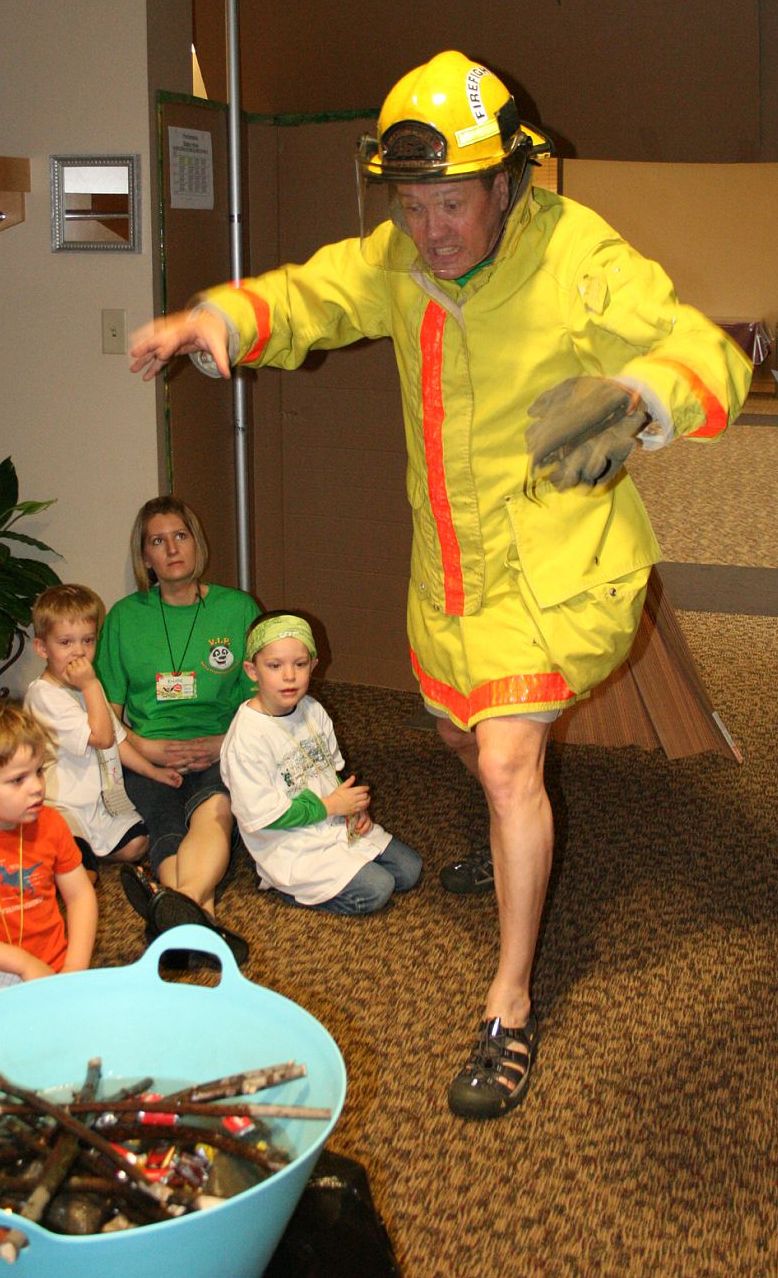
One day we retold the story of Elijah confronting the 450 prophets of Baal from I Kings 18.  We had the children build an altar in a plastic tub with stone and wood. They prepared a sacrifice of chocolate as we reimaged the story.  We even had the children drench the “altar” with pitchers of water, like Elijah.  Then, prior to calling for the LORD God to send down fire, I had to intervene as a fireman.  I warned them because when Elijah called down the fire, it consumed not just the sacrifice, but the wood, stones and water.  I had to prevent the children “from burning down the church.”  Unfortunately, the chocolate was still lost due to the pitchers of water.

Our story telling may not be “historically accurate,” but it does place us in the story, participants in God’s great story.  One of my criticisms of modern Biblical studies is that we can get so bogged down in the historical analysis that we forget the story is meant to engage us as readers.  Scholarship can sometimes place us “over” the text, as a kind of superior critic, when actually God wants to place us “under” the text or “within” the story, so that our hearts, minds, imaginations can be reshaped in God’s image.

As I read the story of Elijah, and visualize the people watching this confrontation, I wonder which side I would be rooting for.  After all, Baal is the ancient version of our own idols and false gods that we give allegiance to: popularity, success, wealth and status.  Baal was the popular god of Israel at the time, that is why 450 prophets stood against Elijah.  As I enter the story, sometimes I am Elijah, but often I am one of bystanders or a prophet of Baal. Through the story, I encounter the call of God to be faithful in my time and place.

How has a Biblical story confronted you and your life?

Lord Jesus, help me to read your Word so that your Word enters into my life.

Name That Commandment IIb

Yesterday I made simplistic remarks about our capitalist economic system, especially the principle of supply and demand.  Fortunately a reader, a professor of economics, gave me a gracious critique of my explanation. She wrote,

I’m not sure if it is society today or human nature which creates the demand for more.    Hobbes contended people operate based on self interest while Locke didn’t believe this was always true.  . . .  The law of demand and supply are not causal models as much as they are descriptive models or this is simply what we observe in the world.  It is true that suppliers only supply what people want but it isn’t true that they have unlimited powers to make this happen as the many failed products and services can attest.

My critique is not on capitalism per se. God made us with wants and desires that are not evil in themselves.  I appreciate how the market allows us to enjoy an amazing amount of products: from Guatemalan mangos to Korean cell phones. I appreciate how the market can reward hard work.

My critique is on the pervasive nature of marketing and advertising.   I am not against all advertising.  My father worked as a newspaper advertising salesperson most of his life.    I like to know when a new product can enhance my life or where I can find a favorite product at a cheaper price.   What I struggle with is the constant barrage of messages that seem to tell me that my life story is incomplete or empty unless I have this product.   Coca Cola has been doing this in its television commercials for years.

In the novel, The Gospel According to Larry, 17 year-old Josh Swenson starts a website that attacks the consumer waste that he sees.  Josh decides to have only 75 possessions, counting all clothes, school supplies, recreational equipment, and software. He has an exact list of how many possessions he has. If he wants a new CD or book he has to sell an old one or trade for it. This means every purchase is a major decision and he takes it seriously.  The novel helped me reflect on the wants and needs of my life.

You show me the path of life.
In your presence there is fullness of joy.
Psalm 16:11

Do you think our culture overemphasizes consumption?

Lord Jesus, teach me to be a good steward of my material blessings.

Down and Out

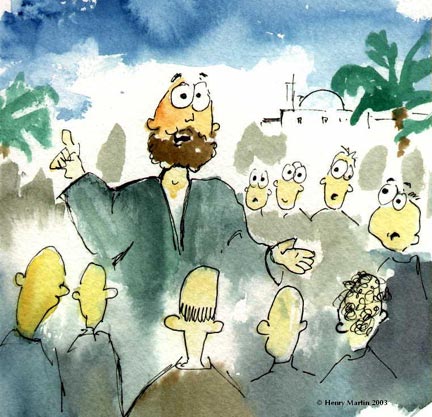
Peter at Pentecost by artist Henry Martin

Last night I met with an amazing group of people who are passionate about using their gifts and strengths for God’s kingdom through Resurrection Lutheran. We are working as a team to prepare for a workshop titled “Discover Your Call – Uncovering Your Dependable Strengths” on November 4 and 5.   The workshop will equip members of Resurrection for service in the world.  

In preparation we watched part of a DVD from Luther Seminary that emphasized the concept that God came “down” to us in Jesus Christ, so we don’t need to “climb” up to God through our actions or good deeds.  As one speaker said, “God does not need your good works. Your neighbor does.”  God calls us to use our gifts and strengths “out” in the world for our neighbor.  Thus the title of the DVD: “Down + Out: Where Grace Takes You.    

God has created each of us with dependable strengths.  God “wires” each of us differently with different abilities, passions and dreams.  Isolated each of us can do a little, but together as the church we can do so much more.  The church is a movement of people, working together to bring healing and hope to a broken world.  The church is not simple to gather in a building and feel good about ourselves.  No, we are to go OUT.

We are to be God’s hands and feet, his voice and presence among the people we interact with each day. This is what Lutheran mean by the word: vocation or calling.  God calls us to serve in the world.

On the day of Pentecost, the Holy Spirit pushed the disciples out into a confused, perplexed world.   Peter was called to preach, but all the disciples had to use their gifts and strengths once the people responded to Peter’s message about Jesus.  They each used their dependable strengths to lead the church out of Jerusalem and into every corner of the world.

What are your dependable strengths and how are you using them in your calling?

Lord Jesus, help me to discover my dependable strengths and to use them for service in your world.


Storms and Trust

Compassion in Joplin

The deadly tornados that struck Joplin, Oklahoma City, and Minneapolis this week evoke spiritual questions. “Why would a loving, compassionate God allow such suffering to happen among His people?” “Was this God’s plan?” I did post a partial answer to these questions after the Japanese earthquake in March. Today I will respond to the question, “Was this an act of God?”

It is our human tendency to seek blame for such tragedies. Since tornados are such chaotic forces that we struggle to understand or predict, we tend to see God as the instigator of such storms. After all, God is the sovereign Lord of the universe, naming every star and directing their path (Psalm 147:4). Certainly God controls the path of every tornado?

Christians have argued this question for generations. My perspective is that in creating the universe, God released this world from strict determinism and gave us and the creation some freedom and control. God gave dominion over creation to humanity (Genesis 1:28). God loves the world, interacts with the world, redeems the world, but has chosen not to “control” the world like some gigantic computer game.

In Mark 4:35-41, Jesus and the disciples climbed into a boat to cross the Sea of Galilee. Jesus fell asleep while a great windstorm arose and the boat nearly swamped. The disciples panicked in the storm. Some Christians believe that God should steer us around the storms, should protect us from such violent destruction. In a sense, we believe God should wrap us in a kind of spiritual “bubble-wrap” that will protect us from all harm.

The disciples awaken Jesus with a question, “Teacher, do you not care that we are perishing?” Jesus then rebuked the wind, “Peace! Be still!” Jesus has the power to still the storm, but more often he stills the storm of doubt and confusion in our hearts. God’s deepest and truest plan is for us to trust Jesus, in the midst of storms and doubts.

Tornados will continue to disrupt creation. Like the tsunami in Japan, the best response of Christians is to love our neighbor in need, to bring tangible compassion to the people. One way to respond is the ELCA disaster relief. Such love is certainly part of God’s plan for creation.

How do you see God in the midst of such suffering?

Lord Jesus, bring healing and hope to those devastated by this week’s tornados.

Death of Osama

Seeking Justice

There has been considerable reflection on the death of Osama Bin Laden and the impromptu celebrations that broke out in parts of America.  NPR asked the question, Is it wrong to celebrate Bin Laden’s death.  I have my own two-part response.

My first response revolves around the issue of justice.  When evil has done harm to people, as a culture we seek justice.   We punish those who have caused the harm with the hope of redeeming the loss.  When a hit-and-run driver leaves the scene of an accident, we feel it is just to find the driver and have that driver pay for any/all damages.  If there is a loss of life, the driver receives a punishment of prison and/or probation based on his or her responsibility for the crime.  Cain was punished for the murder of his brother, Able, in Genesis 4. Punishment is a means for restricting further violence and sin.  Lutherans call this the first use of God’s law, to curb our violent and selfish ways.

Bin Laden claimed responsibility for the tragedy of 9/11.  We had a moral right to seek justice with him regarding this crime.  I trust the statements that the SEAL strike team was seeking first to capture Bin Laden, but had to execute him as a combatant.  I see partial justice in his death and I hope his death will stop further acts of violence.  But we have no guarantee of that.   

Now comes the second response regarding the celebration of his death.   God created all human being with purpose and meaning.  God loves all human beings, even when they turn away from God’s purposes and ways.  God’s law shows us our sinful nature and our need for a savior.   Lutherans describe this as the second use of the law: our profound need for Jesus’ mercy and grace.  So what I celebrate today is the Gospel of Jesus Christ.

The Roman Catholic Church responded to the news of bin Laden’s death with this statement: “Faced with the death of a man, a Christian never rejoices, but reflects on the serious responsibility of everyone before God and man, and hopes and pledges that every event is not an opportunity for a further growth of hatred, but of peace.”

That is my prayer today.  That peace and justice might reign, not more death and destruction.

Lord, have mercy.

John’s Portrait of Jesus

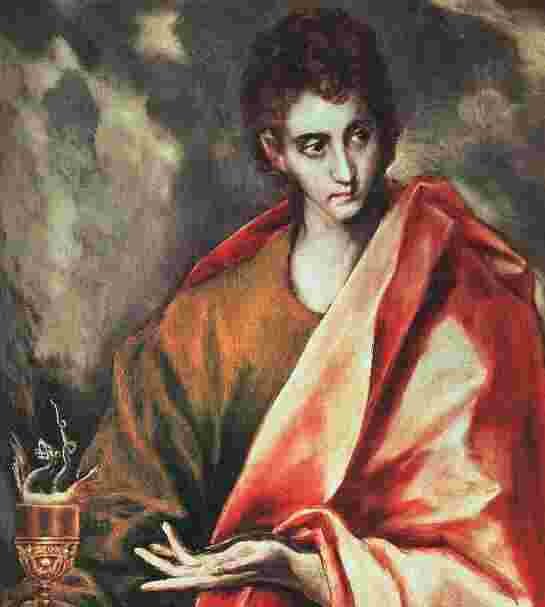
St. John the Evangelist by El Greco

At the end of chapter twenty, John declares,

Now Jesus did many other signs in the presence of his disciples, which are not written in this book. But these are written so that you may come to believe that Jesus is the Messiah, the Son of God, and that through believing you may have life in his name. (John 20:30-31)

Contemporary readers of the Gospels often compare them to modern biographies, but the Gospel writers did not intend this.  They were creating vivid portraits of Jesus that inspire and transform the reader.  The writer of John states that he could have included other material but chose not to.   The gospel writers were artists, not biographers.

Art isn’t only a painting. Art is anything that’s creative, passionate, and personal. And great art resonates with the viewer, not only with the creator.

What makes someone an artist?  I don’t think it has anything to do with a paintbrush.  There are painters who follow the numbers, or paint billboards or work in a small village in China, painting reproductions.  These folks, while swell people, aren’t artists.  On the other hand, Charlie Chaplin was an artist, beyond a doubt. So is Jonathan Ive, who designed the iPod. You can be an artist with oil paints or marble, sure. But there are artists who work with numbers, business models, and customer conversations.  Art is about intent and communication, not substances. (Seth Godin, Graceful, Making a Difference in a World that Needs You. 2010, p. 22)

The writer of John, inspired by God, created a masterpiece. 

How is your life touching others with creativity, joy and vibrancy ?

Prayer, Lord Jesus, inspire me to create beauty and joy in your name.

Ministry Matters™ | Articles | The Logic of Hell

Adam Hamilton


Adam Hamilton has written a thoughtful article on the necessity yet limits of Hell.   Adam is a United Methodist pastor in Kansas City that I have appreciated for many years.   His treatment of Jesus’ statements on hell was particularly helpful to me.

Ministry Matters™ | Articles | The Logic of Hell.

Our Part in the Fifth Act

N. T. Wright, the New Testament scholar, helps me understand the Biblical story as a drama with five acts.  The first act is creation, beautiful and good, Genesis 1-2.  The second act is the human rebellion against God (also known as the Fall), Genesis 3-11.  The third act is the entire story of Israel, from Abraham to the Messiah (Paul sketches this out in Galatians 3 or Romans 4).  The story of Jesus’ life, death and resurrection is the climatic fourth act of the drama, the hinge on which everything turns.  The fifth act is the story of the church beginning with the book of Acts, and this is where we live today.

Wright goes on to explain,   

When we read the story of Jesus, we are confronted with the decisive and climatic fourth act, which is not where we ourselves live – we are not following Jesus around Palestine, watching him heal, preach and feast with the outcasts, and puzzling over his plans for a final trip to Jerusalem – but which, of course, remains the foundation upon which our present (fifth) act is based.    Indeed, telling the story of Jesus as the climax of the story of Israel and the focal point of the story of the creator’s redemptive drama with his world is itself a major task of the fifth act. (The Last Word, N. T. Wright, p. 124)

This story structure is central to our understanding of scripture, how we read and interpret it.  We are still in the story and it has not been completely written, but the main outline is known.  Jesus’ death and resurrection is now our assurance that evil and death has been defeated.    We live in confidence that God has won the war.  There may be individual battles and struggles ahead, times we feel discouraged or in grief.   Yet God’s victory is assured.  The centrality of Jesus’ death/resurrection is why we retell over and over the Good Friday/Easter story every year.

That is also why we can read the story of John 11, the raising of Lazarus, as our story, thinking at times like Martha and Mary that death has won the day.  But we know that Jesus’ resurrection has happened and we live in that new reality.   A new creation is present now and will be fully realized in the future.

How has the story of Jesus become your story?

Weather or Not to Live

Mount Rainier on a clear day

This morning waking up to warm sunshine and blue skies gave my heart a real lift.  I know that  the weather should not determine my mood, especially when one lives in Minnesota year round!   Still God created me as a physical creature that relishes sunshine and abhors long stretches of frigid, grey days.   I am not a robot who has not feelings, but a being that has passion, joy, love, pain and sorrow.

Jesus was one who embraced all of life.  He changed gallons of water into wine at a wedding feast (John 2:6-10).  He enjoyed eating at lavish meals (Luke 5:29-34).  He provided food for the hungry and healing for the sick.  Jesus was not a spiritual ascetic who rejected the simple good pleasures God give to us.  He spent some time in the wilderness, but  even more time with people in the villages and towns of Galilee, Samaria and Judea.  He came from heaven to live among us. 

Jesus gathered friends around him and enjoyed their company.  He wept when his friend Lazarus died (John 11:34).  He rejoiced when his disciples return from their short mission trip (Luke 10:21).  Jesus grew tired on his journey to Galilee (John 4:6). He became angry at the money changers in the Temple (Mark 11:15).   Jesus did not pull away from life, but showed us how to enter it completely.

Growing up in western Washington state, I remember many weeks of grey cold rain.  Though mountains surrounded us to the east and west, we did not regularly see them.   When finally the clouds lifted and Mount Rainier was visible, everyone felt a lift in emotions, a lightness of heart.  Our context had changed, and so did we.  

The vibrant life of faith in Jesus will always be lived in context, in relationship to the culture, community, family and even the weather.   We are physical creatures as well as spiritual.  Let us be passionate in our embracing the vibrant life.  

How have you experienced the Vibrant Life of Faith in Christ lately?