Category Archives: trust

Penny for Your Prayer

Yesterday, I preached on the story of the widow’s offering in Mark 12:41-44. The main point of my sermon was that Jesus noticed the widow’s offering. He heard her two coins in the offering box and drew attention to her sacrificial gift.

As I wrote last week, scholars may debate whether Jesus lifted her up as a model of Christian generosity or as a victim of the religious Temple institution or both. Whatever the case, he noticed her and asked the disciples to observe her.  Jesus observed and cared.

I want to rest on that observation for a moment and to acknowledge the wonder and joy of that observation. In a crowded, bustling temple courtyard, Jesus noticed a poor widow, someone whom the religious leaders seemed to ignore.

This morning as I walked into our church, I heard the birds singing. The Psalmist wrote about the temple in Jerusalem, “Even the sparrow has found a home, and the swallow a nest for herself, where she may have her young– a place near your altar, O LORD Almighty, my King and my God (Psalm 84:3).” Jesus said, “Look at the birds of the air; they do not sow or reap or store away in barns, and yet your heavenly Father feeds them. Are you not much more valuable than they?” (Matt 6:26).

Jesus observation gives me hope. In our complex, crowded, busy world, Jesus notices individuals, you and me. We are not simply some nameless creature, wandering the planet.  We are not some number in a distant computer.  We are a name, a face, a life to God Almighty. God knows our needs, our situation, the pleas of our hearts.

As part of my sermon, I had the congregation first listen to the sound of a large bag of coins filling a metal offering plate: the sound of the rich people. Then I had them listen to the soft clink of two copper coins. One had to listen carefully to hear the clink. How wonderful that Jesus heard.

I also invited the congregation to take a penny home and use it as a reminder of the Widow’s prayer. The penny reminds us that God is always listening, and that our pleas will be heard by God.  It is not a lucky penny, but a reminder of a loving God.

Lord Jesus, keep me mindful that you are listening.

What A Friend We Have

As my mother’s dementia progresses, one deep part of her remains: her love of hymns. She grew up in the Lutheran church and sang in choirs occasionally. She learned hymns as a child and continues to sing them today.

One hymn that we both love is “What a Friend We Have in Jesus.” I like to sing it with her when I visit,

What a Friend we have in Jesus, all our sins and griefs to bear!
What a privilege to carry everything to God in prayer!
O what peace we often forfeit, O what needless pain we bear,
All because we do not carry everything to God in prayer.

The hymn was written around 1855 by Joseph Scriven, a Canadian. He wrote it as poem of comfort and hope to his ailing mother in Ireland. Joseph was a member of the Plymouth Brethren and was known for his compassion and care of the poor and forgotten in his community. He never intended his poem to become a hymn, yet it continues to bring great comfort to those who sing it.

When I sing the hymn, I am reminded of the promise of Hebrews 7:24-25,

Jesus holds his priesthood permanently, because he continues forever. Consequently he is able for all time to save those who approach God through him, since he always lives to make intercession for them.

The book of Hebrews makes the case that Jesus is better than any ancient levitical priest who served in the Jerusalem temple, because Jesus’ sacrifice was pure and sinless.

Since, then, we have a great high priest who has passed through the heavens, Jesus, the Son of God, let us hold fast to our confession. For we do not have a high priest who is unable to sympathize with our weaknesses, but we have one who in every respect has been tested as we are, yet without sin. Let us therefore approach the throne of grace with boldness, so that we may receive mercy and find grace to help in time of need. (Hebrews 4:14-16).

The function of a priest is to give us access to the High and Holy God.  Jesus is our access to God, the one who hears our cries for help and mercy. We truly can take anything to him in prayer, even the love of our aging parents.

Lord Jesus, thank you for bearing all our cares and woes.

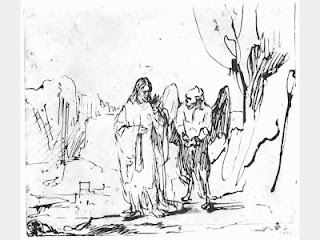
Tempted or Tested?

Yesterday many Lutheran churches read Mark 1:14: Jesus tempted in the wilderness.  Jesus was in the wilderness forty days, tempted by Satan; and he was with the wild beasts; and the angels waited on him. A seminary classmate of mine, Bishop Larry Wohlrabe, preached on this text at the installation of a new pastor and posted his sermon on line.  Here is a section that I really appreciated from his sermon.

What does it mean to be tempted? Temptation is about something far, far worse than falling off your diet or reneging on your no-smoking pledge. Temptation is about doubting your God-given, God-claimed identity. Temptation for Jesus in the parched wilderness was about being distracted from his mission, side-tracked on his path to the Cross, for us and for our salvation.

So what we need to picture here is a battle royal out in the wilderness. Satan, whose name means “adversary,” assaults Jesus repeatedly over the course of a forty day period. Mark doesn’t give us a blow-by-blow account, but maybe that’s OK. Mark’s narrative leaves a lot to our imaginations, and perhaps that helps us identify with Jesus all the more.

Because we, too, have our own “good long times” in the wilderness of doubt and despair. You and I also are pressed to the max, pinned to the wall, by all the “wouldas, couldas, shouldas”—all the ways we doubt ourselves and despair of trusting that God is with us.

Bishop Wohlrabe continued by reminding the local pastor of her task as a preacher in her new congregation.

When they are in the wilderness, serve these folks the same life-giving Word of God that sustained our Lord Jesus in the desert. Proclaim to them the nearness of God’s Kingdom, God’s gentle and glorious rule over all things, in Christ Jesus. Amen.

Yes, Amen.  The ministry of God’s Word continues to give life to thirsty, testy, tempted people.  And God’s Word wins.

Lord Jesus, save us from the time of trial and sustain by your saving word.

Would I Kneel?

Young Man Kneeling by Sam Loggie

Posture can be used to emphasize power and importance. Kings had high, imposing thrones to signify their power over their subjects. Visitors to ancient and medieval courts had to kneel and kiss the ring of their Lord. Even in our democratic society, leaders can be distinguished by their corner office or imposing title. Power demands attention.

In the gospel of Mark, the reader sees people posturing. In chapter five the Gerasene demon-possessed man, the leader of the synagogue (named Jairus), and a woman who suffered from chronic bleeding each knelt before Jesus and begged for his help. They all acknowledged with their kneeling posture that Jesus was Lord, a person with authority and status. They recognized the power of Jesus.

I am not one who kneels easily. I’ve come to realize that I prefer to see Jesus as my friend and guide, who accompanies me, rather than as Lord and Master who commands me. I acknowledge his Lordship verbally, but I wonder if that is more ritual than deep conviction. Am I willing to “beg” Jesus for his assistance, like Jairus (Mark 5:23)?

The question of posture comes into sharper contrast at the end of the chapter. When Jairus heard the news, “Your daughter is dead. Why trouble the teacher (Jesus) any further?” Jesus intervened. He told Jairus not to fear, but to trust in him. Jesus is Lord and has power. When they entered the room of the girl, the scripture says, “He took her by the hand.” I must assume that Jesus knelt down, since all beds were floor level. What an incredible act of tender love!

With love, Jesus knelt to meet the girl’s need. The whole incarnation is a form of God’s kneeling to meet the needs of humanity. Jesus’ birth, ministry, and death was God’s way of kneeling down before us, not to acknowledge our rebellious “power,” but as a way to enter our pain and suffering and lift us up.

As the Philippians hymn states

Jesus who emptied himself, taking the form of a slave, humbled himself and became obedient to the point of death, even death on a cross.

Therefore God highly exalted him and gave him the name above that is above every name, so that at the name of Jesus, every knee should bend, in heaven and on earth and under the earth (Phil 2:7-10)

Lord Jesus, as you knelt to save me, now teach my knees and my heart to bend towards you.

Go Where I Send You

Why would Jesus turn someone away? Someone who begs to follow him?

In Mark 5, Jesus casted out the demon named Legion from a man who lived in Gerasenes, a Gentile region of northern Palestine. When he was restored to his right mind, he sat with Jesus. His neighbors were in an uproar and begged Jesus to leave. As Jesus entered his boat, the man begged to be with Jesus, to be a disciple. Jesus refused.

But his refusal had a purpose. This man was given a very special mission. Jesus said to him,

Go home to your friends, and tell them how much the Lord has done for you, and what mercy he has shown you (Mark 5:19).

This is quite similar to the mission that the apostles are given in the next chapter of Mark. I find it both ironic and hopeful that this Gentile, recently-possessed man is given the mission of proclamation prior to the carefully selected twelve. I also find it highly instructive that he would be given this task to go to his friends and neighbors, not some distant land or foreign culture. Also as one who has recently experienced mercy of Jesus, he is a passionate advocate for Jesus. New converts are often the most passionate and assertive regarding their faith in Christ.

As a Lutheran pastor, I know that some people are specifically called to be pastors and teachers of Jesus’ message. I am thankful for those who answer that specific call. Yet, as this story bears witness, we can all bear witness to what Jesus has done for us, how we have experienced the Lord’s mercy and joy. God may send us to a new location, but the more probable is that he will send us to our friends and neighbors to give witness.

The Gospel of Mark never mentions this man’s name nor reports on his mission, except that all are amazed at the man’s testimony. Let us together rejoice in God’s mercy and amazing grace towards us.

Lord Jesus, help me to be attentive to your voice and to be willing to use my voice to speak of your mercy.

The Path of Questions

Winter Wonderland Road by Andrew Young

Often our journey with Christ is like this snowy roadway, uncertain and slippery. We seek certainty and God gives us surprises and questions.

This morning in our Men’s Bible Study as we read Mark 2 and 3 together, I was struck by how many questions Jesus asked:

Which is easier, to say to the paralytic, ‘Your sins are forgiven,’ or to say ‘Stand up and take your mat and walk’? Mark 2:9

The wedding guests cannot fast while the bridegroom is with them, can they? Mark 2:19

Is it lawful to do good or to do harm on the Sabbath, to save life or to kill? Mark 3:4

How can Satan cast out Satan? Mark 3:23

Who are my mother and my brothers? Mark 3:33

I realized that several of these questions are rhetorical in nature. Jesus answered them himself in short order. Still he asked questions to push and to prod his listeners to think about their faith, to consider how their faith in God impacted their lives. The questions are something that we as readers of the gospel should take seriously.

As a pastor I am often asked questions by congregants about current theological issues. Such as, “Must someone confess Jesus Christ as Lord in order to go to heaven?” or “Is the Bible literally true when it says _________________?” I sometime like being the expert, the answer man. It seems to gives me a certain status or recognition. However there is a danger if I answer too quickly. I can possibly cut off the conversation one is having with God, wrestling with the question. The “chewing” on the question can push us to deeper trust and faith in God.

Jesus seemed to recognize this, often answering a question with a question. Clearly he was the “expert” who knew the answer, but he sought a deeper trust relationship with the questioner and also with us, the modern reader.  He showed us that his path is not like a superhighway, but  more often a winding path on a winter’s day.

So pay attention to the questions Jesus asked by asking yourself, “What is Jesus trying to teach me?” 

Lord Jesus, help me not to settle for easy answers, but to trust you to guide my wandering journey.

P.S.  Andy Young is my nephew in Seattle and has a great photo slide show on Facebook.

My Philadelphia Story

Jesus’ parable on the farmer and the seed in Mark 4 evoked my own story about finding good soil and the mystery of growing seeds of faith.

Between my sophomore and junior year in college, I had a summer internship at Bethany Presbyterian Church in Havertown, an older suburb of Philadelphia, PA.  My mentor and friend, Stan Wood, was a pastor there and he asked me to work the summer with the junior high youth. I had spent my previous summers as a counselor at Lutheran Bible Camps in Washington State.

During that hot and humid summer, I missed the outdoors of Washington, but tried my best to relate to the youth of Bethany. Unlike Bible Camp, where I had different youth every week, we saw the same youth each Sunday for Bible Study and for special events. I tried my best to spread the seed of God’s Word. It didn’t seem to work. I kept missing the mark. I was the outsider, the stranger, and nothing seemed to work.

When that summer was over, I was glad to get back to college, and though Stan asked me to return to Bethany the next summer, I declined I decided my place was back in the good soil of Washington State. Philadelphia seemed a bit too rocky from my perspective.

Six years later, I was back in Pennsylvania, visiting my wife’s sister, Elizabeth, at her college in Suburban Philadelphia, not far from Bethany Presbyterian. As I was walking through her dorm, I heard a voice call my name, “John Keller, is that you?” I turned to see a tall young man who looked vaguely familiar. He introduced himself and said, “I am a member of Bethany Presbyterian and I remember when you were a summer intern.” I then recognized him though he had grown at least a foot. He went on to say, “You know, that summer really made a difference in my faith. I remember that you and the other interns expressed your relationship with Jesus as something real and vital. That stuck with me. I just want to thank you.” I thanked him and we parted.

I never forgot his expression of thanks. What I had determined to be a complete failure, turned out to bear fruit. Good soil can be found almost anywhere by the power of God.

Lord Jesus, continue to cast your Word into the good soil.

Go Home

What path are you following?

When I read the Gospel of Mark, I am struck by how quickly certain people left everything to follow Jesus. Peter, Andrew, James and John immediately left their fishing nets to follow Jesus (Mark 1:18). Levi left his tax booth and followed him (Mark 2:14). I think to myself, “I could never make such a radical, instantaneous decision like them.” The text helps me examine the depth of my conviction to follow Jesus.

Today I was reading the story of the paralytic in Mark 2. Four friends stopped at nothing to place the paralytic in the sight of Jesus. Their plan was that he would be healed. But Jesus’ home was so filled that they could not enter. They still made a way. Jesus then made the controversial move of saying, “Son, your sins are forgiven.” The religious hierarchy had a fit because they did think Jesus had the authority to forgive sins. Jesus could see their skeptical thoughts so he said something even more troublesome, “Which is easier, to say to the paralytic, ‘Your sins are forgiven’ or to say ‘Stand up and take your mat and walk?’”

That is a question that continues to challenge all who read it. Which would you say is easier to say?

Jesus continued, “I will now demonstrate that the Son of Man has authority on earth to forgive sins.” He turned to the paralytic, “Stand up, take your mat and go to your home.” Those last words caught my attention. I expected Jesus to say, “And follow me.” After all, here is an ideal candidate to follow Jesus. The healed paralytic could bear witness to what Jesus had done for him. He could be living proof of Jesus authority and healing power.

But Jesus sent him home.

I don’t know why Jesus would call fisherman and tax collectors to follow him, and not the healed paralytic. (It could have something to do with whether miraculous healing was to be the primary focus of his ministry.)  Still, there are at least two lessons that we need to hear.

First, our sins are forgiven. Our broken relationship with God is restored by Jesus’ authority.

Second, we need to listen carefully as to where and how we serve. Not all of us are called to serve Jesus in the same way, to walk the same path. Yet I think we all are called to listen to his voice, a voice that speaks forgiveness and direction.

Lord Jesus, open my heart, mind and will to hear your promise and command.

Cheerful Giving

Like many of you I have received year-end giving appeals from various organizations, many of them Christian. I realize that many (if not all) realize that people make year-end contributions for two main reasons. The first is the year-end tax deduction that one can receive from the IRS for charitable giving. The other is the “Holiday Spirit” when people feel more charitable.

A part of me sometimes chafes at such reasoning.  “A true and pure Christian would simply give out of love of God, no matter what time of year it is.” But is that just being cynical and snide?

In the Old Testament, the people were instructed to give their offering with the first harvest. It was when they actually had something to give.

Speak to the people of Israel and say to them: When you enter the land that I am giving you and you reap its harvest, you shall bring the sheaf of the first fruits of your harvest to the priest (Lev. 23:10).

I’ve come to think that God is very practical and earthy, not so idealistic as I sometime make God to be. God knows that our hearts need encouragement in giving. Many of us are not instantly generous. If the IRS or the “Christmas Spirit” gives you an incentive to give to your favorite charity, then go for it. And if that helps you become a more generous person, give thanks to God.

Which reminds me of a story of a congregation where a guest missionary preach. After her sermon, an offering was taken by the ushers. The usher stopped by one grim-looking member who refused to pass the offering plate. The usher whispered, “It’s for the mission work in Africa.” The member still refused. The usher whispered louder, “Don’t you care about unbelievers?” Still no response. Finally the usher in a voice everyone could hear, “Then why don’t you take some out, it’s for pagans like you anyway.”

Our generosity is to be a fruit of our trust in Jesus.

With that thought made, I would encourage you to make a year-end contribution to your local congregation. And since this blog is an outgrowth of Resurrection Lutheran Church where I am a pastor, you are welcomed to make a contribution to Resurrection if this blog has been a blessing to you in the past year.

Lord Jesus, teach me to be generous towards others.

The Fiery Furnace and Christmas

The book of Daniel challenges the “normal” perspective of the Old Testament. Throughout the Old Testament, God addressed the people or culture of Israel as a whole. From the exodus, through the wilderness wanderings  up to the divided Kingdoms of Israel and Judah, God interacted with a unified culture: kings and prophets, merchants and farmers. “You shall have no other god before Me.”

In the book of Daniel this changed. The Jews who are in exile in Babylon are not the dominant culture, but rather a small minority. A king like Nebuchadnezzar might come to recognize the God of Shadrach, Meshach and Abednego when God delivers them from the fiery furnace, but he does not force the whole of his society to conform to Jewish culture. Instead the stories of Daniel show how the Jews resisted the religious rules of the dominant culture, even when it might cost them their lives. The Jews in exile had entered a multicultural world.

I wonder if this has a lesson for Christians in the season of Christmas. I know that some Christians are upset that the dominant culture gives only token acknowledgment to the religious basis for Christmas, replacing the manager and baby Jesus with the Christmas tree and Santa Claus.  There are some Christians who long for a more “pure” holiday, when school concerts could sing “Silent Night”” and public prayers could refer to Jesus Christ as Lord. But our current reality is more like the Jews in exile in Babylon than as citizens in the Kingdom of Judah. We might long to live in a monolithic culture in which society promotes our spiritual vision, but we do not.  We live in a multicultural world, with competing worldviews and behaviors.

What this means is that Christians need to do an even better job of telling the great true story of God and Christmas. The book of Daniel was written for the discouraged, scattered Jews to encourage them in the exile and beyond.  The story stated that God still ruled in Babylon, even when kings and other officials denied Him.  The story continues to proclaim that God still rules in America, even if our officials remain silent. And like Meshach, Shadrach and Abednego, we can serve in government, schools, or media, knowing that they are not “god,” and that we may have moments to bear witness to the God who can deliver, Jesus the Christ.

Jesus, let me bear witness to you as my deliverer.