Category Archives: trust

Prison Prayer

I have always admired Dietrich Bonhoeffer.   Bonhoeffer was a Lutheran pastor who worked for the resistance against Adolph Hitler and was executed in April 1945 for his participation in the plot to assassinate Hitler.  He reminds me of Shadrach, Meshach and Abednego when they stood up to the religious tyranny of King Nebuchadnezzar in Daniel 3.   Written in prison, Bonhoeffer’s prayer could have been their prayer.  It certainly can be ours.

 O God, early in the morning I cry to you.
Help me to pray
And to concentrate my thoughts on you;
I cannot do this alone

In me there is darkness,
But with you there is light;
I am lonely, but you do not leave me me;
I am feeble in heart, but with you there is help;
I am restless, but with you there is peace.
In me there is bitterness, but with you there is patience;
I do not understand your ways,
But you know the way for me.

O heavenly Father
I praise and thank you
For the peace of the night;
I praise and thank you for this new day;
I praise and thank you for all the goodness
and faithfulness throughout my life.

You have granted me many blessings;
Now let me also accept what is hard
from your hand.
You will lay on me no more
than I can bear.
You make all things work together for good
for your children.

Lord Jesus Christ,
You were poor
and in distress, a captive and forsaken as I am.
You know all man’s troubles;
You abide with me
when all men fail me;
It is your will that I should know you
and turn to you.
Lord, I hear your call and follow;
Help me.

I remember in your presence all my loved ones,
my fellow-prisoners, and all who in this house
preform their hard service;
Lord have mercy.

Restore me to liberty,
and enable me so to live now
that I may answer before you and before men.
Lord, whatever this day may bring,
Your name be praised. AMEN.

(Letter and Papers from Prison, 1971, p. 139)

Recognizing Our Foolishness

As Resurrection Lutheran nears the end of the Old Testament portion of the Narrative Lectionary, I look forward to Christmas and the birth of Jesus. Though I have enjoyed our survey of the Old Testament, I now long for the familiar story of promise held in the life, death and resurrection of Jesus of Nazareth. The stage is being set for Jesus entrance into God’s drama. Two more Sundays of Advent remain.

This Sunday we will embrace one of the last written books of Old Testament: Daniel. The stories and visions of Daniel are from the time of the Exile when the leaders and skilled labor of Jerusalem were taken to Babylon as captives. The Babylonians wanted to re-indoctrinate the Jews to forget their Jewish heritage and God so as to become productive participants in the empire. Daniel and others resisted such practices.

Daniel chapter three is familiar to many from their childhood. Shadrach, Meshach and Abednego are to be thrown into the fiery furnace but God delivers them. But our childhood version often misses the humor or farcical nature of the story. As you read the text, consider how the repetition and exaggeration  demonstrate how crazy King Nebuchadnezzar is.

King Nebuchadnezzar made a golden statue whose height was sixty cubits and whose width was six cubits; he set it up on the plain of Dura in the province of Babylon. Then King Nebuchadnezzar sent for the satraps, the prefects, and the governors, the counselors, the treasurers, the justices, the magistrates, and all the officials of the provinces, to assemble and come to the dedication of the statue that King Nebuchadnezzar had set up. So the satraps, the prefects, and the governors, the counselors, the treasurers, the justices, the magistrates, and all the officials of the provinces, assembled for the dedication of the statue that King Nebuchadnezzar had set up. When they were standing before the statue that Nebuchadnezzar had set up, the herald proclaimed aloud, “You are commanded, O peoples, nations, and languages, that when you hear the sound of the horn, pipe, lyre, trigon, harp, drum, and entire musical ensemble, you are to fall down and worship the golden statue that King Nebuchadnezzar has set up.” (Daniel 3:1-6)

Is it not comical to read that a human being could “set up” a god? Yet that is how ridiculous King Nebuchadnezzar has become with his power. But are we not as ridiculous when we “set up” something as having ultimate importance? Whether it be our sports teams (think how “over-the-top” the Super Bowl has become), or our careers, or our expectations for Christmas celebrations or our greed. Such humor can disarm our defensiveness and open us to God’s healing. We need to laugh at ourselves when we try to “set up” our mini-gods and see our foolishness.

Lord Jesus, come quickly and deliver me from my foolishness.

Rock of Ages

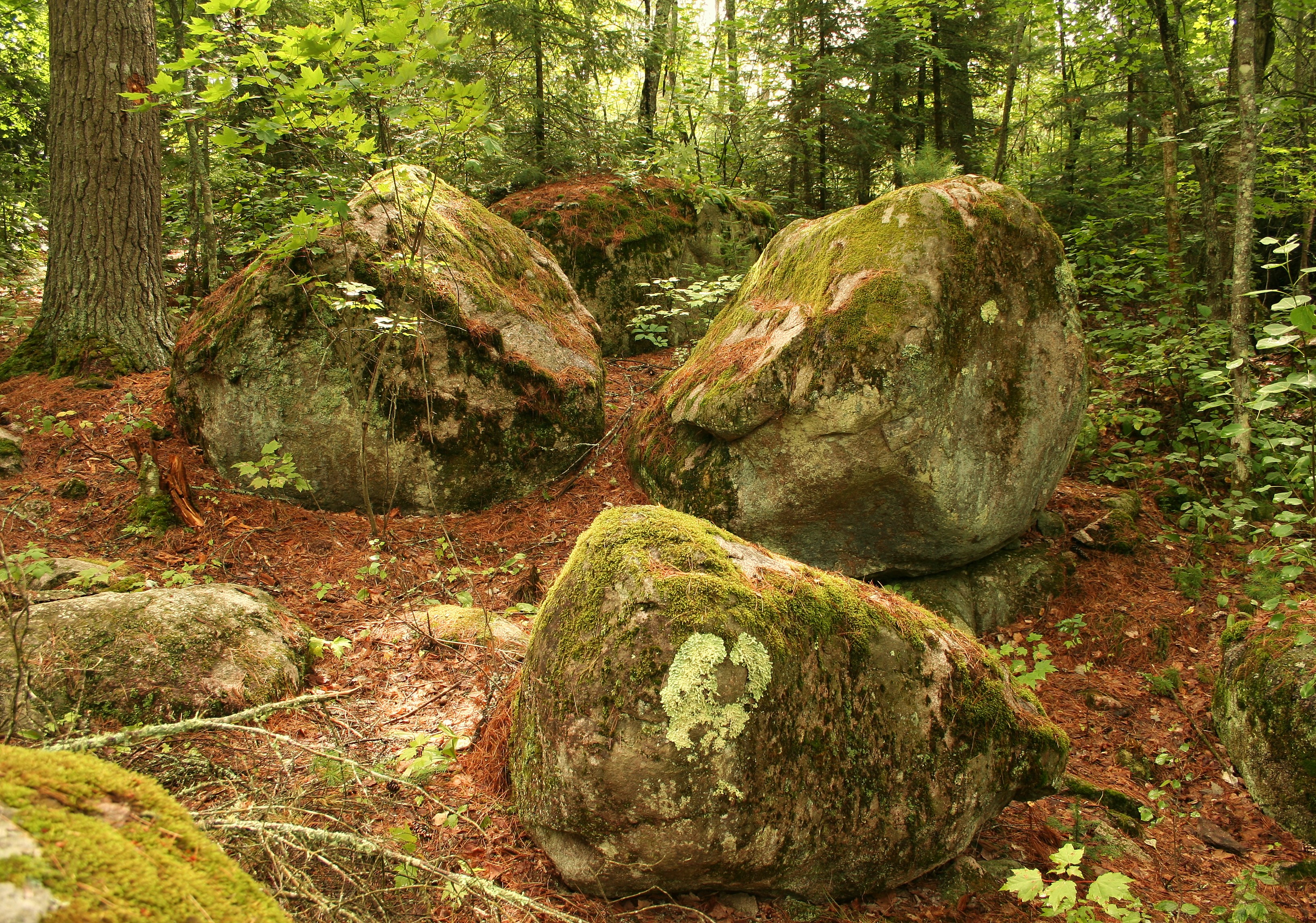
Friend and parishioner, Glenn Jorenby, has been an avid photographer most of his life.  His recent picture of boulders in the BWCA caught my eye as I enjoyed his new website, travelinglightimages.  I have posted on rocks before, but they are such a rich image that I had to return.

Rocks get a bad rap. We often describe a difficult transition as a “rocky road” and an impossible task or person as an “immovable rock.” Yet for the psalmist, the rock became a powerful symbol of God’s strength and faithfulness.

God alone is my rock and my salvation.  (Psalm 62:2)

The LORD is my rock, my fortress, and my deliverer. (Psalm 18:2)

During the exodus from Egypt when the Israelites complained about thirst, God commanded Moses to strike a rock and water flowed out (Numbers 20:8).  In the book of Acts, Peter (the ROCK) preached, “Jesus is  “‘the stone you builders rejected, which has become the cornerstone.'” (Acts 4:11).   Rocks and stones are symbols of God’s trustworthiness.

As a kid, I was fascinated by rocks. The ocean beach at Port Angeles, my childhood home, was lined with rocks of all sizes. I had a habit of picking out a special stone and carrying it home as a reminder of my trip to the beach. Now when I back pack in the mountains, I often pick out a stone by which to remember the trip.  My rock collection continues to grow, as does my trust in God’s strength and mercy.

What image of God gives you strength and hope?

Jesus, be the rock of strength in my life. Amen.

Done Enough?

Yesterday our e-mail and website went down. Our domain name, resurrection-woodbury.org, was dropped as our congregation transitions to a new webhosting site. I am so thankful for people like our office administrator, Sue Guck, and our web volunteer, Matthew Mayer, who immediately saw the problem and are now working hard to correct it.  We should be back up by tomorrow. Technology is a great tool, but it has its glitches.

Though frustrated by this event, it caused me to reflect on my overreliance on such technology tools and the constant “buzz” it produces. I have this feeling that I NEED to be connected. Such feelings can become unhealthy. Sort of like overtraining in running, or becoming a workaholic, it is too much of one thing. God gave us work, exercise and community as gifts, but they are not to become “gods.”

The Sabbath is also a gift from God. Wayne Muller has written about sabbath rest for the Lutheran magazine. He asks the question, “When have we done enough?” Since many of us think we cannot rest until we have finished everything, we never rest.

I remember being on a retreat with a large number of pastors and doing a devotion on resting in God. The one response that stood out was a pastor who said he could never rest, since there is still one more person to visit, one more couple to counsel, one more family to help. God “expected” him to bring care to the entire congregation. I wondered silently, “are you trying to be God, rather than God’s agent?”

So many of us just keep plowing along. Sabbath is the promise of God that we have done enough, worked enough, served enough. It is the promise that we can rest in God’s promise that we are God’s children in spite of our inadequacies and unfinished business. It is a gift of grace that needs to be practiced weekly, whether we are finished or not.

Jesus said, “Come to me, all who are weary and are carrying heavy burdens, and I will give you rest.” (Matthew 11:28)

Lord Jesus, let me rest in you today.

Words of Death and Life

The Old Testament prophets were poets and strong words were their tools. The prophet Hosea used offensive language to stir up the people and to call them back to God. The graphic words were to be a shock to the community in hope that they would repent.

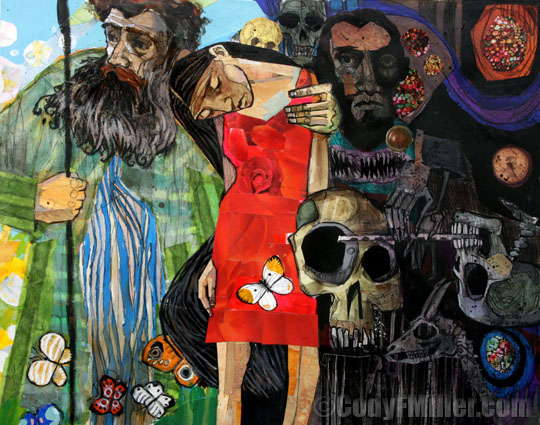
Hosea and Gomer by Artist Cody F. Miller

In the first chapter, Hosea was directed by God to marry an unconventional wife.

The Lord said to Hosea, “Go, take for yourself a wife of whoredom and have children of whoredom, for the land commits great whoredom by forsaking the Lord.” (Hosea 1:2)

His chosen wife, Gomer, may have been a temple prostitute from one of the fertility cults or a simple street prostitute of the city. She bore children to Hosea to whom Hosea gave symbolic names, No-Pity and Not-My-Children, demonstrating God’s strong disfavor with the fickle people of Israel. Afterwards Hosea spoke an extremely harsh word to the people.

Plead with your mother, plead— for she is not my wife, and I am not her husband— that she put away her whoring from her face, and her adultery from between her breasts, or I will strip her naked and expose her as in the day she was born, and make her like a wilderness, and turn her into a parched land, and kill her with thirst. Upon her children also I will have no pity, because they are children of whoredom.

God was angry with Israel’s infatuation with other religions. Instead of being a shining beacon of the Lord God for other nations, they had embraced the gods of other nations, forsaking their unique covenant with God. They had become like a spouse caught in adultery.

The harsh violent language of Hosea can be a shock to our spiritual sensibilities. How can God speak in such cruel severe words?

Perhaps the words are so harsh, because the people’s hearts were so hard. Or perhaps they are so cruel because our hearts are so hard. The words of the prophet “killed” the people (including us the reader), so that God can create a new heart, a new life: a kind of resurrection.

Therefore I will now allure her and speak tenderly to her, . . . I will take you for my wife forever; I will take you for my wife in righteousness and in justice, in steadfast love and in mercy. (Hosea 2:14,19)

Finally the Lord declared, “I will have pity on No-Pity, and I will say to Not-My-Children, ‘You are my people’” (Hosea 2:23). I cling to these words of hope and restoration.

Lord Jesus, the Word of God, you absorbed our sin in your death on the cross. Speak to us again the Word of Life.

86 and Laughing

My blog was interrupted by life. Last Saturday, my 85-year-old mother fell in her apartment and fractured her hip. Since she suffers from dementia I had to make several medical decisions with her, the primary one being whether to have surgery to repair the fracture. Since it was the week-end I could not reach her gerontologist until Monday and then we played phone tag until Tuesday. I wanted her input since she knew both my mother’s dementia and her physical capabilities. After conversation with doctors, family, and friends the decision was made for surgery.

I also prayed a lot during this time, asking God to provide wisdom and guidance. I asked others to pray as well. I don’t see prayer as a magic formula but I trust that God weaves his will into the thoughts and decisions we make. I am thankful for all the prayers that came from family and friends, especially Resurrection Lutheran Church.

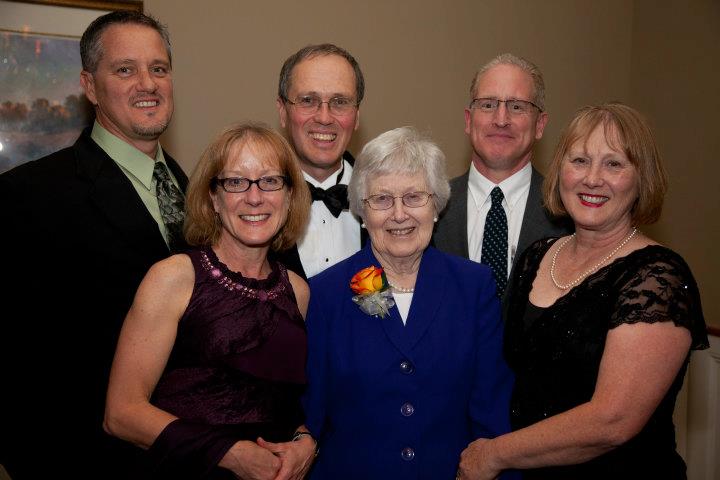
Mom with her children at grandson's wedding.

My mother’s surgery went well at Woodwind’s Hospital and within twenty-four hours she was taking her first steps. Wednesday afternoon she and I watched an old Cosby TV show and we laughed together at his antics. It was her 86th birthday and she had her old smile back, the one she flashed at my son’s wedding a month ago.   Thanks be to God.

The joy of the Lord is our strength. Nehemiah 8:10.

Lord Jesus, we walk by faith and not by sight. Help us to trust you in all things. Amen.

Heroic Flaws

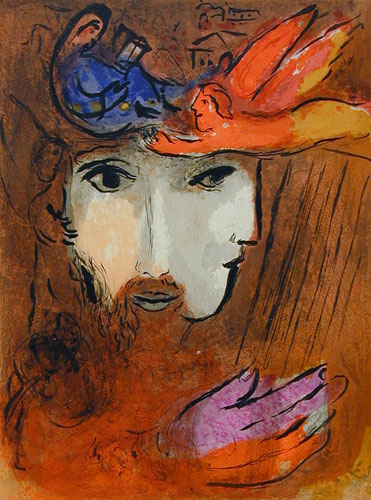
David and Bathsheba by artist Marc Chagall

King David is one of the truly great Biblical heroes.  He unified the twelve tribes of Israel, conquered the once dominate Philistines, expanded the borders and established Jerusalem as the nation’s capital. He also had a deep abiding loyalty to God that he expressed in song and dance. One of my favorite stories is how he brought the forgotten ark of the covenant (the holy box which contained the Moses’ stone tablets) to Jerusalem. As they brought the ark up into the city, “David danced before the Lord with all his might; David was girded with only a loincloth.” (2 Samuel 5:14).  His wife Michal was scandalized by his behavior, but he refused to stop.

David was the heroic leader, the model by which all future kings of Israel and Judah were judged. At the time of Jesus, one thousand years after David’s death, the people still yearned for a new “King David” to arise.  Many hoped Jesus would be that new king. As he entered Jerusalem the people shouted, “Hosanna to the Son of David!” Matthew 21:9.

Yet David had real human frailties, especially as a father and husband. He seduced his neighbor’s wife Bathsheba and then had her husband killed (2 Samuel 11). David’s son Ammon rapes his half-sister Tamar, but David refuse to punish him. So Absalom, Tamar’s brother, avenges her death by killing Ammon. He fled to a neighboring kingdom but eventually returns, only to lead a rebellion against his father, a rebellion that nearly succeeded (2 Samuel 13-17). David’s household was a real mess.

The contrast between David as King and David as husband/dad is so striking, yet true to life. God works through flawed individuals. When we read the stories of Abraham, Jacob, Moses, and David, we discover that they all stumbled in their relationship with God and others. Yet God’s grace was sufficient; God’s power was made manifest in spite of their weaknesses.

If God’s Spirit can work through such flawed, broken human beings like David, God can certainly work through flawed, broken people like you and me. Maybe we just need to dance a bit more?

Lord Jesus, forgive me my sins of doubt and mistrust. Use me for your purposes today.

The Price of Loyalty

King David by artist Rae Chichilnitsky

King David’s complex story fascinates me. Samuel, the prophet, anointed him as king at a young age and “the spirit of the Lord came mightily upon him from that day forward” (I Samuel 16:13). Saul was still on the throne and would use David in his battles against the hated Philistines (David and Goliath), but then Saul turned against David out of jealousy and rage. Yet David remained loyal to Saul, keeping a secret friendship with Saul’s son Jonathan and sparing Saul’s life at least twice (I Samuel 24, 26). When Saul was killed in battle, David executed the messenger who claimed to kill Saul in hope of reaping a reward from David (2 Samuel 1:14-16). David then sang a song of Lament for Saul and Jonathan,

Saul and Jonathan, beloved and lovely!
In life and in death they were not divided;
they were swifter than eagles;
they were stronger than lions (2 Samuel 1:23).

Though chosen by God to be king, David remained faithful and loyal to the first king of Israel, Saul. David must have known that if he was not faithful as a follower of a king, how could his future followers be faithful to him when he did become king? Throughout his struggles with Saul, David turned to God for strength, wisdom and guidance. He had both a strong sense of God’s sovereignty guiding him, while at the same time knowing he had the freedom to choose his path. First and Second Samuel are great books to reflect upon the interplay between our human freedom and God’s ruling, guiding power.

Loyalty remains tricky today. How does one remain loyal to an organization, a congregation, a friend, a family or to God? As a pastor I sometimes stuggle with being loyal to the people of a old congregation while embracing God’s call to be pastor of a new congregation.  I recognize that God has called new pastors to serve in my former congregation who are faithful and compassionate, yet the deep relationship still pull at my heart string.  I also recognize that it takes time and energy to build new pastoral relationships in my current setting and that God will be faithful here as well.

Have you ever struggle to be loyal to God or to others?

Lord Jesus, your kingdom come, your will be done, through me and through your people.

Tears of Joy and Sorrow

Braedon Hyland

Deep emotions are part of the human experience that Christians embrace. This past Friday I experienced the wondrous joy of celebrating the marriage of my son. I rejoiced with family and friends as God’s blessing was placed upon Jon and Maggie. Yet as I came back to Resurrection Lutheran I learned that many are grieving the death of a high school senior, Braedon Hyland, who was killed in an automobile accident last week. Though not a member of our congregation, he was known and loved by many in our community.  As a community we weep with the Hyland family.

St. Paul wrote, Rejoice with those who rejoice, weep with those who weep” (Romans 12:15). Christians do not ignore or reject such deep emotions as joy or sorrow. Jesus himself wept at the tomb of his friend Lazarus. The psalmist cries out with both celebratory praise and with deep anguish. The ups and downs of life are not eradicated by faith in God, but transformed into opportunities for trust and hope. God is to be found in both the wedding and funeral, in both the birth of a child and the death of a grandpa. All of life belongs to God and He gives us strength for the journey.

But there is more than simply the comfort of God’s presence. There is also the hope of God’s promise. The psalmist writes, “Weeping may linger for the night, but joy comes with the morning” (Psalm 30:6). As Christians we trust in a God who suffered death for us on Good Friday, but rose up from the tomb on Easter Sunday. Sometimes we weep the bitter tears of Friday, but sometimes we taste the sweet joy of Sunday with the dance of Christ’s resurrection. Often we live in between on Saturday, remembering the sorrow, yet anticipating the joy.

Jon dances with his FarMor

Plus being God’s children, we do not experience these emotions alone, but share them in community. That is why Paul encourages us to rejoice with others and weep with others. No one need walk life’s journey alone, but rather join in God’s cosmic dance with other, anticipating the great dance of heaven itself.

You have turned my mourning into dancing, you have taken off my sackcloth and clothed me with joy (Psalm 30:11).

Lord Jesus, guide me in my weeping and rejoicing with others in need.

Spying On Our Fears

As Resurrection moves quickly through the Old Testament, many wonderful stories must be skipped. This Sunday we will jump to the book of Deuteronomy which is Moses’ final sermon to the Israelites before they entered the Promised Land (recounted in the book of Joshua).

But this was not Israel’s first attempt to enter Palestine. The book of Numbers recounted a previous attempt to invade the land (chapters 13 and 14). Moses selected twelve spies from the twelve tribes to spy out the land of Canaan. They were selected leaders and instructed to be bold and observant. The spies returned with a huge cluster of grapes suspended on a pole. Their report emphasized a land flowing with milk and honey and with abundant fruit.

However their report also stated that the occupants of the land were many and strong, their towns fortified and very large. Caleb, one of the spies, countered “We can take the land.” The other spies disagreed, saying, “We cannot go up against this people for they are stronger than we.” Their fear overrode their trust in God’s promise. The fear of the leaders/spies also infected the people.

The whole congregation said to Moses, “Would that we had died in the land of Egypt! Or would that we had died in this wilderness! Why is the Lord bringing us into this land to fall by the sword, would it not be better for us to go back to Egypt?” (Exodus 14:2-3)

Fear can destroy a family, a congregation or a nation. We see a potential danger and magnify it beyond reality. We feel threatened and we either seek to fight or flee. The people of Israel wanted to flee.

Caleb spoke again to the people, trying to turn their focus to God.,

The land that we went through as spies is an exceedingly good land. If the Lord is pleased with us, he will bring us into this land and give it to us, a land that flows with milk and honey. Only, do not rebel against the Lord; and do not fear the people of the land, their protection is removed from them, and the Lord is with us; do not fear them.” (Exodus 14:7-9)

The people did not listen to Caleb that day. Their rebellion against God resulted in God’s declaration that this generation which yearned for Egypt must die so that a new generation of hope can arise. The story has a Christian connection: the fearful “old Egyptian” in each of us must die so that the new Christ can rise up within us. Baptism is a reminder of our being joined to Jesus’ death and resurrection.

I have been crucified with Christ, it is no longer I who live, but Christ who lives within me. And the life I now live in the flesh, I live by faith in the Son of God who loved me and gave himself for me. (Galatians 2:19-20

When has fear diverted your trust in God? When has your faith in God overcome fear?

Lord Jesus, today, kill the fear within me and reignite my trust in you.