Category Archives: trust

How Long, oh Lord?

Yesterday in worship I was struck by the cry of Psalm 13.

How long, O Lord? Will you forget me forever?
How long will you hide your face from me?
How long must I bear pain in my soul?
How long shall my enemy be exalted over me?

Like many, I am naturally drawn to the psalms of trust and praise.  I seek to be an upbeat, positive person who sees the cup half-filled.  I prefer the happy psalms that shout praise to God.  Bless the Lord, o my soul, and forget not all his benefits. Psalm 103:2  So when I hear the psalms of complaint and lament, it seems to grate upon my ears and rub against my soul.  Shouldn’t we rejoice and avoid lamentations?

However the book of psalms has almost an equal number of lament psalms as praise psalms.  The book reflects God’s desire to hear our tears and anguish as well as our joys and thanksgiving.  All of life is God’s territory. 

One of the wonders of Psalm 13 is how the psalmist addresses God, even when God seems hidden and aloof.  These questions are not for casual conversation with friends, but a deep cry of the soul to God. Four times the psalmist cries out to God, “How long?”, not knowing when the answer will come, but trusting it will be heard.

Kathy was a parishioner who was wrestling with a potentially terminal illness.  She wanted to live, yet unsure if she had the strength to continue the journey.  When she came to my office, I listened to her complaint and then together we prayed Psalm 13.  The words touched a deep part of her soul, giving her permission to express the throttle cries of her heart, “how long, oh Lord?”

Psalm 13 has a marvelous ending of hope, common to many psalms of lament.

But I trusted in your steadfast love;
m
y heart shall rejoice in your salvation.
I will sing to the Lord,
Because he has dealt bountifully with me.

The psalmist still trusted God, even in the sorrow. God has been faithful in the past and will be faithful in the future, so sing to the Lord.  Weeping may linger for the night, but joy comes in the morning. Psalm 30:5

When was a time you cried out in complaint to God?  How did God respond?

Lord Jesus, teach us to trust in your steadfast love.

Jonah, Nineveh and Nahum

Tomorrow night (Tuesday, June 14), Resurrection will host its first Summer Lite Worship at 7:00 pm.  A central component is the study of neglected, yet vital Bible stories.  Our first four weeks will be the book of Jonah.

"Jonah Prophet 1" by artist Reza Badrossama

Many Christians see the book of Jonah simply as a children’s story that has no relevance to today’s world.  The only part they know is that Jonah was swallowed by a whale (or great fish).  Yet the book has a great message that is told with humor, style and grace that speaks to us today. 

Jonah is listed among the prophetic books of the Bible, yet it is so different.  While the other prophetic books are composed of primarily prophetic poems, Jonah has one prophetic speech that is less than ten words.  Whereas most prophetic books have some description of how God called the prophet to speak, Jonah goes into great detail in how he runs away from God’s call to go to Nineveh.  The contrasts all have a purpose that drives Jonah’s message for us.  I am looking forward to our study.

One key feature in the story that is challenging to understand is the city of Nineveh.  Nineveh was not a city in ancient Israel, but of an arch-enemy.  Nineveh was the capital of the great Assyrian empire.   The Assyrians captured the northern kingdom of Israel in 722 BCE and destroyed it as an independent nation.  The Assyrians nearly captured the southern kingdom of Judah as well.  The brutality and cruelty of the Assyrian empire was legendary. Nineveh became a symbol of all that was evil and hated.  The book of Nahum is a long Hebrew poem celebrating Nineveh’s destruction by the Babylonians in 612 BCE.

O King of Assyria, your people are scattered on the mountain with no one to gather them.  There is no assuaging your hurt, your wound is mortal. All who hear the news about you clap their hands over you. For who has ever escaped your endless cruelty? Nahum 3:19

 As Americans, we have trouble identifying with such hatred, because we have not been dominated by other nations. Yet Israel had a deep hatred of Nineveh as symbol of raw power and brutality.

In what ways is hatred appropriate ever appropriate for Christians?  

Lord Jesus, help me to follow your call no matter what.      

Prayer Challenge

Looking to Heaven in Prayer

Last Sunday I challenged the worshipping community at Resurrection to a prayer commitment.  Following Jesus’ example of prayer in John 17 where he looked to heaven, I asked people to pray for three things and to commit at least five minutes daily to this task.  Consistent prayer is vital to a congregation’s mission.  Are you open to a prayer challenge? 

The first part of my challenge is to pray for those who are close to you: your spouse, children, siblings, parents, or significant others.  Jesus prayed for his disciples.  They had shared years of ministry together and had become a family.  He asked his Father in heaven to protect his disciples.   Our prayers for loved one can be that simple: for God to bless, protect and encourage them. 

Second, I encourage you to pray for your congregation’s missionIn our secular age, it is easy to forget that congregations have a God-given mission to accomplish.  Jesus gave his mission to his disciples: to proclaim “eternal life, that they may know you, the one true God, and Jesus Christ whom you have sent” (John 17:3).   At Resurrection we have that same mission, only we call it the Vibrant Life of Faith in Christ. 

Third, I invite you to pray for your adversary, for the person with whom you struggle daily or weekly.   It might be someone at work, at home or in your neighborhood.   In Matthew 5:44, Jesus told the disciples, “Love your enemies and pray for those who persecute you.” 

A friend told me about his struggle to love his adversary.  Every day as he went to work he saw a picture of the person and felt this internal anger rise up.  It got to the point where he would take a different route to work so as to avoid the picture. He was discussing this with his wife when she suggested that instead of avoiding it, he simply pray for God’s blessing and joy to be with his adversary, to envision the person covered in God’s light.  He listened to his wife and started praying.  At first there was no change in his emotions, but he persevered.  Gradually he felt his animosity dissipate.  He grew to see his adversary as a fellow child of God. 

What are your prayer challenges?

Lord Jesus, bless my family, church and enemies.

Storms and Trust

Compassion in Joplin

The deadly tornados that struck Joplin, Oklahoma City, and Minneapolis this week evoke spiritual questions. “Why would a loving, compassionate God allow such suffering to happen among His people?” “Was this God’s plan?” I did post a partial answer to these questions after the Japanese earthquake in March. Today I will respond to the question, “Was this an act of God?”

It is our human tendency to seek blame for such tragedies. Since tornados are such chaotic forces that we struggle to understand or predict, we tend to see God as the instigator of such storms. After all, God is the sovereign Lord of the universe, naming every star and directing their path (Psalm 147:4). Certainly God controls the path of every tornado?

Christians have argued this question for generations. My perspective is that in creating the universe, God released this world from strict determinism and gave us and the creation some freedom and control. God gave dominion over creation to humanity (Genesis 1:28). God loves the world, interacts with the world, redeems the world, but has chosen not to “control” the world like some gigantic computer game.

In Mark 4:35-41, Jesus and the disciples climbed into a boat to cross the Sea of Galilee. Jesus fell asleep while a great windstorm arose and the boat nearly swamped. The disciples panicked in the storm. Some Christians believe that God should steer us around the storms, should protect us from such violent destruction. In a sense, we believe God should wrap us in a kind of spiritual “bubble-wrap” that will protect us from all harm.

The disciples awaken Jesus with a question, “Teacher, do you not care that we are perishing?” Jesus then rebuked the wind, “Peace! Be still!” Jesus has the power to still the storm, but more often he stills the storm of doubt and confusion in our hearts. God’s deepest and truest plan is for us to trust Jesus, in the midst of storms and doubts.

Tornados will continue to disrupt creation. Like the tsunami in Japan, the best response of Christians is to love our neighbor in need, to bring tangible compassion to the people. One way to respond is the ELCA disaster relief. Such love is certainly part of God’s plan for creation.

How do you see God in the midst of such suffering?

Lord Jesus, bring healing and hope to those devastated by this week’s tornados.

The Rock

Raise Your Ebenezer

Our house has a large granite rock in our backyard. Over two feet high, it is not something easily moved. It may have been there since the house was constructed or perhaps since the glaciers covered Minnesota. The rock is a pain to mow around, but it is a marker in our yard.

Several years after we moved into our house, I looked out the window one day and saw a young boy sitting on the rock. At first I did not recognize him as one of the neighborhood children, but when his mother walked over and called him, I knew who he was. He was the son of the former owner of our house. The son had come back to see, touch, and sit upon the rock that had long been his.  I sensed that he received some strength and comfort in that visit to the rock.

In Israel, large rocks were very common and became part of their faith language. In I Samuel 7, the prophet Samuel invokes God’s help to lead the Israelites in victory over the Philistines. He marks the victory by raising a stone marker.

Samuel took a single rock and set it upright between Mizpah and Shen. He named it “Ebenezer” (Rock of Help), saying, “This marks the place where God helped us.” I Samuel 7:12

In Psalm 18:2 rock is used a symbol of strength and security, where we can find safety.

The Lord is my rock, my fortress, and my deliverer, my God, my rock in whom I take refuge.

Jesus uses the image of a rock to describe his teachings and how we are to rely on his teachings as a firm foundation:

“Everyone then who hears these words of mine and acts on them will be like a wise man who built his house on rock.” (Matt 7:24)

Paul, using the story from Exodus when Moses provided water to the thirsty Israelites in the wilderness, described Jesus as the Rock from which comes spiritual water:

For they drank from the spiritual rock that followed them, and the rock was Christ. (I Cor 10:4).

How is a rock a helpful image of God for you? Would you use a different image today?

Lord Jesus, be my rock and fortress today.

Screwtape Letters I

The Screwtape Letters by C. S. Lewis

C. S. Lewis’ Screwtape Letters is my current read (more accurately, my commuting audio-book). This book launched Lewis as a popular Christian author in 1942 and is a series of letters written by a senior devil, named Screwtape, to his nephew and junior tempter, Wormwood, instructing him on how to lead a young British man (call the patient) towards damnation and hell. These clever letters give the reader a humorous, yet wise perspective on the temptations to pride, lust, greed, gluttony, and self-righteousness.

Lewis’ insights still speak truth today. For example in letter eight, Screwtape writes regarding the natural ebbs and flows, (the undulation) of human emotions, even for Christians.

Humans are amphibians—half spirit and half animal. . . As spirits they belong to the eternal world, but as animals they inhabit time. This means that while their spirits can be directed to an eternal object, their bodies, passions, and imaginations are in continual change, for to be in time means to change. Their nearest approach to constancy, therefore, is undulation—the repeated return to a level from which they repeatedly fall back, a series of troughs and peaks.

If you had watched your patient carefully you would have noticed this undulation in every department of his life—his interest in work, his affection for his friends, his physical appetites, all go up and down. As long as he lives on earth, periods of emotional and bodily richness and liveliness will alternate with periods of numbness and poverty. The dryness and dullness through which your patient is now going are not, as you fondly suppose, your workmanship.

Lewis goes on to write that the trough of spiritual dryness and dull heart can be the true place of spiritual growth, because in these valleys we learn to walk with God out of obedience and trust, and not simply because we feel some good pleasure in it. As a moody Scandinavian I often wrestle with my darker emotions. The tempter wants me to see the dark valley as God’s abandonment; God wants me to see the valley as a training ground for deeper faith and commitment.   As Lewis writes,

Hence prayers offered in the state of dryness are those that please Him (God) best.

How do you understand your emotional, spiritual, and physical ebb and flow?

Lord Jesus, teach me to be faithful, especially at my low points.

Remembering God’s Way

Eustace and Jill from Silver Chair by Dunechaser on Flickr

I am on a C. S. Lewis binge, rereading his Chronicles of Narnia.   The Silver Chair is this week’s read, in which Eustace Scrubb and Jill Pole are given the mission of rescuing the Narnia Prince Rilian.  Near the beginning of the story, King Aslan gives to Jill four signs that will aid in their mission.  She is instructed to remember the signs by repeating them every day, telling them to Eustace and later their companion, Puddleglum. The discipline of the repetition will allow them to recognize the signs when she, Eustace or Puddleglum encounter them.  In the hardship of her journey she neglects the repetition and therefore they must face unnecessary challenges.

This act of remembering echoes God’s words to the Israelites while they were wandering in the wilderness, prior to entering the promise land.  You shall love the Lord your God with all your heart, and with all your soul, and with all your might.  Keep these words that I am commanding you today in your heart.  Recite them to your children and talk about them when you are at home and when you are away, when you lie down and when you rise.  Bind them as a sign on your hand, fix them as an emblem on your forehead, and write them on the doorposts of your house and on your gates. (Deut. 6:5-9)

The act of daily devotions can at time feel like a chore or empty ritual.  Yet to neglect the ritual is to open oneself to other, less healthy, less meaningful influences.  To read a passage of scripture, to pray the Lord’s Prayer, or to confess the Apostle’s Creed aides one in reorienting oneself to God’s mission and path. I confess I can easily be distracted from the main tasks of the day.  Asking for God’s guidance, courage and strength helps me stay true to my mission to trust, live and serve.  

How has daily time with God enhanced your life of faith?

Prayer: Lord God, only you know what is ahead for me today.  I ask you to guide my thoughts, words and deeds, that they might bring honor to you.

Hidden With Christ

Hidden Picture #1

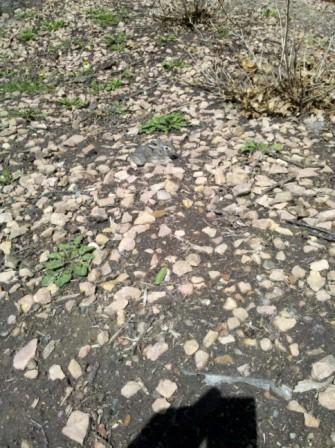
Yesterday, I was cleaning out a small pile of fallen leaves around a bush near our house when suddenly I was startled by a flash of movement from the pile.  A small animal scurried out, frighten by my invasion of its space.  I was startled as well, not sure what kind of animal it was.  I first thought it was a gopher or mole, but after looking more carefully I discovered it was a small rabbit. 

I left the small rabbit burrow alone, and went inside for my camera.  The rabbit stayed motionless for several minutes so I was able to take a picture.   After taking the picture, I saw how well the rabbit blended into its surroundings (see picture #1).  It was hidden even while in plain sight.  Only on closer examination could it be seen (see picture #2).   

Hidden Picture #2

As I thought about this encounter, a Bible phrase flashed into my head, hidden with Christ.  I had to do a search on the computer to find the exact verse. 

Set your minds on things that are above, not on things that are on earth,  for you have died, and your life is hidden with Christ in God. Colossians 3:2-3

Paul, the writer of Colossians, is encouraging us to see our lives as having a secure anchor in the midst of constant earthly turmoil and temptation.  Our place of safety is our relationship with Jesus Christ.  He is our secure burrow, our hiding place, when the evil one attacks.

I have not gone near the rabbit burrow since that first encounter, nor have I seen the small bunny.  I am unsure if I damaged the burrow beyond repair.   And upon further reflection, after seeing the horrific destruction this week by tornadoes in Alabama and other parts of the south, I can never be sure that my own home is forever safe from such destruction.  

The one secure promise is that my life is hidden with Christ and I am safe with him.

In whom is your life hidden?  Where do you find safety and security?

Prayer: Lord Jesus, keep me safe in you, my rock and shield.  Bring comfort, strength and courage to those whose homes and families have been devastated by storms.

Seeing and Believing

Are Your Eyes Open to See?

In the Gospel of John one central thread is “Seeing.”  In chapter one, two disciples begin to follow Jesus and he asks, “What are you looking for?”   They ask where are he is staying. He responds, “Come and See.”   It is as if Jesus is also addressing you and me, the readers of the Gospel, “Come and See.”  As we read the Gospel we begin to “see” Jesus.

In Chapter four, after her encounter at the well of Jacob, the woman runs and invites the town (and the reader as well), “Come and see a man who told me everything I have ever done!”  In chapter nine, Jesus heals a blind man and later Jesus asks him, “Do you believe in the Son of Man.”  When the blind man responds, “Tell me, so I may believe in him,” to which Jesus says, You have seen him, the one speaking with you. ” In chapter twelve some Greeks approach one of Jesus’ disciples and ask, “we wish to see Jesus.”  In chapter fourteen, Jesus tells the disciples that they will know the Father, “From now on you do know him and have seen him.” Jesus is the tangible, visible expression of God, the Father.

The theme of seeing culminates in chapter twenty, when Thomas makes his fateful comment about Jesus’ resurrection, “Unless I see the mark of nails in his hands, I will not believe.”  When Jesus reveals himself to Thomas and says, “Put your fingers here and see my hands. Do not doubt but believe,” Thomas confesses his faith, “My Lord and My God.”   Jesus then speaks as if to you and me, the readers, “Have you believed because you have seen me.  Blessed are those who have not seen and yet have come to believe.”

We may not have visions of Jesus, but we see him in the story of the Gospel and in the lives of God’s children.   Thomas was not the first skeptic nor the last.  At times, I have similar doubts.  Yet as I study God’s word with God’s people, I see Jesus.  We bear witness to one another.

How have you seen Jesus today?

Prayer: Open the eyes of my heart, Lord, that I might see and believe.

Questions about God and Prayer

At Resurrection, confirmation students complete sermon notes.  I enjoy reading the questions they write after the sermon is done.  Normally they offer just one, but this past Wednesday one student was truly inspired.  I had preached on Moses and his encounter with God at the burning bush in Exodus 3.   I started the sermon with the verses that come immediately prior:

Hebrew Slaves Cry Out

The Israelites groaned under their slavery, and cried out.  Out of the slavery their cry for help rose up to God.  God heard their groaning, and God remembered his covenant with Abraham, Isaac and Jacob.  God looked upon the Israelites, and God took notice of them. Exodus 2:23ff

The cry of the Israelites created all kinds of questions for the student:

While God’s people were slaves, many died.  Why did He not save them? Why did he wait?  Were they the “bait”/sacrificed for us to grow closer to God? How do you know if God is listening? (you don’t feel he is there.)  Why did God “then” hear their “cries?”

Great questions!    

Though the Israelites had been slaves in Egypt for generations (Exodus 1:8), this is the first record of their calling out to God for help.  They may have called out before, but we have no record of it.   God knew their struggle and was preparing a way out of Egypt through his preparation of Moses for leadership.   The cry of the people and God’s call for Moses to lead the people are linked here in Exodus.  God waited both for the people’s desire to leave and for the right leader to be ready.

As to the question of whether we know God is listening, the point is the Israelites did not know at first.   They cried out to God and God chose Moses, even though Moses has no desire to be God’s leader.   Moses was God’s answer to the Israelites cry for help, but they did not know it at first.  In fact, when Moses first arrives they reject him, Exodus 5:21!

The story demonstrates that God’s answers prayers, but not always in the time and way we choose.  We are called to trust God even as we wait.  It also demonstrates that we might become the answer to someone else’s prayers.

When was a time that you had to wait for God’s answer to your cries for help?