My daughter-in-law has written a beautiful, emotionally true story on the birth of Jack McCrary Keller.


My daughter-in-law has written a beautiful, emotionally true story on the birth of Jack McCrary Keller.
Our mortality is difficult to face. Even more difficult is to contmeplate the mortality of our children. Yet the ritual of baptism faces the reality of death head on.
When my daughter Suzanne was about two years old, she was diagnosed with mitral valve insufficiency, which means she had a small hole in her heart. The cardiologist told us that she would need open heart surgery to repair her heart. Such surgery required stopping Suzanne’s heart and placing her on a heart/lung machine while the surgeon closed the hole. Such surgery had become routine in the early 90’s, yet nothing is routine when it comes to one’s own child. The news rocked my world.
That night I stood over her bed as Suzanne slept. I prayed for Suzanne and her upcoming surgery. I prayed concerning my own fear and apprehension. Tears welled up. Then I contemplated the promise God made to her in her baptism.
Baptism holds a bold declaration and even bolder promise. In his letter to Romans, Paul writes
Do you not know that all of us who have been baptized into Christ Jesus were baptized into his death? Therefore, we have been buried with him by baptism into death, so that, just as Christ was raised from the dead by the glory of the Father, so we too might walk in newness of life (Romans 6:3-4).
Paul uses the act of baptism by immersion, where the baptized person is completely submerged under the water. This immersion is a symbolic burial, just as Jesus died and was buried. In baptism we die with Jesus. Paul goes on to write that in baptism, “our old self was crucified with him (Jesus) so that the body of sin might be destroyed, and we might no longer be enslaved to sin (Romans 6:6).” Baptism recognizes our mortality comes from our sin, our rebellion with God, and overcomes the power of sin by burying our sinful self with Christ. In stark terms, baptism declares us dead.

Daughters Christina and Suzanne enjoy their nephew Jack at his baptism
But it goes beyond that declaration to a more glorious promise. Not only are we buried with Jesus, but, like Jesus, we are raised to newness of life. The central belief of Christianity is that Jesus rose from the dead. In baptism we are joined to his resurrection. Symbolically this is expressed in an immersion baptism when the newly baptized is raised up out of the water, breathing the new life.
As I stood over my daughter’s bed, contemplating her pending surgery, I remembered this promise. She was alive in Christ and was already experiencing the newness of life. Even if she were to die in surgery, she was Christ’s child and held by the promise of eternal life.
Her surgery went well and she recovered quickly (though, as with any trauma, she did have some emotional residue that was challenging for her and her family at times). Today, twenty years later, she is a vivacious, creative young woman who I deeply love. I am glad that she remains on this earth.
Lord Jesus, let me die to sin and walk in newness of life with you today.
Baptism cleanses us from sin. The Greek word for baptism means “washed or cleansed.” The promise of baptism is that all my sins are washed away by God.
But when God, our kind and loving Savior God, stepped in, he saved us from all that. It was all his doing; we had nothing to do with it. He gave us a good bath, and we came out of it new people, washed inside and out by the Holy Spirit. Our Savior Jesus poured out new life so generously. God’s gift has restored our relationship with him and given us back our lives. And there’s more life to come – an eternity of life! (Titus 3:4-6, The Message)
And with infant baptism (like my grandson Jack’s baptism) that includes Original Sin.
The concept of Original Sin has been a troubling one for me. How can such an innocent baby be labeled as a sinner? It troubled me until I looked at this picture from Jack’s baptism.
Jack was born into a sinful world where sin has entrapped and ensnare him. Jack lives in a family system of sin. (For all have sinned and fallen short of the glory of God, Romans 3:23.) I will not speak for my daughter-in-law Maggie’s family, but I know my own family is tainted and trapped by sin. And the most notable offender being the grandpa who holds baby Jack. Our sin, our brokenness, our wayward fickle hearts will hurt and pull Jack away from God. Or to be perfectly honest, my sin, my brokenness, my wayward fickle heart will hurt and pull Jack away from God. And for that I need God’s grace and forgiveness as much as Jack.
As Frederick Buechner writes,
Original Sin means we all originate out of a sinful world, which taints us from the word go. We all tend to make ourselves the center of the universe, pushing away centrifugally from that center everything that seems to impede its freewheeling. More even than hunger, poverty or disease, it what Jesus said he came to save the world from. (Beyond Words, p. 369)
Jack’s baptism was a powerful reminder to me to once again claim the promise of my own baptism, to be washed clean of my sinful inclination to make it all about me. To remember that God, our kind and loving Savior God, stepped in and saved me. I need to walk “wet and clean,” especially when I am entrusted to love and hold Jack.
The great and glorious news is that Jesus Christ has cleansed Jack and me and given us newness of life.
Next post: D is for dying.
Lord Jesus, cleanse my heart again.
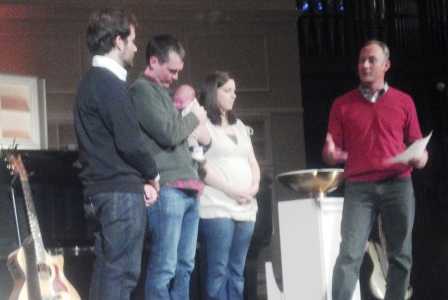 When my grandson was baptized on Sunday it was a family celebration. His parents, aunts, grandparents and friends were present to publicly welcome the tiny newborn into God’s kingdom. Though Jack slept the entire time, his baptism was filled with praise and promises.
Occasionally as a pastor I am asked to do a baptism outside of Sunday worship. I generally decline because one of the central themes of baptism is that the baptized person becomes part of the Christian community. Baptism is not an isolated event between God and the baptized. Baptism is a community event in which the family of God, the church, welcomes and receives the newest member of the family.
In the book of Acts we see a clear expression of this. After Peter preached his first sermon about the death and resurrection of Jesus Christ in Acts 2, the people who heard it were cut to the heart and said to Peter, ‘Brothers, what should we do?’ Peter responded,
“Repent and be baptized every one of you in the name of Jesus Christ so that your sins may be forgiven and you will receive the Holy Spirit (see last post). For the promise is for you, for your children and for all who are far away”. . . . Those who welcomed his message were baptized, and that day about three thousand persons were added (Acts 2:38-40).
 (Side note: I often wonder how they did 3000 baptisms that day. Did they use a fire hose, a supersoaker or the Jerusalem municipal swimming pool?)
The key verse comes next. The newly baptized did not wander back to their old communities and ways. Instead they formed a worshipping community. They devoted themselves to the apostle’s teaching and fellowship, to the breaking of bread and the prayers (Acts 2:42). The apostle teaching became what we know as the New Testament of the Bible. The fellowship they shared involved more that drinking coffee, but actually sharing their possessions with one another. The breaking of bread is a reference to the bread of Holy Communion or Eucharist. And prayer is prayer. All are elements of a worshipping community.
The expectation is that the newly baptized needs the community to grow in his or her understanding of God’s grace and love. We do not live our faith in isolation; the community brings us strength, support, correction and comfort. Jesus modeled this by living in a community of at least twelve disciples.
A wonderful moment for me at Jack’s baptism was when the pastor asked the entire congregation if they promised to support and encourage Jack as he grew in faith. The congregation joyously responded, “Yes, we do!” Jack’s home and family has just grown by a factor of ten.
How does baptism help you stay connected to God’s people?
Lord Jesus, Thank you for providing me with your fantastic family.
 Last evening my grandson, Jack Keller, was baptized. My son and daughter-in-law come from different faith traditions regarding baptism and my son wrote about this on their blog. I plan this week to write on the various perspectives of baptism and how it can be a vital touchstone of faith. Baptism is a beautiful collage of images and promises that revolve around this gift of God. Each image has value, worthy of reflection.
In baptism, therefore, every Christian has enough to study and practice all his or her life. Christians always have enough to do to believe firmly what baptism promises and brings – victory over death and the devil, forgiveness of sin, God’s grace, the entire Christ, and the Holy Spirit with his gifts. In short, the blessings of baptism are so boundless that if our timid nature considers them, it may well doubt whether they could all be true.” (Martin Luther’s Large Catechism, BOC 461)
In the Lutheran tradition, the focus is on God’s promise and God’s initiative in creating the covenant relationship. I cannot come to God on my own, but the Holy Spirit calls me through the Gospel. Baptism is a tangible expression of the gospel, the good news of Jesus Christ. One baptismal image that expresses God’s initiative is adoption with the gift of the Holy Spirit.
Jesus was baptized by John prior to beginning his ministry.
And when Jesus had been baptized, just as he came up from the water, suddenly the heavens were opened to him and he saw the Spirit of God descending like a dove and alighting on him. And a voice from heaven said, “This is my Son, the Beloved, with whom I am well pleased” (Matthew 3:16-17).
Though Jesus was God incarnate, God the Father sent the Holy Spirit as a sign affirming Jesus’ authority as God’s Son. God did this prior to Jesus starting his ministry, before he preached or healed. The same Holy Spirit is given in our baptism and we are “adopted” as God’s children.
For all who are led by the Spirit of God are children of God. For you did not receive a spirit of slavery to fall back into fear, but you have received a spirit of adoption. When we cry, “Abba! Father!” it is that very Spirit bearing witness with our spirit that we are children of God (Romans 8:14-16).
One of the ways this is enacted with an infant baptism is that the infant is normally held by the Christian sponsors or the pastor during the baptism. The pastor or sponsor represents God’s claim and blessing upon the child. After the baptism the child is given back to the parents as a gift from God with the understanding that the child will be raised in faith.
Baptism is a powerful reminder of who I am: I am a child of God. I am God’s child, not because of my actions or inactions, but because of God’s tangible grace given to me in baptism.
Next post: B is for Belonging.
Lord Jesus, Thank you for claiming me as your child.
One key aspect of running is its simplicity. All I need are a pair of running shoes and workout clothes to go for a run. I don’t need any other equipment, gym or teammates to have a quality run. I simply need to get myself dressed and out the door.
Of course that simplicity can turn running into a stale routine, even a rut. I can run the same route at the same pace at the same time everyday. (One reason I avoid treadmills is that I find them to be so boring.)
 To break up the routine, I enjoy running with a group on Saturday morning. For years the St. Andrew’s Running Club has blessed me with great running companions. Most of the runners are not members of the congregation and even though I have moved on to a new and wonderful congregation at Resurrection Lutheran, the Running Club welcomes me back on occasion to run with them. What I appreciate during these run are the lessons I frequently learn. This morning’s run was especially rich.
 Lesson #1 dress properly: The weather has turned colder in Minnesota this week and overall I had the proper gloves, hat and running tights for the chilly morning. However as we started out, I noticed that my neck and chin were almost numb. I also notice nearly everyone else wearing either a turtleneck or neck gaiter to stay warm. Over the years my running mates have taught me several lessons about shoes, socks, tights, shorts, shirts, jackets and hats.
Lesson #2 change of pace: One of the reasons I like to run with others is that it is a change of pace. Sometimes slower, but often faster as it was this morning. Our six-mile run challenged my aerobic system, even as we chatted about films, marathons, books, children and life.
Lesson #3 companions: In recent months I have discovered that I have occasional episodes of tachycardia where my heart rate suddenly jumps 40+ beats during exercise. I have discussed it with my doctor and together we developed a plan so I could continue running. Today I had two episodes; I immediately did my standard treatment of lying down and the heart rate dropped to normal exercise parameters in less than a minute. Each time my friends stopped to see if I was all right and even when I told them to go on (they know about my tachycardia), someone waited. I was never left alone.
Lesson #4 expert advice: This morning Shannon Maixner joined the group. She is the physical therapist who greatly aided my injury recovery over a year ago. After the run, I was showing her some of the exercises I continue to do to stabilize my hip and she graciously shared with me some expert advise on how to do the exercises more effective. Her encouragement and wisdom was one of the highlights of the morning.
Blessed are those who find wisdom, those who gain understanding (Proverbs 3:13).
Lord Jesus, teach me your ways.
Tomorrow our nation stops for Thanksgiving. It is good and right to do so but among all the feasting, family, football, and frivolity, how much time will be given to thanks? May I recommend a simple spiritual exercise that you do early in the morning, prior to the feasting, family, football and frivolity.

1)
2)
3)
. . .
12)
Carry the sheet through the day and during the short pauses in the feasting, family, football and frivolity, remember the people and thank God again.
Let us actually practice Thanksgiving this year.
I thank my God every time I remember you. (Phil 1:3)
Lord Jesus, thank you for remembering me.
Lips will be active this week. Smiles will break out as distant families reunite for Thanksgiving. A big part of the day is the feast that we enjoy with our lips, tongues, mouth and stomachs. Yet it is also a time for us to speak words of thanks to God and others using our lips as the means for such expressions.

All Smiling Lips at the Harvest Festival
The reason “Lips” are my focus is the scripture text that we had in worship yesterday. In Isaiah six, the prophet Isaiah had a vision of God, gloriously enthroned in the heavens. The prophets heard angelic beings rock the temple with their thunderous song, “Holy, Holy, Holy is the Lord of hosts; the whole earth is full of his glory.” As the prophet experienced this vision, he realized his own sinfulness and cried, “Woe is me! I am lost, for I am a man of unclean lips, and I live among a people of unclean lips” (Isaiah 6:5).
I am struck that Isaiah focused on his “unclean lips.” He might have said “unclean heart,” if his will and emotions were sinful. Or he might have said “unclean hands,” if his actions were the center of his sin. But he centers on the lips and thus the words he and his people have used to betray and deny God. I think of my own “unclean lips” when I profess my utter trust in God in worship but then walk into the world and deny him by the words I use at home or the office. Like Isaiah, I am guilty of “unclean lips” that do not express God’s love and faithfulness on a consistent, daily basis.
Yet the good news in Isaiah six is that our lips can be cleansed. An angelic seraph used a live coal from the altar to touch Isaiah’s lips, cleansing him of sin and guilt. The coal symbolizes the burning love of God that cleans, forgives and restores us. With God’s forgiveness, our lips can become trumpets to declare God’s faithfulness and love.
Yesterday at worship, I showed a short humourous video from Igniter Media that captured how our lips can be changed this Thanksgiving. A preview of the video is here. As we gather for thanksgiving, may we truly give thanks to God and listen to each other.
How will you use your lips this week?
Lord Jesus, may my lips declare your praise.
 A favorite scripture verse of mine is Philippians 4:7 “The peace of God, which surpasses all human understanding, will guard your hearts and minds in Christ Jesus.” Like many in this crazy, stressed-out, constantly-running-to-catch-up world, I long for peace. Peace that will last not just for a moment, but for days, months, years. Peace that will calm my stormy seas.
Paul describes God’s peace in some unique ways. First, he states that God’s peace will surpass human knowledge or understanding. This means that God’s peaces comes even when I have not figured everything out or have everything under my control. The future may seem very fuzzy and relationships may be very rocky, still God’s peace can rule. After all it is God’s peace, not mine.
Second he testifies that God’s peace is strong, because it guards us. Paul recognizes that there will be many struggles and conflicts in our daily life. The evil one will harass us. Yet God’s peace is a rock or fortress that guards our hearts and minds from the assaults
Third, God’s peace guards both our hearts and our minds. The heart is the seat of our emotions and the mind is the home of our thoughts. God’s peace is to rule in our emotional and intellectual lives, our feelings and our thoughts.
Finally God’s peace directs us to Jesus Christ. Jesus was a model of peace to his disciples, sleeping in the boat when the stormy sea threatened (Mark 4:35-41). God’s peace is not found in the absence of problems, but with the presence of Jesus.
Right now, as you read this, take a moment to close your eyes and visualize God’s loving, peaceful arms surrounding you. Perhaps you can visualize yourself floating in the peaceful river above. Take a deep breath and say, “God’s Peace surrounds me.” Take another deep breath and say it again, “God’s peace surrounds me.” Practice that breath prayer and discover God’s abiding peace is always near.
Lord Jesus, breathe into me your peace.

Door of the Duomo (cathedral) in Siena, Italy
A recent post by Opreach asked the question, “Where do you find God?” Many of us might first think of churches and cathedrals, places dedicated to God and utilized as gathering spaces to worship God. Over years these buildings can grow in holy significance as we baptize, confirm, marry and bury members of our family and community inside these structures. Candlelight Christmas Eve worship, Easter celebrations and numerous Sunday gatherings add to their spiritual aura.
But the danger of such concentrated focus on a building is that the building can become a box in which to contain or limit God. One must go to church to meet God. Sure, we may believe that God is not limited to the building, but our behavior and practice seems to limit our interaction with God to such spaces. How many of us have other places and practices for prayer, scripture reading or meditation? Do we behave as if God is with us wherever we go?
Tomorrow I will be preaching on King David’s desire to build God a temple.
The king said to the prophet Nathan, “See now, I am living in a house of cedar, but the ark of God stays in a tent” (2 Samuel 7:2).
Prior to David, God’s presence had been linked to the tent of meeting, first used by Moses and the Israelites when they wandered in the desert for 40 years. Now at David’s request Nathan gives him his blessing to build God a house, but that night the Lord God redirects Nathan,
Go and tell my servant David: Thus says the Lord: Are you the one to build me a house to live in? I have not lived in a house since the day I brought up the people of Israel from Egypt to this day, but I have been moving about in a tent and a tabernacle. Wherever I have moved about among all the people of Israel, did I ever speak a word with any of the tribal leaders of Israel, whom I commanded to shepherd my people Israel, saying, “Why have you not built me a house of cedar?” (2 Samuel 7:4-7)

Friend Dave celebrating as he ran Twin Cities Marathon
The key phrase in the text is “whenever I have moved about among all the people of Israel.” God tells Nathan, David and us that God will not be restricted. God is on the move among us, whether we are running a marathon, buying groceries, finishing a spreadsheet or washing dishes. Is it possible to create behaviors and practices that help us recognize God’s presence in our daily lives?
Lord Jesus, thank you for the safe harbor of my church, but be my pilot as I sail out to sea each day.

 Pastor John Keller