Category Archives: Uncategorized

The Mask of Mardi Gras

Today is Mardi Gras, the day of celebration prior to Ash Wednesday.  Tomorrow we begin Lent. As a pastor I am more mindful of Ash Wednesday, but I understand the attraction of Mardi Gras. Most of us like a good party, a reason to celebrate. Since Lent is a time of spiritual discipline, which can involve fasting or personal denial, at Mardi Gras one can “excuse” oneself from the anticipated denial by celebrating in wine and song.

One piece of Mardi Gras captured my attention this year, the use of masks. My guess is that you still do not want to be recognized during the celebration. You fear that you might do something so embarrassing that you prefer to be anonymous. But most masks are very superficial and do not truly cover your identity. It may be more of a psychological mask that allows you to behave in a way you wouldn’t otherwise.

Masks are something that come off on Ash Wednesday. The central theme of Ash Wednesday is our mortality. Adam was told after his rebellion against God, “From dust you come and to dust you shall return” (Genesis 3:19).  The imposition of ashes marks us as mortal sinners.  We may party hard today, but eventually the party ends. The grave will “unmasks” us all.

The season of Lent marches towards the cross of Jesus, where the Son of God is executed. The human rebellion against God is fully revealed. No masked will be allowed on that day.

But then God turns everything around with Easter Sunday. It is no longer masks we wear, but a new resurrected body. The shining reality of God’s mercy and love shines in every hue and color. That celebration is even bigger than Mardi Gras.

Lord Jesus, show me how to find my joy in you.
Buying the Bib

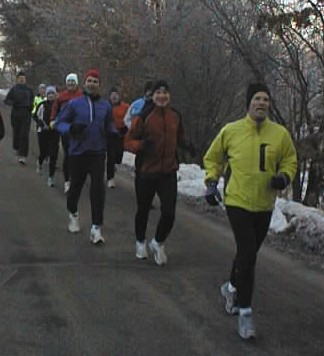
This afternoon I registered for the Twin Cities Marathon on October 7. I did it after completing a cold 5 miles run and noticed an immediate lift in my mood. I was excited to get started in the training. I realize the psychological lift comes partially from setting goals and working towards them. I have completed ten marathons since 1999, but skipped 2011 for a variety of reasons. Now that I have “bought the bib,” I need to back it up with proper training.

Running last Wednesday with friends Tim and Dave, we talked about proper training. Proper training means not being a slave to a training program and learning to listen carefully to our bodies. It means the gradual increase of weekly mileage and seeking the balance between rest and hard training. Above all it means perseverance towards the goal. I know that my initial enthusiasm will wane in the coming weeks as the training intensifies.

What has helped me a great deal in my past training has been a good group with which to do the weekly long run. As those weekly runs gradually climb to over fifteen miles or more than two hours, I appreciate having company to encourage or distract me. When I might have quit and turned back early, the group seemed to pull me along. Running is often a solitary sport, but a good running group can be a true blessing. Being now at Resurrection Lutheran, I look forward to find some new running friends.

The Apostle Paul used the image of a foot race in his writings. The Hellenistic world where he preached continued to celebrate the Olympic Games. The Games included several foot races, from 200 meters to 5 kilometers. (The marathon race is a modern development with ancient roots.) Paul had a much more serious “marathon,” establishing new missionary outposts in the cities and towns of Asia Minor and Greece. He persevered through tremendous opposition to proclaim the good news of Jesus Christ. He preached in a world where people were often more interested in who won the last Olympic wreath than in who could bring them eternal vibrant life. Sounds a bit like today. Near the end of his life Paul wrote, “”I have fought the good fight, I have finished the race, I have kept the faith” (2 Timothy 4:7).

Lord Jesus, train me to fight your good fight and to finish the race you have set before me.

R U Hungry?

This coming Sunday at Resurrection our Gospel reading will be Mark 6, Jesus’ feeding of the 5000. It is a familiar story that is in all four gospels. On several occasions when food was running low at a church event, people would approach me as pastor to duplicate Jesus multiplying the loaves and fishes. I have failed every time to perform some magic trick. However, I never remember anyone going away hungry. Usually we “s-t-r-e—t – c—h” out the food to feed whomever is needy.

Like many stories in scripture this is open to various interpretations as to how it impacts our lives. I don’t believe the story has only one meaning to it, that once the reader discovers it, the story is finished. Rather the story rubs up against my life, challenging, enlightening, guiding my life.

A primary interpretation is that Jesus is like Moses in the Exodus, providing manna in the wilderness for the people of God. In fact Jesus is God himself, since he did not need to consult God about the people’ need, but simply blessed, broke and gave the bread to the people, a foreshadowing of his “blessing, broke and gave” sequence at the Passover meal (Mark 14:22). Jesus is the one who feeds us. John 6 is a lengthy teaching on Jesus as the bread of life.

But I think a second interpretation is the calling of the disciples to feed the people.

Jesus said to them, “You give them something to eat.” (Mark 6:26)

Jesus gave the loaves to the disciples that they might feed the people. As followers of Jesus we are called to be people who feed others, literally. The church has often been an agency that works to feed the hungry. Whether it is the hungry in the horn of Africa or local hunger of our city streets, we are still called by God to feed the hungry around us.  God has blessed us that we might give to others in Jesus’ name.

Lord Jesus, teach me how to feed the hungry in your name.

Remembering Dr. Kari Egge

Dr. Kari Egge was a saint, though she would never use such a title.  She lived her faith in her vocation.  Her death this week stirred all kinds of memories for me, since she was active in the high school youth group at St. Andrew’s Lutheran Church in Mahtomedi when I first came on their staff. Kari’s brain was always working, asking deep questions that I could rarely answer.  Yet she had a passionate heart that saw the needs of the world. She went off to college at George Washington University and then into Humanitarian Aid work with such diverse organizations as the Peace Corp, Catholic Relief Services and the American Red Cross. She played key leadership roles in responding to various disaster’s world-wide from the drought in Southern Africa to the tsunami in Indonesia. She received her doctorate in Public Health from Tulane where she studied HIV/Aids and how to treat it in the developing parts of the world.

I remember one particular conversation with her when she was home visiting her parents. I had an idealistic view of her relief work, thinking how wonderful it must be to help people in need.

Her response brought me back to reality, “Much of what I do is simply handle the bureaucratic mess. I am often tired and overwhelmed; we are usually short of key supplies or personnel and the local government often restricts everything we try to do.”

“So, Kari, what keeps you going?”

“I am not sure, but often some good comes. Some people are helped . . . or lived who would have died. I sense God has a hand in that.”

Kari could have lived a very productive, meaningful life here in the United States. She had a sharp mind and wit, a fun spirit, and caring heart. Instead of staying here, she heeded the call to meet the critical needs of people in distant lands. She lived out Jesus’ command to love our neighbor as ourselves.

When she was diagnosed with terminal cancer she did not dwell on her approaching death (though she did make some rather grim jokes about it), but rather how it affect her two young children, Dylan and Isabelle. She loved them, her parents and the many friends she made around the world. I will miss her.

Lord Jesus, grant comfort to all who grieve the death of Kari Egge.  Thank you for her faithful witness of compassion.

Running Crazy

When I started this blog, I intended to write more about my running passion. For various reasons I have not. Last winter I was recovering from a chronic injury. Last summer I started running again, but got too aggressive too fast, and hit another injury that slowed my return to consistent running.

Runners are often injured. Gather three runners together and you will have an instant debate on how to treat six types of injuries. Once I talked to my doctor about a running injury. After listening to me for less than a minute, he told me, “Stop running. It will only ruin your hips and knees.” Needless to say, I did not like his diagnosis so I went in search of a new doctor. He is the Dr. William Roberts, the medical director of the Twin Cities Marathon. When I tell him I have some running issue he sends me to a physical therapist.

I have been to at least five different physical therapist and each has helped me. My most recent experience with Shannon Maixner at Fitness Focus was the most thorough and helpful. I continue to incorporate several of her exercises into my daily routine and see definite benefit.  I realize that to remain a runner I must broaden my cross-training.

I am writing about this today because I reached a new milestone today. I have run seven days in a row without pain or injury. All my runs were relatively short and slow, in the three to four mile range. Partly it is an experiment to see if frequent, short runs help my body adapt better. Partly it has been the mild winter weather in Minnesota and my need to be outside.

Running is one of the few sports mentioned in the Bible. Paul uses the analogy of the runner’s training to describe his commitment to the gospel of Jesus Christ.

I do it all for the sake of the gospel, so that I may share in its blessings. Do you not know that in a race the runners all compete, but only one receives the prize? Run in such a way that you may win it. Athletes exercise self-control in all things; they do it to receive a perishable wreath, but we an imperishable one.(I Cor. 9:23-25).

There may come a day when I will not be able to run, but until then, I plan to run often and with joy.

Lord Jesus, teach me to joyously run, walk, and dance with you.

Church: Cause, Corporation or Community?

The office staff and I are busy preparing for our annual meeting on Sunday, February 12.  Sometimes it feels like a giant jigsaw puzzle.  Last year  I wrote a post regarding the annual meeting.  In it I argued that every annual meeting needs the presence of the Holy Spirit to guide and challenge us. It remains my prayer this year.

Congregational meeting have often gotten a bad rap because they deal with controversial topics like budgets, mission and staffing. They are the central moment when the corporate business of the church takes center stage. Many (including myself) have a discomfort with this focus because it is not our strength. I did not feel call by God to RUN a church, but rather to preach the Gospel and to shepherd God’s people. Yet the corporate business of the church is necessary.

Twenty years ago Jim Dethmer wrote an article for Leadership Journal that continues to help me. He described the church as having three primary identities: Cause, Corporation and Community. As a Cause the church is like an army with a central mission: to proclaim the Good News of Jesus Christ and to drive back the forces of evil. The model participant in the Cause is the engaged volunteer who works hard to spread God’s love and grace in word and deed.  As a corporation, the church is like a business, seeking to use its financial resources in the most “profitable” ways. As a corporation the church tries to be a wise steward of its assets.  Finally as a Community the church is like a family with the central attribute being love. The focus of that love is often on the weakest among us: the sick, the grieving, the unemployed.

All three identities (Cause, Corporation and Community) have value and purpose. Scripture bears witness to all three circles.  They also can conflict with one another from time-to-time. The Holy Spirit is needed in all three circles so that such conflicts can be creative and energizing, rather than destructive.

Dethmer rightly observed that pastors often have a strength in one of these and a weakness in another. I invested much of my pastoral ministry in the community circle, writing my Doctor of Ministry Thesis on Congregational Care. I also have a passion for the Gospel of Jesus and how it can impact people’s lives. My weakest area is the corporate or business side of the church. I am very thankful for those members of Resurrection who have that as their strength and passion.  With each person using their strengths and gifts, the church can function well in all three circles.

Which circle is your passion and strength?

Lord Jesus, send your Holy Spirit to empower us to your church.

Would I Kneel?

Young Man Kneeling by Sam Loggie

Posture can be used to emphasize power and importance. Kings had high, imposing thrones to signify their power over their subjects. Visitors to ancient and medieval courts had to kneel and kiss the ring of their Lord. Even in our democratic society, leaders can be distinguished by their corner office or imposing title. Power demands attention.

In the gospel of Mark, the reader sees people posturing. In chapter five the Gerasene demon-possessed man, the leader of the synagogue (named Jairus), and a woman who suffered from chronic bleeding each knelt before Jesus and begged for his help. They all acknowledged with their kneeling posture that Jesus was Lord, a person with authority and status. They recognized the power of Jesus.

I am not one who kneels easily. I’ve come to realize that I prefer to see Jesus as my friend and guide, who accompanies me, rather than as Lord and Master who commands me. I acknowledge his Lordship verbally, but I wonder if that is more ritual than deep conviction. Am I willing to “beg” Jesus for his assistance, like Jairus (Mark 5:23)?

The question of posture comes into sharper contrast at the end of the chapter. When Jairus heard the news, “Your daughter is dead. Why trouble the teacher (Jesus) any further?” Jesus intervened. He told Jairus not to fear, but to trust in him. Jesus is Lord and has power. When they entered the room of the girl, the scripture says, “He took her by the hand.” I must assume that Jesus knelt down, since all beds were floor level. What an incredible act of tender love!

With love, Jesus knelt to meet the girl’s need. The whole incarnation is a form of God’s kneeling to meet the needs of humanity. Jesus’ birth, ministry, and death was God’s way of kneeling down before us, not to acknowledge our rebellious “power,” but as a way to enter our pain and suffering and lift us up.

As the Philippians hymn states

Jesus who emptied himself, taking the form of a slave, humbled himself and became obedient to the point of death, even death on a cross.

Therefore God highly exalted him and gave him the name above that is above every name, so that at the name of Jesus, every knee should bend, in heaven and on earth and under the earth (Phil 2:7-10)

Lord Jesus, as you knelt to save me, now teach my knees and my heart to bend towards you.

“Do I Have To Go?”

Barbara Brown Taylor wrote a helpful book on preaching that extends way beyond preaching. Here is a section that she wrote regarding where we go when we follow Jesus.

Affirming the ministry of every baptized Christians is not an idea that appeals to many lay people today. It sounds like more work, and most of them have all the work they can do. It sounds like more responsibility, while most of them are staggering under loads that are already too heavy. I will never forget the woman who listened to my speech on the ministry of the laity as God’s best hope for the world and said, “I’m sorry, but I don’t want to be that important.”

Like many of those who sit beside her at church, she hears the invitation to ministry as an invitation to do more —to lead the every member canvas, or cook supper for the homeless, or teach vacation church school. Or she hears the invitation to ministry as an invitation to be more—to be more generous, more loving, more religious. No one has ever introduced to the idea that her ministry might involve being just who she already is and doing what she already does, with one difference: namely that she understands herself to be God’s person in and for the world. (The Preaching Life, p.27-28)

I totally agree with Barbara that our ministry is our daily activities and relationships, but lived with the identity of being a child of God. God has placed each of us in our unique settings to be God’s agent, God’s hands, feet, heart and voice in God’s world. We don’t need to travel to a distant land to do “mission” work, we do “mission” work in our homes, offices, schools, and community as we interact with others. A “mission” trip may help us to see the needs of God’s world and to discover our dependable strengths and gifts to meet those needs. It may strengthen our relationship with God and others, but mission can happen wherever we are.

Lord Jesus, let me rediscover my mission in you today.

Go Where I Send You

Why would Jesus turn someone away? Someone who begs to follow him?

In Mark 5, Jesus casted out the demon named Legion from a man who lived in Gerasenes, a Gentile region of northern Palestine. When he was restored to his right mind, he sat with Jesus. His neighbors were in an uproar and begged Jesus to leave. As Jesus entered his boat, the man begged to be with Jesus, to be a disciple. Jesus refused.

But his refusal had a purpose. This man was given a very special mission. Jesus said to him,

Go home to your friends, and tell them how much the Lord has done for you, and what mercy he has shown you (Mark 5:19).

This is quite similar to the mission that the apostles are given in the next chapter of Mark. I find it both ironic and hopeful that this Gentile, recently-possessed man is given the mission of proclamation prior to the carefully selected twelve. I also find it highly instructive that he would be given this task to go to his friends and neighbors, not some distant land or foreign culture. Also as one who has recently experienced mercy of Jesus, he is a passionate advocate for Jesus. New converts are often the most passionate and assertive regarding their faith in Christ.

As a Lutheran pastor, I know that some people are specifically called to be pastors and teachers of Jesus’ message. I am thankful for those who answer that specific call. Yet, as this story bears witness, we can all bear witness to what Jesus has done for us, how we have experienced the Lord’s mercy and joy. God may send us to a new location, but the more probable is that he will send us to our friends and neighbors to give witness.

The Gospel of Mark never mentions this man’s name nor reports on his mission, except that all are amazed at the man’s testimony. Let us together rejoice in God’s mercy and amazing grace towards us.

Lord Jesus, help me to be attentive to your voice and to be willing to use my voice to speak of your mercy.

Breaking Free of Chains

No one could restrain him any more, even with a chain. (Mark 5:3)

In Mark 5, Jesus crossed the Sea of Galilee into Gentile territory. He was outside of his native Jewish land and his first encounter is quite symbolic, a demon-possessed man. The encounter with the unclean spirit is described in rich detail. He is living among the tombs (the dead) and totally alone. People had tried to bind him with chains, but failed due to the strength of the demons. The man must have been in great pain, howling at night and bruising himself with stones. He would not be someone I would be excited to meet. My first reaction would be to build a fence to keep him out.

The story may sound bizarre and strange to our ears, but the reality of people caught in destructive behavior is real. To be possessed by Satan should not be restricted to horror movies or distant lands. While I believe in demonic possession and the power of Satan, I also believe that the demonic is more cloaked and hidden in our modern culture.  Addiction, cutting, pornography, and abuse are some of the means that Satan uses today to bind us in chains. Drew Jonell’s photo reminds me that our chains can try to keep us from the light.

As C. S. Lewis once cautioned there are two dangers with a Christian’s understanding of Satan. One is to deny his existence and thereby open the door to his temptations. The other danger is too become overly obsessed with Satan’s affairs.  The Gospel writers see both dangers and steer clear of either. Demons are confronted, but Jesus always wins. The scriptures show us that demons, like death,  may distract us from Jesus, but they will ultimately be defeated. We are to keep our eyes on Jesus.

C. S. Lewis also wrote in Screwtape Letters, “Indeed the safest road to Hell is the gradual one–the gentle slope, soft underfoot, without sudden turnings, without milestones, without signposts.”

The cross and empty tomb are our signposts on the way to God’s kingdom.

Lord Jesus, continue to save us from the time of trial and to deliver us from evil.