Category Archives: Uncategorized

Looking Backward and Forward

The last verses of the Old Testament have both a backward and forward orientation. Malachi instructs the reader to Remember the past and to Anticipate the future.

Remember the teaching of my servant Moses, the statutes and ordinances that I commanded him at Horeb for all Israel. (Malachi 4:4)

Lo, I will send you the prophet Elijah before the great and terrible day of the Lord comes. He will turn the hearts of the parents to their children and the hearts of children to their parents. (Malachi 4:5-6)

Malachi reminds us that God has worked in Israel’s past. Look back and remember how God worked at Mt. Horeb (Sinai). It calls us to remember how God has worked in our own past, to instruct and teach us.

I remember making a pilgrimage to Holy Trinity Lutheran Church in Port Angeles, Washington, to remember the place where I first learned the Bible stories, acted in Christmas plays and sang the familiar carols. Christmas has so many specific memories for many of us. It can be simple nostalgia, but it can also become a deep spring of joy, light and love that calls us back to our spiritual roots. Where and when do you remember hearing the story of God’s statutes?

Yet Malachi also pushes into the future, that God is not simply an ancient figure of distant history, but a God who will act in our future. The prophet Malachi recycles the ancient prophet, Elijah, to describe the messenger who is coming. (Elijah had not “died” but was taken up into heaven on a chariot of fire, 2 Kings 2:11). The future return of Elijah will cause our hearts to turn to one another, to bring peace and harmony to God’s family. And God’s family is much larger than our own households; Jesus redefines family in the New Testament.

Looking at those who sat around him, Jesus said, “Here are my mother and brothers! Whoever does the will of God is my brother, sister and mother.”

Further, Jesus, the Son of God, turns the hearts of God’s children to their heavenly Papa. The future is so much brighter than our present reality. To what do you look forward in God’s glorious kingdom?

As we read scripture, we need to be mindful of how the past, the present and the future all intertwine.

Lord Jesus, be thou my vision, backwards and forwards.

See, the Day is Coming

Malachi is the last book of the Old Testament in the Christian Bible yet it points beyond itself.  It is not the final chapter in God’s dealing with Israel, but rather points to something yet to come.

See, the day is coming, burning like an oven, when all the arrogant and all evildoers will be stubble; the day that comes shall burn them up, says the Lord of hosts, so that it will leave them neither root nor branch.  But for you who revere my name the sun of righteousness shall rise, with healing in its wings. You shall go out leaping like calves from the stall. (Malachi 4:1-2)

Malachi assumes two things.  First, the future day of God’s judgment has not come yet.  God is not finished with God’s creation.  The second assumption is that you and I, the readers of this text, will receive mercy and healing, not burning judgment.  There is hope for you in this world.

As Charles Welsey wrote in  the third stanza of the Christmas carol, Hark the Herald Angels Sing, quoting Malachi 4:2.

Hail the heav’n-born Prince of Peace!
Hail the Sun of Righteousness!
Light and Life to all he brings,
ris’n with healing in his wings.

God’s day will come with Jesus Christ.  He is the true climax to the story of the Old Testament as well as our human story. Are you ready to leap?

Lord Jesus, come quickly so I can leap with joy and justice.

The Fiery Furnace and Christmas

The book of Daniel challenges the “normal” perspective of the Old Testament. Throughout the Old Testament, God addressed the people or culture of Israel as a whole. From the exodus, through the wilderness wanderings  up to the divided Kingdoms of Israel and Judah, God interacted with a unified culture: kings and prophets, merchants and farmers. “You shall have no other god before Me.”

In the book of Daniel this changed. The Jews who are in exile in Babylon are not the dominant culture, but rather a small minority. A king like Nebuchadnezzar might come to recognize the God of Shadrach, Meshach and Abednego when God delivers them from the fiery furnace, but he does not force the whole of his society to conform to Jewish culture. Instead the stories of Daniel show how the Jews resisted the religious rules of the dominant culture, even when it might cost them their lives. The Jews in exile had entered a multicultural world.

I wonder if this has a lesson for Christians in the season of Christmas. I know that some Christians are upset that the dominant culture gives only token acknowledgment to the religious basis for Christmas, replacing the manager and baby Jesus with the Christmas tree and Santa Claus.  There are some Christians who long for a more “pure” holiday, when school concerts could sing “Silent Night”” and public prayers could refer to Jesus Christ as Lord. But our current reality is more like the Jews in exile in Babylon than as citizens in the Kingdom of Judah. We might long to live in a monolithic culture in which society promotes our spiritual vision, but we do not.  We live in a multicultural world, with competing worldviews and behaviors.

What this means is that Christians need to do an even better job of telling the great true story of God and Christmas. The book of Daniel was written for the discouraged, scattered Jews to encourage them in the exile and beyond.  The story stated that God still ruled in Babylon, even when kings and other officials denied Him.  The story continues to proclaim that God still rules in America, even if our officials remain silent. And like Meshach, Shadrach and Abednego, we can serve in government, schools, or media, knowing that they are not “god,” and that we may have moments to bear witness to the God who can deliver, Jesus the Christ.

Jesus, let me bear witness to you as my deliverer.

Prison Prayer

I have always admired Dietrich Bonhoeffer.   Bonhoeffer was a Lutheran pastor who worked for the resistance against Adolph Hitler and was executed in April 1945 for his participation in the plot to assassinate Hitler.  He reminds me of Shadrach, Meshach and Abednego when they stood up to the religious tyranny of King Nebuchadnezzar in Daniel 3.   Written in prison, Bonhoeffer’s prayer could have been their prayer.  It certainly can be ours.

 O God, early in the morning I cry to you.
Help me to pray
And to concentrate my thoughts on you;
I cannot do this alone

In me there is darkness,
But with you there is light;
I am lonely, but you do not leave me me;
I am feeble in heart, but with you there is help;
I am restless, but with you there is peace.
In me there is bitterness, but with you there is patience;
I do not understand your ways,
But you know the way for me.

O heavenly Father
I praise and thank you
For the peace of the night;
I praise and thank you for this new day;
I praise and thank you for all the goodness
and faithfulness throughout my life.

You have granted me many blessings;
Now let me also accept what is hard
from your hand.
You will lay on me no more
than I can bear.
You make all things work together for good
for your children.

Lord Jesus Christ,
You were poor
and in distress, a captive and forsaken as I am.
You know all man’s troubles;
You abide with me
when all men fail me;
It is your will that I should know you
and turn to you.
Lord, I hear your call and follow;
Help me.

I remember in your presence all my loved ones,
my fellow-prisoners, and all who in this house
preform their hard service;
Lord have mercy.

Restore me to liberty,
and enable me so to live now
that I may answer before you and before men.
Lord, whatever this day may bring,
Your name be praised. AMEN.

(Letter and Papers from Prison, 1971, p. 139)

Gloom, Doom and Light

My nephew, Andy Young, an avid photographer, snapped this gripping photo of Seattle on a gloomy afternoon. I immediately thought of both the prophet Jeremiah and the season of Advent.

First, Jeremiah spoke to the people of Jerusalem of the impending disaster that was coming. The people had forsaken their covenant with God and so God gave them a real wake-up call.

But my people have forgotten me, they burn offerings to a delusion; they have stumbled in their ways, in the ancient roads, and have gone into bypaths, not the highway, making their land a horror, a thing to be hissed at forever. Like the wind from the east, I will scatter them before the enemy. I will show them my back, not my face, in the day of their calamity. (Jeremiah 18:15-17)

In 587 BC Jeremiah’s “Word of the Lord” became reality. The Babylonian army march into Judah and conquered Jerusalem. The temple of God was destroyed. The leadership and skilled laborers were taken as prisoners into Exile in Babylon. It was a day of calamity.

But Jeremiah continued to speak God’s Word and so streaks of light and hope came to the people. Jeremiah promised a new covenant, a new relationship between God and God’s people.

But this is the covenant that I will make with the house of Israel after those days, says the Lord: I will put my law within them, and I will write it on their hearts; and I will be their God, and they shall be my people.  No longer shall they teach one another, or say to each other, “Know the Lord,” for they shall all know me, from the least of them to the greatest, says the Lord; for I will forgive their iniquity, and remember their sin no more. (Jeremiah 31:33-34)

This promise is one reason Jeremiah fits so well in the season of Advent. Though we may wait in the dark gloom of winter, praying for spiritual light, we lean towards the coming light of Christmas. A new covenant that will be born in Bethlehem. Alleluia!

Lord Jesus, let your light shine bright through me.

One Year Reflection

Marmot Lake in Washington Cascade Mountains

One year ago today I started this blog. I wanted a platform by which to communicate some of my passion to trust, live and serve as a follower of Jesus Christ. As a newly called pastor at Resurrection Lutheran Church, I wanted a way to communicate with the congregation and beyond. In my first blog, I wrote about having three foci: the physical, mental, and spiritual components of faith. I also thought that I would be posting three times per week.

It turns out that I have posted an average of 4.5 times per week and my favorite topic has been reflections on scriptures. I like to think this blog as a supplement to my sermons on Sunday, helping prepare people for Sunday worship or giving additional insight afterward (“nuggets” that I could not work into my Sunday sermon).

Also I have done a variety of life posts. One of my most “visited” posts was last April when I wrote about my son’s engagement. I have reflected several times regarding my journey with my aging mother. And whenever I can write about the beauty of wilderness I rejoice.

I have not written as much about running as I first thought, probably because I have been struggling with a number of chronic running injuries. As those seem to be clearing up, I may return to that topic on occasion. Running often clears the mind for writing.

I still think this a valuable tool for communicating with the great people of Resurrection and beyond. Though I often post some short comments on Facebook or Twitter, the longer format of a blog seems to work well for me.  If you have any comments/topics/critique, please leave a comment or send an email. Like most bloggers, I appreciate comments.

(BTW, my e-mail is back at resurrection-woodbury.org)

Iron sharpens iron, and one person sharpens the wits (and the words) of another. Proverbs 27:17.

Lord Jesus, thank you for the communion of saints.

Done Enough?

Yesterday our e-mail and website went down. Our domain name, resurrection-woodbury.org, was dropped as our congregation transitions to a new webhosting site. I am so thankful for people like our office administrator, Sue Guck, and our web volunteer, Matthew Mayer, who immediately saw the problem and are now working hard to correct it.  We should be back up by tomorrow. Technology is a great tool, but it has its glitches.

Though frustrated by this event, it caused me to reflect on my overreliance on such technology tools and the constant “buzz” it produces. I have this feeling that I NEED to be connected. Such feelings can become unhealthy. Sort of like overtraining in running, or becoming a workaholic, it is too much of one thing. God gave us work, exercise and community as gifts, but they are not to become “gods.”

The Sabbath is also a gift from God. Wayne Muller has written about sabbath rest for the Lutheran magazine. He asks the question, “When have we done enough?” Since many of us think we cannot rest until we have finished everything, we never rest.

I remember being on a retreat with a large number of pastors and doing a devotion on resting in God. The one response that stood out was a pastor who said he could never rest, since there is still one more person to visit, one more couple to counsel, one more family to help. God “expected” him to bring care to the entire congregation. I wondered silently, “are you trying to be God, rather than God’s agent?”

So many of us just keep plowing along. Sabbath is the promise of God that we have done enough, worked enough, served enough. It is the promise that we can rest in God’s promise that we are God’s children in spite of our inadequacies and unfinished business. It is a gift of grace that needs to be practiced weekly, whether we are finished or not.

Jesus said, “Come to me, all who are weary and are carrying heavy burdens, and I will give you rest.” (Matthew 11:28)

Lord Jesus, let me rest in you today.

Stir-up Sunday

This week is filled with colorful adjectives: Thanksgiving Thursday, Black Friday, Small Business Saturday, and Cyber Monday.   Somehow Sunday was skipped.  Perhaps we could name it Stir-up Sunday (from Bishop Larry Wohlrabe).  He is remembering the prayer for the first Sunday in Advent:

Stir up your power, O Lord, and come. Protect us by your strength and save us from the threatening danger of our sins, for you live and reign with the Father and the Holy Spirit, one God, now and forever.  (Lutheran Book of Worship, p.13)

The prayer is based on Psalm 80:1 -2.

Give ear, O Shepherd of Israel, you who lead  Joseph like a flock!  Stir up your might and come to save us.

I certainly could use some of that stir-up power.

A Thanksgiving Story

Thanksgiving seems like an odd holiday to me. After all shouldn’t we be thankful every day? Why give this virtue a special holiday? We don’t set aside a holiday for patience, joy, peace, kindness or hope. (We might consider Valentine’s Day as the special “love” day, but that is a blog unto itself). Still a thanksgiving story seems appropriate.

In the 1930s, George Strester remembers his father who tried farming in Nebraska in 1873. Thanksgiving was approaching and the family had a tough harvest due to the dry and dusty summer. They wanted to give thanks, but the pantry was nearly bare, so George’s father decided to butcher the cow. It had become nice and fat from eating a variety of vegetables, including some rotten onions, but had gone dry and was not giving any milk.

The children all shed a few tears when Old Broach the cow was killed, for she was a family pet, but the family needed to have something to eat. The cow was butchered the day before Thanksgiving and the next day George’s mother planned a real Thanksgiving feast. — a large roast of meat with potatoes and carrots lay around it. Something the family had not had for years.

However a peculiar odor filled the house as the meal was cooking. Mother said it might have been something on the stove, which now was causing the terrible odor. The table was set and the roast was brought out and how delicious it looked. George’s father first gave a prayer of deep thanks for the many blessing that the family had enjoyed and then he carved the roast, placing a liberal helping of meat, carrots and spuds on each plate. George’s mother took a bite and looked at her husband; he took a taste and looked at the kids.

George took a mouthful and his stomach heaved, – horror of horrors, the taste of rotten onions had permeated every piece of beef. Their cow had not simply fattened up on vegetables, but on rotten onions. Their entire dinner was spoiled and all they had to eat were johnnycakes with nothing to put on them.

Still George observed that though his father was greatly tempted, he did not say any cuss words, but decided on that day, to quit farming and reaffirm his vocation as a Methodist minister.

The Strester family took a moment that could be called a family disaster and turned it into a memory of laughter and joy. It was also turning point in their lives. Their father rediscovered his calling and the family was able to adapt to the changes.

God takes our crisis points, small or large, and turns them into his moments of joy and thanksgiving.

Lord Jesus, thank you for your gifts of grace, love and joy.  Create within me a thankful everyday.

Jesus and the Temple in John

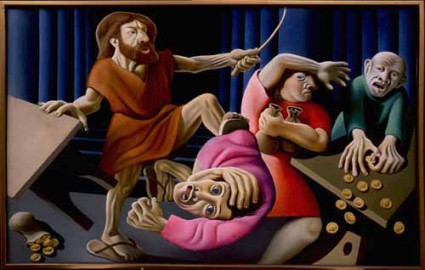
Christ Driving the Money Changers from the Temple by Michael Smithers

With my recent posts on Isaiah and the Temple in Jerusalem, I am reminded that Jesus had some harsh words about the Temple. Solomon’s temple had been destroyed in 587 BC by the Babylonians. The temple was rebuilt in 515 BC but it was not as grand as the previous temple. King Herod had started a major rebuilt of the temple prior to Jesus’ birth.

Early in John’s Gospel, Jesus had a confrontation with the Temple leaders. After driving the money changers from the courtyard with a whip, he was asked, “What sign can you show us for doing this?”

Jesus answered them, “Destroy this temple, and in three days I will raise it up.” The Jews then said, “This temple has been under construction for forty-six years, and will you raise it up in three days?” But he was speaking of the temple of his body.  (John 2:19-21)

Jesus and the Samaritan Woman by He Qi

Later in the gospel, Jesus had a conversation with a Samaritan woman regarding the proper place of worship. Samaritans worshipped on Mt. Gerizim while Jews claimed Mount Zion as the one true place to honor God. Jesus responded,

“Woman, believe me, the hour is coming when you will worship the Father neither on this mountain nor in Jerusalem. The hour is coming, and is now here, when the true worshipers will worship the Father in spirit and truth, for the Father seeks such as these to worship him. God is spirit, and those who worship him must worship in spirit and truth.” (John 4:21-24)

Jesus redirected our understanding of worship away from rituals and places to the essence of worship, a transformed heart or spirit. When our spirit aligns with God’s Spirit worship becomes true and real.

Finally in John’s Gospel, after Jesus’ crucifixion and resurrection, he appeared to the disciples in the locked upper room. Clearly this is not the Temple. But Jesus breathed on them and said to them, “Receive the Holy Spirit.” (John 20:22) The Spirit of God no longer resided in a building of stone, but in gathered human community. You are God’s Temple now. The temple of God has become the portable tabernacle again. Anyone have a tent?

Lord Jesus, send your Holy Spirit into my life today! Transform me into one who worships you in spirit and in truth.