Category Archives: worship

Citizens with the Saints

Eight youth and two adults from Resurrection Lutheran Church are on their way to the Evangelical Lutheran Church in America (ELCA) National Youth Gathering in New Orleans. They will join more than 36,000 participants from across the country for five days of service, study, and worship. They will gather under the theme of Citizens with the Saints, based on Ephesians 2:14-20:

Jesus is our peace. In his life and death on the cross, Jesus broke down the dividing walls so that we are no longer strangers and outsiders, but we are citizens with the saints and also members of the household of God. The foundation of God’s house was built of apostles and prophets, and Jesus, the cornerstone, holds it all together.

Like many of the participants, this will be a mile-stone for our youth. Growing up in a congregation like Resurrection, where their confirmation class is from 15-20 classmates, our youth often perceive the church as a small intimate group. Gathering with several thousand other youth will expand their vision of what the church is and can become. The Holy Spirit power of 36,000 youth singing and rocking the Superdome will energize and renew the faith of many who attend.

A couple of years ago, I attended a similar Christian gathering called Catalyst. About 10,000 young adults gathered from across the nation in a small arena in suburban Atlanta. The packed arena of singing, cheering, stomping, passionate followers of Jesus Christ made my heart sing.

I am so proud of how Hannah Koehler, our first-year youth director, has worked to make this mission trip become reality for our youth. She attended a National Youth Gathering several years ago and the experience transformed her life. She and others on the trip are writing their own blog to keep our congregation informed.

I invited you to join me in praying for all the youth in New Orleans this week as they discover their place as Citizens with the Saints.

Lord Jesus, bless, encourage and nurture all the youth who have gathered in New Orleans this week.


Work, Play and Worship

This week starts a new ministry at Resurrection called Four Square, named after the popular playground game. The four squares of the ministry are explore, play, serve and grow. The children will explore the Bible, serve various needs in the community, play games like four square, and grow in their faith and relationship. Today they actually painted a Nine-Square court in the church parking lot for all to use.

The “play” part of Four Square made me think of a comment that I explored somewhat last year. The idea is that in our American culture we confuse worship, work and play. We worship our work, work at play and play at worship. I know that I can be guilt of each attribute at times.

First we tend to worship our work. Especially men in our society can make their careers the center of their lives. Our whole identity can revolve around our careers and how successful we are within it. Careers often have a clear hierarchy of who is moving up the ladder and who is not. Though God calls us to work in God’s creation, God does not call us to place our career success at the center of our lives. I confess that I can place MY pastoral status ahead of my faithfulness to God’s mission and calling. “Seek first the Kingdom of God and his righteousness and all these things shall be yours as well” (Matthew 6:33).

Second we can work at our play. In our American culture, we can turn our leisure into a new work obsession. Whether it is fishing, hunting, golf, running, tennis, gardening, woodworking or biking, we can turn what is meant to be restful and renewing into competitive, stressful work. I know that I have at times turned my love of running into an obsession when I am training for a marathon and my whole life begins to revolved around a rigorous training schedule. I have this elusive goal of qualifying to run in the Boston Marathon someday, but my fixation can rob me of the joy of simple running. My recent use of the Phil Maffetone training method has helped me slow down and to enjoy the playful act of running.

Finally we can play at worship, or, in other words, turn worship into entertainment. We measure how effective worship is by how popular the worship service is or how people felt during the service. We get confused about the focus of worship. Worship is not about the worshippers, but about God being central to our lives.

God is not my “cosmic therapist” who makes me feel good about myself, but rather my Creator, Savior and Guide before whom I bow in wonder and adoration. God is God, ruler of the universe. True worship helps me remember and live with God at the center. “God is spirit and those who worship him must worship him in spirit and in truth” (John 4:24).

So today, let us live with God at the center, in our work, play and worship.

Lord Jesus, remain Lord of my life in my work, play and worship.

Go In Peace?

Every week at the end of worship, I walk to the back of the worship area and after the last song I say, “Go in peace. Serve the Lord.” The congregation responds, “Thanks be to God.” I have said those words over a thousand times in a variety of settings. I believe in the power of those words, that the congregation is sent into God’s world to be God’s ambassadors of light, hope and love. I proclaim the words with enthusiasm and hope.

Last week I was at our Synod Assembly, where representatives of the 115 congregations of the Saint Paul Area Synod of the ELCA gathered to do the business of the church and to reflect together on what it means to Live Lutheran. We started with worship and at the end I heard the words again, “Go in peace. Serve the Lord.” Of course, we were going “nowhere,” but remaining at our table and chairs for the Assembly. The oddity of the phrase triggered deeper reflection on the words, especially the idea of going in peace.

Peace in the Biblical sense is wholeness or fullness. The Hebrew word for peace, shalom, means that you have everything you need to be whole in your relationship with God, neighbor and self. To “go in peace,” means the worship has filled your cup of blessing and you leave worship whole and empowered to serve.

However in our culture, peace often simply means the absence of struggle or conflict. We are often use peace for a sense of calm and almost passivity. A peaceful lake is calm and tranquil. There are times in our lives when each of us needs a place of tranquil peace.  But such peaceful waters have the danger of becoming stagnant and dead if no outflow occurs.

I wonder if the word “peace” communicates what God truly wants from us? Could it be that instead of going in “peace,” God would want us at times to go with PASSION, the fullness of God pushing us out the door to serve with passion, energy and conviction? The energy and life of a cascading river might be a better picture of what God call us to be in the world.

God’s peace is not passivity but passion.

Go with passion. Serve the Lord.

Lord Jesus, energize my soul with your power and grace to serve you and your world.

Acting Out

Yesterday I was excited as I taught the children to “leap” with praise.  In worship we read Acts 3, the story in which Peter and John healed a crippled beggar outside the temple gate and the man entered the temple with them, “walking and leaping and praising God.” The children and I enjoyed leaping up to give God’s praise. Their energy got me ready to preach.

The original healing and leaping gave Peter the opportunity to preach as well. The miracle caused such a commotion that Peter had to address the crowd to direct the crowd’s attention away from John and himself and back to Jesus Christ. He called the crowd to repent and turn to God (Acts 3:19).

This is Peter’s second sermon in the book of Acts. After the first, on the day of Pentecost, the crowd asked what they needed to do. Peter respond, “Repent and be baptized;” three thousand were baptized that day (Acts 2:38,41). Marvelous fruit for one sermon.

Peter’s second sermon had a different effect: the priest and officials of the temple arrestted them because they were proclaiming that in Jesus there is the resurrection of the dead (Acts 4:1-2). Peter and John were “acting out” against the norms of their temple religion and had to be quieted in some way. So the leaders questioned Peter and John by whose authority they were teaching and healing. Peter, by the Holy Spirit declared to these religious officials,

Let it be known to all of you and to all the people of Israel, that this man is standing before you in good health by the name of Jesus Christ of Nazareth, whom you crucified, whom God raised from the dead (Acts 2:10).

Nothing is keeping Peter from proclaiming Jesus with all boldness, even to the gang that had Jesus executed.

May we each have such boldness to proclaim Jesus Christ.

Lord Jesus, give me courage to speak your name, even to act out when needed.

Seeds that Bear Fruit

Yesterday was a great day of worship at Resurrection. The youth lead us in prayer, preaching and song. All did a great job, from the sound and video team to the ushers and greeters.  I am especially grateful for our three preachers, Cooper Dillon, Garth Natwick and Ryan Garbe. All three have been active in the congregation for years and they each expressed their appreciation for how the congregation and pastors have shaped their faith. Each declared their faith in Jesus as a dynamic, growing relationship that has grown over many years of participation.

Being the newcomer at Resurrection, I need reminding that a solid foundation has been laid prior to my coming. I tend to live my life in episodes and seasons, seeing only the immediate events around me. I forget that God is weaving a much bigger narrative through the life of this congregation and through the history of the global church. The Holy Spirit has been shaping the lives of the youth and families long before I began my ministry here. It is joy to witness the seeds that were planted bear fruit for God’s Kingdom.

Paul wrote about this in his first letter to the Corinthians as the congregation argued over which pastor had the more lasting spiritual impact,

What then is Apollos? What is Paul? Servants through whom you came to believe, as the Lord assigned to each. I planted, Apollos watered, but God gave the growth. I Corinthians 3:5-6

The good news of yesterday was highlighted in the generous response of the congregation for our Youth Scholarship Fund. Over $3500 was donated so that eight of our High School Youth can attend the ELCA Youth Gathering in New Orleans this summer. Thanks be to God!

How has your church community shaped your faith?

Lord Jesus, continue to call me back into deeper relationships with all your children, young and old.

Rushing towards Christmas

Santa racing on a bicycleChristmas is fast approaching. On my way to work this morning, two people asked me if I was ready. It seems like Christmas has become an invasion that requires complex preparation, sort of like the D-day invasion of Normandy beaches during World War II. There are the gifts to buy and wrap, the cookies to bake, the programs and parties to attend. Each is good in itself, but the intensity and high expectation surrounding each piece puts a crimp in the holiday season. Some people just seem to go crazy with the stress of the holidays.

Of course, the first Christmas was a very simple affair: a mom, a dad, and a baby. The setting was a lowly stable, nothing fancy. There was a great sound and light show with angelic choirs, but the family only heard about it second-hand. Mary and Joe kept their focus on the baby. Later Mary pondered the shepherd’s words (Luke 2:19).

As a pastor, my Christmas celebration revolves around the worship services on Christmas Eve and Day. With the familiar carols and Gospel story, it is hard to deliver something new and spectacular. Many have told me that their deepest, most joyful Christmas memory is lighting candle in a darkened church and singing Silent Night, Holy Night. Tradition has depth that builds intensity year-by-year. The new and spectacular is overshadowed by the old and familiar.

I pray that you will have time to ponder, to reflect, to simply embrace God’s love for you. It might be late at night after the packages are wrapped, or early in the morning before you run last set of errands. The Prince of Peace is coming. He is coming for you.

Lord Jesus, break through the complexity of my life and grant me peace, your peace.


Zeal Gone Too Far?

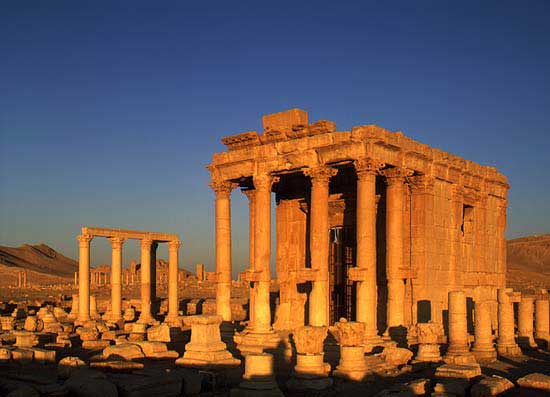
Temple of Baal in Shamin Syria

Having preached Sunday on King Josiah’s renewal of God’s covenant in 2 Kings 22, I am fascinated with his reforms afterwards. According to the book of 2 Kings, Josiah was one of the few kings who followed in the path of God. Despite being raised in a palace where the fertility idols of Asherah and Baal were preferred, Josiah placed his trust in the God of Abraham, Isaac, Jacob and David. And when he heard the Book of the Law for the first time, he became zealous to reform the religion of Jerusalem and surrounding Judah.

First he cleaned out the temple of Solomon, the house of the Lord, removing all the foreign idols (2 Kings 23:4). He burned them outside of Jerusalem and scattered their ashes on public graves, which desecrated these ancient cultic objects. He marched out into the countryside to destroy the “high places” or non-Temple worship sites. He also expelled any foreign priests.

Such “zealous” action may sound excessive to our tolerant ears. Living in our pluralistic culture, we may read such harsh actions as bigotry and intolerance. Yet Josiah and the people of Judah had been given a very specific mission from God: to trust in the Lord God alone. Without this radical obedience their mission could easily be diluted into cultural irrelevance by the neighboring nations. No one would be following God’s covenant. Still, I doubt that we are called to burn or destroy the temples of other religions today. Such a brutal attack would not be honoring Jesus command to love our neighbor (Matt 22:39).

There is a second part to Josiah’s reforms that speaks more directly to our day and culture. It was a revitalization of worship towards the Lord God. He reintroduced the celebration of Passover in Jerusalem, a celebration of God’s victory in releasing the Hebrew slaves in Egypt. (2 Kings 23:21-23). The same holds true today. As Christians we need to more completely understand and celebrate our heritage as God’s people. The narrative lectionary has helped our congregation rediscover some of the Vibrant Life of Faith that can be found in the Old Testament. We don’t need to burn “high places,” but we can certainly burn with the light of faith in God. Our light can beckon our neighbor to a Vibrant Life of Faith in Christ.

How do you bear witness to faith in God in our pluralistic society?

Lord Jesus, may I be faithful as you are faithful.

Jesus and the Temple in John

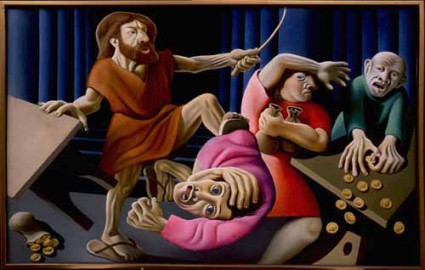
Christ Driving the Money Changers from the Temple by Michael Smithers

With my recent posts on Isaiah and the Temple in Jerusalem, I am reminded that Jesus had some harsh words about the Temple. Solomon’s temple had been destroyed in 587 BC by the Babylonians. The temple was rebuilt in 515 BC but it was not as grand as the previous temple. King Herod had started a major rebuilt of the temple prior to Jesus’ birth.

Early in John’s Gospel, Jesus had a confrontation with the Temple leaders. After driving the money changers from the courtyard with a whip, he was asked, “What sign can you show us for doing this?”

Jesus answered them, “Destroy this temple, and in three days I will raise it up.” The Jews then said, “This temple has been under construction for forty-six years, and will you raise it up in three days?” But he was speaking of the temple of his body.  (John 2:19-21)

Jesus and the Samaritan Woman by He Qi

Later in the gospel, Jesus had a conversation with a Samaritan woman regarding the proper place of worship. Samaritans worshipped on Mt. Gerizim while Jews claimed Mount Zion as the one true place to honor God. Jesus responded,

“Woman, believe me, the hour is coming when you will worship the Father neither on this mountain nor in Jerusalem. The hour is coming, and is now here, when the true worshipers will worship the Father in spirit and truth, for the Father seeks such as these to worship him. God is spirit, and those who worship him must worship in spirit and truth.” (John 4:21-24)

Jesus redirected our understanding of worship away from rituals and places to the essence of worship, a transformed heart or spirit. When our spirit aligns with God’s Spirit worship becomes true and real.

Finally in John’s Gospel, after Jesus’ crucifixion and resurrection, he appeared to the disciples in the locked upper room. Clearly this is not the Temple. But Jesus breathed on them and said to them, “Receive the Holy Spirit.” (John 20:22) The Spirit of God no longer resided in a building of stone, but in gathered human community. You are God’s Temple now. The temple of God has become the portable tabernacle again. Anyone have a tent?

Lord Jesus, send your Holy Spirit into my life today! Transform me into one who worships you in spirit and in truth.

Climb the Highest Mountain

Mount Everest

In the first chapter the prophet Isaiah attacked Temple worship in Jerusalem as a burden and abomination to God (see last post). Yet a chapter later Isaiah made a completely different declaration about temple worship.

In days to come, the mountain of the Lord’s house shall be established as the highest of the mountain and shall be raised above the hills; all the nations shall stream to it. Many people shall come and say, “Come, let us go up to the mountain of the Lord, to the house of the God of Jacob; that he may teach us his way. (Isaiah 2:2-3)

Isaiah is not saying that Mount Zion (where the temple sat) would suddenly become a volcano and literally become a new Mt. Everest for mountain climbers.  Rather, using metaphor, Isaiah declared that the Temple would become a magnate drawing all people into relationship with God and the esteem given to Mount Zion in Jerusalem would be sky-high. The temple would be a great blessing to all nations, just as Abraham had been promised in Genesis 12.

The shift from attack to blessing and promise may seem abrupt to our ears, but Isaiah believed the people’s hearts would be changed. No longer would they go through the empty motions of sacrifice and prayer, but rather their worship would be the avenue by which they renewed their covenant relationship with God. Worship would become real and heart-felt. Prayer would be honest and transforming.

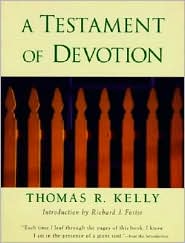
Perhaps too often we approach worship as a kind of therapy session to fix our life problems. We want to consult God like Google: to type in our worries and have him list out possible solutions. Thomas Kelly proposed a deeper, more intensive view of worship similar to Isaiah.

Swiss Valley

It begins first of all in a mass revision of our total reaction to the world. Worshipping in the light we become new creatures, making wholly new and astonishing responses to the entire outer setting of life. These responses are not reasoned out. They are, in large measure, spontaneous reactions of felt incompatibility between the world’s judgment of value and the Supreme Value we adore deep in the Center. (A Testament of Devotion, p. 47)

Lord Jesus, you are the true temple which draws all people to yourself.

Dead Worship or Vibrant Life?

Worship created a controversy for the prophets of the Old Testament. The Lord God had instituted temple worship during the reign of King Solomon. The temple in Jerusalem had various rituals like animal sacrifices and pray incense which had roots from the time of Moses and the Exodus. The Israelites were expected to worship God in the temple on a regular basis and many did.

However the prophets spotted a major problem in worship. It had become empty rituals that did not transform the lives of the worshippers. The prophet Isaiah spoke against such abuses,

What to me is the multitude of your sacrifices? says the Lord;
I have had enough of burnt offerings of rams
and the fat of fed beasts.
Trample my courts no more; bringing offerings is futile;
your appointed festivals my soul hates;
they have become a burden to me,
even though you make many prayers, I will not listen;
your hands are full of blood. (Isaiah 1:11-15 abridged)

Worship had not transformed God’s people into agents of God’s peace and healing for the world. The prophet’s words can be a critique of us today. Has our worship service turned us into servants of God? Do we expect to encounter the living God at worship and be changed?

I have been using Thomas Kelly’s book, A Testament of Devotion, in my personal devotions. He speaks to the transforming power of prayer, but sees it as not our work, but God’s great work within us.

We may suppose these depths of prayer are our achievement. But this humanistic account misses the autonomy of the life of prayer. This inner life has a life of its own, invigorated not by us but by a divine Source. . . . Our prayers are mingled with a vaster Word, a Word that at one time was made flesh. We pray, and yet it not we who pray, but a Greater who prays in us. In a holy hush we bow in Eternity, and know the Divine Concern tenderly enwrapping us and all things within His persuading love. Here all human initiative has passed into acquiescence, and He works and prayer and seeks His own through us in exquisite, energizing life. (p. 45, abridged)

Now that is a description of the Vibrant Life of Faith in Christ.

Lord Jesus, turn my tired, routine prayers and worship into a joyous dance with your Spirit.