Author Archives: John Keller

Unknown's avatar

About John Keller

I am a retired Lutheran pastor whose intention is to consent to God's gracious presence and actions within.

Tempted or Tested?

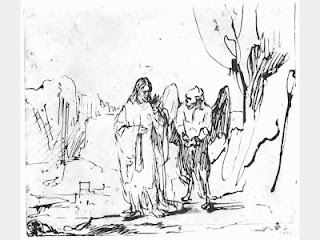
Yesterday many Lutheran churches read Mark 1:14: Jesus tempted in the wilderness.  Jesus was in the wilderness forty days, tempted by Satan; and he was with the wild beasts; and the angels waited on him. A seminary classmate of mine, Bishop Larry Wohlrabe, preached on this text at the installation of a new pastor and posted his sermon on line.  Here is a section that I really appreciated from his sermon.

What does it mean to be tempted? Temptation is about something far, far worse than falling off your diet or reneging on your no-smoking pledge. Temptation is about doubting your God-given, God-claimed identity. Temptation for Jesus in the parched wilderness was about being distracted from his mission, side-tracked on his path to the Cross, for us and for our salvation.

So what we need to picture here is a battle royal out in the wilderness. Satan, whose name means “adversary,” assaults Jesus repeatedly over the course of a forty day period. Mark doesn’t give us a blow-by-blow account, but maybe that’s OK. Mark’s narrative leaves a lot to our imaginations, and perhaps that helps us identify with Jesus all the more.

Because we, too, have our own “good long times” in the wilderness of doubt and despair. You and I also are pressed to the max, pinned to the wall, by all the “wouldas, couldas, shouldas”—all the ways we doubt ourselves and despair of trusting that God is with us.
Bishop Wohlrabe continued by reminding the local pastor of her task as a preacher in her new congregation.

When they are in the wilderness, serve these folks the same life-giving Word of God that sustained our Lord Jesus in the desert. Proclaim to them the nearness of God’s Kingdom, God’s gentle and glorious rule over all things, in Christ Jesus. Amen.

Yes, Amen.  The ministry of God’s Word continues to give life to thirsty, testy, tempted people.  And God’s Word wins.

Lord Jesus, save us from the time of trial and sustain by your saving word.

The US Run

Therefore, since we are surrounded by so great a cloud of witnesses, let us lay aside every weight and sin that clings so closely, and let us run with perseverance the race that is set before us, looking to Jesus the pioneer and perfecter of our faith. Hebrews 12:1-2

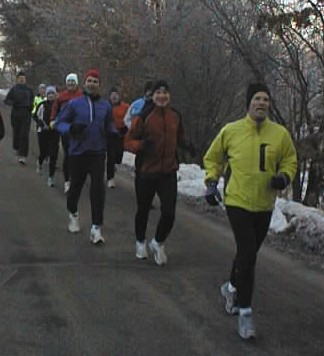
The physical exercise of running appeals to many for its solitary nature. Unlike other sports, one can easily do it alone. When I run by myself, I can do some mental reflection and prayer, seeking peace and tranquility in the steady rhythm of breath and footsteps. I run my own pace, walk when necessary, sprint when desired. Alone, I can enjoy many running benefits.

Yet I also know the power of a community run. The group gives me encouragement and incentive, pushing me beyond my normal boundaries. I especially appreciate other runners during the long runs of marathon training. The Saturday morning ritual of gathering with others gets me up early. I feel a certain obligation to be ready for the sake of other runners. The group conversation can keep me going when the miles are long or when I struggle with some bad patches. I have discovered that a good running group is essential for my development as a runner.

The writer of Hebrews seems to have that community focus as well. In chapter eleven, the writer highlights a number of Old Testament heroes who demonstrated faith in God: Noah, Abraham, Moses and Rehab. And at the beginning of chapter twelve, the writer describes these deceased heroes as “a cloud of witness,” rooting and cheering us on in our faith race. We do not run alone, the writer makes clear. He does not write, “Let me run with perseverance the race that is set before me.” Rather, “Let us run with perseverance the race that is set before us.” Our faith, though personal, is never in isolation.

I am so thankful for those friends and companions who have pushed me to become a better runner. I am even more thankful for my brothers and sisters in Christ, who push me to become a more faithful follower of Jesus Christ. Together we can finish the race of faith.

Lord Jesus, connect me to your people that I might look to you, the pioneer and perfecter of our faith.

Young and Rich

I am preparing to preach this Sunday on Jesus’ encounter with a rich man in Mark 10: 17-27. The man kneels at Jesus’ feet and asks what he must do to inherit eternal life. Jesus responds, “Keep the commandments.”

The man responds, “I have kept them all from my youth.”

Jesus responds with words of love, “You lack one thing; go, sell what you own and give it to the poor, and you will have treasure in heaven; then come follow me.”

The man was shocked and went away grieving, because he had many possessions.

I think many of us are shocked by Jesus’ words as well. “You want me to do what? Sell everything?”

Barbara Taylor Brown in wrote in her book, The Preaching Life, about the two ways we mangle this story, “First by acting as if it were not about money, and second, by acting as if it were only about money.”

As far as Jesus is concerned, money is like nuclear power. It may be able to do a lot of good in the world, but only within strongly built and carefully regulated corridors. Most of us do not know how to handle it. We get contaminated by its power, and we contaminate others by wielding it carelessly ourselves – by wanting it too desperately or using it too manipulatively or believing in it too fiercely or defending it too cruelly.

But it is not a story that is only about money, because if it were we could all buy our way into heaven by cashing in our chips right now and you know that is not so. None of us earns eternal life, not matter what we do. We can keep the commandments until we are blue in the face; we can sign our paycheck over to Mother Teresa and rattle tin cups for our supper without earning a place at God’s banquet table. The kingdom of God is not for sale. The poor cannot buy it with their poverty any more than the rich can buy it with their riches. The kingdom of God is God’s consummate gift, to be given to whomever God pleases, for whatever reason please God. (The Preaching Life., p. 124)

Strong words for a great story. God’s grace is even greater than the world, and especially our love of riches.

Lord Jesus, set me free from the love of money and center my heart on you.

Ashes and Water

Today, Ash Wednesday, begins the 40 days of Lent. In several Christian traditions, the placement of ashes upon one’s forehead is a reminder of our mortality and our need to repent. As Abraham spoke to Almighty God, “Let me take it upon myself to speak to the Lord, I who am but dust and ashes.” Adam was made from the dust of the ground (Genesis 2:7). We each return to the dust and ash when our bodies die and decompose. We may not like to face that fact, but the truth keeps coming back.

Ashes are also a sign of repentance, our need to turn back to God. The book of Jonah describes how the people of Nineveh responded to Jonah’s message to turn back to God.

And Jonah cried out, “Forty days more, and Nineveh shall be overthrown!” And the people of Nineveh believed God; they proclaimed a fast, and everyone, great and small, put on sackcloth. When the news reached the king of Nineveh, he rose from his throne, removed his robe, covered himself with sackcloth, and sat in ashes. (Jonah 3:4-6).

The imposition of ashes also connects us to our baptism. Many Lutherans and others were baptized with water on their forehead. It was a sign of washing and renewal, of dying with Jesus and rising again to new life. Paul writes how baptism is connected to Jesus crucifixion and resurrection.

But if we have died with Christ, we believe that we will also live with him. We know that Christ, being raised from the dead, will never die again; death no longer has dominion over him. The death he died, he died to sin, once for all; but the life he lives, he lives to God. So you also must consider yourselves dead to sin and alive to God in Christ Jesus. (Romans 6:8-11):

The ashes are thus a reminder that we have already died in our baptism. We died to sin and corruption, and have begun to live the new life in Christ. The ashes we place on our head will eventually wash away; the promise of our baptism is not so easily removed. The Holy Spirit holds us in Christ Jesus.

Lord Jesus, let me die to sin and death that I might live with you now and forever.

The Mask of Mardi Gras

Today is Mardi Gras, the day of celebration prior to Ash Wednesday.  Tomorrow we begin Lent. As a pastor I am more mindful of Ash Wednesday, but I understand the attraction of Mardi Gras. Most of us like a good party, a reason to celebrate. Since Lent is a time of spiritual discipline, which can involve fasting or personal denial, at Mardi Gras one can “excuse” oneself from the anticipated denial by celebrating in wine and song.

One piece of Mardi Gras captured my attention this year, the use of masks. My guess is that you still do not want to be recognized during the celebration. You fear that you might do something so embarrassing that you prefer to be anonymous. But most masks are very superficial and do not truly cover your identity. It may be more of a psychological mask that allows you to behave in a way you wouldn’t otherwise.

Masks are something that come off on Ash Wednesday. The central theme of Ash Wednesday is our mortality. Adam was told after his rebellion against God, “From dust you come and to dust you shall return” (Genesis 3:19).  The imposition of ashes marks us as mortal sinners.  We may party hard today, but eventually the party ends. The grave will “unmasks” us all.

The season of Lent marches towards the cross of Jesus, where the Son of God is executed. The human rebellion against God is fully revealed. No masked will be allowed on that day.

But then God turns everything around with Easter Sunday. It is no longer masks we wear, but a new resurrected body. The shining reality of God’s mercy and love shines in every hue and color. That celebration is even bigger than Mardi Gras.

Lord Jesus, show me how to find my joy in you.

Table Matters

My wonderful new daughter-in-law, Maggie Keller, wrote a awesome post on Something Holy about the Table.  It reminded me of how my wife worked hard and long to finish our dining room table when we were first married.  And how many thousands of meals around that table began with the invitation, “Come, Lord Jesus, be our guest.  May these gifts to us be blessed.   Quakers teach that every meal can be a meal of Holy Communion.
As I sit in a hospital room, waiting for my Mom’s hip surgery, I remember all the delicious meals she made.  Our table may have been simple, but it was blessed.  Thanks be to God.

image

Hospitals and Churches

I have been sitting at the hospital today, watching my mother as she recovers from a nasty fall.  Mostly she is sleeping and when she is awake, her dementia limits conversation.  Still I am thankful that I can simply be with her.

image

Churches are often describes as hospitals for sinners.  I want to push the metaphor as I sit with my mom.

1.  The hospital staff cares:  they use my Mom’s name and explain what they are doing even though she has dementia.   Do the people of God show as much care for the stranger who visits?

2.  The staff knows their roles and strengths.  The Personal Care Assistant has a different role from the Nurse.   Do the people of God know their strengths and gifts?

3. The staff will push my mom at times.  The Physical Therapist had to challenge, cajole and push my Mom to stand and take a walk down the hall.  Are the people of God willing to challenge one another in compassion, generosity, and service?

There may be other lessons to be learned.  What do you think?

Lord Jesus, bring healing and hope to your people.

Buying the Bib

This afternoon I registered for the Twin Cities Marathon on October 7. I did it after completing a cold 5 miles run and noticed an immediate lift in my mood. I was excited to get started in the training. I realize the psychological lift comes partially from setting goals and working towards them. I have completed ten marathons since 1999, but skipped 2011 for a variety of reasons. Now that I have “bought the bib,” I need to back it up with proper training.

Running last Wednesday with friends Tim and Dave, we talked about proper training. Proper training means not being a slave to a training program and learning to listen carefully to our bodies. It means the gradual increase of weekly mileage and seeking the balance between rest and hard training. Above all it means perseverance towards the goal. I know that my initial enthusiasm will wane in the coming weeks as the training intensifies.

What has helped me a great deal in my past training has been a good group with which to do the weekly long run. As those weekly runs gradually climb to over fifteen miles or more than two hours, I appreciate having company to encourage or distract me. When I might have quit and turned back early, the group seemed to pull me along. Running is often a solitary sport, but a good running group can be a true blessing. Being now at Resurrection Lutheran, I look forward to find some new running friends.

The Apostle Paul used the image of a foot race in his writings. The Hellenistic world where he preached continued to celebrate the Olympic Games. The Games included several foot races, from 200 meters to 5 kilometers. (The marathon race is a modern development with ancient roots.) Paul had a much more serious “marathon,” establishing new missionary outposts in the cities and towns of Asia Minor and Greece. He persevered through tremendous opposition to proclaim the good news of Jesus Christ. He preached in a world where people were often more interested in who won the last Olympic wreath than in who could bring them eternal vibrant life. Sounds a bit like today. Near the end of his life Paul wrote, “”I have fought the good fight, I have finished the race, I have kept the faith” (2 Timothy 4:7).

Lord Jesus, train me to fight your good fight and to finish the race you have set before me.

R U Hungry?

This coming Sunday at Resurrection our Gospel reading will be Mark 6, Jesus’ feeding of the 5000. It is a familiar story that is in all four gospels. On several occasions when food was running low at a church event, people would approach me as pastor to duplicate Jesus multiplying the loaves and fishes. I have failed every time to perform some magic trick. However, I never remember anyone going away hungry. Usually we “s-t-r-e—t – c—h” out the food to feed whomever is needy.

Like many stories in scripture this is open to various interpretations as to how it impacts our lives. I don’t believe the story has only one meaning to it, that once the reader discovers it, the story is finished. Rather the story rubs up against my life, challenging, enlightening, guiding my life.

A primary interpretation is that Jesus is like Moses in the Exodus, providing manna in the wilderness for the people of God. In fact Jesus is God himself, since he did not need to consult God about the people’ need, but simply blessed, broke and gave the bread to the people, a foreshadowing of his “blessing, broke and gave” sequence at the Passover meal (Mark 14:22). Jesus is the one who feeds us. John 6 is a lengthy teaching on Jesus as the bread of life.

But I think a second interpretation is the calling of the disciples to feed the people.

Jesus said to them, “You give them something to eat.” (Mark 6:26)

Jesus gave the loaves to the disciples that they might feed the people. As followers of Jesus we are called to be people who feed others, literally. The church has often been an agency that works to feed the hungry. Whether it is the hungry in the horn of Africa or local hunger of our city streets, we are still called by God to feed the hungry around us.  God has blessed us that we might give to others in Jesus’ name.

Lord Jesus, teach me how to feed the hungry in your name.

Remembering Dr. Kari Egge

Dr. Kari Egge was a saint, though she would never use such a title.  She lived her faith in her vocation.  Her death this week stirred all kinds of memories for me, since she was active in the high school youth group at St. Andrew’s Lutheran Church in Mahtomedi when I first came on their staff. Kari’s brain was always working, asking deep questions that I could rarely answer.  Yet she had a passionate heart that saw the needs of the world. She went off to college at George Washington University and then into Humanitarian Aid work with such diverse organizations as the Peace Corp, Catholic Relief Services and the American Red Cross. She played key leadership roles in responding to various disaster’s world-wide from the drought in Southern Africa to the tsunami in Indonesia. She received her doctorate in Public Health from Tulane where she studied HIV/Aids and how to treat it in the developing parts of the world.

I remember one particular conversation with her when she was home visiting her parents. I had an idealistic view of her relief work, thinking how wonderful it must be to help people in need.

Her response brought me back to reality, “Much of what I do is simply handle the bureaucratic mess. I am often tired and overwhelmed; we are usually short of key supplies or personnel and the local government often restricts everything we try to do.”

“So, Kari, what keeps you going?”

“I am not sure, but often some good comes. Some people are helped . . . or lived who would have died. I sense God has a hand in that.”

Kari could have lived a very productive, meaningful life here in the United States. She had a sharp mind and wit, a fun spirit, and caring heart. Instead of staying here, she heeded the call to meet the critical needs of people in distant lands. She lived out Jesus’ command to love our neighbor as ourselves.

When she was diagnosed with terminal cancer she did not dwell on her approaching death (though she did make some rather grim jokes about it), but rather how it affect her two young children, Dylan and Isabelle. She loved them, her parents and the many friends she made around the world. I will miss her.

Lord Jesus, grant comfort to all who grieve the death of Kari Egge.  Thank you for her faithful witness of compassion.