Author Archives: John Keller

Unknown's avatar

About John Keller

I am a retired Lutheran pastor whose intention is to consent to God's gracious presence and actions within.

Slow Lent – Third Season

YOUNG WOMAN RECEIVES MARK OF ASHESToday is Ash Wednesday, the start of Lent.  With the placement of ashes on our forehead, we acknowledge the words, “From dust you come and to dust you shall return.”   Words that describe our mortality, the prospect that we will all die some day.  So we take time now to face our own death as we also reflect on Jesus’ death on the cross.  “For while we were yet sinners, Christ died for us.” Romans 5:8.

I continue to be a fan of the Slow Lent Movement.  I have posted in past years regarding it and still think it is helpful today.   I wrote this a couple of years ago.

Bishop Margaret Payne introduced me to the Slow Lent Movement several years ago and her passionate explanation of our need for it still rings true.

She spoke on how pastors have bought into the seduction of our culture’s three A’s: Accomplishment, Adrenalin, and Affirmation. As pastors we think our worth is based on how much we accomplish in our congregations and we enjoy the adrenalin rush that comes from having much to do and being needed by many people. And we relish the public affirmation that often comes from having our hands in many programs and ministries. I found myself nodding my head several time, recognizing my own self-delusions being exposed by her words.

But I don’t think her words are limited to pastors. In spite our professed trust in God’s grace, so many of us who are Christians still seek our self-worth based on our accomplishments. We rush about trying to fulfill the many “shoulds” we carry inside our heads. We seek public affirmation even as we feign humility. We have bought into the prevailing culture without seeing our need for a new way of life.

This year for Lent, I am focusing on a specific act of slowing down: prayerful eating.  I will write more about this in next week’s post.

Lord Jesus, teach me to rest in you.
Rock and View

In my last post, I described my initial yearning to be with God during my two night hermitage at Pacem in Terris. I wanted to be still and simply rest in my heavenly Father’s presence.

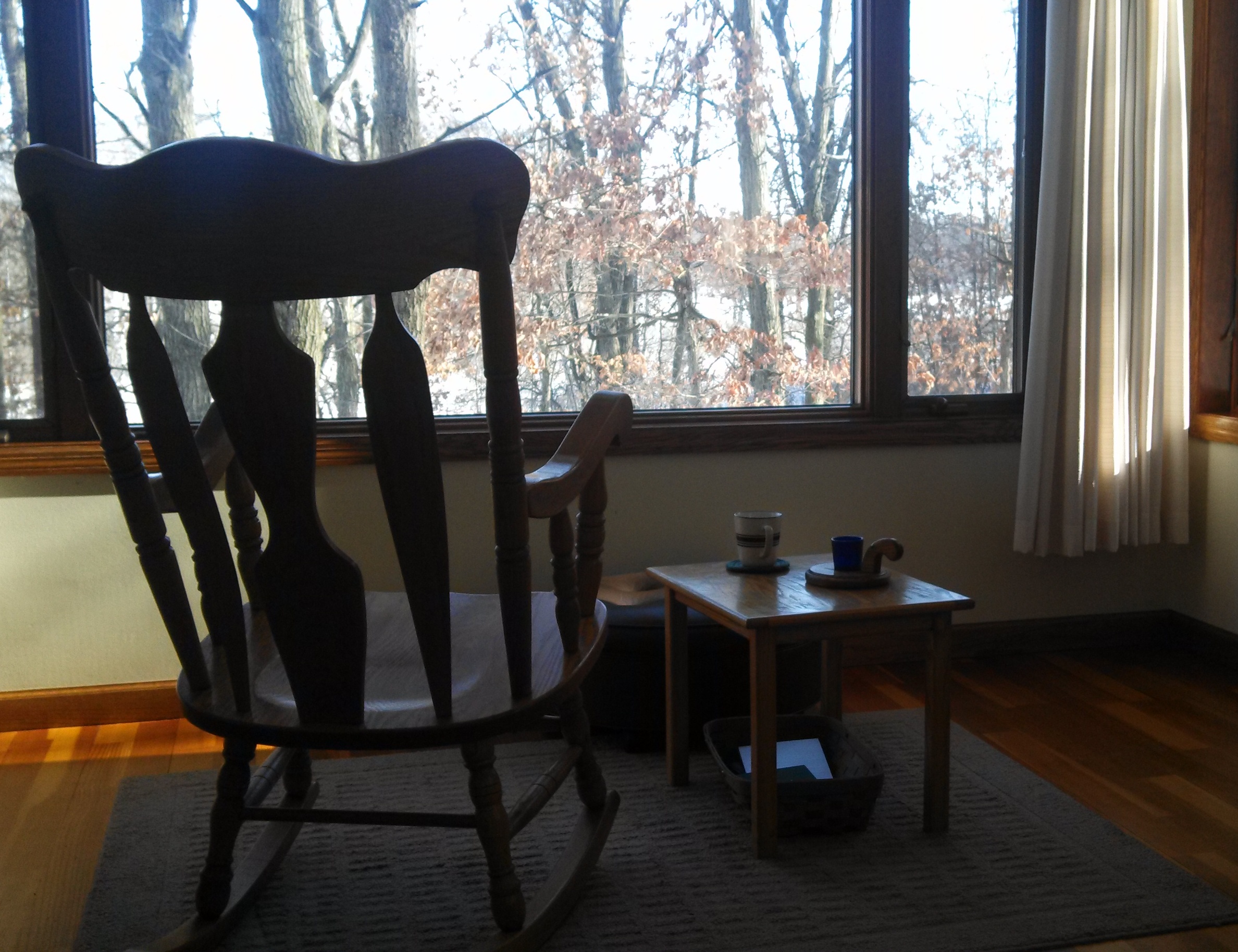
St John the Beloved hermitage insideThe inside of the hermitage encouraged my yearning. The large rocking chair helped me slowly rock my anxious thoughts away and enter into a time of quiet rest. Windows covered the whole east wall and the view, though not stunning, was calm and serene. The many trees were stripped of leaves and dappled with snow. In the distance I could see portions of a small snow-covered lake. The view invited me to be at peace.

I spent time simple rocking, reflecting, and reading scripture. I also was feeling blessed and  meditated on a favorite psalm, 103.

Bless the Lord, oh my soul, and all that is within me, bless his holy name.

Later the Psalmist writes.

Who satisfies you with good as long as you live,
so that your youth is renewed like the eagle’s. v5

I reflected on the down-to-earth satisfaction of being open to God’s Spirit. I prayed for all who seek satisfaction in our world. I prayed for my family, my congregation and the world, that we might be satisfied in God’s gracious love.

I went to bed early and slept well. I rose before dawn, observing the slowly brightening sky. I rocked as I watched the sky turn shades of red and magenta as the sun lifted over the horizon. What a simple yet profound joy to watch the sun give light and life to our world. That east window gave me perspective on my life.

Tahuya River near my father’s cabin

Years ago, my dad bought a small piece of property on the Tahuya River (really more of a creek than a river) in an isolated section of Washington state. Every week-end he would drive the thirty miles to the property where he constructed his own cabin in the woods. I had started seminary at the time; he was about the age I am now. He constructed the cabin without power tools, mixing the cement by hand with water from the river. It was a plain A-frame cabin, with few frills. He spent years building it.

I visited the cabin only three to four times during the time he owned it. I never slept in it; my dad rarely did either. One thing it seemed to lack in my memory were any large windows. I remember it as a dark, dreary place – though I also remember how satisfied and content my father was when he visited it. It was his place of rest.

We each need places of rest and restoration, though each of us may discover different places that suit our personality. I know that if I should ever build a cabin in the woods it will need windows and lots of them.

Where do you find your window on the world?

Lord Jesus, open the windows of my heart that I might see you.

Being the Beloved

Some people have an idealized image of their pastor as a person of automatic piety and prayer. They like to believe that their pastors are always walking with God, constantly filled with love of God and neighbor. But if one talks with a pastor for any length of time, one discovers that he or she is human, filled with flaws, failings and foibles. Yet hopefully, she also know where to go for restoration.

After a busy and emotionally draining season of church work, I knew my own flaws, failings and foibles were rising close to the surface. Fortunately my 12 step spirituality group had schedule a Step Eleven Retreat: “Sought through prayer and meditation to improve our conscious contact with God, praying only for the knowledge of His will for us and the power to carry it out.” We had chosen to spend 1-2 days at Pacem in Terris where each of us would spend time in our individual tiny cabin called a hermitage.

Like anything new, I approached the retreat somewhat awkwardly, wondering if I had brought enough clothing for the sub-zero or enough reading material. It turned out I had plenty of each.

My Hermitage for two days

My hermitage for two days

The staff warmly welcomed me at the central house, gave me a brief orientation (“this is a place to rest your body, soul and spirit, so if your body needs a nap take it.”) and then took me out to my hermitage. Laura presented me with a basket of bread, cheese and fruit, showed me how to operate the gas burner for tea and how to light the sole gas lantern for light at night. Then she left me to be alone with God.

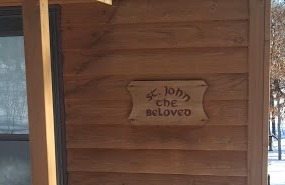
St. John the Beloved signEach hermitage is named after a saint, and mine was St. John the Beloved. I took that name to heart and read from John’s Gospel and I John, relishing the promise of God’s love

But to all who received him, who believed in his name, he gave power to become children of God, John 1:12

See what love the Father has given us, that we should be called children of God; and that is what we are. The reason the world does not know us is that it did not know him. I John 3:1

I reflected on a piece of mission statement I wrote nearly twenty years ago

Created in the image of God,
baptized into the death and resurrection of Jesus Christ,
and empowered by the Holy Spirit,
I am a child of God,

In our culture, even the church culture, our value is often determined by what we produce: what have I accomplished, achieved and acquired. Yet in God’s economy, our value rests solely in being his child.

What a valuable reminder to rest in that promise.

When or where have you spent time alone with God?

Lord Jesus, thank you that I am your beloved.

Next post: Inside the little cabin in the woods.

Family, Business or Army?

This past Sunday Resurrection Lutheran Church had its annual meeting. The meeting is stipulated in our constitution so that we can conduct the business of the church: review and pass a budget, elect officers and hear staff reports. On the surface this can seem fairly dry. Yet beneath the surface, vital vibrant ministry is going on.

For example, the discussion of the budget is really a question of stewardship and priorities. Where do we as a congregation want to invest ourselves? How does the stewardship of our physical church building compare with our stewardship of our outreach and mission in the world?

The Family of God gathers at the Table

The Family of God gathers at the Table

Many people compare the church to a FAMILY, which can be helpful metaphor. We are brother and sisters in Christ (Mark 4:34). As a family we care for each other and support each other in time of need. In a family, the focus is often on the most vulnerable, the “weakest” such as a our children or infirmed. Love is central to a good family.

Stewardship involves opening our wallets

Stewardship involves opening our wallets

But the church is not simply a family. Another valid metaphor is the church is a BUSINESS.  It has finances to raise, property to maintain, staff to hire, and budgets to negotiate. We have constitutions and bylaws to uphold. One thing to remember is that this is a “business” ultimately owned by God; we are stewards or overseers who manage God’s resources for God’s purposes. “It is required of stewards that they be found trustworthy” (I Cor. 4:2). As stewards, we are called to examine the finances as God’s money. Trust is key to good business. 

Feed My Starving Children has unique "helmets" for service

Feed My Starving Children has unique “helmets” for service

But there is a third priority: mission. “Seek first the Kingdom of God and his righteousness” (Matthew 6:33). Here the metaphor is that the church is like an ARMY, charging forward into a broken, dangerous world to bring the light of God. The church is not simply a country club that enjoys each other company, nor a business that has a balance budget. The church has a mission to carry God’s message of love, grace and justice out into a world that is broken and hurt.  Preparing meals for overseas shipment at Feed My Starving Children is one place our Army serves.  Courage is vital to mission.

At Resurrection we describe that mission as calling all people to a vibrant life of faith in Christ.

In a healthy congregation, all three -family, business, army- compete for attention. Some members are clamoring for more dollars spent on caring and educating our members (especially our children and youth). Others are sharpening their pencil to make sure we are not spending beyond our means and that we are being good stewards of our resources. And others will be pointing out the door, wondering how we will become God’s hands and feet in God’s mission for the world. We need all three to converse to function well.

Our annual meeting is the opportunity to have that conversation: how we are fulfilling our mission, managing our finances and caring for one another?

Which metaphor (family, business, army) is your passion?

Lord Jesus, empowers us to work together for your kingdom.

Next: How Worship links all three.

Experience the Way

Christina with her sister Suzanne and holding nephew Jack

Christina with her sister Suzanne and holding nephew Jack

My daughter, Christina, was not quite three. She was waking up from a nap and my wife noticed that she did not seem fully responsive. Christina’s eyes were open and she was breathing, but her face was blank and she did not respond to any touch or sound. This persisted for a few minutes, so we called 911 and an ambulance came. We rushed off to the children’s hospital, uncertain what was happening, but praying for God’s intervention.

I think about that ambulance ride, when I read the story (John 4:46-54) of the royal official whose son was ill. The official traveled more than twenty miles by foot to Jesus and “begged him to come down and heal his son.” The official was someone who normally gave orders and told people what to do. Begging was not part of his daily life—especially with a wandering, controversial preacher. Yet he was desperate to help his son and if begging was necessary, he would do it.

Many parents would do the same. I know my prayers in the ambulance were a form of begging, “God, help my daughter.” It was raw and real and I waited for God to hear me.

Jesus’ response to the official sounds ambivalent, almost callous, “Unless you see signs and wonders, you will not believe.” It sounds like it is meant for the crowd that surrounded Jesus and not for the official.

Yet the father persisted. As I said he was desperate. “Sir, come down before my little boy dies.”

I hear and empathize with this father’s plea. At times God seems distant and silent, yet I persist in my prayer for God’s assistance.

Jesus responded, “Go, your son will live.”

This is not what the father asked. He wanted Jesus to come with him, to be present and touch his son. I would want the same. I want Jesus to be physically present, reassuring me as much as my child.

Yet the official believed the word of Jesus. He started on his way, not knowing what would happen, but simply trusting in the promise of Jesus. I wonder what thoughts and feelings he experienced as he walked towards home. (I let you read the story to discover how it concludes.)

Sometimes the WAY seems isolated and cold.

Sometimes the WAY seems isolated and cold.

Many parents live right there in the story.  We are walking the way, unsure of the future.  We have the promise of God’s love and healing, but are uncertain how it will unfold. We walk, trusting in the promise of God for our children and for ourselves. We are on the way, but the way seems dark and cheerless.

Shortly after my daughter arrived at the hospital, we met with doctors and discovered that she had experienced a mild form of epileptic seizure, something that could be treated with a prescription. They assured us that she would grow out of it. And she has.

Still I remember clearly that feeling as we drove to the hospital, the begging quality of my prayer and the simple trust in the promise of God’s love. We all walk by faith and not by sight (2 Corinthians 5:7).  We try to remember that Jesus is the way, the truth and the life (John 14:6)

When have you walked by faith and not by sight?

Lord Jesus, I believe, help me in my unbelief.

Wrong Interpretation

I have written in the past about how I have changed my perspective or interpretation on a certain passage of scripture. An example is the widow’s coin.

Artist He Qi Samaritan Woman At The Well

John 4 is another example. Years ago I taught a Bible study based the story of Jesus’ conversation with the woman at the well. Like others, I saw the woman as somehow morally bankrupt and in need of repentance. The evidence was clear.

First, she came to the well at noon. (John 4:6-7).  The woman came at the heat of the day so as to avoid others who would chastise or shun her because most women came in the cool of the morning.

She has had five husbands and is now with one who is not her husband (John 4:18). Obviously she must be a sinner to have had five husbands and to be living with a non-husband. Perhaps she was a prostitute or some other moral deviant who needs to repent.

Yet over time I began to see a problem with my old interpretive framework.

Dr. David Loose at Luther’s Seminary writes at www.workingpreacher.org,

And that’s precisely the sentence that has moved preachers of all stripes and across the centuries to brand her a prostitute. Yet if we read more closely we discover that there is nothing in the passage that makes this an obvious interpretation. Neither John as narrator nor Jesus as the central character supply that information. Jesus at no point invites repentance or, for that matter, speaks of sin at all. She very easily could have been widowed or have been abandoned or divorced. Five times would be heartbreaking, but not impossible.

Further, she could now be living with someone that she was dependent on, or be in what’s called a Levirate marriage (where a childless woman is married to her deceased husband’s brother in order to produce an heir yet is not always technically considered the brother’s wife). There are any number of ways, in fact, that one might imagine this woman’s story as tragic rather than scandalous.

The difficulty with the all too regular interpretation is that it interrupts and distracts from the rest of the story.

David Loose then points out that the woman’s response is not a deflection from herself but rather a sign of faith. “I see that you are a prophet.” Seeing in John’s Gospel is tied to faith. One sees and one believes. The story of John 9 when Jesus heals a man born blind demonstrates this. Such seeing also casts light on the time of the story. The woman encounters Jesus in the brilliance of day, not to avoid scandal but rather to encounter truth.  Contrast this with Nicodemus who comes at night in John 3.  (A great Bible Study is to compare and contrast Nicodemus encounter with Jesus and the woman encounters.)

Later the woman tells her neighbors to “come and see the man” (John 4:29). Just as Philip invited Nathanael to “come and see” Jesus.  (John 1:46).  She is one of the first evangelists.

Studying scripture is an ongoing experience that can change our perspective.

When has studying scripture changed your perspective?


Lord Jesus, help us to see with fresh eyes.

Jesus the Poet

The Gospel of John is the current focus of my preaching. I am excited, challenged and transformed by the Word of God encountered in John. The powerful language, metaphors and word images stir new thoughts and perspectives. I cannot read John passively; I am called into an encounter with Jesus.

From the start, John uses poetic symbols and metaphors to describe Jesus. “In the beginning was the Word and the Word was with God and the Word was God” (John 1:1). Marcus Borg, a New Testament scholar, writes,

John’s use of symbolic language is extraordinarily powerful. His images are often “archetypal” (literally, imprinted in human psyches from the beginning). They flow out of the depths of human experience and longing. We see this with great clarity in the “I am” statements that he attributes to Jesus:

“I am the light of the world” (John 8:12). The archetypal image is darkness and light and it close relative blindness and seeing. The image is not only in John’s prologue, but also in the story of Nicodemus (John 3), who comes to Jesus “by night” —he is still in the dark. In John 9, the overcoming of blindness and Jesus as the “light of the world” are juxtaposed. (Marcus Borg, Evolution of the Word, p. 305-306)

John’s use of metaphor can often be confusing and unsettling—that is his intention. Take the story of Nicodemus in John 3. Nicodemus is a religious leader, a Pharisee, who comes to talk with Jesus by night. He starts with a clear declaration of respect, “Rabbi, we know that you are teacher who has come from God; for no one can do these signs that you do apart from the presence of God.” Nicodemus calls Jesus Rabbi—teacher—and Nic appear ready to learn.

But Jesus’ use of language seems only to confuse Nic. “No one can see the kingdom of God without being born from above (or again)” Nic does not catch the true impact of Jesus. He is not simply a teacher who give more data, but rather God who give birth to a new cosmos. Nic responds, “How does someone climb back up into his mom’s uterus?”

Nic comes to Jesus like an engineer or scientist, wanting the new set of blueprints for remodeling one’s life. Jesus responds like a fiery poet, burning down Nic’s safe path to religious enlightenment with the declaration that one needs a fresh birth (implying the death of the old and a new birth with a new perspective?). Like a poet Jesus uses dramatic graphic language: birth from above, born of water and Spirit, the wind blows where it will. All this leaves Nic confused, questioning, wondering, “How can these things be?”

As a reader, I am often like Nic, wrestling with questions and concepts. I need to die to my simple approach that wants to fit Jesus into my life. Rather Jesus comes to “break open” my religious perspective and start a new creation in my life. The new creation is not always clear, but I know that staying close to the poet Jesus, I will find the way, the truth and life.

Lord Jesus, speak your word of new birth for me today.

Discover the Unnamed Disciple

At the beginning of each gospel, Jesus calls disciples to join his mission. Jesus will not be a solo prophet, working independently. He starts a community that will explore God’s new reality together.

In John’s Gospel, John the Baptist introduces two of his own disciples to Jesus with the words, “Behold, the lamb of God.” (John 1:35-42) The two disciples follow Jesus at a distance but soon Jesus spots them and invites them to spend the evening. As we read further, we discover that one of the disciples is named Andrew. Andrew is so excited by the encounter that he hurries off to his brother Simon and brings him to meet Jesus as well. Jesus renames Simon as Peter – The Rock.

unknown-personBut the other disciple remains unnamed.

Immediately following this story comes a second like it. Philip meets Jesus and he also is transformed by his encounter that he tracks down his friend Nathaniel and brings him to Jesus.  By the end of chapter one there are five disciples following Jesus: Andrew, Peter, Philip, Nathaniel, and the “unnamed disciple.”

We can speculate who that disciple was, but I think a more productive reading is to reflect on who that disciple is. I believe the unnamed disciple is you (and me), the reader of the Gospel. Like Andrew, we are invited by Jesus, to “come and see” as we study the Gospel of John. We are invited to experience the life transformation of a personal relationship with Jesus as we read the Gospel of John.

John, the writer of the Gospel, address the reader (you and me) directly at the end of the Gospel.

Now Jesus did many other signs in the presence of his disciples, which are not written in this book.  But these are written so that you may come to believe that Jesus is the Messiah, the Son of God, and that through believing you may have life in his name.(John 20:30-31)

As you read the Gospels, place yourself in the story. See yourself in the mirror of scripture.  And receive the life Jesus has to offer.
How do you respond to Jesus invitation to “come and see?”

Lord Jesus, open my eyes to see you today.

New Year’s Run and Devotional

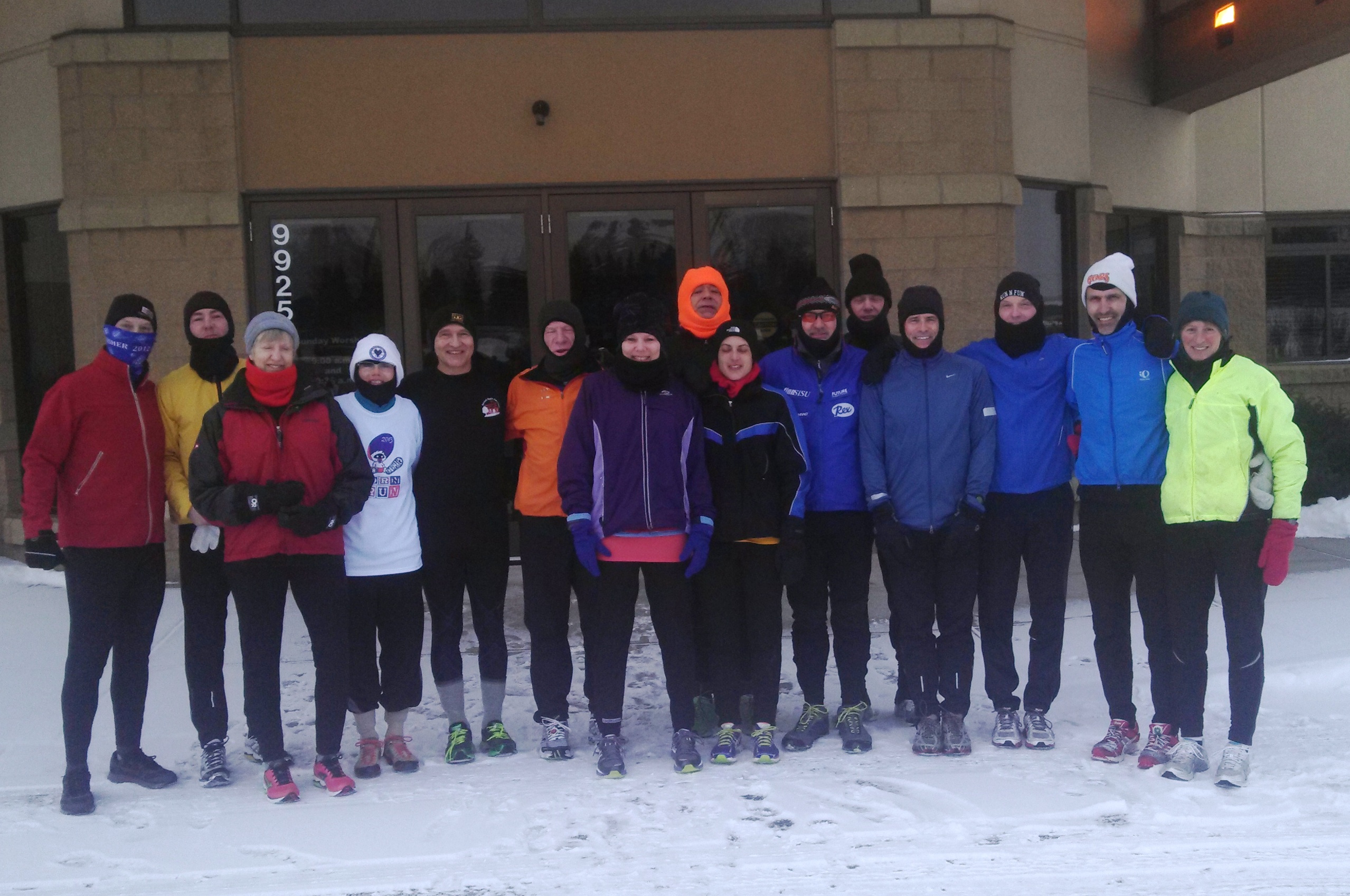
My running group had a New Year’s Day run, even though the temperature was -5 degrees at the start.

Bundled Warm for a 4 mile run

Bundled Warm for a 4 mile run

Here is the devotional we shared together prior to our run.

Mark 1:1  The beginning of the good news of Jesus Christ, the Son of God.

Today is the beginning of a new year.   Recently I was reading in Mark’s gospel and I was struck by this opening sentence.  It is the Beginning of the good news of Jesus Christ.  Now that may not be so profound, because it is the start of the gospel.  But on the other hand, there is no final statement in the book that says, the End of the gospel.   Only the beginning is mentioned.  This reflects our relationship as a reader of the Gospel and as a disciple of Jesus Christ.  We have a beginning in our relationship with Jesus, but we don’t have a finish line.  We are continually growing, running, moving, becoming the person Jesus created us to be.  God is not finished with me yet.  And that is truly Good News.  

Prayer:   Lord Jesus, in our relationship with you, we are closer to the starting line than the finish line.  Throughout 2014 increase our trust in you, so that we can run, and leap and rejoice in your love for us.  May our spirits hunger for you each day and may we find ways to serve you as we serve one another.  Guide us as we run today, in Jesus name. AMEN

Afterwards, we enjoyed some pancakes and conversation. 

Enjoying the warmth inside Resurrection Lutheran Church

Enjoying the warmth inside Resurrection Lutheran Church

How are you starting your New Year?

Four Lessons for Joyful Habits

Today I reached 100.

100 days of consecutive running.

Grandma's 06 smile

During this streak I learned four lessons about healthy habits.

Turn disappointment towards joy

I used as motivation the disappointment I felt last September when I was unable to register for the Boston Marathon. (Read more here. )

My disappointment was the initial start to my running streak, but I knew that such motivation could only take me so far. I knew that I had to have an interior attitude of joy and thanksgiving towards running and NOT simply a “I should do this” attitude. Almost anyone can start a healthy habit or discipline; it is staying the course when the mind/body/spirit begins to resist the habit for a variety of reasons: “I am too busy with work” or “I don’t feel like running today” or “The weather outside is too cold.”

Focus on joy of the habit

527355_10150757438158830_723953829_9331133_942278610_nFor me, running has been a source of joy, especially when I am dealing with stress or disappointment. I enjoy the movement through space (especially if it is outdoors along a scenic trail) or the camaraderie I experience running with friends. I know that not all runs will be filled with joy or endorphins, but many will be.  I need to lace up my shoes and start running to discover if it will happen.

Keep the habit simple and flexible

My running streak did not require me to run huge miles every day. I needed to do at least a mile, but once I got started I usually did more. I averaged 4.1 miles per day.

I also kept it flexible. I originally thought I would do all my running outdoors, but in early December we had some nasty ice and cold so I joined a local gym and did my running on a treadmill. It was not my first choice, but I prefer to be safe and steady.  I still go outdoors when the weather permits.

The joy flows into other areas.

Learning to Pray Anew

Rolling into Prayer

I have discovered that my best time to run is early in the morning. Then afterwards, I allow the joy to flow into my time of prayer and meditation. I have created a small holy space in my home where I have my Bible and devotional reading so that I can easily shift gears and focus my mind on my life of faith in Christ. I am learning to be silent and still, listening for God’s still quiet voice (I Kings 19:12).

I recognize that someday this running streak will end, but for now it has been a healthy habit that bring joy to my body/mind/spirit.

What habit brings you joy?

Lord Jesus, guide me into habits that honor you.