Category Archives: Beginnings

Rebellion and Love

Why do we do the stupid things we do? Why would Adam and Eve eat from the forbidden tree in the Garden of Eden? Why do I continue to trust in my own abilities and not God’s direction and commands?

“Woman gives her man to eat” by Lucile Butel, 1989

I ask those questions whenever I read Genesis 3, the story of Adam’s and Eve’s choice to disobey God. The story is often called “The Fall” since it describes humanity’s fall from God’s loving, eternal presence, yet I prefer the title “The Rebellion” since it is our human tendency to rebel against God’s commands. We rebel when we place ourselves in the center of our lives, and not God. We listen to the crafty voice of the serpent that says “you will not die, but will find pleasure, riches, knowledge, significance, or fame” if we yield to our own temptations. The story of Adam and Eve’s rebellion is our story of rebellion; our human choice to sin. And if we try to blame anyone or anything else, we are only echoing their response when God confronted them afterwards. Adam blamed Eve, Eve blamed the serpent (Genesis 3:11-13).

The Bible introduces sin and brokenness as an essential piece of our humanity. Though the biblical story begins with humanity created in the image of God (Genesis 1:26), the image is quickly twist and stained by our rebellion. The next eight chapters of Genesis highlights how the infection of sin penetrates all of life: Cain murders Able, The Flood, and the Tower of Babel. Each story hammering home the sinful quality of humanity.

You Will Be A Blessing by David Hetland

Yet each story also shows elements of God’s mercy and grace. After Adam and Eve rebel, God provides them with animal skins for clothing. After Cain murders his brother, God provides a place of sanctuary for him. As God contemplates destroying the sinful world with a flood (Genesis 6), God provides a new beginning through Noah and his family. And after God scatters the people when they build the idolatrous Tower of Babel, God selects Abraham to become a blessing to all people (Genesis 12).

Even our rebellion will not stop God from loving us.

Lord Jesus, have mercy upon us.
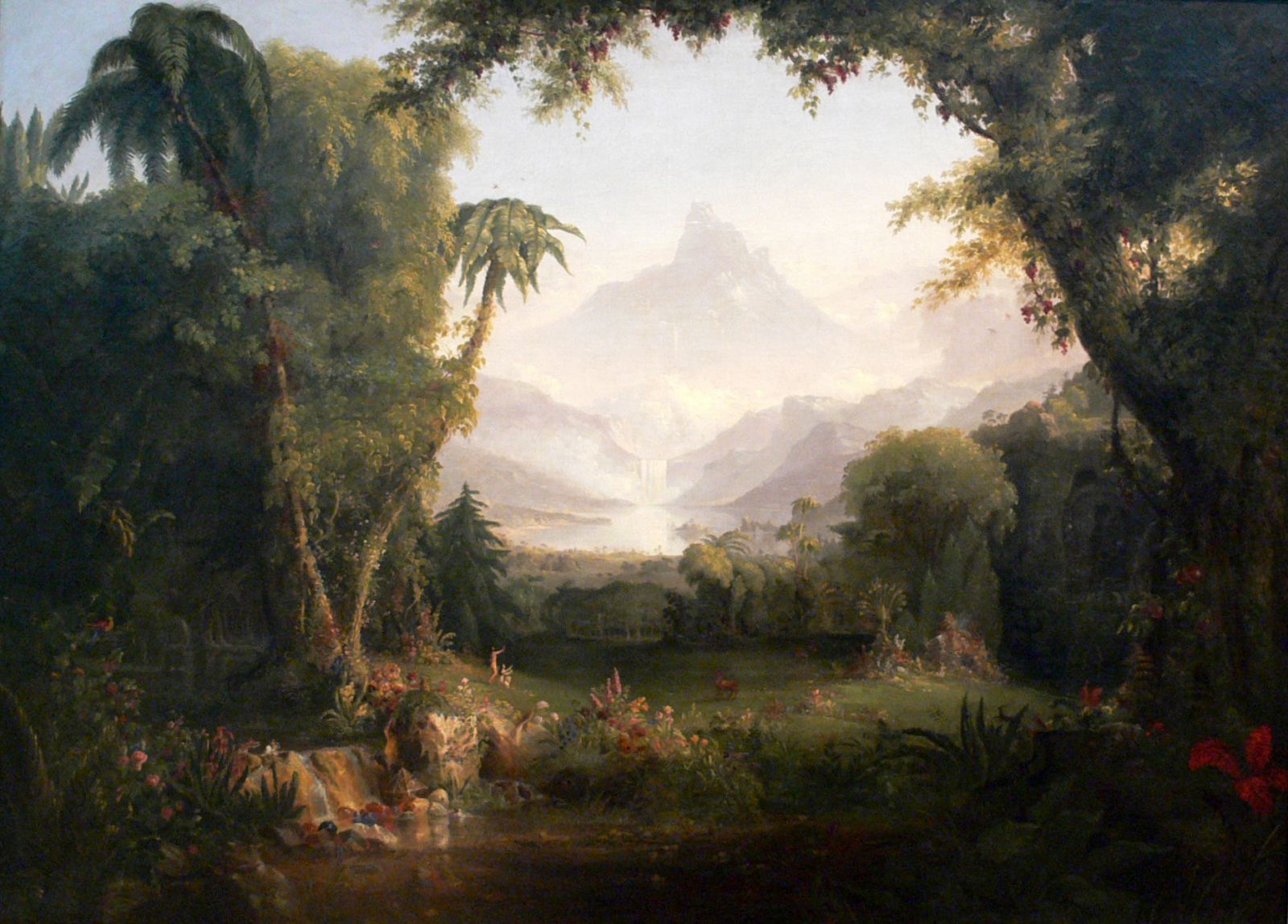
Garden of Eden

This Sunday I am preaching on the first story in the Bible, Genesis 2 and 3. The story begins with God creating man from the mud of the earth and breathing into adam/man the breath of life. The story has word-play because the Hebrew word for man ‘adam’ sounds like the Hebrew word for ground or dirt is ‘adamah.’ Then the Lord God places the man in a garden in Eden that has “every tree that is pleasant to the sight and good for food” (Genesis 2:8).

The Garden of Eden has fascinated humanity. My initial impression was of a small compact garden, sort of like a resort on the edge of a river. At the center of the garden is the tree of the knowledge of good and evil, with the crafty serpent nearby. I tend to push the story forward to the temptation scene in chapter three, where both the woman and the man disobey and rebel against God.

But that tight image has been challenged by the painter Thomas Cole and his painting called “The Garden of Eden” (1828).

Philip Tallon, a Methodist seminary professor, writes about the painting,

As painted by Cole, the garden seems to encompass the whole earth. It is an infinite playground in which Adam and Eve are dwarfed by rivers, mountains, trees, and even sparkling gems that erupt from the earth. As Cole himself wrote in an 1828 letter about the painting, “I have endeavored to conceive a happy spot where all the beautiful objects of nature were concentered.” This conveys first to me the magnificent, plurality of creation: a Christmas stocking so overflowing with treats that we will never get to the bottom.

The abundance and wonder of the God’s creation can be seen in the scripture. It is essential for understanding the story to rest a moment in the awesome beauty of God’s gift to humanity before moving to the fateful confrontation with the serpent. The wonder of that creation remains all around us, if we have eyes to see.

Lord Jesus, thank you for the beauty of your creation.

Doing Something New

One of my favorite quotes is from Ken Blanchard, a business consultant. “Unless you feel awkward doing something new, you are NOT doing something new.”

Awkward Second Change

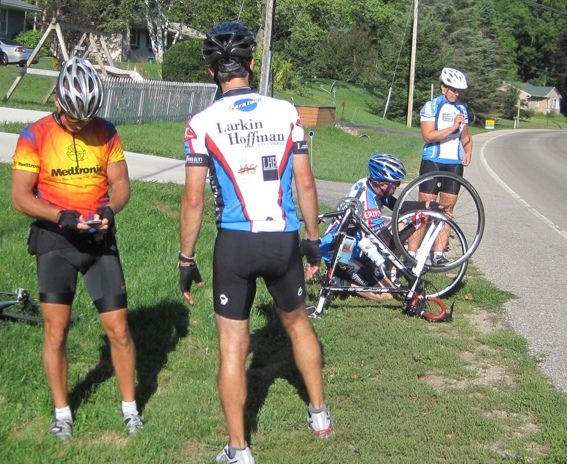
I remembered it as I joined six friends in August on a long bike ride near La Crosse WI and learned that I was one of the least experienced cyclists in the group. In the first seven miles I had a flat and I felt awkward as I tried to change the tire as quickly as possible.  In my haste I only pinched or damaged two new tubes and so felt a triple embarrassment as I changed each new flat.  I seriously thought about dropping out and riding/walking back to the motel.

Yet the marvelous thing about my cycling buddies is that they graciously responded to my awkwardness with understanding and care. No one abandoned me. No one spurned me. The helped me in part because they each had been in the same awkward position on other rides. They had experienced flat tires and awkward changes.

This fall I want to encourage you to try something new. It might be a new volunteer opportunity or new social group.  It might be a small group Bible Study or worship experience.  You may feel a bit awkward starting out, but unless you try something new you will never fully appreciate the wonder of discovery.

At the same time, if you are in an established group and someone new arrives, practice  hospitality and be attentive to their needs.   Jesus taught this simple rule, “In everything, do to others as you would have them do to you” (Matt. 7:12). This is our encouragement to see the newcomer as someone to welcome and to guide as we remember our own first arrival in the group.  The newcomer may feel awkward the first time they run with a group or open a Bible or serve on a task force or change a flat.   Yet we can help them move out of the awkward, beginning stage.

I am so glad I was able to swallow my pride and continued the ride.  We saw some spectacular scenery and shared some major climbs.   As we finished our sixty-plus miles, we all marveled at what a wonderful day it was.  And no one mentioned flat tires.

Lord Jesus, challenge me again to discover something new in life.

Wilderness Journey – Day One

As a young boy, my favorite playground was the large tract of woods behind my house. Port Angeles was a lumber town, with five mills busy turning Douglas fir into paper and lumber. My neighbors were loggers who cut the tress or drivers who transported the huge logs to the mills. The huge forests of the Olympic Peninsula were a magnet for my imagination. Only later did I see the devastation that clear-cut logging created.

North Boundary Trail in Rocky Mountain National Park

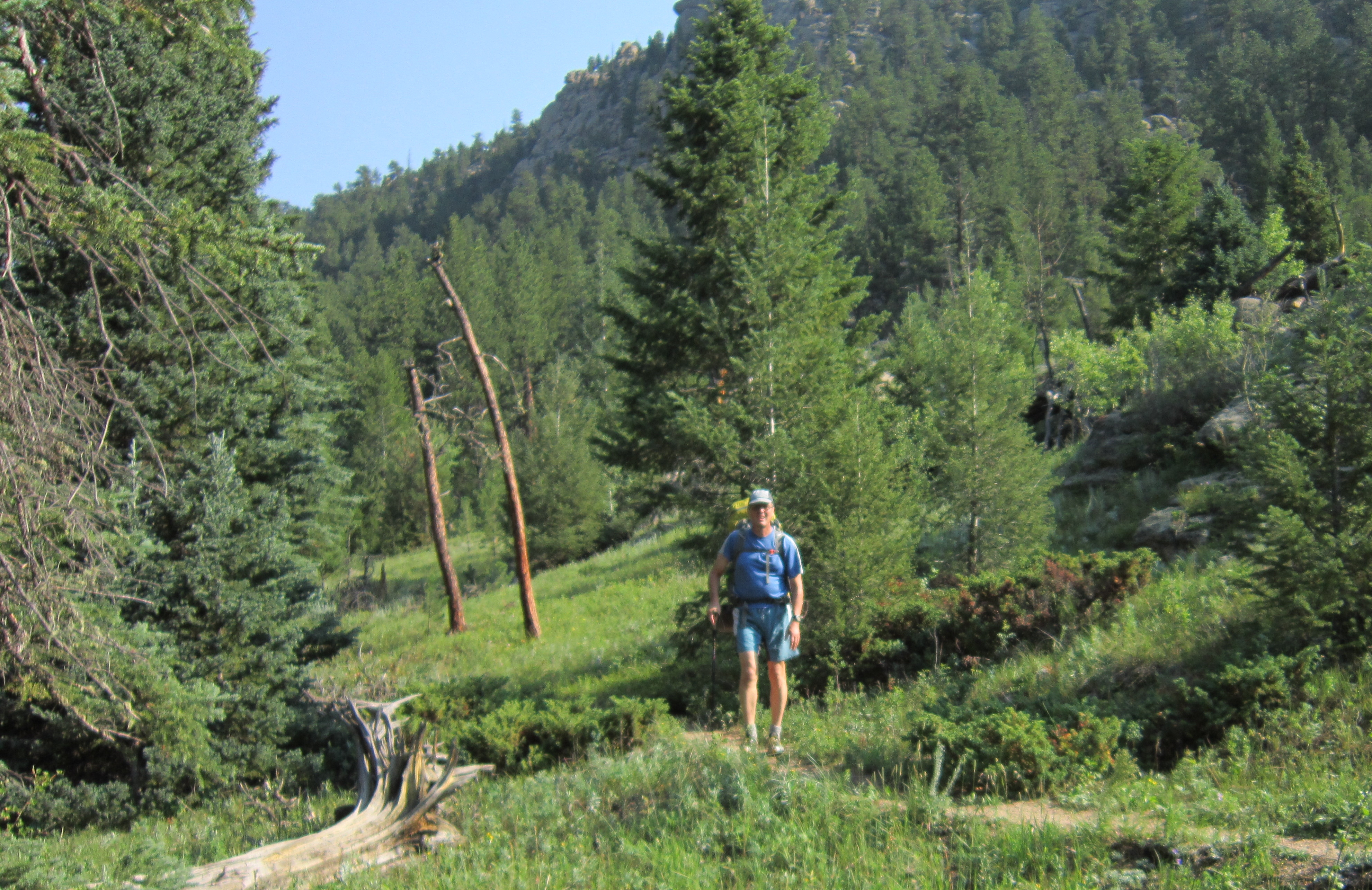
I remembered my childhood fascination with the forest as I started my four-day solo backpacking trip in Rocky Mountain National Park last week. Since I wanted to do a loop route, I started from Cow Creek trailhead and headed north along the North Boundary Trail. I normally see the mountain forests as a transition zone that I quickly want to ascend so as to reach the open alpine areas with their vast vistas. For me, the forest was only a prelude to the main event.

Yet I knew that my first day would remain in the forest. The North Boundary Trail ascends three ridges, each time descending to a mountain stream. The constant up and down challenged both my legs and my lungs. There were a few open meadows where one could see the higher peaks to the west, but mostly it was the forest that surround me. I yearned for the high alpine country ahead.

Crossing West Creek along North Boundary Trail

During my trip I was reading Baptized into Wilderness: A Christian Perspective on John Muir by Richard Cartwright Austin. In the book, Austin emphasizes Muir sensuous emersion into the wilderness. Muir became present to the trees, birds, insects, life of American wilderness, experiencing God in the midst of all of it.

Muir suggested that the path to the Spirit is not away from the world, but deeper into the world, deeper into communion with nature and with the primary forces where is Spirit is lightly clothed. Probing the simplest elements to discover their full character and vitality, he developed an incarnational understanding of God’s personality incarnate in Jesus (p. 25).

God’s presence was all around me, in the beauty of the tall lodge pines and the tiniest of mushrooms. Could I simply open my heart and mind to experience the wonder and beauty of God’s creation?

Let the heavens be glad, and let the earth rejoice; let the sea roar, and all that fills it; 12 let the field exult, and everything in it. Then shall all the trees of the forest sing for joy before the Lord; for he is coming, for he is coming to judge the earth. He will judge the world with righteousness, and the peoples with his truth. Psalm 96:11-13

Lord Jesus, open my heart to see your beauty all around me.

The END Came and Went

Yesterday I wrote on the END OF THE WORLD as expressed in Mark 13. In the chapter Jesus taught his disciples regarding the signs of a new world being birthed. Jesus said, “Truly I tell you, this generation will not pass away until these things have taken place. Heaven and earth will pass away but my words will not pass away” (Mark 13:30).

Like most apocalyptic literature, Mark 13 is written in highly descriptive language that evokes strong emotions, but is often difficult to interpret precisely. The chapter is more like a beautiful mosaic of pictures than a precise timeline of events. Parts of the chapter seem to refer to the destruction of the Jerusalem Temple by the Roman legions in 70 AD (v 2, 4-11, 14-23). Other sections may refer to the persecutions the church faced in its early years. Readers can be challenged to see how it applies to our current life.

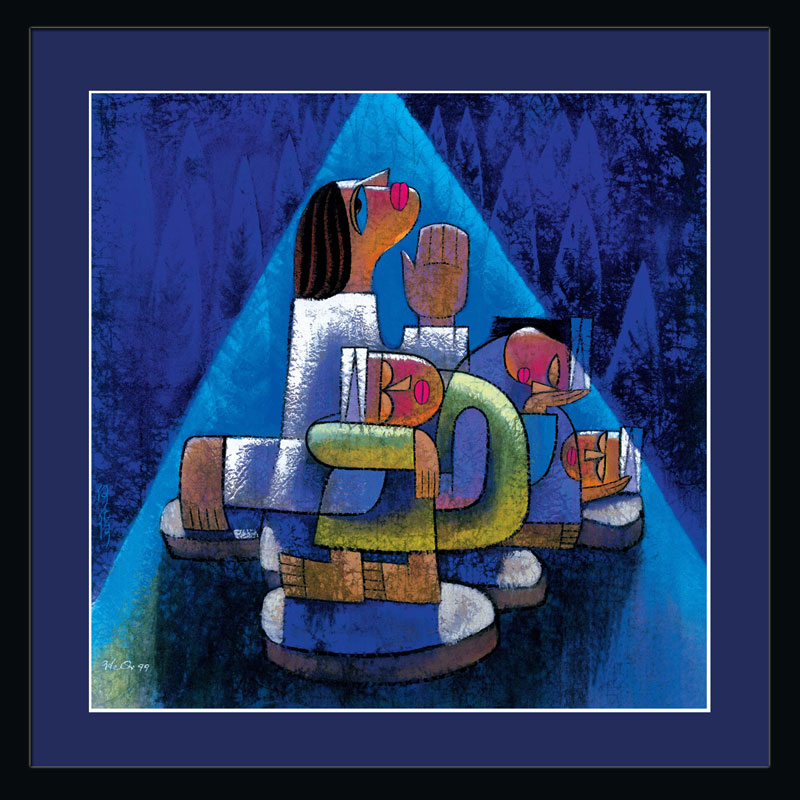
Praying at Gethsemane by Artist He Qi

Yet the reader is given a key verse in v. 35. “Therefore, keep awake–for you do not know when the master of the house will come, in the evening, or at midnight, or at cockcrow, or at dawn, or else he may find you asleep when he comes suddenly.”

The four hours of the watch (evening, midnight, cockcrow and dawn) are significant because they become the outline of Mark’s next two chapters: the story of Jesus’ betrayal, prayer,  arrest and trial.

When it was evening, he came with the twelve. And when they had taken their places and were eating, Jesus said, “Truly I tell you, one of you will betray me, one who is eating with me” (Mark 14:17).

Jesus said to Peter, “Truly I tell you, this day, this very night, before the cock crows twice, you will deny me three times” (Mark 14:30).

At that moment the cock crowed for the second time. Then Peter remembered that Jesus had said to him, “Before the cock crows twice, you will deny me three times.” And he broke down and wept (Mark 14:72).

As soon as it was morning, the chief priests held a consultation with the elders and scribes and the whole council. They bound Jesus, led him away, and handed him over to Pilate (Mark 15:1).

The disciples were unable to stay awake in the garden when Jesus prayed (Mark 14:41). They all scattered. Still Jesus remained faithful.  His words from Mark 13 came true. Jesus’ passion became the birth pangs of a new creation. The world as we knew it ended with Jesus’ crucifixion and a new world dawned with his resurrection.

Paul captures this new age in 2 Corinthians 5:17 “If anyone is in Christ, there is a new creation: everything old has passed away; see, everything has become new!” The end of the world is not simple some future event for which we wait. The “end” started with Jesus’ death and the “new” has begun with his resurrection. We live in a new age with Jesus!

Lord Jesus, let my life end and begin again with you.

New Year’s with JB

John the Baptist’s message is great for this week between Christmas and New Years.  He calls us back to a simple life-style. After all the feasting we may need repentance.

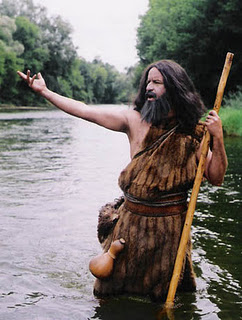
John the baptizer appeared in the wilderness, proclaiming a baptism of repentance for the forgiveness of sins.  And people from the whole Judean countryside and all the people of Jerusalem were going out to him, and were baptized by him in the river Jordan, confessing their sins.  Now John was clothed with camel’s hair, with a leather belt around his waist, and he ate locusts and wild honey. (Mark 1:4-5)

The wilderness in Scripture was not some beautiful garden-like place where people went on vacation.  Wilderness was wild, uncivilized, stripped of all niceties and refinement.  Israel had spent forty years in the wilderness during the Exodus to purify themselves from all the toxic Egyptian cultural practices. It was a place for spiritual death and rebirth.

John’s clothes of camel’s hair and leather belt, reminded the people of the Old Testament prophet Elijah (2 Kings 1:8).  Sort of like wearing a red cape to remind people of Superman. But John/Elijah had a stronger purpose than Superman, to call the hearts and lives of people back to God.

John called people to recalibrate their vision of life, success, and values.  They were baptized as a cleansing of their sinful ways so that they could begin anew, fresh and clean.

Now as 2011 concludes, we can come to our Lord seeking a fresh beginning, a new start in 2012.  We can confess our sin, knowing that God forgives us our sin and will give us a clean start.

Try this the next time you take a bath or shower.  As you wash the sweat and dirt of the day, say to yourself as you pray to God, “I am cleansed, body, mind and spirit, by the power of the Holy Spirit.”  Then step out into the promise of vibrant new life in Christ. Resolve to act as a child of God, seeking God’s path this day.

Lord Jesus, cleanse me and make me new.

Beginning the Gospel School

Beginnings need special attention. On the first day of school I would wait with my children at their bus stop and snap a picture to mark the occasion. My first day at Resurrection, I arrived early in the morning and walked the grounds, thinking and praying for the congregation’s future. Our western culture declares a holiday to begin each New Year. The Bible starts with the awesome statement, “In the beginning, God created the heavens and the earth.”

The New Testament begins with four gospels, each declaring Jesus Christ as Lord, but in unique ways. Matthew begins with the genealogy of Jesus, showing his Jewish heritage through Abraham and David. Mark begins with the words of the Old Testament, “I am sending my messenger ahead of you,” an introduction to John the Baptist and Jesus’ baptism. Luke begins in the temple of Jerusalem where an angel announces to the priest Zechariah that in his old age he will have a son, John the Baptist. John has perhaps the most auspicious beginning, directly echoing the words of Genesis, “In the beginning was the Word, and the Word was with God, and was God.”

All four Gospels want to make clear from the beginning that Jesus is a central actor of God’s ongoing story to redeem a corrupt and broken world. The story of the Old Testament set the stage for Jesus’ entrance into the cosmic drama. His entrance shifts the story in a radical new direction, but it is still connected to God’s ongoing redemption.

Matthew, Mark, Luke and John are called Gospels (Good News) and not biographies. Their purpose is not simple to inform the reader about Jesus’ life, but rather to transform the reader into a passionate follower of Jesus. They make no claim to be unbiased. They have an announcement to declare: Jesus is Good News for those who embrace his mission.

As 2012 begins, I pray that you will embrace this news and seek to follow Jesus as you read from the Gospels. At Resurrection, our Sunday morning Bible texts will be from the Gospel of Mark and we will follow Jesus chapter by chapter to his death on Good Friday and his resurrection on Easter. Good news is coming in 2012 as we begin our study of Jesus.  Let’s start with joy.

Lord Jesus, show me the way.


Teach Your Children Well

I am amazed that God’s first act of his Creation Recovery Plan is the birth of a child. (Genesis 12:1-3). God will rescue humanity through humanity. There is something humorous, laughable even, to think that a child could save the world. It was a good thing that Isaac name was linked to laughter (Genesis 18:12-15). Yet the birth of Isaac to Abraham and Sarah will eventually lead to the birth of Jesus to Mary and Joseph.

Children continue to be a prime focus of God’s plan of redeeming the world. Resurrection Lutheran Church has made the faith formation of children a central component of our mission. We will continue that in the years and decades to come. Each generation needs to inspire and educate the next.

Centuries after Abraham and Isaac’s death, Moses was instructed by God to teach God’s word to the Abraham’s descendants.

You shall put these words of mine in your heart and soul, and you shall bind them as a sign on your hand, and fix them as an emblem on your forehead. Teach them to your children, talking about them when you are at home and when you are away, when you lie down and when you rise. Write them on the doorposts of your house and on your gates, so that your days and the days of your children may be multiplied in the land that the Lord swore to your ancestors to give them, as long as the heavens are above the earth. Deuteronomy 11:18-21

Crosby, Stills, Nash and Young sing a song about teaching our children,

Teach your children well, their father’s hell did slowly go by,
And feed them on your dreams,
the one they picked, the one you’re known by.
Don’t you ever ask them why, if they told you you would cry,
So just look at them and sigh and know they love you.

In my own experience, my parent’s “dream” was to follow Jesus. They brought me to church, taught me to pray and to trust in Jesus. And for this I love them.  And my wife and I are called to do the same. Children deeply matter to God.

How are you passing the faith to the next generation?

Lord Jesus, help me to teach our children well.

Blessed or Blessing?

Abraham and Sarah celebrate Isaac's birth

What an incredibly simple start.  After the mess of Genesis 3-11, God finds the best solution: an elderly childless couple! Abraham and Sarah become the start of God’s rescue plan for creation. They are blessed in order to be a blessing to others.

God said, “I will make you a great nation, and I will bless you and make your name great, so that you will be a blessing.” Genesis 12:2

God promised a son to Abraham and Sarah. They wait, and wait, and wait, and wait. They try their own shortcut and fail. But eventually their son Isaac is born. Eventually after centuries of waiting his offspring will be Jesus, the truest blessing for all.

We so often seek blessing only for ourselves. But God showers us with generous blessings, so that we can be blessings to others.

How have you been a blessing to others?

Lord Jesus, make me into a blessing for others today.

The Rebellion

When I read the first few chapters of the Bible, I am always struck as to how quickly everything slides from being GOOD to being BAD.  Declaring all creation to be “very  good” in chapter one and creating beautiful garden of paradise for Man and Woman in chapter two, the Bible provides us a glimpse into creation as God intended it to be: beautiful, balanced, and harmonious.

But the creation (and especially the human creatures) do not remain in harmony.  Man and Woman, Adam and Eve, choose to disobey God. The story in Genesis 3 is often called “The Fall”, because humanity “fell” out of God’s favor, but I prefer to call it “The Rebellion” because they rebelled against God’s order and design.  The Fall sounds accidental or unintended.  Their rebellion is not an isolated historical oddity.  It is a deliberate act., a rebellion in which we all participate.

We have all decided to go our own way and leave God’s chosen path.  We each do it in unique ways, but at the root of it all, we rebel against God being God.

For all have sinned and fallen short of the glory of God. Romans 3:23

Our rebellion is our sinful desire to be little gods.  Genesis 3-11 show how the human rebellion grow as Cain kills Abel (Genesis 4) and wickedness permeates all humankind (Genesis 6:5).

Yet there is good news in these chapters as God always provided for God’s children even during the rebellion.  God provided animal skins to clothe Adam and Eve (Genesis 3:21).  God provided protection for Cain (Genesis 4:15) and an ark for Noah (Genesis 6:13-14).  Ultimately God chose Abraham to be the pioneer in God’s restoration (Genesis 12:3).  Through Abraham, a savior would come to save us from our Rebellion.

How do you rebel against God?  How has God continued to reach out to you?

Lord Jesus, forgive me of my sin and restore me to the Vibrant Life of faith in you.