Category Archives: Bible

The Prophet’s Profit

The prophetic books have always been a challenge to me as a preacher and pastor. I prefer to work with narrative portions of the Bible: stories that make a point about God and humanity. The Biblical prophets rarely tell stories (the prophet Jesus being the exception). Isaiah, Jeremiah, Hosea, Micah and others tend to use poetic language of metaphor and direct speech. The language is often harsh and demanding. Law seems to prevail over gospel; God’s judgment over God’s mercy.

Do not rejoice, O Israel! Do not exult as other nations do; for you have played the whore, departing from your God. You have loved a prostitute’s pay on all threshing floors. Threshing floor and wine vat shall not feed them, and the new wine shall fail them. They shall not remain in the land of the Lord; but Ephraim shall return to Egypt, and in Assyria they shall eat unclean food. (Hosea 9:1-3)

Yet this is God’s Word and needs our faithful attention. Like a good doctor, the prophet gives a proper diagnoses of our spiritual condition. The prophet does not sugar-coat the news, but rather forcefully calls for the repentance of God’s people. The prophet shows us our sinful arrogance and calls us back to God’s ways. It is our disloyalty to God and God’s ways that causes the judgment. It is our mistreatment of our neighbor that causes God’s to be angry.

 Return, O Israel, to the Lord your God, for you have stumbled because of your iniquity.  Take words with you and return to the Lord; say to him, “Take away all guilt; accept that which is good, and we will offer the fruit of our lips.   (Hosea 14:1-2)

The prophets announce God’s mercy and tenderness. God’s love permeates even the judgment.  The prophet Hosea proclaims God’s grace towards us in a poem that reminds of the paradise garden of Eden in Genesis 2.

I will heal their disloyalty; I will love them freely, for my anger has turned from them.  I will be like the dew to Israel. . .   They shall again live beneath my shadow, they shall flourish as a garden; they shall blossom like the vine, their fragrance shall be like the wine of Lebanon.

The prophets can still speak God’s Word of life for us. Are we willing to listen?

Lord Jesus, you have the words of eternal life. Open our hearts to hear them.

Mountain Voices

Elijah, in a spiritual funk, ran away from Queen Jezebel to the mountain of God. Called Horeb by the northern tribes of Israel, it is the same mountain where Moses received the 10 commandments and saw the back side of God (Exodus 33). Moses had hid in a cleft in the rock when God passed by and scholars think it was this cleft or cave to which Elijah ran.  In this high place God was sure to meet him (I Kings 19).

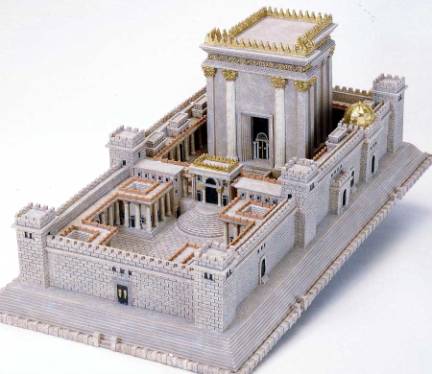
Israel is a hilly country, with deep valley and high craggy peaks. The high places were often used for worship, whether for idols or for the Lord. Solomon’s Temple was built on Mt. Zion. Elijah confronted the priest of Baal on Mt. Carmel. Jesus preached his sermon on the mount (Matthew 5).  The most significant high place was a hill outside Jerusalem when Jesus was crucified.

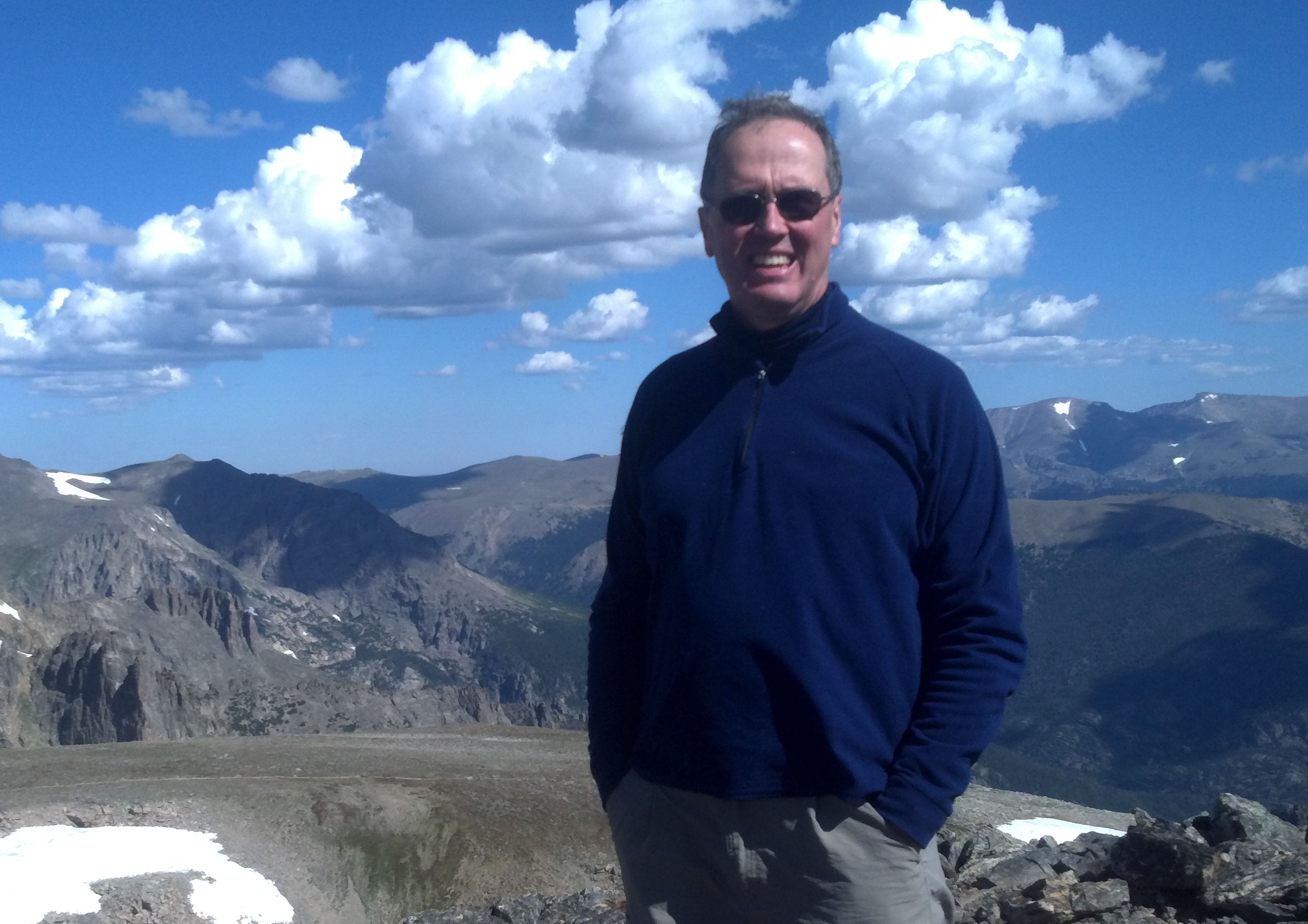
Atop Hallett Peak in RMNP

Mountains have always been associated with holiness and transcendence. They reach towards the heavens and can give a person a unique perspective on the world. I have been drawn to mountain peaks since boyhood, looking up at either Mt. Angeles or Mt. Rainier. Last summer I climbed Hallett Peak in Colorado as a kind of spiritual exercise in prayer.

But as Elijah discovered, God is not restricted to mountain peaks. Though Elijah experienced a dramatic sequence of wind, earthquake and fire, God was not in the dramatic. It was in the sheer silence that followed where Elijah heard God speak. This silence can be found anywhere, in the deepest valley as well as the loftiest peak. We seek a holy space where the ears of our souls yearn for simple assuring voice of God. And “voice” may not be the right word, more like presence, peace, hope, like a mother’s calm shush that ease’s a baby cries. As a child of God, I still yearn for that quiet, assuring voice of God’s grace.

God’s “voice” gives us the assurance to carry on the journey. Elijah did not stay on the mountain, but turned around and went back to face Queen Jezebel. More on that tomorrow.

Lord Jesus, quiet my noisy life that I may hear your loving voice.

Heavenly Reststop

On Sunday Resurrection Lutheran will engage the story of Elijah the prophet. Elijah lived about seventy-five years after the death of King Solomon or about 850 BC. He spoke against King Ahab and Queen Jezebel and their re-introduction of Baal worship and human sacrifice (I Kings 16:34). Elijah’s story is a roller coaster of spiritual and emotional energy.  I Kings 18 contains the story of Elijah’s victory over the Baal priests, calling down the fire of God on his sacrifice. I posted on it last June after re-telling the story at Vacation Bible Adventure.

Elijah in the Desert by Michael D. O'Brien

After securing this victory, one would think Elijah would be filled with supreme confidence. Instead he sank into depression when he learned that Queen Jezebel wanted him dead. He could face the 450 prophets of Baal, but not an angry queen. The instinct to escape took hold, and he ran away to the edge of the map and beyond. Beersheba is the southern edge of civilization and Elijah pushed beyond it into the wilderness. There he collapsed under a broom tree and prayed for death. Like the prophet Jonah after Nineveh’s repentance, Elijah asked the Lord to take his life. He had hit bottom, emotionally and spiritually. Exhausted he fell asleep.

At this low point, God intervened.

Suddenly an angel touched him and said to him, “Get up and eat.” He looked, and there at his head was a cake baked on hot stones, and a jar of water. He ate and drank, and lay down again. The angel of the Lord came a second time, touched him, and said, “Get up and eat, otherwise the journey will be too much for you.” He got up, and ate and drank; then he went in the strength of that food forty days and forty nights to Horeb the mount of God. (I Kings 19:5-8)

What a comforting moment, with  the angel’s touch, the warm cakes, and the jar of water. And then the cycle is repeated: rest, touch, cakes, water. It was if Elijah needed to slow down, to stop and rest.

Perhaps that is the intent for us as the reader. To stop and rest in this story for a moment. Are you able at this moment to simply rest in God’s grace and love?

You have made us for yourself, oh Lord, and our hearts are restless until we rest in you. Augustine.

Lord Jesus, teach me to rest in you.

Sanctuary Light

On Sunday, our Biblical focus will be King Solomon’s building and dedicating the temple in Jerusalem. His father, King David, had wanted to build a temple, but through the prophet Nathan, God instructed him to wait.

Thus says the Lord: Are you the one to build me a house to live in?  I have not lived in a house since the day I brought up the people of Israel from Egypt to this day, but I have been moving about in a tent and a tabernacle.  Wherever I have moved about among all the people of Israel, did I ever speak a word  saying, “Why have you not built me a house of cedar?” (2 Samuel 7:5-7)

The temple was a mixed blessing to Israel. Like many beautiful cathedrals it provided a place for the worship of God to flourish. Awe and wonder could be expressed in multiple ways within its walls. The book of Psalms captures some of the beauty of that magnificent structure.

One thing I asked of the Lord, that will I seek after: to live in the house of the Lord all the days of my life, to behold the beauty of the Lord, and to inquire in his temple. Psalm 27:4

But as I mentioned in yesterday’s post, the danger of a fixed structure is that we compartmentalize God’s activity and restrict God’s presence to the “box on the hill.” A temple, church or cathedral should draw us into the wondrous presence of God yet also send us out renewed and refreshed to be God’s people in the world. The light of Christ is to shine both inside and outside the sanctuary.

I have been rereading Thomas Kelly’s A Testament of Devotion.  A Quaker, Kelly testifies to how the light of prayer is to be transformative wherever we are:

A practicing Christian must above all be one who practices the perpetual return of the soul into it inner sanctuary, who brings the world into its Light and rejudges it, who brings the Light into the world with all its turmoil and it fitfulness and recreates it (p. 35).

Having worshipped in a simple Friend’s Meeting House, I know that it was not the magnificent space that inspired Kelly’s deep conviction, but rather the Light in the people who gathered to listen and be in the Light. The Light calls us together where we amplify its wavelength in community but then the Light directs us back into the world. Our meeting places are to be launch pads.

Lord Jesus, let your light shine in me.

Port-a-Temple

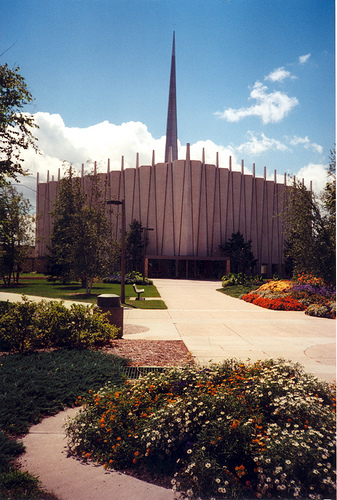
Thirty years ago, I completed an internship at Gustavus Adolphus College. Though my office was in a neighboring building, I walked by or through Christ’s Chapel several time a day. The chapel’s simple, yet provocative architecture often stimulated spiritual reflection.

For example, the chapel is situated in the center of the campus where its high steeple bears witness to God’s central place in the mission of the college. It has clear windows on all four sides, so that worshippers can visually interact with the other college functions. You could see the science center, the library, or the dining hall from your pew. Some saw this as a distraction but also it reminded me that God does not cut me off from the world, but rather prepares me to re-enter it as God’s servant.

Christ’s Chapel also had a unique outer “shell” or wall. The wall panels are long triangular pieces with stain glass separating each panel. The “wavy walls” shimmered in the sunlight. One day after worship Professor Robert Esbjornson explained that the shimmering walls served as a representation of the ancient Israelites’ tabernacle or tent of meeting. When the Israelites left Egypt, they needed a symbolic reminder of God’s presence in their midst. So they were instructed to build a fabric tent of meeting. God said to Moses, “And have them make me a sanctuary so that I may dwell among them” (Exodus 25:8). Christ Chapel was a re-imagined tabernacle in a contemporary setting, .

The tabernacle became  a visual reminder of God’s presence and power in Israel’s midst. “Then the cloud covered the tent of meeting and the glory of the Lord filled the tabernacle” (Exodus 40:34).  In the time of King Solomon the portable tabernacle was replaced with a permanent stone temple.

The portability of the tabernacle continues to challenge me. Too often we want to restrict God to church building or temples. We compartmentalize our space and time. Perhaps we need tabernacles today that can be placed on Wall Street or in front of the Capital, in our homes and our workplaces, to remind us that God travels with us. Of course, at Pentecost God’s Spirit filled the people of God creating a portable sanctuary in each of us. “Do you not know that you are God’s temple and that God’s Spirit dwells in you?” (I Corinthian 3:16).  How are you carrying God?

Lord Jesus, make me mindful of your presence in my life.

The Riddle of King David

King David’s life is a complex riddle that defies easy classification. He was the greatest king of Israel, yet he and his family abused their royal authority. He was a friend of God yet capable of great sin.  In the book of II Samuel (during David’s reign as king) there are seven murders, ten executions, twelve rapes, and a suicide. Yet in spite of this personal violence, God’s presence and power permeates the book.

A clear example is after King David has raped Bathsheba and killed her husband, the warrior Uriah (II Samuel 11). At first, David seemed able to cover up his crimes and to carry on business as usual. Then in II Samuel 12:1-2

But the thing David had done displeased the Lord, and the Lord sent Nathan to David.

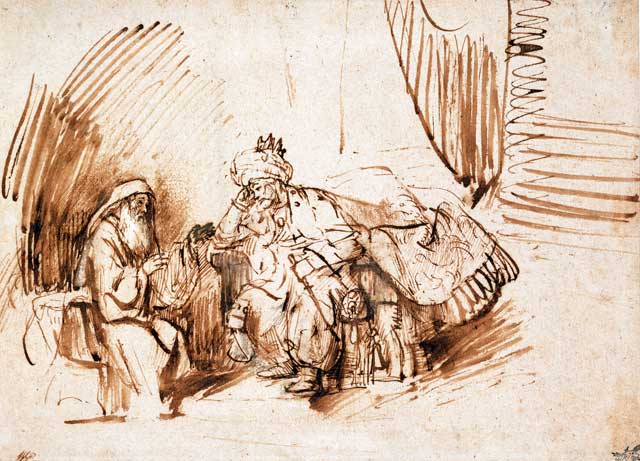
Nathan was the court prophet, one who spoke for God.  Nathan told David a parable in which a rich man with many sheep steals the only ewe lamb of a poor neighbor so that the rich man can prepare a meal for a guest. Hearing the story, David became angry against the rich man and said to Nathan, “As the Lord lives, the man who has done this deserves to die!”

Nathan said to David, “You are the man!”

Thus says the Lord, the God of Israel: I anointed you king over Israel, and I rescued you from the hand of Saul; I gave you your master’s house, and your master’s wives into your bosom, and gave you the house of Israel and of Judah; and if that had been too little, I would have added as much more. Why have you despised the word of the Lord, to do what is evil in his sight? You have struck down Uriah the Hittite with the sword, and have taken his wife to be your wife. (II Samuel 12:7-9)

David’s only response was simple and direct: “I have sinned against the Lord.” No excuses. David had abused his power.

David deserved death, yet God was merciful with him. We may not be as blatant in our abuse of power or authority, yet each of us has sinned against the Lord. We have not loved the Lord God with all our heart, mind and strength. We have not loved our neighbor as ourselves. Do we recognize our need for God’s mercy and forgiveness?  Are we not a riddle in our own behavior?

Lord Jesus, have mercy on me.

David Danced

With the current remake of the movie Footloose, I am reminded of Kevin Bacon’s speech in the original movie.  He comes before the city council to argue for the abolition of law that prohibited dancing in the town.  He  pulls out a Bible and reads from 2 Samuel 6:14 and 16, “David dancing and leaping before the Lord.”

With our current cultures focus on dance and movement, from Zumba fitness classes to “Dancing with the Stars,”  I wonder if dance will have a revival in worship?  I know that in certain Pentecostal or Charismatic churches, “dancing before the Lord” is not unheard of.  I just wonder if Lutherans, the frozen chosen, would ever thaw enough to tap their toes or to sing their praise with dance.  Can one keep the Joy of the Lord bottled up forever?

Lord Jesus, you are the Lord of the Dance.  May I follow your lead.

Heroic Flaws

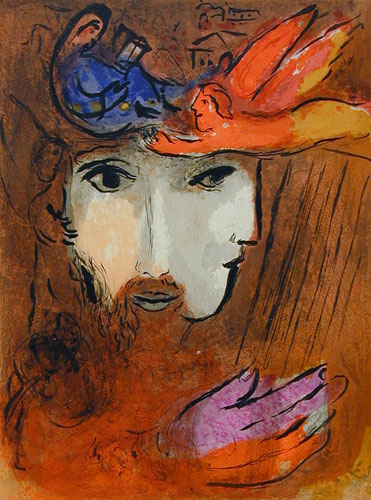
David and Bathsheba by artist Marc Chagall

King David is one of the truly great Biblical heroes.  He unified the twelve tribes of Israel, conquered the once dominate Philistines, expanded the borders and established Jerusalem as the nation’s capital. He also had a deep abiding loyalty to God that he expressed in song and dance. One of my favorite stories is how he brought the forgotten ark of the covenant (the holy box which contained the Moses’ stone tablets) to Jerusalem. As they brought the ark up into the city, “David danced before the Lord with all his might; David was girded with only a loincloth.” (2 Samuel 5:14).  His wife Michal was scandalized by his behavior, but he refused to stop.

David was the heroic leader, the model by which all future kings of Israel and Judah were judged. At the time of Jesus, one thousand years after David’s death, the people still yearned for a new “King David” to arise.  Many hoped Jesus would be that new king. As he entered Jerusalem the people shouted, “Hosanna to the Son of David!” Matthew 21:9.

Yet David had real human frailties, especially as a father and husband. He seduced his neighbor’s wife Bathsheba and then had her husband killed (2 Samuel 11). David’s son Ammon rapes his half-sister Tamar, but David refuse to punish him. So Absalom, Tamar’s brother, avenges her death by killing Ammon. He fled to a neighboring kingdom but eventually returns, only to lead a rebellion against his father, a rebellion that nearly succeeded (2 Samuel 13-17). David’s household was a real mess.

The contrast between David as King and David as husband/dad is so striking, yet true to life. God works through flawed individuals. When we read the stories of Abraham, Jacob, Moses, and David, we discover that they all stumbled in their relationship with God and others. Yet God’s grace was sufficient; God’s power was made manifest in spite of their weaknesses.

If God’s Spirit can work through such flawed, broken human beings like David, God can certainly work through flawed, broken people like you and me. Maybe we just need to dance a bit more?

Lord Jesus, forgive me my sins of doubt and mistrust. Use me for your purposes today.

The Price of Loyalty

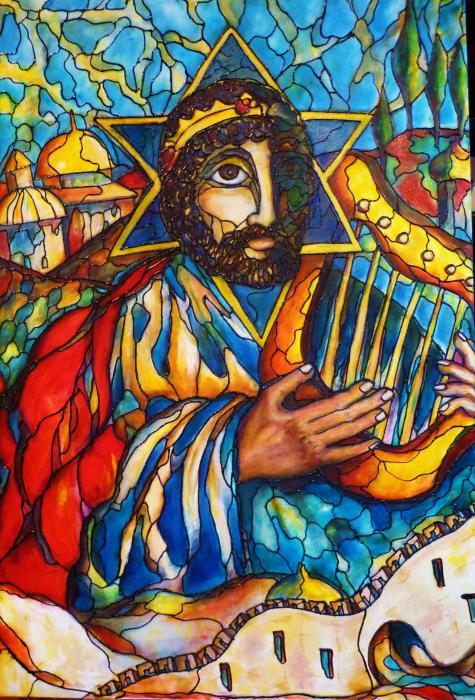
King David by artist Rae Chichilnitsky

King David’s complex story fascinates me. Samuel, the prophet, anointed him as king at a young age and “the spirit of the Lord came mightily upon him from that day forward” (I Samuel 16:13). Saul was still on the throne and would use David in his battles against the hated Philistines (David and Goliath), but then Saul turned against David out of jealousy and rage. Yet David remained loyal to Saul, keeping a secret friendship with Saul’s son Jonathan and sparing Saul’s life at least twice (I Samuel 24, 26). When Saul was killed in battle, David executed the messenger who claimed to kill Saul in hope of reaping a reward from David (2 Samuel 1:14-16). David then sang a song of Lament for Saul and Jonathan,

Saul and Jonathan, beloved and lovely!
In life and in death they were not divided;
they were swifter than eagles;
they were stronger than lions (2 Samuel 1:23).

Though chosen by God to be king, David remained faithful and loyal to the first king of Israel, Saul. David must have known that if he was not faithful as a follower of a king, how could his future followers be faithful to him when he did become king? Throughout his struggles with Saul, David turned to God for strength, wisdom and guidance. He had both a strong sense of God’s sovereignty guiding him, while at the same time knowing he had the freedom to choose his path. First and Second Samuel are great books to reflect upon the interplay between our human freedom and God’s ruling, guiding power.

Loyalty remains tricky today. How does one remain loyal to an organization, a congregation, a friend, a family or to God? As a pastor I sometimes stuggle with being loyal to the people of a old congregation while embracing God’s call to be pastor of a new congregation.  I recognize that God has called new pastors to serve in my former congregation who are faithful and compassionate, yet the deep relationship still pull at my heart string.  I also recognize that it takes time and energy to build new pastoral relationships in my current setting and that God will be faithful here as well.

Have you ever struggle to be loyal to God or to others?

Lord Jesus, your kingdom come, your will be done, through me and through your people.

A Wedding Song and Holy Apples

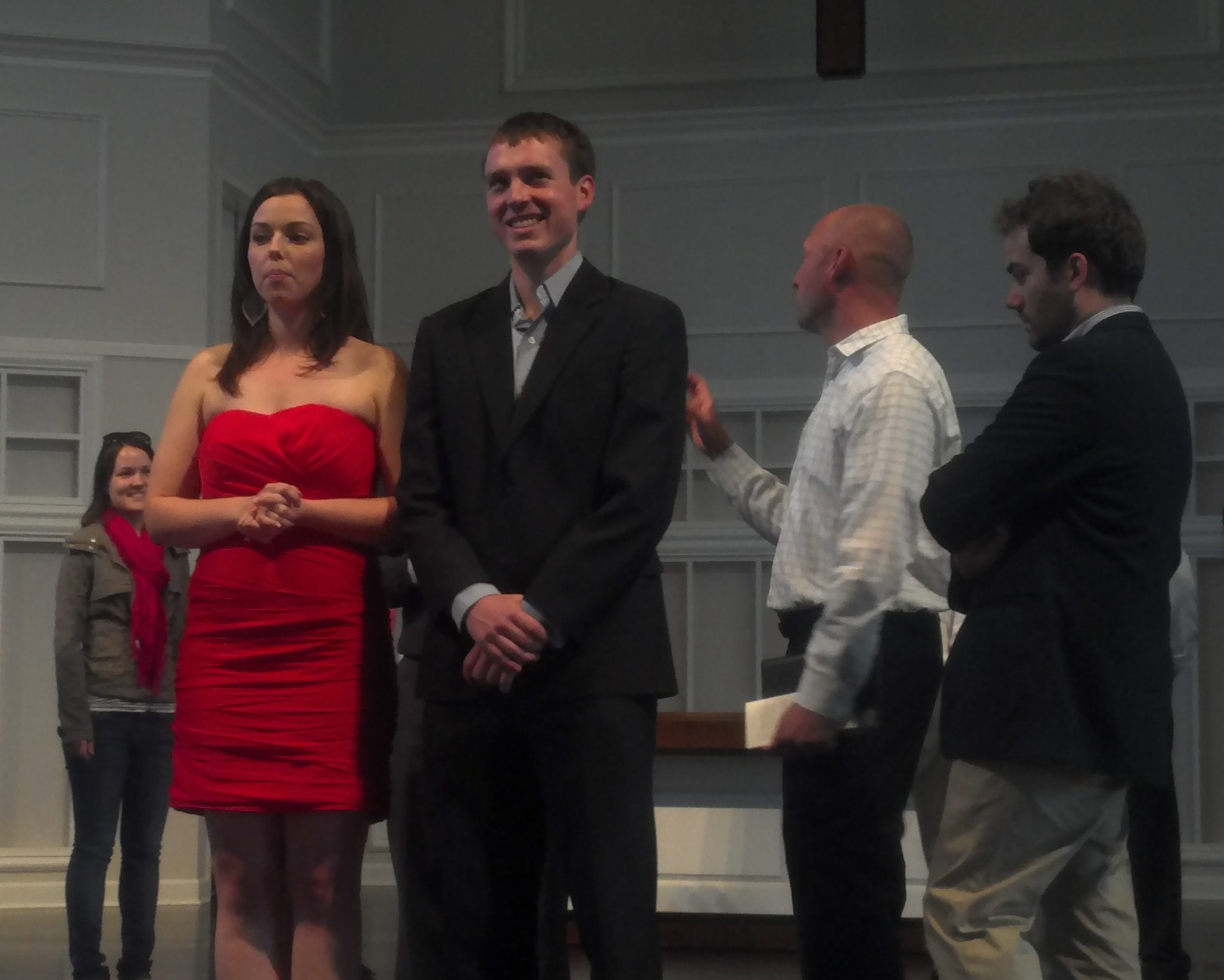
Wedding Rehearsal

Yes, it really happened.  My son Jonathan is now a married man, wedded to Maggie Thomas.  I am glad that I chose to be a proud papa instead of presiding pastor, since it allowed my wife and myself to simple rejoice in the moment.  And it was a joyous celebration of song and word, in which I was able to shout “Amen!” during a few choice moments.   The couple selected  Colossians 3 which includes,

Let the Word of Christ dwell in you richly; teach and admonish one another in all wisdom; and with gratitude in your hearts sing psalms, hymns, and spiritual songs to God. (Col 3:16)

Kyle Jackson, on of two pastors, admonished them to actually practice this verse, singing to one another in the kitchen or the shower.  And during communion they sang with the congregation, while the wedding party distributed the elements.   It was a holy time.

At the reception, I had the opportunity to bless the meal, but first I told the story that when Jonathan was born, I gave out “Jonathan” apples to friends and staff.  Now that I have new daughter-in-law, I want to give out the new Sweet Tango apples for it takes the two of them to tango.  Finally, after reminding everyone about Pastor Kyle’s admonition,  I invited the whole wedding reception to sing as table grace, Jonny Appleseed.

O the Lord is good to me, and so I thank the Lord, for giving me the things I need, the sun and the rain and the apple seed.

Jon and Maggie at Afton Apple Orchard

So what did Jon and Maggie choose to do on their first day as a married couple?  To gather many of their friends and family for an apple picking outing at Afton Apple Orchard.  Made me think of Psalm 17:8

Guard me as the apple of the eye; hide me in the shadow of your wings.

I am pretty sure one of the twelve heavenly  fruits in Revelation 22 must be the apple.

Lord Jesus, bless all married couples that they might delight in each other as the apple of your eye.