Category Archives: Bible

Praying the Lord’s Prayer (Part Two)

Whichever version of the Lord’s Prayer we pray (the topic of my last post), the words can become a string of sounds without meaning. One helpful way to truly pray the prayer is to slow it down, to breathe each phrase or petition and pause to reflect upon it for a moment. For example: God is our Father, our Papa, our Dad, and like a good father God wants to spend time with us, to be in relationship. May this time of prayer be such a time of holy conversation.  Slowing down the Lord’s Prayer allows it to become a form of meditation rather than recitation. To quickly rattle off the words of the prayer rarely becomes true prayer.

Another way to pray the prayer is to use other biblical translations of the prayer. With the plethora of Bible translations one can find unique wordings that can reawaken Jesus’ prayer for us. For example, Eugene Peterson’s The Message translates Matthew 6:9-13 as following:

With a God like this loving you, you can pray very simply. Like this:
Our Father in heaven, Reveal who you are.
Set the world right; Do what’s best – as above, so below.
Keep us alive with three square meals.
Keep us forgiven with you and forgiving others.
Keep us safe from ourselves and the Devil.
You’re in charge! You can do anything you want!
You’re ablaze in beauty! Yes. Yes. Yes.

Or you might try writing your own version of the Lord’s Prayer. A thoughtful personal translation can help you rediscover the beauty and wonder of Jesus’ simple prayer. Here is my recent attempt.

Papa who rules the cosmos,
let Your honor be our vision.
Bring Your desires and justice to our world,
So that heaven can be seen here.
Provides us with sufficient food for today.
Teach us to forgive with the same passion that You forgive us.
Protect us from the evil within and without.
And let us never forget that You are our Glorious King.

Lord Jesus, continue to imprint your words on our hearts and lives
Jacob’s Ladder

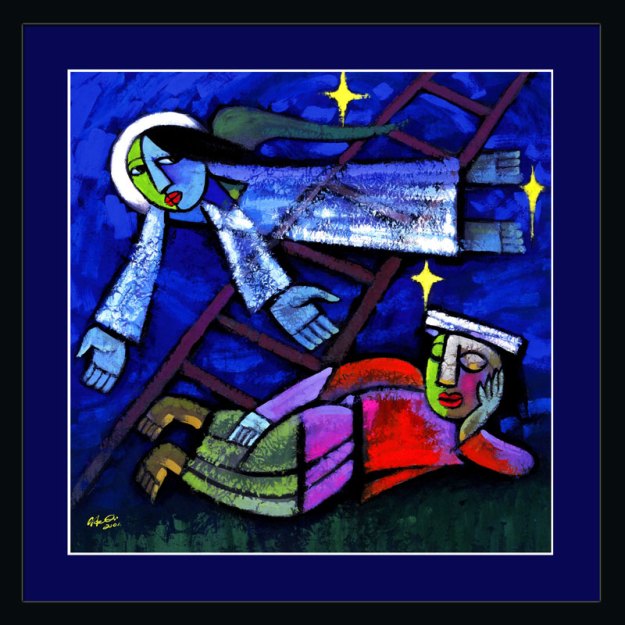
The Dream of Jacob by artist He Qi

One of my favorite stories in Genesis is Jacob’s dream at Bethel in chapter 28.  Jacob, the grandson of Abraham, is running away from his brother Esau.  Twice he had tricked his elder twin.  First Jacob had taken Esau’s birthright for a hot lunch.  Then with the help of his mother, Rebekah, he stole his father’s blessing from Esau.   Esau had reason to threaten Jacob’s life and so Jacob fled.

When he stopped for the night, Jacob dreamed of a ladder reaching up to the heaven with angels ascending and descending on it.  The Lord God stood at the top and speaks to Jacob.  One might expect God to chastise Jacob, to demand his repentance.  After all, Jacob has tricked not only his brother, but his father, Isaac, as well.   Surely God would demand justice.

Instead, God speaks only of the promise and blessing.  God promises Jacob shall return to the promise land and will become the father of a great nation, a blessing to all nations.

Know that I am with you and will keep you wherever you go, and will bring you back to this land (Genesis 28:15).

Some Christians think that the God of the Old Testament is a wrathful, angry God and that grace and love only appears in the New.   Yet the story of Abraham, Isaac and Jacob is filled with moments of grace and blessing.  God has always been a God of grace and love who will always keep His promises.  Jacob had to taste some of his own medicine when he reached his Uncle Laban’s home in Haran, but eventually he returned.  God kept the covenant.

The other strong image from the dream is that God’s angelic hosts go up and down the ladder.  God comes to humanity, not humanity climbing up to God.  God initiates the dream and the covenant.  Jacob can only respond in faith.

After Jacob awoke from the dream, he recognized that he was on sacred ground.  He named it “Bethel” or House (Beth) of God (El).   Later in Israel’s history Bethel would become one of the holy places for worship. (Judges 20).

Lord Jesus, make me ever mindful of your promise and grace.

A Tale of Two NFL Players

I occasionally check the USA Today’s sport’s page for amusement. Today I was struck by two contrasting stories regarding NFL players. The first is on Vince Young, the third player taken in the draft six years ago. He made millions of dollars as a pro-bowl quarterback with the Tennessee Titans but was cut by the Buffalo Bills last month. He is now out of job and seems to have squandered his wealth in either out-of-control spending or bad business partnerships. His story is not so unique among sport’s stars, though the speed of his decline is remarkable.

Even in pro sports, where tales of squandered wealth abound, Young’s plight is “pretty dramatic,” said Kenneth Shropshire, a professor at the University of Pennsylvania’s Wharton School of Business who has written and lectured extensively on the business of sports. “You’d think it would be hard to blow that much money,” Shropshire said.

Contrast Young with a story about NFL rookie running back, Alfred Morris. The article focused on his surprising success with the Washington Redskins and the fact that he still drives a 1991 Mazda, worth less than $1300.

“It has some sentimental value to it now,” Morris told The Redskins Blog. “It just keeps me grounded, where I came from and all the hard work for me to get to this point. So that’s what helps me.”

As I read the two articles, I was reminded of Jesus’ words from the Sermon on the Mount.

“Do not store up for yourselves treasures on earth, where moth and rust consume and where thieves break in and steal;  but store up for yourselves treasures in heaven, where neither moth nor rust consumes and where thieves do not break in and steal.  For where your treasure is, there your heart will be also.” (Matt 6:19-21)

Lord Jesus, keep me grounded in you, so I can store my treasure in heaven.

“I am” and Green Algae

Last week-end I participated in our ninth grade confirmation retreat at Camp Wapo.  The sixteen youth will be confirmed in October, affirming their baptismal covenant. This group had a few “energetic” boys who could be distracting at times so we had to find creative ways to teach.

The retreat focused on the “I am” statements in John’s Gospel. At Friday’s campfire we introduced God’s name “I AM WHO I AM;” God gave this name to Moses at the burning bush (Exodus 3:14). The name in Hebrew became so sacred that later generations of Jews would not pronounce it. Yet Jesus utilized the “I am” name to describe himself. For example in John 9 when he healed a man born blind, he said, “I am the light of the world.”

The next morning we explored the other “I am” statements of Jesus. To keep their attention, we walked about the camp as we discussed, thinking about “I am the way” (John 14:6). We walked through the gate of the “Gaga Pit,” for a discussion of “I am the gate for the sheep” (John 10:7).

I am the vine, you are the branches.

As we stopped in a grove of trees, we listen to Jesus’ words, “I am the vine; you are the branches” (John 15:1) and prayed as we grasped the trunk/vine in our hands. For the most part, the students seem to be connecting to Jesus’ words.

As we approached the swimming beach, I had planned to have the student remember their baptism and Jesus’ words, “I am the resurrection and the life” (John 11:25-26). We were to walk down to the lake shore, dip our hands in the water and make the sign of the cross on our forehead. We would say the words, “I am alive in Christ.” The water would connect us to our baptism and our life in Christ.

However I had neglected to scout the beach prior to our approach. It had not been used for a few weeks, since summer camp ended. As I walked to the shore, I discovered that there was at least a half-foot of thick mud at the water’s edge and that the water had become a sickly green. Instead of life, the water reminded me of death. Uncertain what to do, I looked up to see one of the “energetic” boys walking out onto the dock. It stretched beyond the mud and green algae.

So there on the dock, we reached over into the lake water and renewed our baptism, water dripping from our heads and hands.

I hope someday that I can incorporate an actual immersion under the water as a way of remembering our baptism. I am still Lutheran in my embrace of infant baptism as God’s means of grace. God starts the covenant relationship. But I think many of us need experiential rites along the way to affirm and remember this covenant. Being dunked in a lake could help us remember that we are buried with Christ and raised with Christ in the waters of our baptism (Roman 6:3-4).

I will first need to find a lake without green algae.

Lord Jesus, I am alive in you. Thank you

Root Beer Float

Every Tuesday I drive to a neighboring Lutheran Church for a Bible study with local pastors.  Together we study the scripture text for Sunday so that we can be better prepared to preach God’s Word.

Today, as I drove up to Amazing Grace Lutheran Church I noticed this “float” in their parking lot.  The congregation had used it in the local community parade, where they handed out both root beer candy and “church information on a stick.”  It was a creative way of inviting new comers to their congregation.

A couple weeks before, Resurrection Lutheran Church had participated in our local Woodbury days parade with our worship band playing  for the crowd.  It was a delight to see and hear them that day as they praised God and invite all to come for worship.

As I left Amazing Grace and took this picture, I rejoiced that congregations seek to find creative ways to proclaim the Good News of Jesus Christ.  Churches too often are seen as dry, boring places.   Resurrection and Amazing Grace both seek to express the Vibrant Life of Faith.

I also realized that Amazing Grace had quench my thirst by hosting the study of God’s Word.  What a treat!

Lord Jesus, let me drink again from the fountain of living water.

Rebellion and Love

Why do we do the stupid things we do? Why would Adam and Eve eat from the forbidden tree in the Garden of Eden? Why do I continue to trust in my own abilities and not God’s direction and commands?

“Woman gives her man to eat” by Lucile Butel, 1989

I ask those questions whenever I read Genesis 3, the story of Adam’s and Eve’s choice to disobey God. The story is often called “The Fall” since it describes humanity’s fall from God’s loving, eternal presence, yet I prefer the title “The Rebellion” since it is our human tendency to rebel against God’s commands. We rebel when we place ourselves in the center of our lives, and not God. We listen to the crafty voice of the serpent that says “you will not die, but will find pleasure, riches, knowledge, significance, or fame” if we yield to our own temptations. The story of Adam and Eve’s rebellion is our story of rebellion; our human choice to sin. And if we try to blame anyone or anything else, we are only echoing their response when God confronted them afterwards. Adam blamed Eve, Eve blamed the serpent (Genesis 3:11-13).

The Bible introduces sin and brokenness as an essential piece of our humanity. Though the biblical story begins with humanity created in the image of God (Genesis 1:26), the image is quickly twist and stained by our rebellion. The next eight chapters of Genesis highlights how the infection of sin penetrates all of life: Cain murders Able, The Flood, and the Tower of Babel. Each story hammering home the sinful quality of humanity.

You Will Be A Blessing by David Hetland

Yet each story also shows elements of God’s mercy and grace. After Adam and Eve rebel, God provides them with animal skins for clothing. After Cain murders his brother, God provides a place of sanctuary for him. As God contemplates destroying the sinful world with a flood (Genesis 6), God provides a new beginning through Noah and his family. And after God scatters the people when they build the idolatrous Tower of Babel, God selects Abraham to become a blessing to all people (Genesis 12).

Even our rebellion will not stop God from loving us.

Lord Jesus, have mercy upon us.

Garden of Eden

This Sunday I am preaching on the first story in the Bible, Genesis 2 and 3. The story begins with God creating man from the mud of the earth and breathing into adam/man the breath of life. The story has word-play because the Hebrew word for man ‘adam’ sounds like the Hebrew word for ground or dirt is ‘adamah.’ Then the Lord God places the man in a garden in Eden that has “every tree that is pleasant to the sight and good for food” (Genesis 2:8).

The Garden of Eden has fascinated humanity. My initial impression was of a small compact garden, sort of like a resort on the edge of a river. At the center of the garden is the tree of the knowledge of good and evil, with the crafty serpent nearby. I tend to push the story forward to the temptation scene in chapter three, where both the woman and the man disobey and rebel against God.

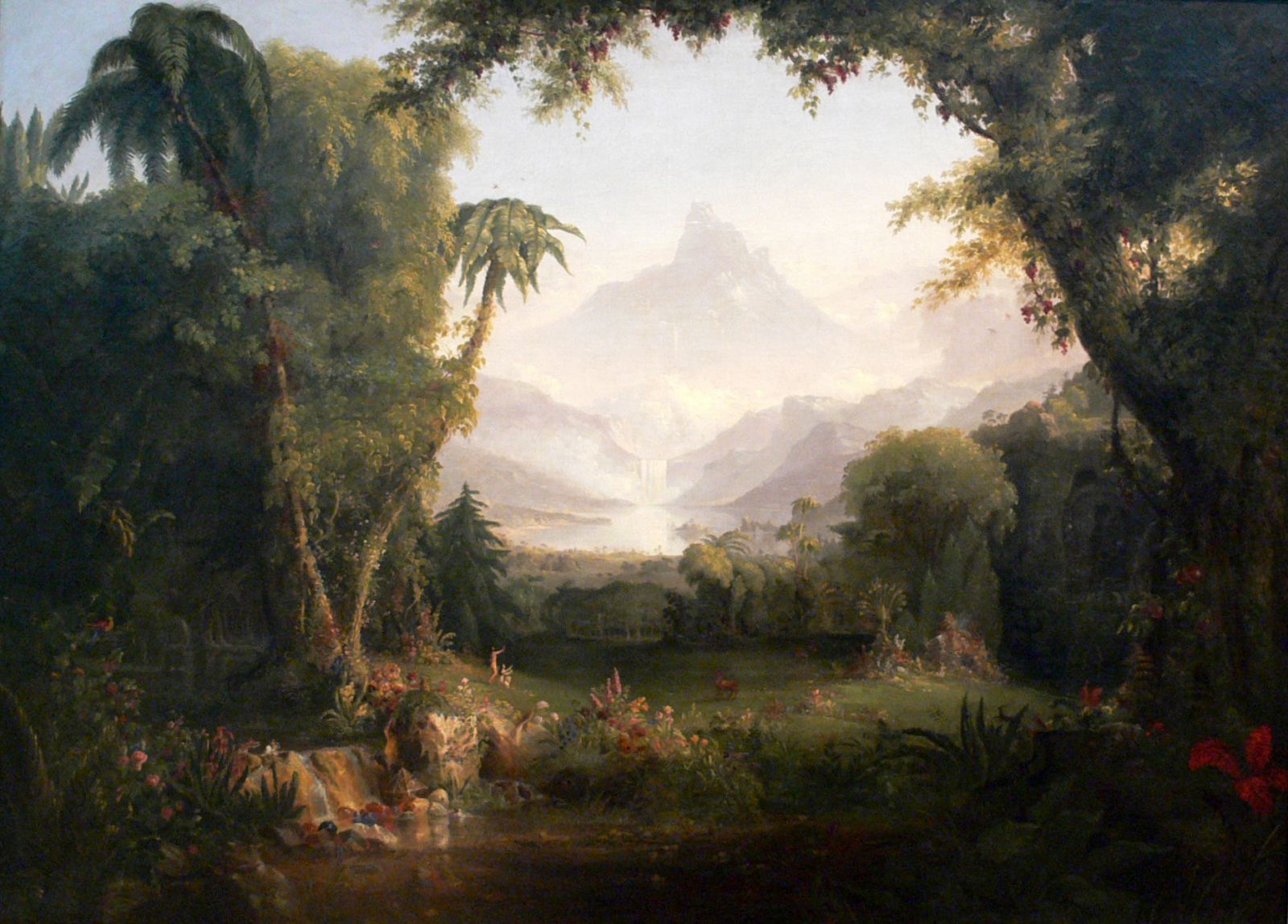
But that tight image has been challenged by the painter Thomas Cole and his painting called “The Garden of Eden” (1828).

Philip Tallon, a Methodist seminary professor, writes about the painting,

As painted by Cole, the garden seems to encompass the whole earth. It is an infinite playground in which Adam and Eve are dwarfed by rivers, mountains, trees, and even sparkling gems that erupt from the earth. As Cole himself wrote in an 1828 letter about the painting, “I have endeavored to conceive a happy spot where all the beautiful objects of nature were concentered.” This conveys first to me the magnificent, plurality of creation: a Christmas stocking so overflowing with treats that we will never get to the bottom.

The abundance and wonder of the God’s creation can be seen in the scripture. It is essential for understanding the story to rest a moment in the awesome beauty of God’s gift to humanity before moving to the fateful confrontation with the serpent. The wonder of that creation remains all around us, if we have eyes to see.

Lord Jesus, thank you for the beauty of your creation.

Wilderness Journey – Day Three – Afternoon

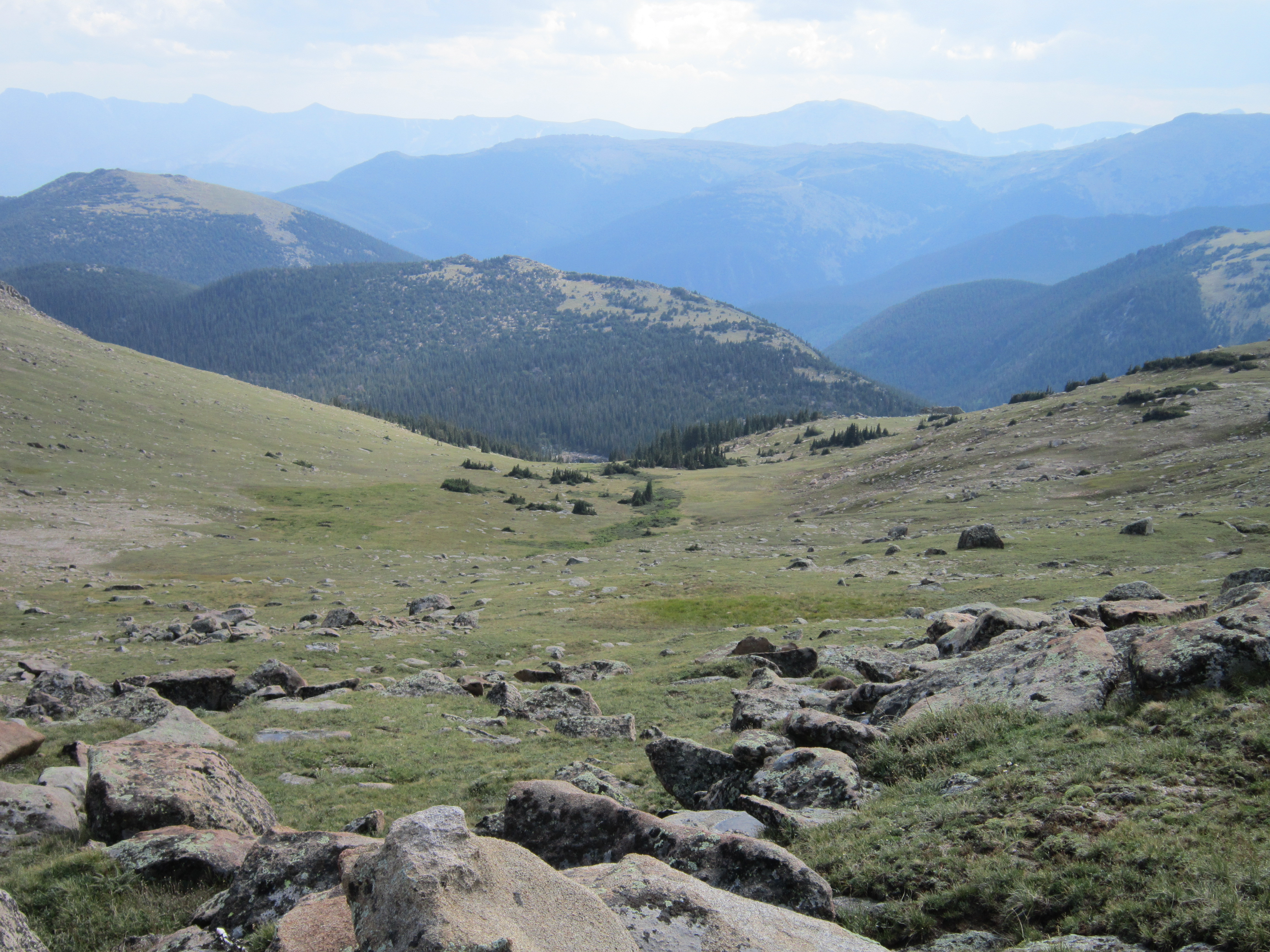
As I continued my journey around Mummy Mountain I remained well above timberline.  I could see far down the West Creek basin, even spotting the place on a distant ridge where I had lunched two days before.

Gathering Storm Clouds

I also spotted a gathering thunderstorm to the west and I hurried my pace.

About 1:00 pm I ran into my first real challenge. The slope transitioned from a meadow to gigantic boulder field. I scrambled between boulders, always seeking a safe, secure route. This took time and energy. I slipped a few times. I also heard cracks of thunder in the distant and  felt a few  raindrops. I dropped lower on the slope, hoping to find fewer boulders. Dark clouds moved closer.  I started looking for a place to wait out the approaching storm.

Krummholz in West Creek Basin

I finally reached the open valley below the final ridge. It was free of boulder fields and had several small krummholz of alpine trees. These small dense stands of trees could give me some protection. As I looked over this isolated valley, I reveled at how beautiful it was, especially in the storm’s twilight.

My revelry was broken by the first splattering of large rain drops. I had to find shelter fast.

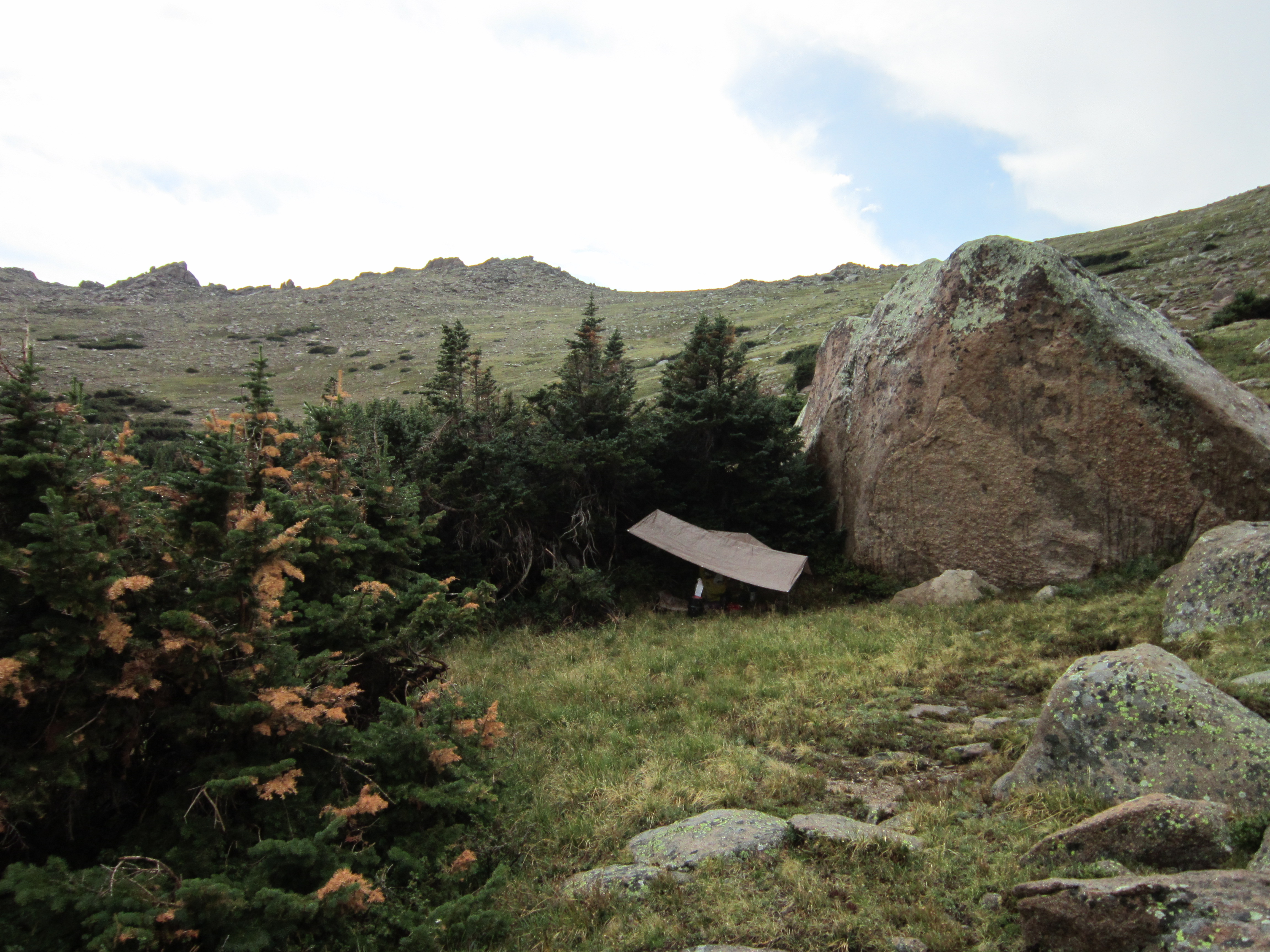
The thunder was louder and closer now. I headed toward a large boulder in the valley, close to a krummholz. Even though the boulder offered some protection, I realize the storm may last awhile and I needed better shelter. My problem was that I had not packed my backpack with such a need in mine. My trusty rain-tarp was at the bottom of my bag. I had to pull everything out into the rain to reach it. However, my experience of pitching a rain-tarp in wet Washington state proved helpful. In less than five minutes the rain tarp was set and my gear and I safely under it.

Shelter from the Storm

For the next two hours it rained, hailed, thundered and boomed. Counting the seconds between flash and thunder, the closest strike was less than a mile away. Fortunately, I was off the exposed ridge line, and away from the largest trees and boulders. I changed out of my wet clothes, fixed a cup of hot chocolate and waited. As the storm continued I wondered if I might have to spend the night here.

Just as suddenly as it started, the storm ended. The sun broke through the clouds and I again marveled at the beauty of this rain-splashed alpine meadow. I repacked my gear, this time keeping my wet rain-tarp tied to the outside of my pack for quick access.

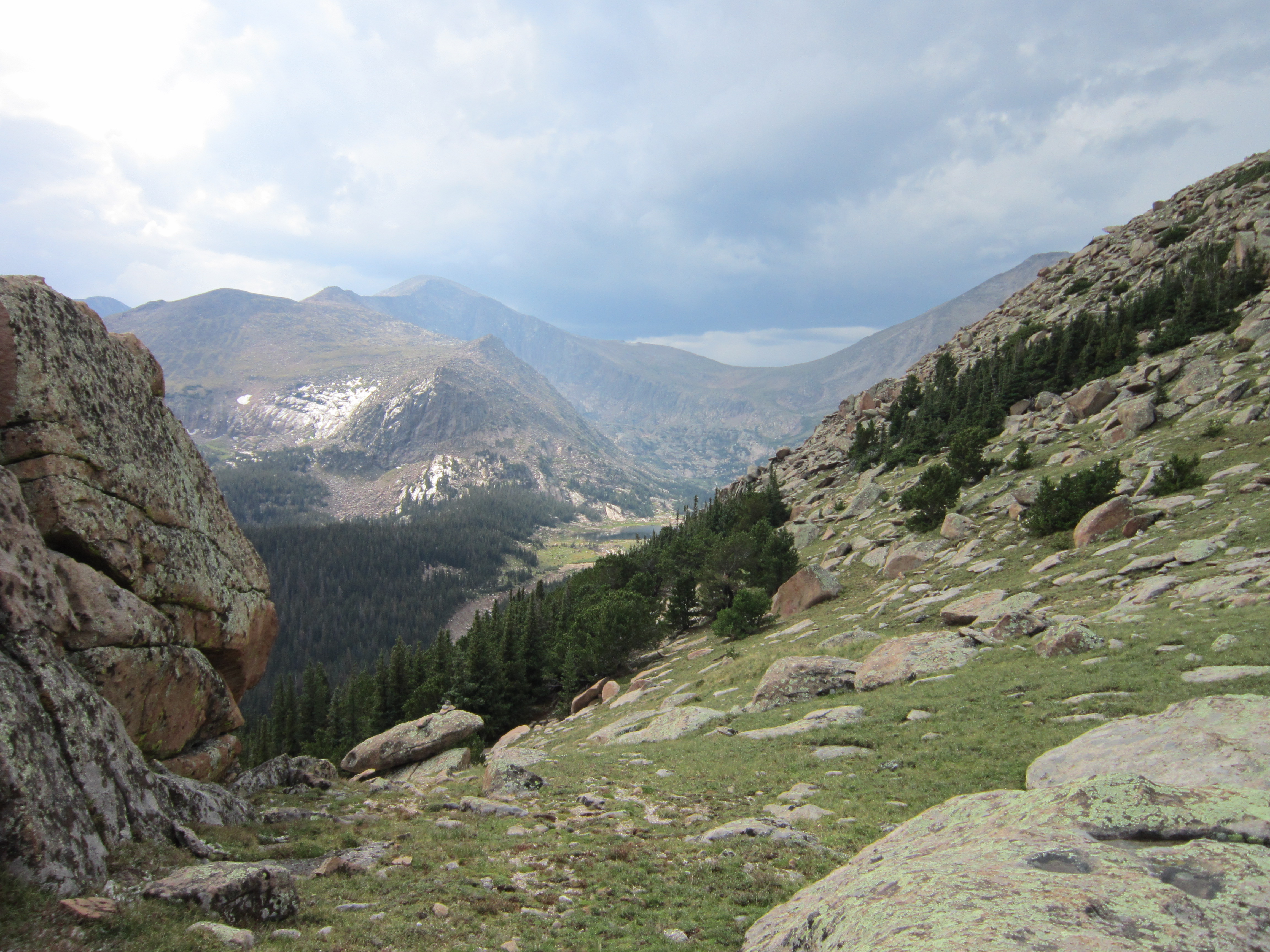
Looking south from the last Mummy Mountain ridgeI reached the final ridge shortly after 4:00 pm and crossed from the West Creek Basin into the Black Canyon. I quickly worked my way off the ridge and towards the forest below.

As I climbed down the ridge, I kept thinking about the thunder-storm and how it had humbled me.   I was not the master of this domain, but a simple wilderness wanderer.  The Israelites at Mount Sinai encountered God in a thunderstorm.

    On the third day at daybreak, there were loud claps of thunder, flashes of lightning, a thick cloud covering the mountain, and an ear-piercing trumpet blast. Everyone in the camp shuddered in fear. Moses led the people out of the camp to meet God. They stood at attention at the base of the mountain. Exodus 19:16-17

I reflected, “God is reminding me once again who is LORD!”

About halfway down, I spotted two rock cairns (small piles of stones) used to mark a way trail. Finally I had reached the improvised trail that leads directly from Black Canyon trail to Mummy Mountain. I followed it down, losing it a couple of times due to poor markings and tired legs and mind. Eventually I connected to the main Black Canyon trail and reached my campsite at Tileston Meadows about 5:15 pm, tired, but safe.

Lord Jesus, Let me never forget that you are LORD.

Wilderness Journey – Day Three – Morning

North Fork of the Big Thompson River

At dawn’s first light, I was up and on the last portion of National Park trail. I passed Lost Lake and quickly found a place to wade the North Fork of Big Thompson River (more like little Thompson creek at this altitude).

From here on, I would be off-trail, but I was above timberline and the slope was not too steep. I took my time, enjoying the unfolding view and relishing the challenge of finding my own route (which was no challenge at this point.)

By 10:00 I was on the wet plateau between Mt Dunraven and Mummy Mountain and I stopped for an early lunch.

Looking south towards Mummy Mountain

At this point I debated whether to climb Mummy Mountain, 13425 feet in elevation. It would delay me from climbing off the ridge and thus expose me to possible storms. However I figured I may never again have the opportunity to climb the peak and, like John Muir, I hungered for some mountain adventure. Just below the peak, at about 12,300 elevation, I dropped my pack near a large boulder and started hiking straight up.

Can you spot my pack?

As I climbed, I kept looking back to see where my pack was. I was glad I did, since after a while every boulder looked like another and I could have easily lost my pack.

I took my time, stopping to rest several times. The climb was challenging and I began to wonder if I might be one of the first people to climb Mummy Mountain this summer because of its isolation. Perhaps there would be climber’s log at the summit that would answer my question.

Looking West from Mummy Peak at Crystal Lake and Fairchild Mountain

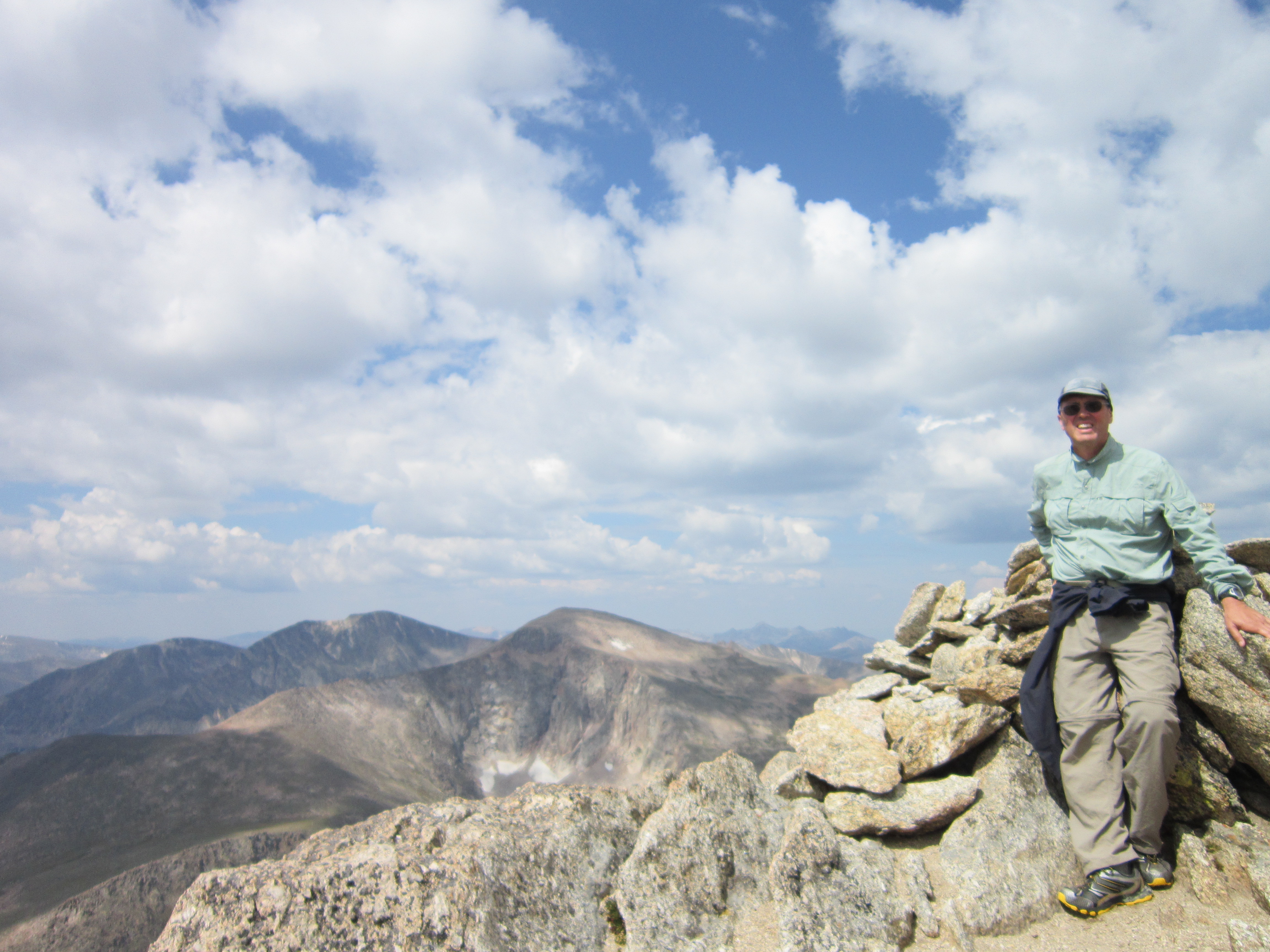
At 11:10 I reached the summit. The peak has a spectacular view to the south and west. I could see Lawn Lake, Crystal Lake, the Saddle, Fairchild Mountain and even Ypsilon Mountain. I found the climber’s log in a plastic plumber’s pipe and discovered that I was the fourth climber that week! I realized that there must be an established route (directly up the ridgeline from the southeast?) and that I might be able to use a portion of it later on.

My pack remained a thousand feet below me so I decided to continue my original plan: to contour around Mummy Mountain, remaining in the West Creek basin until I came to the ridge above Tileston Meadow’s. The ridge was at 11,750 feet so I figured I could gradually lose some elevation as I hiked around the mountain side. I scrambled back to my pack and continued on.

The terrain remained mostly meadow with many large boulders. Occasionally I encountered large clumps of boulders that I had to go over or around. I generally chose to go around, dropping to a lower elevation.

Contemplating which path to take

As I picked my way along the slope, I reflected on what a seminary professor once regarding Psalm 119:105, Your word is a lamp to my feet and a light to my path.   He said, “Remember that the lamps of ancient Israel where not blazing maglite flashlights by which you can see the path for hundreds of feet.  Rather they were flickering oil lamps which gave you visibility of only a few feet.  But that is all you need.  The text reminds us that God does not reveal the whole path at once, but just enough to show us the way.”

As I worked my way around Mummy Mountain, I thanked the Lord for each small section of path that I could see.

Lord Jesus, show us our path for today.

Next: a stormy afternoon.

Wilderness Journey – Day One

As a young boy, my favorite playground was the large tract of woods behind my house. Port Angeles was a lumber town, with five mills busy turning Douglas fir into paper and lumber. My neighbors were loggers who cut the tress or drivers who transported the huge logs to the mills. The huge forests of the Olympic Peninsula were a magnet for my imagination. Only later did I see the devastation that clear-cut logging created.

North Boundary Trail in Rocky Mountain National Park

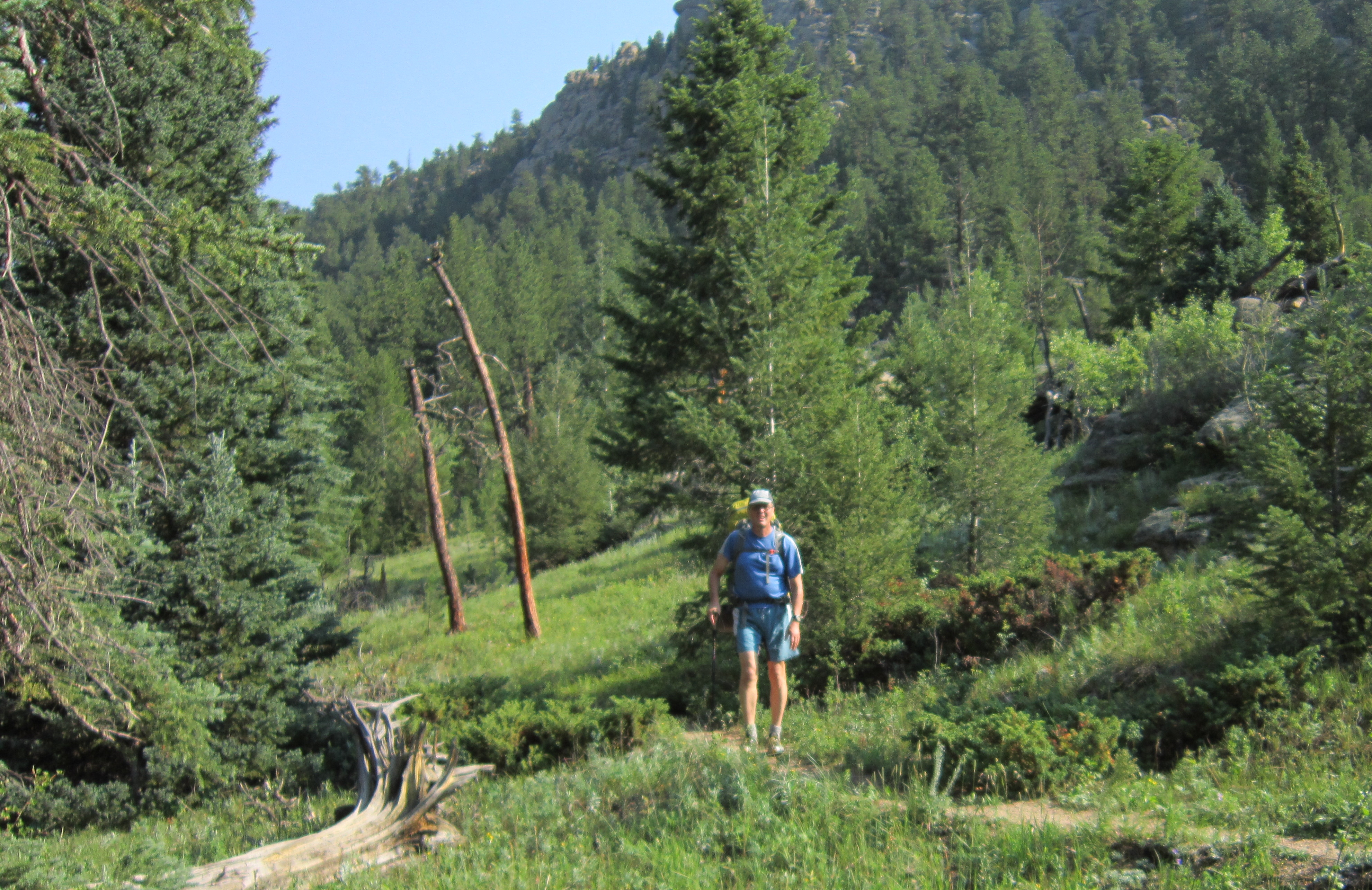
I remembered my childhood fascination with the forest as I started my four-day solo backpacking trip in Rocky Mountain National Park last week. Since I wanted to do a loop route, I started from Cow Creek trailhead and headed north along the North Boundary Trail. I normally see the mountain forests as a transition zone that I quickly want to ascend so as to reach the open alpine areas with their vast vistas. For me, the forest was only a prelude to the main event.

Yet I knew that my first day would remain in the forest. The North Boundary Trail ascends three ridges, each time descending to a mountain stream. The constant up and down challenged both my legs and my lungs. There were a few open meadows where one could see the higher peaks to the west, but mostly it was the forest that surround me. I yearned for the high alpine country ahead.

Crossing West Creek along North Boundary Trail

During my trip I was reading Baptized into Wilderness: A Christian Perspective on John Muir by Richard Cartwright Austin. In the book, Austin emphasizes Muir sensuous emersion into the wilderness. Muir became present to the trees, birds, insects, life of American wilderness, experiencing God in the midst of all of it.

Muir suggested that the path to the Spirit is not away from the world, but deeper into the world, deeper into communion with nature and with the primary forces where is Spirit is lightly clothed. Probing the simplest elements to discover their full character and vitality, he developed an incarnational understanding of God’s personality incarnate in Jesus (p. 25).

God’s presence was all around me, in the beauty of the tall lodge pines and the tiniest of mushrooms. Could I simply open my heart and mind to experience the wonder and beauty of God’s creation?

Let the heavens be glad, and let the earth rejoice; let the sea roar, and all that fills it; 12 let the field exult, and everything in it. Then shall all the trees of the forest sing for joy before the Lord; for he is coming, for he is coming to judge the earth. He will judge the world with righteousness, and the peoples with his truth. Psalm 96:11-13

Lord Jesus, open my heart to see your beauty all around me.