Category Archives: grace

Authority to Forgive

Though most of us spent decades in classrooms, rarely do we remember a specific class. Each hour of instruction tends to blend with the others to build a cumulative base of knowledge. Occasionally one hour of instruction will stand out among all the others. One such hour for me was my first year at Luther Seminary in 1977. The class was being taught by Dr. Warren Quanbeck, a renown Lutheran theologian.

One monring he was leading us through a story in the Gospel of Mark, the healing of the paralytic (Mark 2:1-13). He pointed out the controversy surrounding Jesus’ announcement that the man’s sins were forgiven. The religious scribes thought it was blasphemy for Jesus to claim such authority. Then Dr. Quanbeck asked a question that rocked my understanding of Jesus and forgiveness.

“If Jesus died in order to forgive us our sin, how could he forgive the sins of the man prior to his crucifixion?”

Like many Christians, I had grown up with a rather simplistic idea that Jesus “paid” the penalty for my sins by being a sacrifice to the righteousness of God. Often this line of reasoning turns God into a “mean vindictive judge” who demands the death of his only son. Dr.Quanbeck challenged that understanding by pointing out that Jesus was forgiving sin prior to his death just as God had been doing in the Old Testament. God’s business is forgiveness.

What put Jesus on the cross was the human inability to accept such gracious mercy and love. Throughout the Gospel of Mark we witness this tension with the religious official over Jesus’ authority. Ultimately they crucify Jesus precisely because he claimed the divine power to forgive sins. It was humanity’s ultimate rejection of God’s grace. But God would not be denied. To demonstrate Jesus’ authority, God raised him from the dead and turn the crucifixion into the very path to eternal life.

Dr. Quanbeck died less than two years after that class. But his instruction guided me into a deeper understanding of God’s grace and mercy. Thanks be to God.

Do you remember a class, teacher, or moment that rocked your understanding of God?

Lord Jesus, thank you for being so gracious towards me.

Go Home

What path are you following?

When I read the Gospel of Mark, I am struck by how quickly certain people left everything to follow Jesus. Peter, Andrew, James and John immediately left their fishing nets to follow Jesus (Mark 1:18). Levi left his tax booth and followed him (Mark 2:14). I think to myself, “I could never make such a radical, instantaneous decision like them.” The text helps me examine the depth of my conviction to follow Jesus.

Today I was reading the story of the paralytic in Mark 2. Four friends stopped at nothing to place the paralytic in the sight of Jesus. Their plan was that he would be healed. But Jesus’ home was so filled that they could not enter. They still made a way. Jesus then made the controversial move of saying, “Son, your sins are forgiven.” The religious hierarchy had a fit because they did think Jesus had the authority to forgive sins. Jesus could see their skeptical thoughts so he said something even more troublesome, “Which is easier, to say to the paralytic, ‘Your sins are forgiven’ or to say ‘Stand up and take your mat and walk?’”

That is a question that continues to challenge all who read it. Which would you say is easier to say?

Jesus continued, “I will now demonstrate that the Son of Man has authority on earth to forgive sins.” He turned to the paralytic, “Stand up, take your mat and go to your home.” Those last words caught my attention. I expected Jesus to say, “And follow me.” After all, here is an ideal candidate to follow Jesus. The healed paralytic could bear witness to what Jesus had done for him. He could be living proof of Jesus authority and healing power.

But Jesus sent him home.

I don’t know why Jesus would call fisherman and tax collectors to follow him, and not the healed paralytic. (It could have something to do with whether miraculous healing was to be the primary focus of his ministry.)  Still, there are at least two lessons that we need to hear.

First, our sins are forgiven. Our broken relationship with God is restored by Jesus’ authority.

Second, we need to listen carefully as to where and how we serve. Not all of us are called to serve Jesus in the same way, to walk the same path. Yet I think we all are called to listen to his voice, a voice that speaks forgiveness and direction.

Lord Jesus, open my heart, mind and will to hear your promise and command.

Done Enough?

Yesterday our e-mail and website went down. Our domain name, resurrection-woodbury.org, was dropped as our congregation transitions to a new webhosting site. I am so thankful for people like our office administrator, Sue Guck, and our web volunteer, Matthew Mayer, who immediately saw the problem and are now working hard to correct it.  We should be back up by tomorrow. Technology is a great tool, but it has its glitches.

Though frustrated by this event, it caused me to reflect on my overreliance on such technology tools and the constant “buzz” it produces. I have this feeling that I NEED to be connected. Such feelings can become unhealthy. Sort of like overtraining in running, or becoming a workaholic, it is too much of one thing. God gave us work, exercise and community as gifts, but they are not to become “gods.”

The Sabbath is also a gift from God. Wayne Muller has written about sabbath rest for the Lutheran magazine. He asks the question, “When have we done enough?” Since many of us think we cannot rest until we have finished everything, we never rest.

I remember being on a retreat with a large number of pastors and doing a devotion on resting in God. The one response that stood out was a pastor who said he could never rest, since there is still one more person to visit, one more couple to counsel, one more family to help. God “expected” him to bring care to the entire congregation. I wondered silently, “are you trying to be God, rather than God’s agent?”

So many of us just keep plowing along. Sabbath is the promise of God that we have done enough, worked enough, served enough. It is the promise that we can rest in God’s promise that we are God’s children in spite of our inadequacies and unfinished business. It is a gift of grace that needs to be practiced weekly, whether we are finished or not.

Jesus said, “Come to me, all who are weary and are carrying heavy burdens, and I will give you rest.” (Matthew 11:28)

Lord Jesus, let me rest in you today.

The Prophet’s Profit

The prophetic books have always been a challenge to me as a preacher and pastor. I prefer to work with narrative portions of the Bible: stories that make a point about God and humanity. The Biblical prophets rarely tell stories (the prophet Jesus being the exception). Isaiah, Jeremiah, Hosea, Micah and others tend to use poetic language of metaphor and direct speech. The language is often harsh and demanding. Law seems to prevail over gospel; God’s judgment over God’s mercy.

Do not rejoice, O Israel! Do not exult as other nations do; for you have played the whore, departing from your God. You have loved a prostitute’s pay on all threshing floors. Threshing floor and wine vat shall not feed them, and the new wine shall fail them. They shall not remain in the land of the Lord; but Ephraim shall return to Egypt, and in Assyria they shall eat unclean food. (Hosea 9:1-3)

Yet this is God’s Word and needs our faithful attention. Like a good doctor, the prophet gives a proper diagnoses of our spiritual condition. The prophet does not sugar-coat the news, but rather forcefully calls for the repentance of God’s people. The prophet shows us our sinful arrogance and calls us back to God’s ways. It is our disloyalty to God and God’s ways that causes the judgment. It is our mistreatment of our neighbor that causes God’s to be angry.

 Return, O Israel, to the Lord your God, for you have stumbled because of your iniquity.  Take words with you and return to the Lord; say to him, “Take away all guilt; accept that which is good, and we will offer the fruit of our lips.   (Hosea 14:1-2)

The prophets announce God’s mercy and tenderness. God’s love permeates even the judgment.  The prophet Hosea proclaims God’s grace towards us in a poem that reminds of the paradise garden of Eden in Genesis 2.

I will heal their disloyalty; I will love them freely, for my anger has turned from them.  I will be like the dew to Israel. . .   They shall again live beneath my shadow, they shall flourish as a garden; they shall blossom like the vine, their fragrance shall be like the wine of Lebanon.

The prophets can still speak God’s Word of life for us. Are we willing to listen?

Lord Jesus, you have the words of eternal life. Open our hearts to hear them.

Heavenly Reststop

On Sunday Resurrection Lutheran will engage the story of Elijah the prophet. Elijah lived about seventy-five years after the death of King Solomon or about 850 BC. He spoke against King Ahab and Queen Jezebel and their re-introduction of Baal worship and human sacrifice (I Kings 16:34). Elijah’s story is a roller coaster of spiritual and emotional energy.  I Kings 18 contains the story of Elijah’s victory over the Baal priests, calling down the fire of God on his sacrifice. I posted on it last June after re-telling the story at Vacation Bible Adventure.

Elijah in the Desert by Michael D. O'Brien

After securing this victory, one would think Elijah would be filled with supreme confidence. Instead he sank into depression when he learned that Queen Jezebel wanted him dead. He could face the 450 prophets of Baal, but not an angry queen. The instinct to escape took hold, and he ran away to the edge of the map and beyond. Beersheba is the southern edge of civilization and Elijah pushed beyond it into the wilderness. There he collapsed under a broom tree and prayed for death. Like the prophet Jonah after Nineveh’s repentance, Elijah asked the Lord to take his life. He had hit bottom, emotionally and spiritually. Exhausted he fell asleep.

At this low point, God intervened.

Suddenly an angel touched him and said to him, “Get up and eat.” He looked, and there at his head was a cake baked on hot stones, and a jar of water. He ate and drank, and lay down again. The angel of the Lord came a second time, touched him, and said, “Get up and eat, otherwise the journey will be too much for you.” He got up, and ate and drank; then he went in the strength of that food forty days and forty nights to Horeb the mount of God. (I Kings 19:5-8)

What a comforting moment, with  the angel’s touch, the warm cakes, and the jar of water. And then the cycle is repeated: rest, touch, cakes, water. It was if Elijah needed to slow down, to stop and rest.

Perhaps that is the intent for us as the reader. To stop and rest in this story for a moment. Are you able at this moment to simply rest in God’s grace and love?

You have made us for yourself, oh Lord, and our hearts are restless until we rest in you. Augustine.

Lord Jesus, teach me to rest in you.

The Riddle of King David

King David’s life is a complex riddle that defies easy classification. He was the greatest king of Israel, yet he and his family abused their royal authority. He was a friend of God yet capable of great sin.  In the book of II Samuel (during David’s reign as king) there are seven murders, ten executions, twelve rapes, and a suicide. Yet in spite of this personal violence, God’s presence and power permeates the book.

A clear example is after King David has raped Bathsheba and killed her husband, the warrior Uriah (II Samuel 11). At first, David seemed able to cover up his crimes and to carry on business as usual. Then in II Samuel 12:1-2

But the thing David had done displeased the Lord, and the Lord sent Nathan to David.

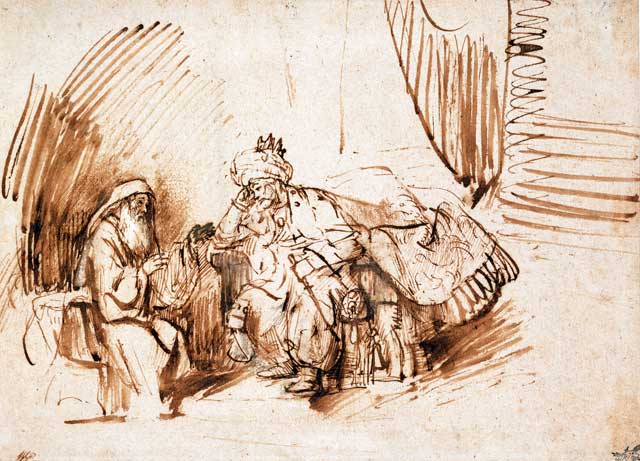
Nathan was the court prophet, one who spoke for God.  Nathan told David a parable in which a rich man with many sheep steals the only ewe lamb of a poor neighbor so that the rich man can prepare a meal for a guest. Hearing the story, David became angry against the rich man and said to Nathan, “As the Lord lives, the man who has done this deserves to die!”

Nathan said to David, “You are the man!”

Thus says the Lord, the God of Israel: I anointed you king over Israel, and I rescued you from the hand of Saul; I gave you your master’s house, and your master’s wives into your bosom, and gave you the house of Israel and of Judah; and if that had been too little, I would have added as much more. Why have you despised the word of the Lord, to do what is evil in his sight? You have struck down Uriah the Hittite with the sword, and have taken his wife to be your wife. (II Samuel 12:7-9)

David’s only response was simple and direct: “I have sinned against the Lord.” No excuses. David had abused his power.

David deserved death, yet God was merciful with him. We may not be as blatant in our abuse of power or authority, yet each of us has sinned against the Lord. We have not loved the Lord God with all our heart, mind and strength. We have not loved our neighbor as ourselves. Do we recognize our need for God’s mercy and forgiveness?  Are we not a riddle in our own behavior?

Lord Jesus, have mercy on me.

Heroic Flaws

David and Bathsheba by artist Marc Chagall

King David is one of the truly great Biblical heroes.  He unified the twelve tribes of Israel, conquered the once dominate Philistines, expanded the borders and established Jerusalem as the nation’s capital. He also had a deep abiding loyalty to God that he expressed in song and dance. One of my favorite stories is how he brought the forgotten ark of the covenant (the holy box which contained the Moses’ stone tablets) to Jerusalem. As they brought the ark up into the city, “David danced before the Lord with all his might; David was girded with only a loincloth.” (2 Samuel 5:14).  His wife Michal was scandalized by his behavior, but he refused to stop.

David was the heroic leader, the model by which all future kings of Israel and Judah were judged. At the time of Jesus, one thousand years after David’s death, the people still yearned for a new “King David” to arise.  Many hoped Jesus would be that new king. As he entered Jerusalem the people shouted, “Hosanna to the Son of David!” Matthew 21:9.

Yet David had real human frailties, especially as a father and husband. He seduced his neighbor’s wife Bathsheba and then had her husband killed (2 Samuel 11). David’s son Ammon rapes his half-sister Tamar, but David refuse to punish him. So Absalom, Tamar’s brother, avenges her death by killing Ammon. He fled to a neighboring kingdom but eventually returns, only to lead a rebellion against his father, a rebellion that nearly succeeded (2 Samuel 13-17). David’s household was a real mess.

The contrast between David as King and David as husband/dad is so striking, yet true to life. God works through flawed individuals. When we read the stories of Abraham, Jacob, Moses, and David, we discover that they all stumbled in their relationship with God and others. Yet God’s grace was sufficient; God’s power was made manifest in spite of their weaknesses.

If God’s Spirit can work through such flawed, broken human beings like David, God can certainly work through flawed, broken people like you and me. Maybe we just need to dance a bit more?

Lord Jesus, forgive me my sins of doubt and mistrust. Use me for your purposes today.

Living Generously

The Rock and the Rainbow as Promises of God

Jesus lived generously.  He gave himself easily to others.  When a religious leader asked him to heal his sick daughter, Jesus immediately started towards his home and eventually healed her (Mark 5:21-43).   When Jesus saw the hungry crowd, he took what his group of disciples had and fed 5,000 people (Mark 4:30).  He graciously gave of himself as he blessed little children and invited the rich man to join his school of discipleship (Mark 10:13-17).  Ultimately Jesus gave his very life for all humanity.  Jesus lived graciously and creatively, never fearful of his choices to give.  He has become the rock of our salvation, the culmination of God’s creative promise in the rainbow to redeem the world (Genesis 9:15).

Gracefulness, generosity and creativity are interrelated and form key elements of a Godly character.  Seth Godin, author and speaker, wrote,

Fear.  It creates anger and selfishness.  They sit together, supporting each other, as inseparable as red, orange, and yellow on the spectrum.

Generosity, creativity, and gracefulness are at the other end in a similar cluster.  If you seek to be creative, start by being generous.  Like blue, indigo and violent, they live together.

At which end of the spectrum do you reside?  When have you experienced grace and generosity together?

Lord Jesus, thank for your never-ending spring of life. Show me the path to generosity and gracefulness.

Jonah the Gardener

Pure speculation but I think Jonah was a gardener prior to his call as a prophet. 

"Sower with Setting Sun" by Vincent Van Gogh, 1888

How else can the reader understand his roller coaster of emotions in chapter four?  When God is merciful and does not punish Nineveh, Jonah plunges into despair and wants to die.   He pouts outside the city.  God causes a “bush” to grow up rapidly.  Its shade provides Jonah comfort; “so Jonah was very happy about the bush” (v.7).  The next day God sends a tiny worm to attack the bush so that it withered.   Without the bush, the hot sun and sultry east wind hit Jonah so that he wants to die (v.8).  Jonah’s passion for a plant reminds me of a gardener’s deep identity with her garden.

Castor Bean Plant

Scholars speculate as to what kind of bush it was.   The Hebrew word here is qiqayon which is used nowhere else in the Bible.   Some think it was castor bean plant which can grow very quickly, up to ten feet in a few months (but not overnight, which is God’s doing in the story). Whatever kind it was, Jonah immediately sees its value.  He has it for a day and then it is gone.

After the bush dies, God confronts Jonah again, “Is it right for you to be angry about the bush?”Clearly Jonah valued the bush and its comfort and he makes the judgment that he is angry enough to die.  God challenges Jonah’s perspective and judgment.

God said, “What’s this? How is it that you can change your feelings from pleasure to anger overnight about a mere shade tree that you did nothing to get? You neither planted nor watered it. It grew up one night and died the next night.  So, why can’t I likewise change what I feel about Nineveh from anger to pleasure, this big city of more than a hundred and twenty thousand childlike people who don’t yet know right from wrong, to say nothing of all the innocent animals?”   Jonah 4:10-11 The Message

The book of Jonah ends with this question.  The tension between God and Jonah is left unresolved.  It is as if God is now the gardener, planting a seed of compassion and mercy in the reader’s heart to see if it will grow.  Will it grow in you?

Lord Jesus, Master Gardener, plant and water the seeds of compassion and grace in my life.

Is it right to be angry?

Last night we wrapped up the study of Jonah for Summer Lite Worship.   Most remember Jonah’s attempt to escape from God’s mission to Nineveh and how God sends his pet whale to retrieve him.  What happens next is even more fantastic, because when Jonah finally reaches Nineveh, a city renown for sin, he preaches a one-sentence sermon and the ENTIRE CITY REPENTS, including the cattle, sheep, dogs and cats.   It is a marvelous scene with everyone wearing ashes and gunnysacks, seeking the mercy of a God they did not know prior to Jonah’s arrival.    And wonder of wonders, “God changed his mind about the calamity that he had said he would bring upon them and he did not do it.”  Jonah 3:10

The reader would think that Jonah would rejoice.  After all, what preacher has ever had 100% positive response to her sermon?   But not Jonah; he despairs!   He wants Nineveh to be punished for what it had done to Israel.   Jonah starts to argue with God,

“O Lord! Is not this what I said while I was still in my own country? That is why I fled to Tarshish at the beginning; for I knew that you are a gracious God and merciful, slow to anger, and abounding in steadfast love, and ready to relent from punishing.  And now, O Lord, please take my life from me, for it is better for me to die than to live.” Jonah 4:2-3  

The mercy of God causes Jonah pain because he sees others getting away with “murder.” Even though he received mercy when the great fish rescued him from the depths of the sea, he cannot stomach others receiving mercy.  God’s mercy irks him so much that he wants to die.

So God asked Jonah a fateful question, “Is it right for you to be angry?”

Almost all emotions involve some kind of judgment.   We are sad when we are deprived of something that we valued.  We are happy when we receive something we value.  A Garmin Forerunner 410 as a birthday present could give joy to an avid runner and disappointment to a six-year-old.  

God asks Jonah if his anger towards God’s compassion is right.  Should God be merciful to all sinners, even the most horrendous ones? Should God be gracious towards those who have hurt you?

Lord Jesus, wash me in mercy, that I might be merciful.