Category Archives: grace

Name that Commandment Part II

The ninth and tenth commandments*, “You shall not covet,” are the two most challenging commandments in our culture today.  Our consumer society is built on the idea that an individual does not have enough. It is the economic law of supply and demand.  We must create a “want” for more stuff, so that we have a demand to produce more stuff.   If there is no demand for something, there is no reason to produce it.    

Yet our mass market culture is good at producing wants.  We are constantly seeing/hearing/experiencing messages that tell us to want something, anything and everything. We are caught in the game of “wanting” the newest whatever because everyone else has it and we “need” it.  Our culture constantly stokes the fire of desire.   So when we hear the commandment, “you shall not covet,” it seems so bizarre and difficult.  Confirmation students are not the only people wrestling with this.  

Several years ago I took a group of seniors on a tour boat ride around Lake Minnetonka.  The tour guide started telling us about the large homes that surround the lake. “This property was purchased for $5 million dollars, and the new owner remodeled with another $5 million.” Or “That property was purchased for $7 million, the old house torn down, and a new house built for $10 million.”  After the boat ride, I told the group of seniors, “We just spent the afternoon breaking the tenth commandment.”  Now we may not  want a house on Lake Minnetonka, but looking and pricing such homes rarely feeds our contentment center.  

So how do we obey this commandment?  By shifting our focus away from this constant barrage for “bigger, better and more” to the Gospel message that I am loved and accepted by God just the way I am.   My real identity is not a consumer who needs more, but a steward who hold everything as a trust from God. I truly need to hear God’s message of gracious acceptance on a consistent basis.  Otherwise the culture’s message that “You are not good enough, unless you buy this or pursue that’ will win our souls. 

 How do you define “coveting?”  How do you deal with it?

 Lord Jesus, help me to seek you with all my heart and soul.

 *Martin Luther in his catechism followed the Roman Catholic tradition from St. Augustine in numbering the commandments. Presbyterians, Episcopalians and others use a slightly different system that combines the ninth and tenth commandments.

Screwtape Letters II

Temptation by artist Sabzi

In C. S. Lewis’ book Screwtape Letter, Senior demon, Screwtape, instructs junior tempter, Wormwood, to take full advantage of the trough or dry periods in his patient’s spiritual life:

In the first place, I have always found that the Trough periods of the human undulation provide excellent opportunity for all sensual temptations, particularly of sex. . . . The attack has a much better chance of success when the man’s whole inner world is drab and cold and empty. . . It is often true with other desires of the flesh. You are more likely to make your man a sound drunkard by pressing drink on him as an anodyne (pain reliever) when he is dull and weary. . .

Never forget that when we are dealing with pleasure in its healthy and normal and satisfying form, we are, in a sense, on the Enemy’s ground. I know we have we have won many a soul through pleasure. All the same, it is His invention, not ours. He made the pleasures: all our research so far has not enabled us to produce one. (Letter IX)

Lewis was a strong advocate of God as the real source of pleasure, joy and happiness; someone who is a party-giver, not a party kill-joy. Remember the Father in the prodigal son story in Luke 15, who starts a celebration when his wayward son returns home. Our Father in heaven enjoys a good party, where all his children are welcomed and loved.

Satan is the one who perverts pleasure into unhealthy or destructive habits and sins. When we turn a pleasure like sex, which is made for a committed married relationship, into lust and perversion, the pleasure itself dissipates and dries up. It is like the alcoholic who needs more and more alcohol to derive whatever pain-relief he seeks. Seeking pleasure away from its true source leads into spiritual bondage. Satan delights in such bondage. God, however, calls us back to his ways through forgiveness and healing.

My own temptation is to compare myself with others, especially other pastors. There is pleasure in doing a job well; in heaven God will greet his faithful servants with the words, “Well done, good and faithful servant” (Matt 25:21). But to waste time comparing myself to other preachers or leaders is to neglect the gifts and strengths God has given to me. My focus needs to be on God’s call, not other pastors’ accomplishments.

What are your temptations? How do you find strength from God for deliverance?

Lord Jesus, save us from the time of trial.

Cleopas the unknown apostle

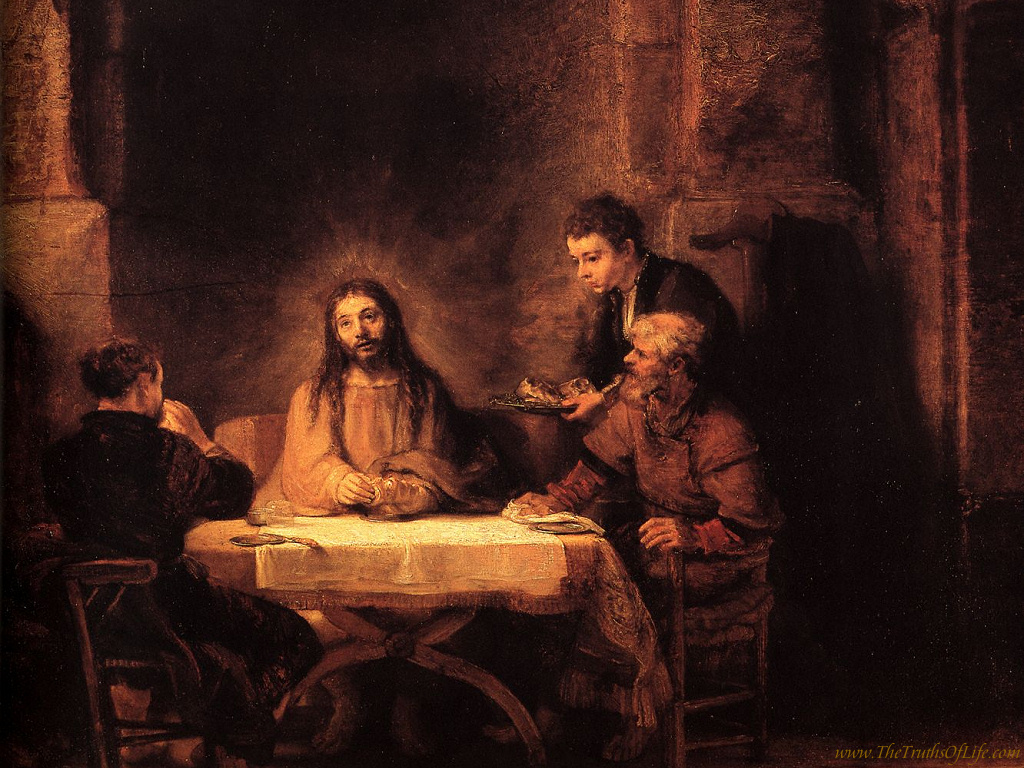
Cleopas is mentioned once in the Bible.  In Luke 24 two disciples leave Jerusalem on Easter evening and walk to Emmaus, a village seven miles away.  They are distraught that their leader has been executed.  They are joined in their walk by a stranger who is the resurrected Jesus, but they do not recognize him. (This is a common experience for Jesus after his resurrection; I think it still happens today.)   As they walk along the stranger (Jesus) asks what they are discussing about Jerusalem. 

Then one of them, whose name was Cleopas, answered him, “Are you the only stranger in Jerusalem who does not know the things that have taken place there in these days?” (Luke 24:18). 

Jesus Revealed During The Meal in Emmaus - Rembrandt

Cleopas is not listed in Luke 6 with the other apostles.  We do not know how deep his commitment was to Jesus.  Yet Jesus chose to reveal himself to Cleopas and his unnamed companion when they stopped for a meal together.  Cleopas, in turn, had the opportunity to race back to Jerusalem and tell the other disciples what he had seen and heard. 

He did not care whether he got future credit.  He simply had to tell someone.   

I think ministry is often like that today.  God does not always choose the most committed or gifted or wisest person to be the messenger.   God chooses the one who is willing to speak her mind and who is willing to share the good news that God is at work. 

Cleopas was willing to hurry back to Jerusalem and to testify to the truth.  He ended up where he started, but everything changed in the journey to Emmaus and back. 

What journey are you on?  Are you open to God speaking through a stranger?

Prayer: Lord Jesus, open my heart, soul, and mind to hear your voice and to do your will.

Death of Osama

Seeking Justice

There has been considerable reflection on the death of Osama Bin Laden and the impromptu celebrations that broke out in parts of America.  NPR asked the question, Is it wrong to celebrate Bin Laden’s death.  I have my own two-part response.

My first response revolves around the issue of justice.  When evil has done harm to people, as a culture we seek justice.   We punish those who have caused the harm with the hope of redeeming the loss.  When a hit-and-run driver leaves the scene of an accident, we feel it is just to find the driver and have that driver pay for any/all damages.  If there is a loss of life, the driver receives a punishment of prison and/or probation based on his or her responsibility for the crime.  Cain was punished for the murder of his brother, Able, in Genesis 4. Punishment is a means for restricting further violence and sin.  Lutherans call this the first use of God’s law, to curb our violent and selfish ways.

Bin Laden claimed responsibility for the tragedy of 9/11.  We had a moral right to seek justice with him regarding this crime.  I trust the statements that the SEAL strike team was seeking first to capture Bin Laden, but had to execute him as a combatant.  I see partial justice in his death and I hope his death will stop further acts of violence.  But we have no guarantee of that.   

Now comes the second response regarding the celebration of his death.   God created all human being with purpose and meaning.  God loves all human beings, even when they turn away from God’s purposes and ways.  God’s law shows us our sinful nature and our need for a savior.   Lutherans describe this as the second use of the law: our profound need for Jesus’ mercy and grace.  So what I celebrate today is the Gospel of Jesus Christ.

The Roman Catholic Church responded to the news of bin Laden’s death with this statement: “Faced with the death of a man, a Christian never rejoices, but reflects on the serious responsibility of everyone before God and man, and hopes and pledges that every event is not an opportunity for a further growth of hatred, but of peace.”

That is my prayer today.  That peace and justice might reign, not more death and destruction.

Lord, have mercy.

John’s Portrait of Jesus

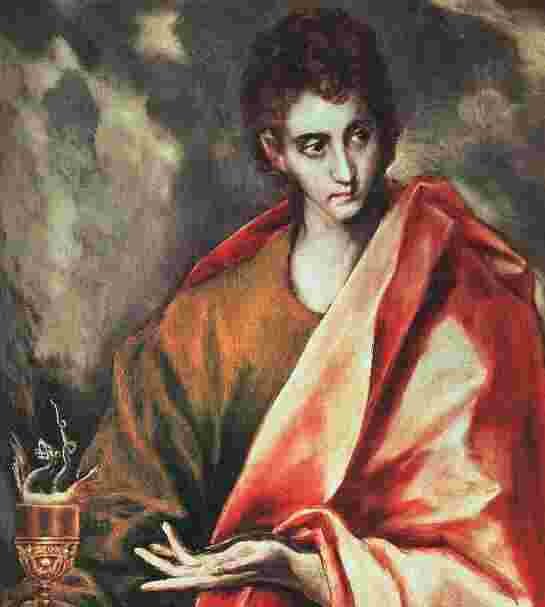
St. John the Evangelist by El Greco

At the end of chapter twenty, John declares,

Now Jesus did many other signs in the presence of his disciples, which are not written in this book. But these are written so that you may come to believe that Jesus is the Messiah, the Son of God, and that through believing you may have life in his name. (John 20:30-31)

Contemporary readers of the Gospels often compare them to modern biographies, but the Gospel writers did not intend this.  They were creating vivid portraits of Jesus that inspire and transform the reader.  The writer of John states that he could have included other material but chose not to.   The gospel writers were artists, not biographers.

Art isn’t only a painting. Art is anything that’s creative, passionate, and personal. And great art resonates with the viewer, not only with the creator.

What makes someone an artist?  I don’t think it has anything to do with a paintbrush.  There are painters who follow the numbers, or paint billboards or work in a small village in China, painting reproductions.  These folks, while swell people, aren’t artists.  On the other hand, Charlie Chaplin was an artist, beyond a doubt. So is Jonathan Ive, who designed the iPod. You can be an artist with oil paints or marble, sure. But there are artists who work with numbers, business models, and customer conversations.  Art is about intent and communication, not substances. (Seth Godin, Graceful, Making a Difference in a World that Needs You. 2010, p. 22)

The writer of John, inspired by God, created a masterpiece. 

How is your life touching others with creativity, joy and vibrancy ?

Prayer, Lord Jesus, inspire me to create beauty and joy in your name.

Saint and Sinner – Stoning Greg Mortenson

How do you use stones?

This is a rare second posting, but I want to respond to all the recent accusations surrounding Greg Mortenson, the author of Three Cups of Tea and Stones into Schools.   The mission of his foundation, Central Asia Institute, is to build and support schools in the isolated mountain villages of Afghanistan and Pakistan.   Mortenson has received incredible publicity and significant donations for this work.  No one denies that he and his foundation have done incredible work for the children of the region.

However the TV show 60 minutes and the author Jon Krakauer have made substantial and credible accusations that Mortenson partially fabricated some of the stories in his books and that he has mismanaged funds.  Mortenson has not totally denied these accusations, but continues to stand by the work he has done. 

I cannot discern who has the total truth in this tempest.  I suspect the truth is somewhere in middle.  

What disturbs me is how quick I was “to judge” Greg Mortenson.   I felt this incredible disappointment as I read the Jon Krakauer’s report and saw some of the major blemishes on the “saintly” portrait I made of Mortenson.  I discovered that my hero has feet of clay.  But this should not surprise me.

Greg, like I, grew up a Lutheran and one of Martin Luther’s contributions to our spiritual heritage is the concept of saint and sinner: simul Justus et Pecator or simultaneously saint and sinner.   We are all sinners by our actions.  We all have self-serving hearts that seeks only our interests.  Greg Mortenson is a sinner just like me.  When Jesus was confronted with the woman caught in adultery he responded by asking the person without sin to cast the first stone.  Her accusers all slipped away one by one, leaving her alone with Jesus.  He did not condemn her, but sent her away to sin no more.  (John 8:1-11)

Greg Mortenson will need to be held accountable for any mismanagement he has done.  His foundation will need to take drastic steps to rebuild the trust that is being eroded by these reports.  I am praying that such steps will be taken wisely and courageously.

But I also want to state that Greg is still a saint in my eyes.   Our sainthood is not based on our reputation, but on the grace of God.   I am praying that Greg will find his faith and mission strengthened and renewed by God’s Spirit, just as I am praying that prayer for myself and my congregation.  After all I prefer stones to be used in building schools, not attacking reputations.

Holy Week Story – Monday

"A Woman Anoints Jesus" by Floridian artist Jan Richardson, 2006.

For the next five days I will be reflecting on parts of Holy Week Story.

Today’s reading is Matthew 16:1-16.

Jesus said to his disciples, “You know that after two days the Passover is coming, and the Son of Man will be handed over to be crucified.” (Matt 16:2)

Plans and plots abound. The climax of God’s plan to rescue and restore humanity is near.  Jesus knows this and has tried his best to prepare his disciples.   The chief priest and religious officials are also planning their own intervention to arrest Jesus by stealth and kill him.  They think that now they must take control of the situation, but they do not realize that only Jesus is truly writing the story.  Even Judas, Jesus’ friend and betrayer, is not working in total independence.  He is part of a bigger plot.   This does not excuse his betrayal, but rather demonstrates God’s power to weave a new thing from our human foibles and sin.

The only person, besides Jesus, who acts with compassion and understanding, is the woman who anoints Jesus with costly perfume (Matt 16:6-13).  Her name is never given, but she prepares Jesus for his tomb. The disciples object to her apparent extravagant waste of money, but Jesus defends her.  By pouring this ointment on my body she has prepared me for burial. (Matt 16:12).

 I think, at times, I am like every character in the story.  I can be the religious official that tries to control how and when God will act.   I can be the disciples, misunderstanding how a brother or sister in Christ is serving God’s kingdom.   I can even be Judas, betraying a friend in little acts of bitterness or disappoint, whether in thought, word or deed.   And then, by the grace of God, I can also experience the woman’s joy of generosity in giving God a special gift.    The Holy Spirit can use .

 Prayer starter: Lord Jesus, turn my heart away from control, betrayal or manipulation to being generous towards You and Your people.

Love Wins or the Great Divorce?

C. S. Lewis's Great Divorce

Yesterday I finished Rob Bell’s book, Love Wins.  I understand how evangelical can be upset with him, but as a Lutheran I don’t feel such judgement.   If I could use one word to describe God it would be Gracious.   God’s grace is infinite and total and I see it extending beyond this life.   Like Bell, I don’t understand how God can condemn someone to eternal, infinite punishment if they never had the opportunity to hear the gospel of Jesus Christ.  I remember conversations I had with fellow students at Fuller Seminary where some thought that the church had the obligation to proclaim the Gospel to keep people from going to hell.  They believed that we HAD to preach it or else unbelievers would burn, even those in distant lands.

I do believe in proclaiming the Good News of Jesus Christ, but not as some cosmic obligation to keep people from hell.   I preach the good news because I am in love with Jesus, the creator of the universe and I am excited to have others experience that liberating love as well.  I am a participant in the new creation with Jesus and I am humbled that God can use someone like me to accomplish God’s will.  

Rob Bell does a great job of describing the incredible, awesome, overwhelming love of God for us.  However I do have qualms with him, such as how he misquotes Martin Luther as if Luther was a closet universalist.  Carl Trueman, Departmental Chair of Church History at Westminster Theological Seminary in Philadelphia, has written a length blog post on this very subject. See http://www.reformation21.org/articles/easy-virtues-and-cruel-mistresses.php.  Then again I disagree with Carl Trueman’s comparison of Love Wins with Dan Brown’s Da Vinci Code.  But disagreements are part of  a healthy theological conversation.

In an earlier post, I wrote that I have been rereading parts of C. S. Lewis.  When I finished Bell’s book, I discovered that he had a section for further reading.  His second reference is this: “On hell, see C. S. Lewis’s The Great Divorce.”  Later in the acknowledgments he thanks his parents for suggesting that while in high school he read C. S. Lewis.   I must agree.  I appreciate both writers, but the better IMHO is C. S. Lewis.  Next week I will move on to other topics.

What writer or artists has best help you see the magnificent love of God?

I can’t lose.

Yesterday I posted on hell; not fun to write.  Today I promised heaven and wonder if it will be as difficult to create.   I certainly can write about “longing” for heaven. 

Life Wins!

Today a cold rain continues to fall with the promise of snow tomorrow.  The calendar says spring, yet my physical  surrounding says “not yet.”  I long for the green and warmth of spring, for the hope of life renewed.

I think yearning for heaven is an appetite within us.  C. S. Lewis wrote extensively about this yearning or desire in his autobiography, Surprised by Joy.   Lewis argued that just like a man in a desert longs for water, so we, as creatures made for heaven, yearn for God’s joyful presence.  This yearning is an indication that we are not just material creatures, but have a spiritual dimension.   How could this spiritual yearning have developed out of only material longings?  We are spiritual beings seeking our spiritual home.

 Rob Bell argues in Love Wins that Jesus came to reconnect heaven and earth.

What Jesus taught, what the prophets taught, what all of Jewish tradition pointed to and what Jesus lived in anticipation of, was the day when earth and heaven would be one. The day when God’s will would be done on earth as it is now done in heaven.  The day when earth and heaven will be the same place.  As it’s written at the end of the Bible in Revelation 21: “God’s dwelling place is now among people.”

Lewis and Bell both believe that Jesus accomplished the reconnection in his life, death and resurrection.  Though we do not fully experience heaven on earth, we do have a taste of the heavenly joy while living in this life.  We begin to become what God created us to be.   And in death we become even more alive in God.  Paul writes about this letter of joy, Philippians 2:21. “To live is Christ, and to die is to gain” or as Eugene Peterson translates it in the Message “Alive, I’m Christ’s messenger; dead, I’m his bounty. Life versus even more life! I can’t lose.”  

In what ways have you tasted heaven here on earth?

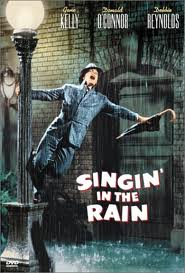
Singin’ in the Rain

To Sing and Dance with Joy? Put down the umbrella!

Su Sorenson, a member of Resurrection, wrote a devotional that I neglected to place in our congregation’s Lenten devotional.  I truly appreciated her image of taking down our umbrellas.

For I am convinced that neither death nor life, neither angels nor demons, neither the present nor the future, nor any powers, neither height nor depth, nor anything else in all creation, will be able to separate us from the love of God that is in Christ Jesus our Lord.”  Roman 8:38-39

These verses have strengthened me and carried me through tragedies, suffering, and loss.  I have been assured that whatever is happening to me, to those I love, or even to this world, God is still present.  God is still showering me and the world with His love. 

However, there are still times when I am separated from the love of God.  Those times when I build a wall around myself and don’t let God in.  Those times when I put up my umbrella and don’t allow the rain of God’s love and grace to shower me.  I might put up my umbrella when I get busy with my own “to-do list” or begin to feel self-important (how will the place run without me?)  I put up the umbrella when I am exhausted, in times of self-pity, in loneliness.  Yet, God’s love is still there. 

To live in God’s grace I need to step out from the umbrella.  I need to stand in the rain, to be washed each and every day with God’s love and power.  Nothing will be able to separate us from the love of God when we take down our umbrellas.  Will you take your’s down too?  Enjoy the shower.

Dear God, continue to tug at my umbrella so I may be fully washed in your love and grace, each and every day.  Amen