Category Archives: Holy Spirit

Down and Out

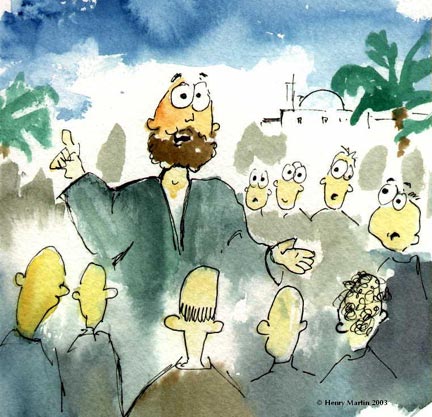
Peter at Pentecost by artist Henry Martin

Last night I met with an amazing group of people who are passionate about using their gifts and strengths for God’s kingdom through Resurrection Lutheran. We are working as a team to prepare for a workshop titled “Discover Your Call – Uncovering Your Dependable Strengths” on November 4 and 5.   The workshop will equip members of Resurrection for service in the world.  

In preparation we watched part of a DVD from Luther Seminary that emphasized the concept that God came “down” to us in Jesus Christ, so we don’t need to “climb” up to God through our actions or good deeds.  As one speaker said, “God does not need your good works. Your neighbor does.”  God calls us to use our gifts and strengths “out” in the world for our neighbor.  Thus the title of the DVD: “Down + Out: Where Grace Takes You.    

God has created each of us with dependable strengths.  God “wires” each of us differently with different abilities, passions and dreams.  Isolated each of us can do a little, but together as the church we can do so much more.  The church is a movement of people, working together to bring healing and hope to a broken world.  The church is not simple to gather in a building and feel good about ourselves.  No, we are to go OUT.

We are to be God’s hands and feet, his voice and presence among the people we interact with each day. This is what Lutheran mean by the word: vocation or calling.  God calls us to serve in the world.

On the day of Pentecost, the Holy Spirit pushed the disciples out into a confused, perplexed world.   Peter was called to preach, but all the disciples had to use their gifts and strengths once the people responded to Peter’s message about Jesus.  They each used their dependable strengths to lead the church out of Jerusalem and into every corner of the world.

What are your dependable strengths and how are you using them in your calling?

Lord Jesus, help me to discover my dependable strengths and to use them for service in your world.


Organizational Care

Seth Godin, wrote an intriguing post recently about caring and organizations:

No organization cares about you. Organizations aren’t capable of this.

Your bank, certainly, doesn’t care. Neither does your HMO or even your car dealer. It’s amazing to me that people are surprised to discover this fact.

People, on the other hand, are perfectly capable of caring. It’s part of being a human. It’s only when organizational demands and regulations get in the way that the caring fades.

If you want to build a caring organization, you need to fill it with caring people and then get out of their way. When your organization punishes people for caring, don’t be surprised when people stop caring.

I began to wonder if that is true of a congregation.  Certainly one of the confessed values of a Christian congregation is to care, to love, to be like Jesus. But what does care look like?  Here leadership is essential. Leadership within the congregation can promote a culture of care, can model what caring looks like, and how collectively and individually we care.

Pentecost by artist Jean Sader

This Sunday is Pentecost, the church holiday in which we celebrate the coming of the Holy Spirit to ignite the birth of the church. Fifty days after Jesus’ death and resurrection, the first disciples remained huddled in a room in Jerusalem.  As described in Acts 2, the outpouring of the Holy Spirit was dramatic: a mighty rush of wind, tongues of fire on people’s heads, and multiple languages suddenly heard.  A huge crowd gathered outside the room, amazed, perplexed, confused.  What was this?

Here is where caring leadership stepped up.

 But Peter, standing with the eleven, raised his voice and addressed the crowd. Act 2:14

Peter took the leadership role and modeled how this new community would express itself.  He cared for the assembled crowd by telling them the story of Jesus Christ and how his life, death and resurrection had changed the world.  His words were tough at time, reminding the people of their participation in Jesus’ crucifixion.  Yet Peter, with the support of the eleven, did the most loving thing possible: he called people to trust in Jesus.  At Resurrection, we would say Peter “called all people to a vibrant life of faith in Christ.”

How does the church promote or restrict caring?

Lord Jesus, teach me to care as you cared for others.

Love to Tell the Story

One of my favorite hymns is “I Love to Tell the Story.”  

 The second stanza is
I love to tell the story: How pleasant to repeat
What seems, each time I tell it,
More wonderfully sweet! 
I love to tell the story, For some have never heard
The message of salvation
From God’s own Holy Word.”

In Acts 10:34-43, Peter tells Jesus’ story to Cornelius and his household with a similar joy.  Peter is delighted to tell them about Jesus Christ and is amazed at how open and receptive they are.  Too often in our culture we have this perception that bearing witness to Jesus Christ is stressful and difficult.  Peter demonstrates that as we follow the Spirit’s prompting, it can be a joyous, amazing event that the Spirit can bless. 

Samaritan Woman meets Jesus at the Well

Tomorrow I am preaching on another story-teller, the Samaritan woman at the well (John 4).  Her encounter with Jesus leads to her spontaneous testimony about Jesus to others in her village.  It is as if a well of joy and excitement has bubbled up inside her.  She is the one of the first evangelist or story tellers in the Gospel of John.   She loves to tell the story!    

My prayer today is simple: 
Lord Jesus, grant me the joyous opportunity to bear witness to your life story.  Your life has changed my life in so many ways; may I bear witness to you today in some special way. Amen.

What story in scripture excites you?

Colorful Vegetables for the Spiritual Life

Whats more colorful or spiritual than VeggieTales?

Every week I receive an e-mail from Mayo Clinic on how to live a healthier life.  Recently it recommended that my dinner plate become more “colorful” with a variety of vegetables and fruit.   Yesterday when I visited my mom, she and the other residents were served a plate bright with red pepper, yellow squash, green beans and orange carrots.  Mom was eating healthy.

Afterwards I made the connection to yesterday’s post and my disparaging comments about zucchini.  As I thought more, zucchini grows into what God created it to be: zucchini.    It adds color and nutrition,  if not taste, to many meals.   It can be part of a healthy diet.

So I want to stretch the vegetable analogy.  Perhaps, as Christians, we need variety in our spiritual disciplines to live healthy lives with God.  We need to add color or spice (even zucchini?) to the ways we open our lives to God.  

Certainly, if one has no discipline, no method of reading scripture, saying prayers, or attending worship, then the simple acts of reading Matthew or John, saying the Lord’s Prayer and participating in Sunday worship are a great beginning.  But if such a pattern is already established, then variety may be needed.  Here are just a few suggestions:

  • Instead of praying a list of prayers,  light a candle and sit in silence, listening for God
  • Instead of reading a Bible chapter, do research on a favorite word in the Bible: love, joy
  • Instead of praying at your desk or table, go for a walk outside and converse with God.
  • Instead of attending your normal church, worship in a church of a different tradition: charismatic, Quaker, Roman Catholic (this is very hard to write as a pastor, but I do it when I am on vacation, so why shouldn’t you?)

In other words, change your pattern of spiritual discipline, with the intention of opening your life in a new way to God’s presence.   You may discover that the old ways are still the best, but you may return with a fresh perspective.  Or you may discover a new spiritual practice that you can embrace fully.

Lent starts tomorrow; what new spiritual disciplines might you embrace for the journey?

Integrity of Patience

As I reread Robert Roberts’ The Strength of a Christian, I notice my own impatience rising to the surface.  I want to glean some quick insight into the practice of patience, so that I can immediately apply it to my life.  I want patience NOW.  Roberts provides instruction on the practice of patience (that I will post tomorrow, be patient), but first Roberts makes a wise observation on the necessity of patience for becoming a whole person.

Patience is also a condition for the integration of the person. Like other strengths, patience gives our lives continuity and autonomy, enabling us to live not by impulse, or at the beck and call of environmental stimulus, but by some design.  The Christian design is of course the love of God and neighbor.  It is one thing to have noble sentiments, such as compassion and concern for one’s neighbor and gratitude to God, but quite another to be in the appropriate sense the author of these, the kind of person who through “interior strength” has etched this design upon life.  Only someone self-present in the way a patient person is can practice Christian life as a spirit does. (p. 56)

The strength of an oak tree

When I was in my twenties, I remember reading a Christian article about how God is more interested in growing mighty oak trees than in zucchini.   Zucchini are rather amazing plants in that they grow from seed to fruit rapidly. Yet they will not survive a hard frost.  Oaks take considerable more time.  Yet it is the oak that survives the winter and summer storms and bears witness to God’s glory, year after year, by being the oak it was created to be.    In the same way, as Christian, we are called to serve God faithfully, becoming fully what God created us to be.   Growth in Godly character is often seasonal, with long stretches where one wonders if God has forgotten you. This is where the integrity of patience comes to bear, trusting God is at work, even in the times of waiting and hoping.  I continue to pray and seek patience as God works on my character of becoming a strong oak (see Psalm 1).

Who has been a model of patience for you?

Bible Favorites

What are you?

Recently I asked members of Resurrection Lutheran to write brief devotionals based on their favorite Bible verse.  These devotionals will be assembled into a booklet to used during Lent by members and friends of the congregation.  I am excited with how the writers have engaged Scripture and its interplay with their lives.  Each person has a unique perspective, reflection, or idea that opens up a verse or story in a new way.

When I was growing up, the Bible was a storybook filled with fascinating characters and plots.  It was exciting, lively and challenging.  As a teenager I sometimes went down strange tangents, looking for new interpretations that would catch my fancy.  I remember reading the “wheel within a wheel” passage in Ezekiel 1 and wondering if it was describing a spaceship!    The wonder and mystery of the Bible was alluring to me.   

 Then I went off to college and I was challenged to see the historical context of the authors, to learn the Biblical languages of Hebrew and Greek, and to understand the literary motifs and forms within the Bible.  At times I was fascinated with this knowledge, gaining tremendous insight into this ancient collection of books, poems and laws. To read Genesis 1 and 2 in light of the Babylonian creation myths brought me new wisdom and excitement.   But I also was disturbed by this avenue of learning because it seemed to make the Bible into an artifact to be dissected and classified.  The Bible lost some of it awe and wonder.

I know that some of my classmates lost their faith during this time of critical examination.  I waffled from time-to-time in my own grasp of  truth and faith.   Yet the sheer power of God’s glorious grace continued to shine through to me.  God’s love was evident in the midst of the history, language and myth of the scripture.   I remember hearing a quote from the great Swiss theologian, Karl Barth.   When asked how one could best summarize the Bible, he said, “Jesus loves me, this I know, for the Bible tells me so.”   

I am excited to see how the Lenten devotional will touch and influence the culture of Resurrection.  We are all called to engage scripture, to listen for God’s voice in God’s Word.  

How or when has a Bible story or verse impacted your life?

Slow Lent Movement: Part Two

Slow down for Lent

Yesterday I introduced Bishop Payne’s concept of a Slow Lent.   Here are five slow spiritual disciplines that complement traditional Lenten disciplines.

1. Traditional: repentance 
    Slow: speak less, listen more.

In our hurried culture, we often are so quick to speak, to get our words out, that we rarely take the time to listen to what others say, especially those that we disagree with.  We rush to judgment when we need to listen and possibly to change the direction of our thinking, planning, and acting.

2. Traditional: forgiveness
   Slow: let go of one “should.”    

Many of us carry various kinds of “ought’s or should’s” that overload our schedule. We need to “forgive” ourselves.   For example, as a new pastor, I feel I should be involved in different local community activities.  One piece of wisdom I received recently is that a new pastor should not be involved in local community activities during the first year so that he or she can fully enter into the life of the congregation.   So I have given up that “should” even before Lent starts.

3. Traditional: catechesis (teaching)
    Slow: re-learn one basic of the faith

Rather than focusing on the newest spiritual discipline, simply re-focus on some basic spiritual discipline.  This year at Resurrection Lutheran, we will be re-learning the Lord’s Prayer and its meaning for prayer and life.

4. Traditional: fasting
    Slow: choose one way to ‘unplug’

For some Christians, Lent means giving something up so that one can better focus on God.  The usual items are chocolate, desert, alcohol, or meat.   Bishop Payne suggested that perhaps we “unplug” from the internet or turn off our smartphones or television.  We might not be able to do it 24/7, but we might choose to turn it off every evening or every Saturday.  Of course, the purpose is to open our time and our lives in a fresh way to God.

5. Traditional: almsgiving
     Slow: simplify

Certainly we need to be as gracious as our God and give to people in need.   Lent is a great time to practice such giving.  Yet our culture is so focused on the accumulation of things, perhaps we can shift our attention from accumulating to letting go.  My uncle Jerry lived for several years during his retirement in an RV.  Whenever he considered buying something, he had to consider what he would give away to make space for the new.  It made him think twice before buying.

Which discipline might help you slow down this Lent?

Everything Glorious

When I was in college, one of my Christian mentors was a German professor.  He provided rides each Sunday to his Episcopal church and breakfast afterwards.  The worship was quite liturgical and mysterious to my simple tastes.  I often felt overwhelmed by the ancient language, the various postures of prayer, and the classical music.  My mentor gave me one piece of advice to which I still cling.  He said, “Be open to one moment of clarity, of revelation, of God’s presence.  You can’t control when or how, just be open.”  Ever since I have tried to worship with that open, expectant attitude.  It does not happen every week, or even every month.  But, on occasion, the Holy Spirit hits me with  AWE.

This past Sunday I was surprised by awe.   It was just for a moment while our worship team lead us in singing “Everything Glorious” by David Crowder. (You can listen to it on YouTube here http://youtu.be/81dK2Vu1IUs )

The lyrics that struck me are:
You make everything glorious

You make everything glorious
And I am Yours,
So what does that make me?

Somehow the words broke through my insecurities and masks and I sensed the Holy Spirit being rather direct with me.  I am a participant in glory, not because of my role or behavior or morals or status or accomplishments.   I am a participant in glory simple because God made me so.   And it is the glory of God’s love, revealed in the cross.  It is the glory of God’s grace to makes me so.  

For a moment, as we sang, I FELT the power of that truth. It was surprising how through that simple song God gave me light, hope and joy.  I am thankful that the Holy Spirit, David Crowder and the Resurrection’s worship team gave me that moment of glory and AWE.

When or how has God’s glory touched your life?

Are You Listening?

To Listen Is To Focus.

When I was about ten years old, I was pulled from my class room and given a hearing test by the school nurse.  I was surprised, since no other student was given the test that day.  I listened carefully to the instructions and dutifully raised my hand whenever I heard the special ping come through the earphones.  I was certain that I had done extremely well, and said so to my mother that afternoon.   Then I told her how strange it was being the only one tested.  

My mom then gave me the second surprise of the day.  She said, “John, I asked for that test, because you don’t seem to listen very well at home.  I was wondering if you had a hearing problem.”  After the test, my mom talked with the school nurse and they agreed that I did not have a hearing problem, but that I did have a listening problem.  I would selectively hear what I wanted to hear, ignoring those sound/voices/instructions that I did not want to hear.  

In a congregation there is always some selective listening.  We tend to pay attention to those activities and ministries that excite or appeal to us.  A busy mother of young children may tune out the invitation to a men’s retreat (or she may tune in if she thinks her husband should go!)  We all have filters that select what to hear, see, or feel.   In our media culture, we are all surrounded by so much “communication noise” in so many forms (music, internet, television, video games, cell phones) that it can be difficult to listen to one another.   Yet each of us can work to improve.

Here are six of my communication rules.  

  1. I never read letters or notes that are not signed. 
  2. Important information deserves face-to-face conversation.
  3. To over communicate is much better than to under communicate.
  4. Never write in an e-mail what you would not say face-to-face.
  5. To over communicate is much better than to under communicate.
  6. God communicates his love to me every day.  Am I listening?

How are your listening for God?  for others?

Holy Spirit Business

Holy Spirit comes to work

I am preparing for my first annual congregational meeting at Resurrection Lutheran which will be this Sunday.  Annual meetings among pastors often have the reputation either of being boring, business-as-usual constitutional necessities or of being highly emotional and conflicted debates on peripheral or personality issues.   As a pastor, I don’t want either extreme to happen, but I do pray that the Holy Spirit comes to work: to coax, push, pull and move the congregation towards God’s future.  Discussion regarding a congregation’s priorities can be passionate and yet loving, for we share a common mission to trust, live and serve God.

The book of Acts has a lengthy account of a large church meeting in Jerusalem.  Paul and Barnabas brought a major concern to the whole church for discussion and debate.   Their concern was whether new Gentile members to the church had to fully convert to Judaism before they could embrace Jesus.  Since most of the early members of the church were Jewish and since Jesus was a Jew, many believed that Jewish laws should be upheld.  Paul felt otherwise and a strong debate developed among the leadership of the church.  What rules and regulations, if any, were needed?  After a lengthy debate, the leadership wrote a letter to the many new Gentile believers,  “It seems good to the Holy Spirit and to us to impose on you no further burden than these essentials: that you abstain from what has been sacrificed to idols and from fornication” (Acts 15:28-29).  What stands out is that they trusted the Holy Spirit to be part of the discussion.  This was a matter of faith, since the Holy Spirit did not fly into the meeting like a dove and deliver a telegram from heaven.  It was in the discussion itself that God’s Spirit worked.

I think every pastor hopes and prays that the Holy Spirit would be the key partner in any congregational meeting. The Holy Spirit is neither boring, nor highly emotional, but is trustworthy.   The Spirit calls us to trust God in all things.   That seems good to me!

How has the Spirit worked in guiding you and your life with other Christians?