Category Archives: Jesus

Who me? Betrayer?

For I received from the Lord what I also handed on to you, that the Lord Jesus on the night when he was betrayed. . . (I Corinthian 11:23)

In the Catholic church the Wednesday of Holy Week is often called Spy Wednesday, because it is the day we remember that Judas betrayed Jesus and spied upon him. Judas had been one of the twelve disciples, trusted by Jesus. But he arranged with the chief priests to turn Jesus over to them at an opportune time, when there would be no fawning crowd to interfere.  In the Garden of Gethsemane, Judas betrayed his master with a kiss.
People often wonder what motivated Judas to betray Jesus. Was it only the money? Or was he trying to force Jesus’ hand so that he would call down God’s angels to overthrow the Romans? Or did he simply lose faith in Jesus, choked by the worries and concerns of the world?

The scriptures are unclear. That non-clarity may be intentional because it can push us to think about the ways we may have betrayed Jesus. Probably not as openly as Judas, but we all betray, deny, run from, or avoid Jesus and his call upon us. We all fall short of his command to love one another. The story of Judas betrayal is both a warning but also a description of our own wandering hearts.

Yet the words of Paul in I Corinthian 11 are the opening words of Holy Communion, the supper Jesus gave to his disciples and to us. The meal holds the promise of forgiveness and grace. “This is my blood, shed for you for the forgiveness of sins.” Even in the midst of betrayal, Jesus gives us mercy and grace.

Though we be faithless, he is faithful. Praise be to God.

Lord Jesus, renew a right heart within me.
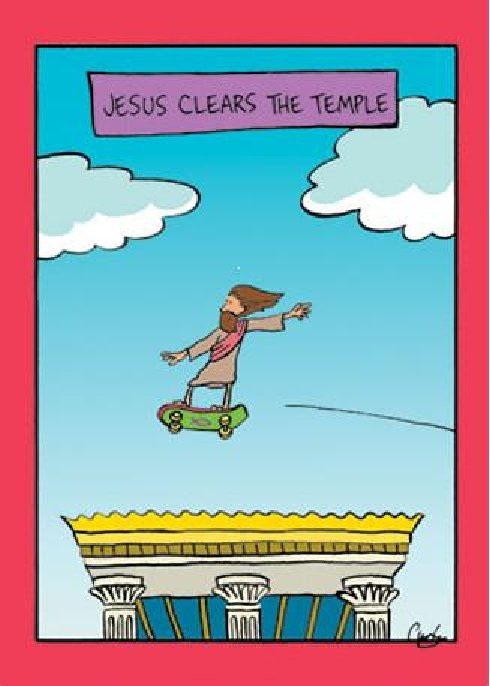
Jesus Clears the Temple

A member of Resurrection sent me this cartoon today: “Jesus clears the temple.”* The cartoon got me thinking about the story in Jesus’ ministry (Mark 11:15-18). For many of us, the fact that Jesus cleared the temple of money changers is not significant or  meaningful. We don’t realize how upsetting and radical  Jesus’ action was for the ruling religious council in Jerusalem. We often see Jesus’ angry expression as some sort of deviation from the nice, kind Jesus we adore.  It was sort of “bizarre,” like someone “clearing” the temple on a skateboard.

But the Temple Cleansing was central piece of his Messianic vocation.  N. T. Wright helps to clarify this from the historical perspective of first century Judaism (the full essay is here):

Jesus believed he was Israel’s messiah, the one through whom God would restore the fortunes of his people. . . .  Anyone doing and saying what Jesus did and said must have faced the question “Will I be the one through whom the liberation will come?” All of the evidence—not least the Temple-action and the title on the cross—suggests that Jesus answered, “Yes.”

Second, Jesus’ radical and counter-cultural agenda, subverting both the political status quo and the movements of violent revolution, was focused in his awareness, of vocation.  John the Baptist re-enacted the Exodus in the wilderness; Jesus would do so in Jerusalem. Jesus’ gospel message constantly invokes Isaiah 40-55, in which God returns to Zion (Jerusalem), defeats Babylon, and liberates Israel from her exile. At the heart of that great passage there stands a job description. This would be the victory over evil; this would be the redefined messianic task. Jesus had warned that Israel’s national ideology, focused then upon the revolutionary movements, would lead to ruthless Roman suppression; as Israel’s representative he deliberately went to the place where that suppression found its symbolic focus. He drew his counter-Temple movement to a climax in Passover week, believing that as he went to his death Israel’s God was doing for Israel (and hence for the world) what Israel as a whole could not do.

Third, Jesus believed something else, I submit, that makes sense (albeit radical and shocking sense) within precisely that cultural, political, and theological setting of which I have been speaking. Jesus evoked, as the overtones of his own work, symbols that spoke of Israel’s God present with God’s people. He acted and spoke as if he were in some way a one-man, counter-Temple movement. He acted and spoke as if he were gathering and defining Israel at this eschatological moment—the job normally associated with Torah. He acted and spoke as the spokesperson of Wisdom. Temple, Torah, and Wisdom, however, were powerful symbols of central Jewish belief: that the transcendent creator and covenant God would dwell within Israel and order Israel’s life. Jesus used precisely those symbols as models for his own work. In particular, he not only told stories whose natural meaning was that YHWH (God) was returning to Zion, but he acted—dramatically and symbolically—as if it were his vocation to embody that event in himself.

Jesus saw himself as the means of salvation, no longer the Temple as the means. He became the sacrifice for our sins. He cleansed not only the Temple, but our hearts so that God can live in us. Amen.

Lord Jesus, continue to cleanse us.

*The cartoon is by Cuyler Black and you can find more of his cartoons here

He is Dangerous!

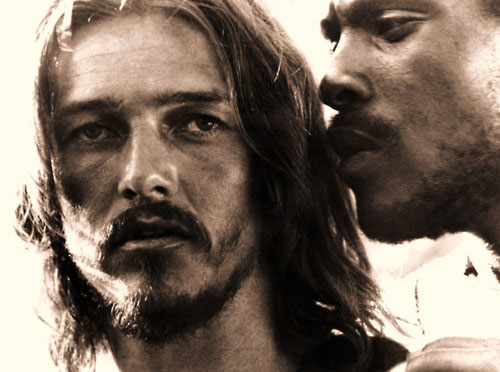
Thirty years ago I was asked to perform in a production of Jesus Christ Superstar. I was type-casted, not as Jesus, but as one of the priests who plotted to have Jesus executed. I and the other priests were place on a scaffold above the stage, looking down with condemnation on Jesus and his disciples as they entered Jerusalem. Like the movie, we sang “This Jesus Must Die.” The refrain in the Weber and Rice song still rings in my head, “He is dangerous.”

The 1973 movie captured the mood of this scene.

The high priests and Pharisees called a meeting of the Jewish ruling body. “What do we do now?” they asked. “This man keeps on doing things, creating God-signs. If we let him go on, pretty soon everyone will be believing in him and the Romans will come and remove what little power and privilege we still have.” Then one of them – it was Caiaphas, the designated Chief Priest that year – spoke up, “Don’t you know anything? Can’t you see that it’s to our advantage that one man dies for the people rather than the whole nation be destroyed?” He didn’t say this of his own accord, but as Chief Priest that year he unwittingly prophesied that Jesus was about to die sacrificially for the nation. (John 12:47-51)

Jesus continues to be dangerous, even though people have tried to domesticate and soften the image of Jesus over the centuries. He is not some quaint moral teacher who loved children and stray cats. He was the Son of God who came to challenge our self-righteous lives and to call us into a transformed way of life.

I fear that society has made Jesus meek and mild and that we have forgotten how dangerous he truly is. It is deadly to follow Jesus. Like Bonhoeffer wrote in The Cost of Discipleship, ““When Christ calls a man, he bids him come and die.”

Are you willing to die with Jesus?

Lord Jesus, call me out of my complacent tomb into the Vibrant Life of Faith.

Enter the Holy Week Story

Stories shape our lives. The story of our family, our nation and our world gives meaning to our lives. My own story of being raised in western Washington, going east to college and then coming to Minnesota for seminary shaped my life. The simple story of how we met our spouse or how we chose our career has profound implications on our life. Do we simply drift along from one day to the next, or are we active participants?

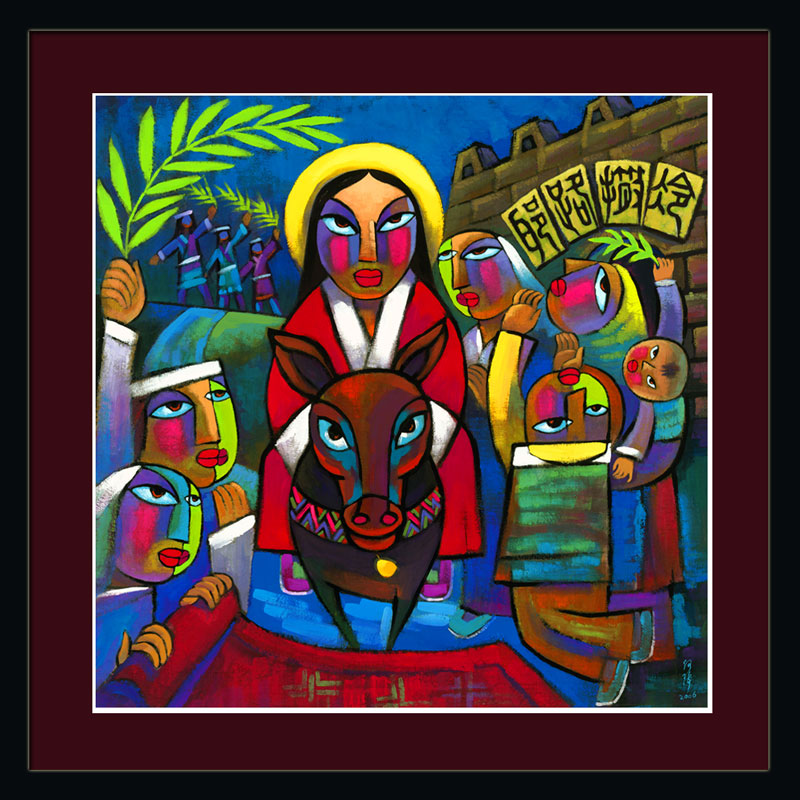
Triumphant Entry into Jerusalem by artist He Qi

As followers of Jesus Christ, we are molded by the story of Jesus, especially his last days. As we prepare to enter Holy Week, we have an opportunity to walk with Jesus from Palm Sunday to Easter, to enter his story. We can be with the crowd that cheered his entrance into Jerusalem, shouting our praise to our king. We can ask ourselves, “How do I allow Jesus to be ruler in my life? Am I simply following the crowd? Or do I fully seek to follow Jesus this week?”

On Maundy Thursday, we can enter the upper room with Jesus and watch him humbly wash the feet of his disciples. Are we willing to be servants like him? We can share in his meal of Holy Communion, remembering his steadfast, nurturing love for us. We can walk with him to the Garden of Gethsemane and pray with him as he seeks the Father’s strength and courage for his coming suffering. Will we stay close to him, when all the other disciples run away?

On Good Friday, we can stay in the crowd as they shout to Pilate, “Crucify Him! Crucify Him!” Do we hear our own voices mingled in the crowd? As the soldiers nail him to the tree, do we hear his words, “Father, forgive them, for they know not what they do,” and wonder if he is speaking to us? As he dies, do we feel the sorrow of Mary, his mother? Does something in us die as he is laid in the tomb?

Such a walk through the story of Holy Week prepares us for the ultimate story of Jesus’ resurrection on Easter.

Lord Jesus, keep my life in your story this week.

The Parable of the Lost Door

Simple, wonderful stories happen every day. We just need to keep our eyes and ears open.

For over a year Resurrection Lutheran Church has been missing a door from a cabinet in our conference room. The small room had functioned as an office for a time with the previous pastor. He asked to have the cabinet doors removed so that the open shelves could function as bookshelves. When I was called as pastor, we determined that the “office” should be a conference room once again and the cabinet doors restored.

Our energetic Property Image Team (PIT crew) took up the challenge to re-install the cabinet doors soon after I arrived. The doors had all been stored in the storage room and were easy to re-installed. However one of the eight doors was missing. The PIT crew looked everywhere for the missing door, then the staff and family members turned offices and homes inside out, searching for the missing door. A few of the PIT crew thought it might have been “used” in some church project, but no one could remember. The door remained missing for over a year.

The conference room had a slightly “unfinished” look due to the missing door. Ministry and meetings continued to flourish in spite of the absent door, but still the room did not feel right. Our office coordinator, Sue Guck, continued to remind the PIT crew of this “blemish” and finally they agreed to create a new door.

The congregation has several talented woodworkers, but they all seemed busy with various projects of their own. Barry Van Ornum agreed to take on the task, but wanted to see if any other woodworkers in the congregation could assist him. Someone on the PIT crew remembered a member who had crafted a Bible stand for our worship center several years ago, so Barry decided to contact him. As Barry explained the project, the member interrupted him.

“You know, Pastor Ted was a stickler on details and he wanted me to make sure the Bible stand was stained to the proper color. He went into the storage room and picked up a small board for me to match. Is it possible that I might have the missing cabinet door in my garage?”

Barry Van Ornum

Within three days, Barry Van Ornum had the missing cabinet door and it is now back in the conference room. The unfinished project is now complete.

The PIT crew and staff also have a deeper appreciation of Jesus’ Parable of the Lost Coin.

“Or imagine a woman who has ten coins and loses one. Won’t she light a lamp and scour the house, looking in every nook and cranny until she finds it?  And when she finds it you can be sure she’ll call her friends and neighbors: ‘Celebrate with me! I found my lost coin!’  Count on it – that’s the kind of party God’s angels throw every time one lost soul turns to God.” (Luke 15:8-10 The Messsage).

Anyone want to join us for a party in the “restored” conference room after Easter?

Lord Jesus, thank you for seeking us out even when we are lost or forgotten.

Backpacking For a Weary Soul

Last Monday I attended a class on light-weight backpacking at my local REI store. The class re-energized my long-term goal to hike the Washington state portion of the Pacific Crest Trail. The Pacific Crest Trail (PCT) is a 2,650-mile national scenic trail that runs from Mexico to Canada through California, Oregon and Washington.

In the summer of 2009 my son and I hiked 90 miles of it in seven days. We started at Stevens Pass and ended at Snoqualmie Pass east of Seattle. We had great weather except for the last 24 hours, where we hiked through a cold, wet fog and heavy drizzle. It was a trip that whetted my appetite for more. I am planning to hike another section in 2013.

A key component to long-distance hiking is to keep your backpacking basics to a minimum, ideally under twenty pounds. This include the pack, sleep system, shelter, clothes and cooking gear. This does not include food, which is usually about two and half pounds per day. My pack for a week-long trip should start at 35-40 pounds, not including water, but in 2009 it was over 50 pounds.  I need to lose pack weight.

As a child, I first saw people with strange monstrous packs when our family went on a short nature hike near Lake Crescent in Olympic National Park. As we meanders and strolled towards Marymere Falls, a group of backpackers marched by us as they headed down out of the mountains. I asked my dad about the packs and people. He told me about backpacking and how hikers could travel far into the mountains. My thirst for the high alpine adventure started that day.

One thing backpacking has taught me is how little we truly NEED to survive. I can carry it all on my back if I choose. When I return, I do appreciate a dry house, warm bed, running water, flush toilets, fresh vegetables and electrical appliances (like my laptop). Still backpacking is a way of cleansing my soul and mind of my perceived need for more stuff. (Except perhaps my need for more light-weight backpacking stuff.)

Backpacking gives me a deep appreciation for Jesus’ words from Matthew 11:28-30.

Come to me, all you that are weary and are carrying heavy burdens, and I will give you rest. Take my yoke upon you, and learn from me; for I am gentle and humble in heart, and you will find rest for your souls. For my yoke is easy, and my burden is light.

How do you keep your soul light when you are weary?

Lord Jesus, let us find rest for our weary souls in you.

Trayvon Martin and the White Christian Leader’s Response

I must confess the whole Trayvon Martin case in Florida has me stumbling for words and fighting my “normal” reaction to ignore such cries for justice.  But Pastor Drew G.I. Hart calls for me to speak out about the injustice.  Our world needs to change, to repent and come to see Jesus as a man for all people. Please read this post.

Trayvon Martin and the White Christian Leader’s Response.

The END Came and Went

Yesterday I wrote on the END OF THE WORLD as expressed in Mark 13. In the chapter Jesus taught his disciples regarding the signs of a new world being birthed. Jesus said, “Truly I tell you, this generation will not pass away until these things have taken place. Heaven and earth will pass away but my words will not pass away” (Mark 13:30).

Like most apocalyptic literature, Mark 13 is written in highly descriptive language that evokes strong emotions, but is often difficult to interpret precisely. The chapter is more like a beautiful mosaic of pictures than a precise timeline of events. Parts of the chapter seem to refer to the destruction of the Jerusalem Temple by the Roman legions in 70 AD (v 2, 4-11, 14-23). Other sections may refer to the persecutions the church faced in its early years. Readers can be challenged to see how it applies to our current life.

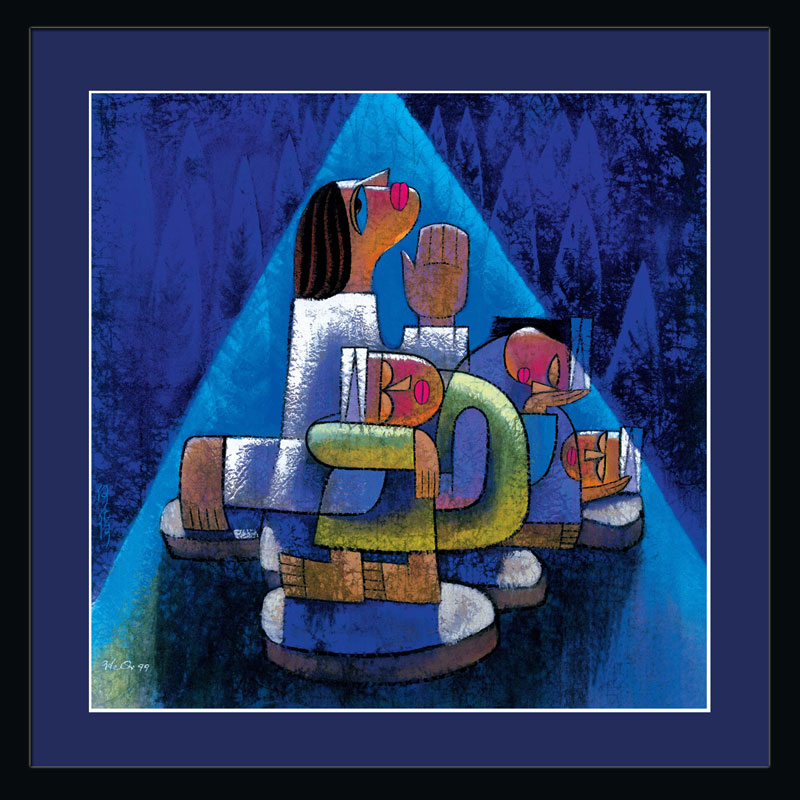
Praying at Gethsemane by Artist He Qi

Yet the reader is given a key verse in v. 35. “Therefore, keep awake–for you do not know when the master of the house will come, in the evening, or at midnight, or at cockcrow, or at dawn, or else he may find you asleep when he comes suddenly.”

The four hours of the watch (evening, midnight, cockcrow and dawn) are significant because they become the outline of Mark’s next two chapters: the story of Jesus’ betrayal, prayer,  arrest and trial.

When it was evening, he came with the twelve. And when they had taken their places and were eating, Jesus said, “Truly I tell you, one of you will betray me, one who is eating with me” (Mark 14:17).

Jesus said to Peter, “Truly I tell you, this day, this very night, before the cock crows twice, you will deny me three times” (Mark 14:30).

At that moment the cock crowed for the second time. Then Peter remembered that Jesus had said to him, “Before the cock crows twice, you will deny me three times.” And he broke down and wept (Mark 14:72).

As soon as it was morning, the chief priests held a consultation with the elders and scribes and the whole council. They bound Jesus, led him away, and handed him over to Pilate (Mark 15:1).

The disciples were unable to stay awake in the garden when Jesus prayed (Mark 14:41). They all scattered. Still Jesus remained faithful.  His words from Mark 13 came true. Jesus’ passion became the birth pangs of a new creation. The world as we knew it ended with Jesus’ crucifixion and a new world dawned with his resurrection.

Paul captures this new age in 2 Corinthians 5:17 “If anyone is in Christ, there is a new creation: everything old has passed away; see, everything has become new!” The end of the world is not simple some future event for which we wait. The “end” started with Jesus’ death and the “new” has begun with his resurrection. We live in a new age with Jesus!

Lord Jesus, let my life end and begin again with you.

End of the World?

The end of the world evokes strong emotions. Current books and movies play on the theme that the culture/world/civilization that we know is ending and a new one is replacing it, usually more horrific than our current culture/world/civilization. The roots of the transformation are in our current society and will bear fruit in the coming years. The fear of global nuclear war spurred such writings from 1950s through the 1990s. The book and movie Hunger Games is a contemporary expression of such apocalypses and their aftermath.

Mark 13 is also an expression of apocalyptic literature. Jesus and his disciples were in Jerusalem for the Passover festival. Jesus would be arrested and executed by the Roman officials in a few days. Jesus warned the disciples of coming tribulation and devastation. The magnificent temple that was central to Jewish worship would be destroyed in less than forty years by the Roman Empire. The early Christians would face frequent persecution for their faith. These trials might cause the new church to despair, yet Jesus said, “This is but the beginning of the birth pangs” (Mark 13:8).

Birth pangs, though painful in the moment, result in the beginning of a new life. Jesus was teaching his disciples to persevere, to stay hopeful, in spite of the troubles they face. He then goes on to say that to speculate on the exact day or time of this new birth is wasteful use of time. “But about that day or hour no one knows, neither the angels in heaven, nor the Son of Man, but only the Father” (Mark 13:32). Instead he says to be engaged in our daily tasks with a watchful heart, that God is near. “It is like a man going on a journey, when he leaves home and puts his slaves in charge, each with his work, and commands the doorkeeper to be on watch” (Mark 13:34). God has given us each tasks to do in this world, to love our neighbor in word and deed. We do not abandon those tasks to run and hide on some mountain because we fear the “world” is ending. Rather we continue to serve God and God’s world, knowing that someday the master will return and put things right for all people.

Tomorrow I will explore how the “world” has already ended for Christians (Mark 13:35-36).

Lord Jesus, help me not to slip into despair, but to be faithful in my service.

Penny for Your Prayer

Yesterday, I preached on the story of the widow’s offering in Mark 12:41-44. The main point of my sermon was that Jesus noticed the widow’s offering. He heard her two coins in the offering box and drew attention to her sacrificial gift.

As I wrote last week, scholars may debate whether Jesus lifted her up as a model of Christian generosity or as a victim of the religious Temple institution or both. Whatever the case, he noticed her and asked the disciples to observe her.  Jesus observed and cared.

I want to rest on that observation for a moment and to acknowledge the wonder and joy of that observation. In a crowded, bustling temple courtyard, Jesus noticed a poor widow, someone whom the religious leaders seemed to ignore.

This morning as I walked into our church, I heard the birds singing. The Psalmist wrote about the temple in Jerusalem, “Even the sparrow has found a home, and the swallow a nest for herself, where she may have her young– a place near your altar, O LORD Almighty, my King and my God (Psalm 84:3).” Jesus said, “Look at the birds of the air; they do not sow or reap or store away in barns, and yet your heavenly Father feeds them. Are you not much more valuable than they?” (Matt 6:26).

Jesus observation gives me hope. In our complex, crowded, busy world, Jesus notices individuals, you and me. We are not simply some nameless creature, wandering the planet.  We are not some number in a distant computer.  We are a name, a face, a life to God Almighty. God knows our needs, our situation, the pleas of our hearts.

As part of my sermon, I had the congregation first listen to the sound of a large bag of coins filling a metal offering plate: the sound of the rich people. Then I had them listen to the soft clink of two copper coins. One had to listen carefully to hear the clink. How wonderful that Jesus heard.

I also invited the congregation to take a penny home and use it as a reminder of the Widow’s prayer. The penny reminds us that God is always listening, and that our pleas will be heard by God.  It is not a lucky penny, but a reminder of a loving God.

Lord Jesus, keep me mindful that you are listening.