Category Archives: Jesus

Bet the Farm on Jesus

My blog’s name, Trust Live Serve, comes from Resurrection Lutheran Church where I am  pastor.  As a congregation we are called to Trust in Jesus as Savior, Live the call of God’s Word, and Serve the World God loves.   The first phrase, Trust in Jesus as Savior, gives centrality to Jesus Christ.  Without Jesus’ life, death and resurrection there would be no reason for any church to gather.  As we move towards Holy Week and the mystery of the cross and empty tomb, I am mindful of how Jesus trusted the Father throughout the passion.  Jesus is not only the object of our trust, but a model of what trust looks like.

The Oehlke farm house remains on church property

Yesterday, I met another example of trust.  Inez Oehlke was the former owner of the farm on which Resurrection Lutheran is now built. She had been a faithful member of a neighboring Lutheran congregation, Gethsemane, and she wanted to make a contribution to her congregation.  She also knew that her farm, on the corner of Bailey Road and Woodbury Drive, was prime commercial real estate because, in time, it would be adjacent to a major intersection in this growing suburb.   She had been approached by various commercial vendors who wanted to purchase parts of her farm, but she had a different vision.  She wanted and prayed for a church on the corner.  And her prayers were answered twice.

Resurrection Lutheran from the farm buildings

Not only was Resurrection Lutheran able to purchase this prime location at a very reasonable price, but St. Ambrose Catholic church as well (St. Ambrose is across the street from Resurrection).  Inez used the purchase price to benefit her own congregation and Luther Seminary.  She now lives in a modest apartment here in Woodbury and, at the age of 91, continues to give “talks” or testimonials on the value of being generous.   After my visit with her, I came away blessed by her trust in Jesus.  Inez continues to live a vibrant life of faith.   Trust in Jesus is in the very foundation of this congregation, even in the soil itself.

Who has been a model of trust in Jesus for you?
Your Will Be Done RIGHT NOW!

Learning to Pray Anew

On coming to Resurrection Lutheran Church four months ago, I discovered that the congregation had adopted the contemporary translation of the Lord’s Prayer.   I appreciated this because the only time I used “thee” and “thine” in prayer was in the Lord’s Prayer.    Praying “forgive us our sins” makes much more sense than “forgive us our trespasses” as does “save us from the time of trial.”  But I knew that it would be a challenge to change my interior prayer life to the new translation, just as it is for congregations when they embrace the newer version.  The old is deeply imbedded.

I have had little trouble during public worship, since it is projected on the screen to read.   The real challenge is for me to pray it in non-worship settings.  After our annual meeting, I wanted us to close with the Lord’s Prayer.   I started off strong, but after praying “Forgive us our sins as we forgive those who sin against us” I crashed and burned, stumbling over “lead, ah, save us from time,  . . temptation, No,  of trial?”  My voice trailed off.  Fortunately strong prayer leaders picked up the congregation as I fell.  It was a congregational prayer after all.

With this in mind, I decided to practice the prayer through Lent, using it as part of my drive to church.  My intention was not to simply recite the prayer, but to pray it with all my heart and mind. Still I would keep eyes open as I drove.

Am I praying or driving?

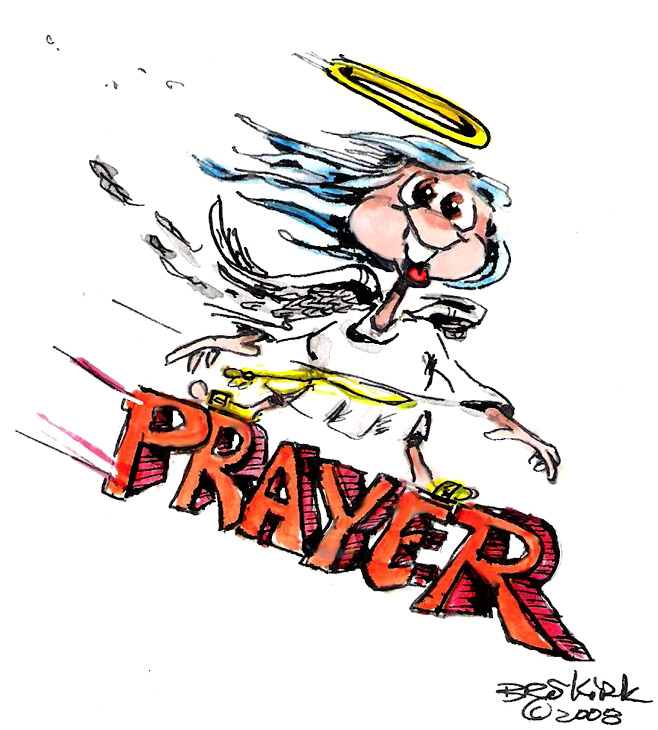
So last Saturday morning as I pulled onto the partially plowed freeway,  I began to pray.  Suddenly I saw the car next to me pull to the shoulder,  and at the same instance an ambulance dashed by, its lights blazing.   Also I was surprised to see a police car stopped to assist two cars in the ditch; I touched my brakes and realized that road was more slick than I anticipated.  I was praying the petition, “your will be done,”  and it struck me, “God’s will is for me to be a non-distracted driver RIGHT NOW!”  I stopped praying and immediately gave full attention to driving my car.  Later I could give God full my full attention.

How has prayer impacted your life?

Tsunami of Grace

How will you respond?

Like so many, I have been overwhelmed by the pictures, video and stories coming out of Japan.   Last week’s earthquake and tsunami were horrific.  Prayers for mercy, compassion and strength are lifted up to God on behalf of the survivors and victims.  Two thoughts rise in my heart and mind.

First, I realize that some people may be asking, “Why God allow this tragedy to happen?  Could He not stop it? Or is it some kind of punishment from God?”  Jesus faced such a question once when asked about eighteen people who were killed when a tower fell on them.  “Do you think that they were worse offenders than all the others living in Jerusalem?  No, I tell you; but unless you repent, you will all perish just as they did.” Luke 13:5.   The people of Japan are no worse sinners than you or I.  We are not entitled to prosperity and safety.  Each day of life is a gift from God that easily be lost.

Part of our repentance, transformation, is to recognized the potential folly of our human enterprise.  I took basic geology in college.  The professor stressed two points for all the non-geology majors: don’t build your home near a geological fault-line nor on a flood plain.  Japan is located near a major fault: earthquakes and tsunamis have and will happen there.   Even with the best technological structures, humanity continues to build where such destruction can/will happen.  We can not blame God for our folly.

But a second thought rises as well.   This is again our opportunity to love our neighbor and to show grace and compassion.   We each can participate in some way in the restoration of Japan and other devastated lands.  I am a citizen of a nation that is already sending support; I can inform my elected representatives that I support such aide.  I am also a member of the Evangelical Lutheran Church in America and I have given financial support to its Disaster Response fund. We are called now to act with the compassion of Jesus so that a tsunami of grace can touch Japan.

There are many agency by which you can help the victims of Japan.  If you want to use the ELCA disaster relief fund or learn more about it, go to https://community.elca.org/NetCommunity/SSLPage.aspx?pid=631

How has the earthquake shaken your life?

The Folly of Ashes

"From dust you come, to dust you shall return"

Ash Wednesday brings the strange custom of placing ashes on the forehead of  Christians.  This custom was not so strange in ancient cultures.  People would sit in ashes as a public confession that they had done wrong, that they deserved to be punished and that they seek God’s mercy.  Jesus noted this custom when he cursed two cities that did not receive him, For if the deeds of power were done in you had been done in Tyre and Sidon, they would have repented long ago, sitting in sackcloth and ashes (Luke 10:13).

Ashes are a symbol of our sinful, broken, self-serving character and our desperate need for God’s mercy.  Unless we acknowledge and confess our sin, God’s grace has no power, Christ’s death has no purpose.  But with such confession comes the brilliant healing light of God’s love.

The most powerful (even ridiculous?) image for the use of ashes comes in the book of Jonah.   The King of Nineveh heard of Jonah’s preaching on Nineveh’s impending destruction.  He rose from his throne, removed his rob, covered himself with sackcloth, and sat in ashes.  He even declared all men and animals to be covered in sackcloth, with the hope that God would be merciful.  The king showed his wisdom in this foolish behavior.

 This morning I read something on a blog that took God’s mercy deeper.

With that in mind, I’ve been wrestling the last few days: Isn’t it ironic how casually we are willing to talk about God’s mercy, as if we deserve it? As if it’s owed to us? At the same time, we cringe at the idea that God might be calling us to live on less; to give some stuff up. We pile on excuse after excuse about why God would want us to live cushy, comfortable, safe lives… Yet, the God we follow wasn’t willing to cling to the glory he deserved, because he was so moved by his love for us. We, on the other hand, don’t even deserve the breath in our lungs. It’s a gift. How, then, could we ever justify our security?

via Perfect Choreographed Dance. « The Trees Will Clap.

How does God’s mercy impact you?

Papa in Heaven

Brother David and Grandnephew Troy

I saw this picture of my brother with his first grandchild and proud PAPA jumped to mind.  It seemed to fit with last night’s confirmation class on the Lord’s Prayer.   The prayer’s introduction, Our Father in heaven, became special when I learned that Jesus used the word “abba” for father.  It was a term of endearment, more like “daddy” or “papa.”  “Father” seems a bit stiff.  

The power of the Abba prayer came home to me in a strange way when I was in college.  I was home for Christmas break and wanted to get a Christmas gift for the family.  I had recently been introduced to C. S. Lewis and thought that a box set of The Chronicles of Narnia would be a good gift, but I had no money.   I decided to pray about it and ask God to help.  As I entered the Christian bookstore, I was asking God to provide me the money so that I could buy the books.  I picked out the books, got in line for the cash register, waiting, hoping for some miracle.  How was God going to intervene?  A stranger noticing my need, cash on the floor?   But as I waited in line, nothing seemed to happen.  When I finally reached the register, I stepped out of line and put the books back.   I was deeply disappointed that God had not helped me.

The Christian bookstore was directly across from the offices were my dad worked for a local newspaper.   I walked across the street to see if he was there.   He was and he asked me how I was doing.  I am not sure now exactly how the conversation went, but somehow I asked for a few dollars and he gave me enough to buy the books.   Abba had provided after all, just not the way I expected.

The lesson I learned that day was that prayer is not magic, but a relationship.  There are Christians who have their prayers answered in miraculous, amazing ways.  I tend not to be one of them.  Instead, God uses the means around me to provide for my daily bread and to save me from the time of trial.  Papa in Heaven is at work through my brothers and sister who live here on earth.  And that also means that at times I may be God’s answer to someone else’s prayer.  And I thank God that I am one of His beloved children who can call him Papa.

How have you experienced Papa‘s answer to prayer?

Presidents and Leaders

G.W. - Greatest President?

As an American history major in college, I remember a discussion in which we debated who was the greatest president in our history.  Several classmates argued for Abraham Lincoln because he was able to hold the union together during the Civil War.  Others thought Franklin Roosevelt was the greatest because of his leadership during the Great Depression and World War II.  You may want to add a name or two yourself.  I thought then and continue to think that our greatest president was our first, George Washington, for one simple reason.  After two terms he stepped down.

Watching the current turmoil in North Africa as large crowds protest their countries’ long-time leaders, I am thankful that our nation has a rich history of orderly presidential transitions.  George Washington started that tradition when he potentially could have been president for life.  His advisors were advocates for a longer tenure. They feared that the country would break apart without Washington.  But Washington wanted to step down and go back to Mount Vernon.  After eight years he was ready to hand leadership to someone else.

One danger for any leader is to think that your leadership is indispensable for the organization.   That is true in businesses, congregations, colleges and non-profits.  “The organization NEEDS me,” can become an egotistical justification for remaining in a leadership position long past one’s effectiveness.   George Washington showed our nation how one can gracefully step down from high office.  He modeled  a key characteristic of what Jesus described as servant leadership:

 A dispute also arose among them as to which one of them was to be regarded as the greatest.  But (Jesus) said to them, “The kings of the Gentiles lord it over them; and those in authority over them are called benefactors.  But not so with you; rather the greatest among you must become like the youngest, and the leader like one who serves.” Luke 22: 24-26

What characteristics in your opinion makes a president or leader great?

Walking with Jesus in Jamaica

Someone once asked me , “Do you enjoy running every time you go?”   I had to stop and reflect for a moment.  My answer was, “No, not every time.  In fact there are many runs that I don’t enjoy at all.  But there are enough moments of joy and peace that I continue to lace up my running shoes and head out.”  And now, as I struggle to complete my physical therapy and watch the snow melt, I especially miss the joy of heavy breathing and quickly moving feet.

I believe the same is true for our walk with Jesus Christ.  Not every moment is filled with love, joy and peace.  In fact our connection to Jesus will also connect us to the suffering and pain in the world.  I don’t think God calls us out of the world, but to deeper life in the world, the world he created and redeemed.

Learning to be patient with my Jamaican friends

For the past ten springs I led a mission trip to Jamaica.  Yes, I would spend some time on the beach soaking up the sun and enjoying the surf.  But Jamaica is a very poor country and I invested more time in parts of Jamaica that the tourist rarely see, helping to build  Habitat for Humanity homes.  The work certainly had moments of frustration and discouragement.  “What is one house among so many needy people?”  Still I knew from years of experience that one house, one life, one testimony can bear witness to the transforming love and power of Jesus.  As I listened to Jamaicans, I discovered their patient faith and joy. And those moments of joy keep me going through the tougher times.

Even as I struggle in the present with my lack of running, I am hopeful for the future.  I am confident that I will run again with Jesus.  I am confident that new international mission trips lie ahead for Resurrection Lutheran Church.  Patient trust in God’s mercy will provide the way. “You show me the path of life. In your presence there is fullness of joy; in your right hand are pleasures forevermore.” Psalm 16:11 

 What has struggle taught you in your relationship with Jesus?

The Purpose of Scripture

The Bible is Word Power

Have you heard the concept, “The BIBLE stands for Basic Instruction Before Leaving Earth?”   I struggle with that concept.  My fear is that we will turn the Bible into a glorified self-help book that we try to control, rather than the Word of God that comes to recreate us in God’s image.  God’s Word has more than great advice; it has the power to transform us.

N. T. Wright describes this transforming power. “The Bible isn’t there simply to be an accurate reference point for people to look things up and be sure they’ve got them right.  It is there to equip God’s people to carry forward his purposes of new covenant and new creation.  It is there to enable people to work for justice, to sustain their spirituality as they do so, to create and enhance relationships at every level, and to produce that new creation which will have about it something of the beauty of God himself.”   (Simply Christian, p. 182-183)  God’s Word is to actively work at transforming us into the image of Christ.   It calls and empowers us to love God by loving our neighbor in creative, just ways.

Jesus himself had to reinterpret the law because the Pharisees and other religious officials had misused it.   The Pharisee’s loved the Torah (first five books of the Bible), but in their love they tried to control and protect it by building sharp boundaries between holy and unholy.   They tried to avoid all contact with unholy people, so as to remain pure before God.   They used the scripture as their way to stand apart from those in need (lepers, tax collectors, prostitutes, sinners).  Jesus proclaimed a message that engaged the unclean and envisioned a new creation.   Jesus did not come to abolish the law but to fulfill it (Matthew 5:17).

How is God’s Word transforming your life?

Prayer Helps

Bishop N. T. Wright

I am preparing for a talk on prayer this evening and wonder if and when anyone uses the written prayers of others to guide their prayers.  I am convicted by N. T. Wright’s comments that, “we moderns are so anxious to do things our own way, so concerned that if we get help from anyone else our prayer won’t be ‘authentic’ and come from our own heart, that we are instantly suspicious about using anyone else’s prayers. . . . We are hamstrung by the long legacy of the Romantic movement, (which) produced the idea that things are authentic only if they come spontaneously, unbidden, from the depths of our hearts. ” (N. T. Wright, Simply Christian, p. 164-165)

I confess that I have at time been such an advocate of spontaneous prayers of the heart.   Yet I also know the value of written prayers that have guided Christian prayer for centuries.   Jesus, being a first-century Jew, learned memorized prayers such as the Shema (“Hear, O Israel: the Lord is our God, the Lord is one,” found in Deuteronomy 6:4)  and the Psalms.  He taught his own disciples his kingdom prayer, the prayer we call the Lord’s Prayer (Matthew 6 and Luke 11).  The prayer of St. Francis continues to “make us instruments of God’s peace.”   Martin Luther wrote short prayers for the morning and evening to be included in his Catechism.   AA groups use Reinhold Niebuhr’s Serenity Prayer to close their meetings.  Written prayers can give shape and structure to our devotional life.

One of my favorite written prayers I learned from the Lutheran Book of Worship, but it probably has a deeper history.   The prayer is part of the morning prayer service and I have used it at various time in my ministry, especially at the beginning of something new.

Lord God, you have called your servants to ventures of which we cannot see the ending, by paths as yet untrodden, through perils unknown.  Give us faith to go out with good courage, not knowing where we go, but only that your hand is leading us and your love supporting us; through Jesus Christ our Lord.  Amen.

What written prayer(s) have shaped your faith life?  In what ways?

Holy Place of Peace

Hiking below Mt. Rainier

This morning I lead a class on prayer and one of the prayer exercises was a guided meditation, based on Psalm 46:10, “Be still and know that I am God.”  One method that has helped me enter into silent meditation is to take an imaginary trip to a favorite place that emotes peace.  Many people (especially during a Minnesota winter) might choose a tropical beach with warm breezes and rhythmic surf.  Or a beautiful garden that is under a brilliant blue sky and filled with fragrant blooms.  I choose the Cowlitz Ridge near Mt. Rainier.

I hiked the ridge once, nearly forty years ago.  The week before I left for my freshman year of college, my friend Marv and I decided on one last hike together.  We picked a three-day trip along the Wonderland trail which circles Mt. Rainier.  At first we climbed the steep switchbacks up out of the dark forested river canyon.  As we near the top of the ridge we stepped out of the dark forest into brilliant sunshine and a spectacular view of Mt. Rainier.  We camped in that meadow for two nights, soaking up the beauty and wonder of that ridge.

Now whenever I want a special time of prayer, I go on an imaginary journey to that same spot.  The only difference is that I take the imaginary trip with Jesus as my guide and friend.  For many reason, I find rest, comfort, strength, hope in visualizing him there with me.  As I meditate a deep abiding peace grows up around me.  I realize that I could imagine Jesus with me in other locations, but that spot has become a very holy spot.

I sometimes wonder if I will ever make the hike back to Cowlitz Ridge.  I might, but it is not essential to my spiritual life.  The essential part remains Jesus who is my guide and source of peace and joy wherever I am.

 Has guided meditation helped you in your spiritual journey?  Where do you find God’s peace?