
Category Archives: love

Simply Love

davepykeWhile in college, I remember having a long, intense conversation on the concept of law in the Bible with my roommate, David Pyke. (Dave went on to get his Ph.D. and is now the dean of the School of Business Administration (SBA) at the University of San Diego. He was/is one smart dude!)

I do not remember the specific issue. It might have whether it was possible to be a pacifist and a Christian, whether one could every lie to a friend or whether one must worship on Sunday. What I do remember vividly was that we agreed on the ethic of love. Love was Jesus’ great command – love your neighbor as yourself – and Paul’s great summary of the Christian duty.

The commandments, “You shall not commit adultery; You shall not murder; You shall not steal; You shall not covet”; and any other commandment, are summed up in this word, “Love your neighbor as yourself.” Love does no wrong to a neighbor; therefore, love is the fulfilling of the law. Romans 13:9-10

EKGThroughout my pastoral ministry, love has been the guiding light in many situations. For example, I have been with a critical ill person in the hospital and the family faced a difficult decision: whether or not to remove their loved one from life support machines. The physicians have done all that they can do and the chance of recovery is extremely small.

Occasionally a family member would think that they were breaking the commandment, “You shall not kill,” since the removal of life support almost certainly meant death.  Yet after much prayer and conversation, the family began to understand that maintaining “life support” in such situations was rarely life, but only a form of prolonged death. The Biblical commandment to prohibit killing was not written in the context of modern hospitals and their agonizing choices. The difficult but “loving” choice at times can be to remove “life-support.”

I realize that the rule of love can be viewed as fuzzy and manipulative, an ethic of convenience. I want to be clear that it is NOT simply doing what I “feel” is right. Paul gives us an extended definition of love in his letter to the Corinthians.

Love is patient; love is kind; love is not envious or boastful or arrogant or rude. It does not insist on its own way; it is not irritable or resentful; it does not rejoice in wrongdoing, but rejoices in the truth. It bears all things, believes all things, hopes all things, endures all things. Love never ends. 1 Corinthians 13:8-10.

Jesus gives us the pure example of love when he died on the cross, taking our violent sin upon himself.

To love our neighbor is rarely easy. It is not simply being soft-hearted. Love requires a strong spine as when a parent needs to confront a son or daughter with the need for rehabilitation when the child is addicted to drugs or alcohol. Yet that confrontation needs to be done with compassion and grace, seeking the healing of the son or daughter. Love seeks the very best in and for others.

How does the rule of love impact your daily life and decision?

Lord Jesus, give me the strength to love as you have loved me.
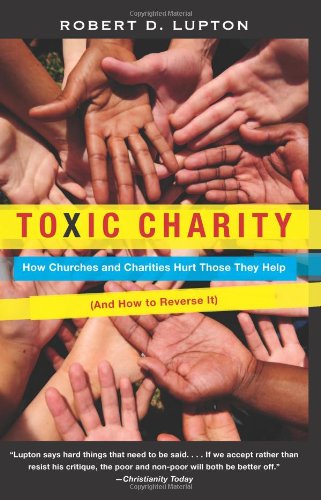
Toxic Charity?

Saturday I returned from a short-term mission trip to Denver with our youth. I was pumped by the diverse and intense experiences we had together serving the urban poor. I preached on how the week gave me a new perspective on prayer in yesterday’s sermon and how excited I am to see future mission trips.

Then this morning I read a short article in L Magazine titled: Toxic Charity. It is an excerpt from the book, Toxic Charity: How Churches and Charities Hurt Those They Help (and How to Reverse It). In the article, Robert Lupton argues that many of the service projects that churches and nonprofits perform with good intentions are not really helping the needy. Americans work hard at serving others, but do rarely consider the outcomes of such service.

What is so surprising is that its outcomes are almost entirely unexamined. The food shipped to Haiti, the well we dig in Sudan, the clothes we distribute in inner-city Detroit — all seem like such worthy efforts. Yet those closest to the ground — on the receiving end of this outpouring of generosity — quietly admit that it may be hurting more than helping. How? Dependency. Destroying personal initiative. When we do for those in need what they have the capacity to do for themselves, we disempower them.

The article started me wondering about some of the service projects we assisted in Denver. One was the David Clifton Carpenter’s Cupboard, a food shelf in Wheat Ridge, CO. David Clifton was homeless for a time early in his life and had gone to churches for help. Afterwards he started a food shelf to help others like himself. But in my one day of service at his food shelf, I wondered if it was helping people transitioning out of poverty or was simply a “band-aid” that continued a cycle of dependency. From my limited observation it appeared that many families came every week for the free food.

Robert Lupton writes,

To be sure, not all charitable response is toxic . . .  But our compassionate instinct has a serious shortcoming. Our memory is short when our recovery is long. We respond with immediacy to desperate circumstances but often are unable to shift from crisis relief to the more complex work of long-term development. Consequently, aid agencies tend to prolong the “emergency” status of a crisis when a rebuilding strategy should be underway.

NewHabitatLogoOne agency that I believe has long-term development in mind is Habitat for Humanity. It seeks to transition people out of poverty by helping them move into home ownership. One of their mottos is “Not a handout, but a hand up.” Habitat home recipients must first complete 500 hours of “sweat equity” working on Habitat homes, complete a course on homeownership and sign a mortgage agreement that is not more than 1/3 of their income before receiving their home. Habitat is not toxic charity but transitional charity.

What do you think about charity and service for other?

Lord Jesus, teach us to love our neighbor in ways that honor you.

Sidewalk Sunday School

image

In college I went to an evening service for healing. I went with a friend expecting to pray for her health. But while I was there, I went forward for prayer myself. I asked the pastor to pray for my critical, skeptical thinking that often blocked my faith experience.

I remember his prayer. He asked for “the wings of my intellect to be folded, so that the Holy Spirit might soar within me.”

I have prayed that prayer frequently this week as five youth and I  serve at the Denver Metro Ministries.  Pastor John Gallegos and his team take their puppet ministry, songs and games, called
Sidewalk Sunday school, to various urban projects in Denver.  My team has helped working puppets and leading games.

My skeptical mind finds many parts of the ministry uncomfortable.  For example, competitive games and prizes are not my specific vision of Christian children’s ministry. The focus on “making a decision for Christ” runs counter to my focus on responding to  God’ s grace. Yet I have folded the wings of my intellect so that the Holy Spirit can soar.

The Spirit is soaring because Pastor John Gallegos and his team are there to share the love of Jesus. His team are dedicated to loving children who are forgotten by many in our society. They share the love of Jesus in song, puppets, food and word.  Week after week –spring, summer, and fall –they go to the very neighborhoods that many of us avoid.  The youth and I are blessed to serve with them.

Sidewalk Sunday School’s Bible verse this week is Proverbs 14:21, “Being kind to the needy brings happiness.”   Their kindness has brought each member of Resurrection’s team happiness.

Lord Jesus, thank you for your soaring Spirit.

Family of God

I am away with Family Camp at Camp Wapo near Amery, WI. Nearly a dozen families, many with young children, came to share time together. Even though I made the journey alone, I was immediately swept up into games of hide and seek, yarn introductions and campfire songs. Though threatening thunder storms cut our campfire short, we still enjoyed a crazy camp skit and plenty of snacks.

HeidemannThis morning the families participated in a family devotional scavenger hunt. They followed clues to various hidden scripture boxes scattered around the camp. Each scripture box had a Bible verse they read and a short activity related to it. For example, they read about God creating human being, by breathing into the man the breath of life (Genesis 2:7). The children then blew bubbles as a way to think God’s breath/spirit in their life.

JensensI took advantage of the Bible activity based on Matthew 11:28. Jesus said, “Come to me, all you who are weary and burdened and I will give you rest.” I took a short nap.

Saturday afternoon families are enjoying the beach, taking pontoon boat rides and playing in the gaga pit. It is a chance for children to play together and adults to have relaxing conversations. The sun even poked its head out from the clouds.

I am reminded of Jesus’ words to his disciples when his family sought him out.

Then Jesus’ mother and his brothers came; and standing outside, they sent to him and called him. A crowd was sitting around him; and they said to him, “Your mother and your brothers and sisters are outside, asking for you.” And he replied, “Who are my mother and my brothers?” And looking at those who sat around him, he said, “Here are my mother and my brothers! Whoever does the will of God is my brother and sister and mother” Mark 3:31-35.

At family camp and on Sunday morning Resurrection lives out the sense of being family together. We are brothers and sisters one to another when we do the will of God. I came to family camp alone, yet I am surrounded by family.

Thanks be to God.

New Connections and New Shoes

Yesterday I was with a group of Resurrection members, discussing our New Connections campaign. I asked them to name some of the connections that keep them connect to the congregation. The answers varied widely. Several commented on the connections of friendship that comes from worshipping, serving and playing together.

One member spoke to the fun he had serving on the Property and Image Team (aka “The P.I.T. crew”) who meet monthly to use tools and fix things around the church facility. Another appreciated the connections she makes in playing with a talented worship team and the praise we give together to God. A widow spoke on the comfort she finds in hugging others after church.  A grandfather shared how significant it is to help shape and share the developing faith life of his granddaughter as she discovers the joy of God’ Word.

Discovering connections in God's Word

Discovering connections in God’s Word

Community is a central piece of the Christian faith. Jesus started his ministry by immediately calling disciple to be his followers, his community (Mark 1:16-20). Throughout his ministry, Jesus gathered with people for meals and hospitality, even eating with outcasts and sinners like Zacchaeus (Luke 19:1-10). As he prepared to leave this motley crew of followers, he gave them his most demanding command.

I give you a new commandment, that you love one another. Just as I have loved you, you should love one another (John 13:34).

I shared my own recent connection. In the morning worship Sarah Strovick had gathered the children for the children’s message. I was sitting in the front row watching the children seated on the floor in front of me. One little girl, about two years old, had taken off her new shoes.  She was looking to her older sister for help. Her sister pointed to me and the younger child toddled over, holding up her new shoes for me.

brown ShoeI reached out my arms and placed her on my lap. She handed me each shoe and peacefully watched as I replaced them on her feet.  As I did this, I was reminded of the story of Moses and the burning bush when God commanded Moses to take off his shoes since he was on holy ground. I also thought of Jesus washing the feet of his disciples. Memories of putting shoes on my own children years ago flowed through me.  As the little girl sat in my lap it became a holy connection for me. It became a moment when God reminded me again that I am loved, just as this little girl is loved and cared for. With a touch of reluctance I place set the toddler back on the floor with the other children.

A new connection with God and community had been formed in me.

Lord Jesus, thank you that I am your child, connected to you through your word and your people.

Running After Boston

Boston CupYesterday’s bombing at the Boston Marathon had repercussions throughout America, especially within running communities. The Boston Marathon is the most prestigious marathon in our country. Many marathon runners yearn to run it; I have had it as a running goal for more than a decade.  My office coffee cup is a gift from a running buddy who ran Boston eleven years ago.  Last fall at Twin Cities Marathon, I was finally able to qualify for Boston in 2014.

Yesterday I was tracking on-line my friends Mike Johnson and Dan Foster as they ran the marathon. (Runners carry a timing chip which charts their progress as they cross timing mats along the course.) Mike and Dan were moving along the course nicely. It was cool spring day, a good day for running. Dan finished the race in 3:28:57, a great time on a challenging course. Mike was further back; his training for the marathon had suffered from a variety of issues. I noted that he had complete 40K in 4:25:47 and was less than 2 miles from the finish. This was at 2:46 pm.

When the bombs went off, Mike was only a half mile from the finish. Here is what he wrote on his Facebook page

I was about a half mile from the finish when everyone ahead of me was stopped. The spectators around us said they heard two explosions near the finish line area. I asked the spectator that first told us about the explosion if I could use his phone and I was able to connect with Zanny (his wife) right away. I am so glad I was able to do that so she wouldn’t worry.

Later Mike was able to reconnect with Dan and both are now recovering: physically, emotionally and spiritually. Like so many in the world, Mike and Dan are praying for those victims who were injured or killed in this terrible event. Events like this show us the depth of human sin and wickedness and push us to reflect on life’s meaning.

I remember writing to my running friends the day after the 9/11 attacks that I planned to run that day. On the day of the attacks I was too upset to run, but I decided that I could not let the terrorists “win a disruptive victory” and deny me the routine of solace and prayer. I ran that day praying for those who had died, praying for the responders and leaders, praying for our nation, and even praying for the terrorists who cause such evil. After all Jesus said, “Love your enemies and pray for those who persecute you” (Matthew 5:44).

I plan a similar run today (though it will be more a walk due to my sprained ankle). I will reflect on ways that I can be God’s agent of peace, hope and love for the world. The tragedy of Boston places a media spotlight on the evil that human beings can cause (as well as the tremendous response of dedicated care from first responders). Yet this tragedy will not turn me away from the ultimate source of hope and renewal: Jesus Christ. His cross and resurrection is the paradigm through which I see all such tragedy. Even when humanity killed God’s Son, God brought new life: the resurrection.

In the fall I plan to register for Boston, train and run it next April. I am confident that officials will find ways to improve security, though no one can make it absolutely safe. At the start the marathon will have a moment of silence to remember those killed and injured. Then the race will start and runners will do what they do: run. I plan to be one of them.

Good Friday’s Promise

Jesus crucified outside the city walls of Jerusalem.

Roman did not conduct quiet executions. They wanted maximum public disgrace when they executed an outlaw. The marched the convicts out through the public crowds to demonstrate their power over the population. They stripped the criminals of all clothing and possession.

And they chose a public place where all who passed by could see their display of power. To show that Jesus was no one special, they crucified him with two other criminals.  And to mock Jesus they printed a sign over his head, “King of the Jews.” The sign reminded all that any rebellion against Roman was futile.

If you want to be king, this is the kind of throne you will have, a throne of nails with a crown of thorns. Here is the kind of royal court you deserve, two criminals who share in your crucifixion. It will be your total humiliation and the complete demonstration of Rome’s power.

But the Romans were not alone. The temple priest and others joined in scoffing Jesus. They threw back at him his words of healing and hope. “He saved others, let him save himself.” Three times the word “save” is thrown at Jesus. But no saving angels came to rescue him.

Here was the miracle worker, who at his most desperate hour, had no miracle. Here was the great teacher, who from his bloody pulpit had no word for the crowd. From all outward appearances, Jesus was defeated, destroyed and dead.

From the outside all was darkness and pain. Jesus was utterly abandoned by his disciples, his friends, his powerful deeds and words. As the crowd stared at the cross, they did not see a Godly messiah, only a miserable joke.

But something else was going on behind the scenes. And only those who come with the eyes of faith will see it.

As the soldiers, priests and others mock Jesus, one of the criminal, for reasons unknown, spoke up to defend Jesus. He reminded the other criminal that they are being executed for just reasons, but Jesus had done nothing wrong. “Have you no fear of God?” he asks.

He turns to Jesus and says “Jesus, remember me, when you come into your kingdom” (Luke 23:42).

Whether this criminal fully understood the words he spoke or not, we do not know. But Jesus had once said, “If you have the faith of a mustard seed, God will hear and act”(Luke 17:6). In many ways, this criminal echoes our prayer as we watch this battle between the powers of darkness and destruction and the power of God’s love. We ask that Jesus will remember us.

Jesus, remember me, when you come into your kingdom.

Jesus responds, “Today you will be with me in paradise.”

Lord Jesus, lock your promise in my heart today.


Of Crucial Importance

the-return-of-the-prodigal-son-1669_jpg!HalfHD

The best devotional book I have read in the past decade is Henri Nouwen’s The Return of the Prodigal Son.  Nouwen uses Rembrandt’s painting, Return of the Prodigal Son, to unpack Jesus’ parable in Luke 15. He helped me see that at times I am the wayward younger son, at times the angry elder son, and even at times, the compassionate father. I found his description of the elder son’s reluctance to join in the celebration of the father’s love speaking directly to my own heart.

For me, personally, the possible conversion of the elder son is of crucial importance. There is much in me of the group of which Jesus is most critical: the Pharisees and the scribes. I have studied the books, learned about laws, and often presented myself as an authority in religious matters. People have shown me respect and even called me “reverend” . . . I have been critical of many types o behavior and often passed judgment on others.

So when Jesus tells the parable of the prodigal son, I have to listen with the awareness that I m closest to those who elicited the story from him with the remark, “This man welcomes sinners and eats with them.” Is there any chance for me to return to the Father and feel welcome in his home? Or am I so ensnared in my own self-righteous complaints that I am doomed, against my own desires, to remain outside of the house, wallowing in my anger and resentment?

Jesus says: “How blessed are you when you are poor . . . blessed are you who are hungry . . . blessed are you who are weeping . . . ,” but I am not poor, hungry or weeping.  Jesus prays: “I bless you Father, Lord of heaven and earth, for hiding these things [of the kingdom] from the learned and clever.” It is to these, the learned and clever, that I clearly belong. Jesus shows a distinct preference for those who are marginal in society—the poor, the sick, and the sinners—but I am not marginal.

But the story of the elder son puts all of these agonizing questions in a new light, making it very plain that God does not love the younger son more than the elder. In the story the father goes out to the elder son just as he did to the younger, urges him to come in, and says, “My son, you are with me always, and all I have is yours.”

The harsh and bitter reproaches of the son are not met with words of judgment. There is no recrimination or accusation. The father does not defend himself or even comment on the elder son’s behavior. The father moves directly beyond all evaluations to stress his intimate relationship with his son when he says, “You are with me always.” (p. 79-80)

Lord Jesus, thank you for the promise: “You are with me always.”

Who Is In the Ditch?

A common interpretation of Jesus’ parable on the Good Samaritan (Luke 10:25-37) is to think it is moral story. The moral objective is for us to do good for our neighbors. If you see someone stranded by the side of the road, you should stop and help them in some way. There is nothing wrong with this moralistic interpretation of the parable. At the end Jesus says, “Go and do likewise.”

Good Samaritan by He Qi

Good Samaritan by He Qi

Yet such a moral interpretation is not the only way to read this story. Jesus’ parables nearly always contain a surprise that trips us up. The Good Samaritan has such a surprise. This was the focus of yesterday’s sermon which you can hear here.

Jesus told the story in order to answer a religious lawyer’s question about loving our neighbor. The lawyer asked, “Who is my neighbor?” Jesus answered the question with the parable:

A man was going down from Jerusalem to Jericho and fell into the hands of robbers, who stripped him, beat him and left him half dead. (This not a big surprise since that road was an isolated one.) Now, by chance, a priest was coming down the road and when he saw him, he passed by on the other side of the road. (Minor surprise here, a priest might be one who would see the religious obligation to help, but does not.) Likewise a Levite, when he came to the place and saw him, passed by on the other side. (The Levite, another religious person who should help him, does not.)

Now in classic storytelling fashion, Jesus has set up the third person to break the pattern of passing by and thereby demonstrate what loving the neighbor means. Since he is speaking to a religious lawyer and wants him to learn what love is, one might expect the third person to be a religious lawyer who stops to aid the beaten man. This would make the moral point very explicit.

Instead, Jesus surprised the lawyer (and us) by introducing a Samaritan into the parable. Samaritans and Jews had a great deal of religious hatred with one another since they disagreed on where God’s temple should be (see John 4:20). The Samaritan is the one who goes out of his way to care for the beaten man; the Samaritan is a totally unexpected hero.

But where is the lawyer in the parable? For that matter where are we in this story? He (or we) might identify with the priest or Levite or possible the Samaritan. But there is another possibility. Perhaps Jesus is inviting lawyer (and the reader as well) to see oneself as the man beaten and thrown in the ditch.

Many of us have a hard time accepting the love and compassion of others. We prefer being the one in control, dispensing the compassion. We keep our wounds (emotional, spiritual, relational, and vocational) hidden. Perhaps Jesus is calling us to receive compassion and care from others and not be so stoic. There are risks to such vulnerability. Yet Jesus took such risks when he was beaten, stripped and died for us. (More later on this later in the week).

Lord Jesus, help me to receive compassion for others.

Do Pets Go to Heaven?

Like many pastors, I have members ask me questions about God and Jesus, heaven and hell. I don’t always have an answer, but I try to help the person reflect on God’s grace and love as reflected in scripture.

long-coated-german-shepherd-maleThe question whether our pets will be in heaven is one such question. The Bible and Christian tradition gives no explicit answer. Revelation 21 describes a new heaven and new earth, but no reference to pets. My basic answer is that God loves you and if God determines that you need your pet in heaven then God will provide. But the promise of heaven revolves around God and not our pets.

Dietrich BonhoefferDietrich Bonhoeffer had an intriguing pastoral conversation when he was a newly ordained pastor serving a small German congregation in Barcelona, Spain. He writes about it in a letter to his brother-in-law.

At 11:00am there was a knock at my door and a ten-year-old boy came into my room. I noticed that something was amiss with the boy, who is usually cheerfulness personified. And soon it came out: He broke down into tear, completely beside himself, and I could hear only the words, “Herr Wolf ist tot” [Mr. Wolf is dead], and then he cried and cried. As it turns out, Herr Wolf is a young German shepherd dog that was sick for eight days and had just died a half-hour ago. So the boy, inconsolable, sat down on my knee and could hardly regain his composure; he told me how the dog died and how everything is lost now. What could I say? So he talked to me about it for quite a while. Then suddenly his wrenching crying became very quiet and he said, “But I know he’s not dead at all.” “What do you mean?” “His spirit is now in heaven, where it is happy. Once in class a boy asked the religion teacher what heaven was like, and she said she had not been there yet; but tell me now, will I see Herr Wolf again?”

So there I stood and was supposed to answer him yes or no. If I said, “no, we don’t know” that would have meant “no” . . . . . So I quickly made up my mind and said to him. “Look, God created human beings and also animals, and I’m sure he loves animals. And I believe that with God it is such that all who loved each other on earth—genuinely loved each other—will remain together with God, for to love is part of God. Just how that happens, though, we admittedly don’t know.”

You should have seen the happy face on this boy; he completely stopped crying. . . he was ecstatic. I repeated to him a couple of times that we don’t really know how this happens. He, however, knew, and knew it quite definitely in thought. . . . And there I stood— I who was supposed to “know the answer”— feeling quite small next to him; and I cannot forget the confident expression he had on his face when he left. (Bonhoeffer, Pastor, Martyr, Prophet, Spy by Eric Metaxas. p.87)

I take comfort that even Bonhoeffer struggled to answer this pastoral question. I also am thankful he landed on God’s love as the best answer for a boy in pain.

What do you think about the question, “Do Pets Go To Heaven?”

Lord Jesus, thank you for the love you lavish upon us in so many ways.