Category Archives: Prayer

Snow Days and Daily Bread

sleddingsnowblastwebYesterday was a snow day for many school districts in the Twin Cities area. The foot of snow was a fun excuse for many families to be outdoors, sledding on hills and building snow forts. Afterwards they could warm up with hot cocoa or bake fresh cookies.

But the school districts in Saint Paul and Minneapolis did not have snow day. Instead the buses took their time delivering these urban children to their school. I don’t know all the reasons they stayed open, but one of them was probably hunger. For many children in poverty, school is the one place where they are assured of getting a nutritious meal. According to Bread for the World, 16.2 million children struggle with hunger every day. You can learn more about hunger through the new documentary, “A Place at the Table.”

BreadAs a Christian I pray the Lord’s prayer daily. In it I pray, “Give us today our daily bread.” I am not simply praying, “Give me today my daily bread,” but for OUR daily bread. I am praying for my brothers and sister in Christ who need food today. After all the book of James cautions,

What good is it, my brothers and sisters, if you say you have faith but do not have works? Can faith save you? If a brother or sister is naked and lacks daily food, and one of you says to them, “Go in peace; keep warm and eat your fill,” and yet you do not supply their bodily needs, what is the good of that? (James 2:14-17)

I am thankful for the efforts my congregation (and many congregations) who work to fed others. Efforts like the Cure Ministry that serves meals at East Emmanuel Lutheran in St. Paul and the Christian Cupboard that provides food to many families in the Woodbury area. But I sense that more can be done. What do you think?

Lord Jesus, give us today our daily bread, especially for the hungry children in our midst.

Slow Lent Revisted

Slow Lent Movement

Slow Lent Movement

In two days, Lent begins. Lent is a church season of preparation, looking towards Jesus’ passion. I have written about Lent before and as I stopped to reread it, I realize that I need to learn once again to slow down, to realign my life.

Two years ago I wrote about Bishop Margaret Payne’s passion for a Slow Lent Movement. A brief section of what I wrote then,

She spoke on how pastors have bought into the seduction of our culture’s three A’s: Accomplishment, Adrenalin, and Affirmation. As pastors we think our worth is based on how much we accomplish in our congregations and we enjoy the adrenalin rush that comes from having much to do and being needed by many people. And we relish the public affirmation that often comes from having our hands in many programs and ministries. I found myself nodding my head several time, recognizing my own self-delusions being exposed by her words.

But I don’t think her words are limited to pastors. In spite our professed trust in God’s grace, so many of us who are Christians still seek our self-worth based on our accomplishments. We rush about trying to fulfill the many “shoulds” we carry inside our heads. We seek public affirmation even as we feign humility. We have bought into the prevailing culture without seeing our need for a new way of life.

I confess that I continue to find my primary worth in my accomplishments, rather than my identity as God’s child. This Lent our congregation will be focused on the Lord’s Prayer and the opening phrase always give me pause, “Our Father in heaven.” Jesus instructs us to approach God as a loving father who seek us out.

I pray for you that the season of Lent will provide be a time of slow, reflective prayer, of simply being with God.

Yes, there is much to do.

Yes, our neighbor needs love.

But in our anxious hurry, you and I forget who we are. We need to slow down and be with our loving papa in heaven.

Lord Jesus, remind me once again to slow down in you.

Prayer Challenge

Title: The Prayer of Jesus (St John Passion - ...

Title: The Prayer of Jesus (St John Passion – 3) Painter: Jacek Andrzej Rossakiewicz (b.1956) Year: 1990 Characteristics: Oil on canvas, 245 x 137 cm (Photo credit: Wikipedia)

Jesus made radical promises regarding prayer.

  Ask, and it will be given you; search, and you will find; knock, and the door will be opened for you. (Matthew 7:7)

If you abide in me, and my words abide in you, ask for whatever you wish, and it will be done for you. (John 15:7)

Jesus promised that his disciples could “ask whatever they wish” and God would make it so. Such bold promises challenge my observation of the church and the world. So many prayers seem to go unanswered or forgotten.

I am not talking about what I consider “childish” prayers, like winning the lottery or finding a parking spot at the shopping mall. I am thinking about those real prayers of the heart, when day-after-day you pray for the healing of a loved one. A friend is afflicted with cancer or an addiction, a spouse is battling depression or a child is traveling in the wrong crowd and we pray. We pray asking God to bring healing and peace to this person believing that this is God’s will for God’s people. Jesus certainly brought healing to those in need; healing and wholeness is what God desires for all of creation, especially his children.

Naturally if the person resists God’s healing, God will not force mercy. Often a person wrestling with addiction has to hit bottom before they can see how powerless they are in their addiction. God does not force healing.

Still many of us pray daily for God’s healing and we do not experience it. Oh, there are those occasions when miraculous healings occur. Thanks be to God! I have participated in prayer services where God’s power has restored the sick to health. Yet such answers seem almost arbitrary because others have not had the same prayers answered even when their faith was strong and their prayers persistent.

I do not know the answer to my own question, other than to look to Jesus. In the Garden of Gethsemane he prayed for his own cup of suffering to be taken away, yet the next day he walked to the cross and death. His prayer was real and deep. And though he did drink the cup, his prayers gave him the strength and power to walk to Golgotha . . . . and three days later, the empty tomb.

And that is what we each need: the strength and courage to walk the path God has given us. So, like Jesus, we pray, “your will be done.”  The final answer to all prayers comes in Jesus’ resurrection and the promise of new life in him.

Lord Jesus, your will be done in my life.

Mystery of Prayer

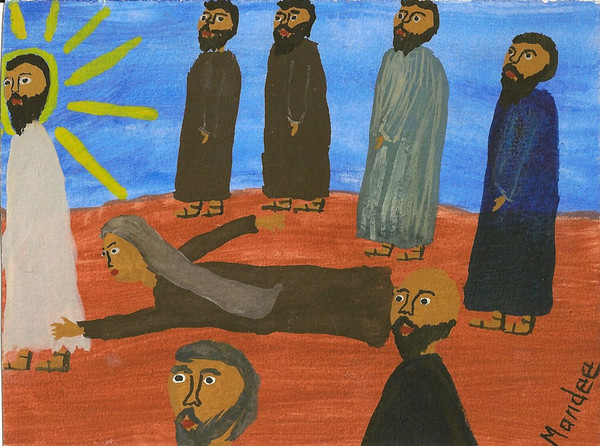
Prayer can often be a challenge to my rational mind. I like to have concrete, explicit answers to my requests of God. But the very act of conversing with an unseen, often silent, Being challenges all my rational expectations. Yet I would not want a god whom I can easily fit into my own limited understanding. That god would be too small if it could fit into my mind. To truly pray is to enter into the mystery of God, the creator of heaven and earth.  In a way prayer is our attempt to touch the hem of God’s robe.

Touch the Hem of his Garment by artist Amanda Retana

Touch the Hem of his Garment by artist Amanda Retana

Ted Loder writes about the mystery of God in his book Guerillas of Grace: Prayers for the Battle.

Mystery means that, in spite of all our efforts, all our insights, discoveries, and experiences, we will never do much more than touch the hem of God’s robe. It is enough that such touching brings healing. It is too much, idolatrously too much, to claim more than a very little information about the wearer of the robe. And even that little information we can claim only with enormous humility. However, humility is the twin of trust.

It has been said, referring to the temptation to which biblical literalists often succumb, that we should never confuse the love letter with the lover. We all have our version of such literalism, our dogmaticisms, our exaggerated (if unadmitted) claims of knowledge. Humble acknowledgment of mystery delivers us from the imprisonment of such certainties into the awesome dimensions of possibilities. Trust begins here. So, in some primitive way, does prayer. (p. 17)

I will never be able to fully comprehend how or why prayer “works,” but I continue to pray, trusting in God’s grace and love. Through out his life Jesus prayed to his Father; I follow in his example.

To use Ted Loder’s own prayer Calm Me into a Quietness,

Now, O Lord,
Calm me into a quietness that heals and listens,
And molds my longings and passions,
my wounds and wonderings,
Into a more holy and human shape (p.27)

Cry Out!

Out of the depths I cry to you, oh Lord (Psalm 130).

Yelling!I try not to be a complainer. My preference is to simmer on the inside, while smiling on the outside. However there are times when things don’t go my way and I get frustrated and complain. No, more accurately, I yell.


Last week as I prepared for confirmation, I had three you-tube videos I wanted to show the students. I tested my laptop and projector in our class room the afternoon prior to the class. The set-up needed some minor adjustments but I thought I had all the tech “gremlins” worked out so that I could easily show the video clips that evening. I was psyched to teach.

I came back early to reset the laptop and projector for the actual class and two tech gremlins attacked my system. First my laptop kept “freezing” during the video and the projector refused to power up. Neither of these happened during the afternoon test run. The students were restless, ready to start, and my whole lesson plan had gone out the window. I could feel the frustration and anger rising up within me and I confess it came out sideways. I “yelled” at the students to be quiet. It actually was my “crying out to the Lord,” since I thought he had abandoned me. After the outburst I attempted to teach my first lesson on the Apostle’s Creed from scratch.

Yet as I stumbled along, God heard my cry. Or at least two of God’s servants did. Two adults who are tech savvy, started working on the laptop and projector. Within ten minutes they had the projector and laptop working and the video clips cued. Our confirmation class could continue.  (And later I apologized to the students for my outburst.)

Not every cry of the heart is heard so quickly. Some cries come from much deeper within us.  In hospital rooms,  I have joined others in crying out to the Lord, asking for healing from Almighty God.  After worship, I have cried out to the Lord with members who need real guidance and strength.  After a counseling appointment, we cry to the Lord for mercy and grace.  At times our cries seem to be lost in the heavens. Yet like the Psalmist, we continue to cry out. God does not promise how or when he will answer our prayers. He simply commands us to pray. Or to cry out!

We know that the whole creation has been groaning in labor pains until now; and not only the creation, but we ourselves who have the first fruits of the Spirit, groan inwardly while we wait for adoption, the redemption of our bodies (Roman 8:22-23).

How do you cry out to the Lord?

Lord Jesus, hear my cry and rescue me.

Prayer Basic Practices

Jesus Praying at Gethsemane by Artist He Qi

Jesus Praying at Gethsemane by Artist He Qi

Last week I posted about starting an intentional prayer streak of daily prayer. Yesterday I challenged members of Resurrection to become more intentional in praying for our congregation and the world. (You can listen to the sermon here until January 14).  Today I want to provide some basic prayer practices that can enhance your prayer life.

Intentional: most habits are formed when we make it a priority and intentionally schedule time and energy for it. If we want our prayer life to deepen we need to  schedule an intentional time and place to pray. Many people find the first thing in the morning best; others prefer the evening. I know one person who made sure to leave for work early so he could have fifteen minutes to pray in his office parking lot. I  pray just after my morning run. I have my Bible and prayers placed near my prayer chair so I am ready when I return.

Written versus Spontaneous. Most of my prayers for Sunday morning worship are spontaneous with a basic mental framework to guide me. However my daily prayers are now a mixture of written prayers and silence for more spontaneous prayers. Having both allows me to stay focused and keeps my mind from wandering as much. I also plan to change some of the written prayers on monthly basis so as to give it some variety and freshness. This month I am using Psalm 130 and the refrain, I wait for the Lord, my soul waits, and in his word I hope.  I wrote more about using written prayers here.

Relaxed: My goal in prayer is not to finish the liturgy as quickly as possible but rather to spend time with God. Be still and know that I am God! Psalm 46:10. During the moments of silence, I simply imagine God being close to me, His breath matching mine own. If my mind wanders I acknowledge the wandering thought and bring it back to prayer and being with God.

Consistent: We certainly can pray at any time. Paul calls us to pray without ceasing (I Thess. 5:17). People often practice” bullet prayers”, asking for God’s guidance, strength, or intervention in quick snippets of prayer throughout the day. Such prayers are not wrong, but should not be confused with developing a deeper intentional prayer life. As an analogy, bullet prayers are like calling yourself a runner, when the only running you do is to sprint from the parking lot to the office door during rain storm. To become an honest runner you need to consistently take time to lace up your running shoes and run. To become a disciple of prayer you consistently need to take time to step off the daily treadmill and be in prayer. Fifteen minutes on a daily basis will do wonders for your soul.

What other prayer practices have worked for you?

What time or place have you found most helpful?

Lord Jesus, teach me to pray.

“I Hold My Life Up to You Now”

Years ago a friend and spiritual mentor introduced me to Ted Loder’s book of prayers called, Guerrillas of Grace: Prayers for the Battle.  Ted Loder is a retired United Methodist pastor who has written several book and has a semi-active blog here.   Below is Ted’s prayer for New Year’s Day is titled “I Hold My Life Up to You Now.”  His last petition is my prayer for the coming year.

infinity-clock

Patient God,
the clock struck midnight
and I partied with a strange sadness in my heart,
confusion in my mind.
Now I ask you to gather me
for I realize
the storms of time have scattered me,
the furies of the year past have driven me,
many sorrows have scarred me,
many accomplishments have disappointed me,
much activity has wearied me,
and fear has spooked me into a hundred hiding places,
one of which is pretended gaiety.

I am sick of a string of “have-a-nice-day’s.”
What I want is passionate days, wondrous days, dangerous days,
blessed days, surprising days.
What I want is you!

Patient God,
this day teeters on the edge of waiting and things seem to slip away from me,
as though everything is only a memory and memory is capricious
Help me not to let my life slip away from me.
O God, I hold up my life to you now,
as much as I can, as high as I can, in this mysterious reach called prayer.
Come close, lest I wobble and fall short.
It is not days or years I seek from you,
not infinity and enormity,
but small things and moments and awareness,
awareness that you are in what I am
and in what I have been indifferent to.

It is not new time,
but new eyes, new heart I seek,
and you.

Streaks

This past Thanksgiving I started my first running streak. It came from a challenge at Runner’s World. The goal of the streak was to run at least a mile every day between Thanksgiving and New Years. I normally run 3-5 days a week, giving my body plenty of time to rest and recover from any muscle damage during runs. Since my marathon in October, my running has been rather sporadic, lacking a goal or passion. So I decided to embrace a new challenge.

The key for me was to keep my normal rest days easy, just a slow-pace mile or two. I wear a heart rate monitor so it was easy to check my pulse and see if I was pushing too hard. I have discovered that doing an easy mile was both relaxing and a great way to start the day.

Yaktrax RunnersI added to the challenge by making every run an outdoor run. Treadmills and indoor tracks have their place, but I wanted fresh air. This became more challenging when our first Minnesota snow fell in mid-December. Fortunately I had a pair of Yaktrax that gave me good footing. Still, for an outdoor run I often took twenty minutes to dress for a ten minute jog.

I did get a short break when I traveled to Austin, Texas, for a memorial service after Christmas. A ten-mile run in warm sunshine and shorts lifted my spirit and confidence.

SA runners 122212 small

Some of my running buddies on Saturday morning.

I am not sure how long the streak will continue into the New Year. My legs are feeling strong and injury free. I have developed a habit that I enjoy and that promotes health. I suspect sometime in the next month a cold or tight schedule will end the streak. I don’t plan to be obsessive about it. I am confident that my running friends will be both encouragers as well as wise advisors.

It has got me wondering about my own spiritual practices. I pray daily, but my devotions have become sporadic and unfocused. The memorial service I attended was at an Episcopal church and it had more liturgy than I normally used. I found the prayers helpful and healing. So I have decided to use a written liturgy to guide my prayers during the month of January. You can see a copy of it here.

Thus, I am committing myself to new streak, a prayer streak.  My first goal is to use the daily liturgical prayer format each morning for the month of January.   Care to join me?

Lord Jesus, thank you for your tender mercies in 2012. Guide me deeper into your love in 2013

Thanksgiving Practice

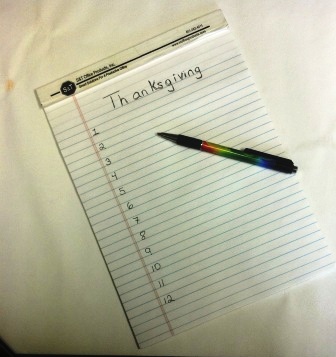
Tomorrow our nation stops for Thanksgiving. It is good and right to do so but among all the feasting, family, football, and frivolity, how much time will be given to thanks? May I recommend a simple spiritual exercise that you do early in the morning, prior to the feasting, family, football and frivolity.

  • Take a simple sheet of paper and pen.
  • Number it  1-12

1)
2)
3)
. . .
12)

  • Beside each number write the name of someone for whom you are thankful.
  • Pause for a moment to thank God for that person and to ask God to bless him or her.

Carry the sheet through the day and during the short pauses in the feasting, family, football and frivolity, remember the people and thank God again.

Let us actually practice Thanksgiving this year.

I thank my God every time I remember you. (Phil 1:3)

Lord Jesus, thank you for remembering me.

Thankful Lips

Lips will be active this week. Smiles will break out as distant families reunite for Thanksgiving.  A big part of the day is the feast that we enjoy with our lips, tongues, mouth and stomachs. Yet it is also a time for us to speak words of thanks to God and others using our lips as the means for such expressions.

All Smiling Lips at the Harvest Festival

The reason “Lips” are my focus is the scripture text that we had in worship yesterday. In Isaiah six, the prophet Isaiah had a vision of God, gloriously enthroned in the heavens. The prophets heard angelic beings rock the temple with their thunderous song, “Holy, Holy, Holy is the Lord of hosts; the whole earth is full of his glory.” As the prophet experienced this vision, he realized his own sinfulness and cried, “Woe is me! I am lost, for I am a man of unclean lips, and I live among a people of unclean lips” (Isaiah 6:5).

I am struck that Isaiah focused on his “unclean lips.” He might have said “unclean heart,” if his will and emotions were sinful. Or he might have said “unclean hands,” if his actions were the center of his sin. But he centers on the lips and thus the words he and his people have used to betray and deny God. I think of my own “unclean lips” when I profess my utter trust in God in worship but then walk into the world and deny him by the words I use at home or the office. Like Isaiah, I am guilty of “unclean lips” that do not express God’s love and faithfulness on a consistent, daily basis.

Yet the good news in Isaiah six is that our lips can be cleansed. An angelic seraph used a live coal from the altar to touch Isaiah’s lips, cleansing him of sin and guilt. The coal symbolizes the burning love of God that cleans, forgives and restores us. With God’s forgiveness, our lips can become trumpets to declare God’s faithfulness and love.

Yesterday at worship, I showed a short humourous video from Igniter Media that captured how our lips can be changed this Thanksgiving. A preview of the video is here.  As we gather for thanksgiving, may we truly give thanks to God and listen to each other.

How will you use your lips this week?

Lord Jesus, may my lips declare your praise.