Category Archives: story

Young and Rich

I am preparing to preach this Sunday on Jesus’ encounter with a rich man in Mark 10: 17-27. The man kneels at Jesus’ feet and asks what he must do to inherit eternal life. Jesus responds, “Keep the commandments.”

The man responds, “I have kept them all from my youth.”

Jesus responds with words of love, “You lack one thing; go, sell what you own and give it to the poor, and you will have treasure in heaven; then come follow me.”

The man was shocked and went away grieving, because he had many possessions.

I think many of us are shocked by Jesus’ words as well. “You want me to do what? Sell everything?”

Barbara Taylor Brown in wrote in her book, The Preaching Life, about the two ways we mangle this story, “First by acting as if it were not about money, and second, by acting as if it were only about money.”

As far as Jesus is concerned, money is like nuclear power. It may be able to do a lot of good in the world, but only within strongly built and carefully regulated corridors. Most of us do not know how to handle it. We get contaminated by its power, and we contaminate others by wielding it carelessly ourselves – by wanting it too desperately or using it too manipulatively or believing in it too fiercely or defending it too cruelly.

But it is not a story that is only about money, because if it were we could all buy our way into heaven by cashing in our chips right now and you know that is not so. None of us earns eternal life, not matter what we do. We can keep the commandments until we are blue in the face; we can sign our paycheck over to Mother Teresa and rattle tin cups for our supper without earning a place at God’s banquet table. The kingdom of God is not for sale. The poor cannot buy it with their poverty any more than the rich can buy it with their riches. The kingdom of God is God’s consummate gift, to be given to whomever God pleases, for whatever reason please God. (The Preaching Life., p. 124)

Strong words for a great story. God’s grace is even greater than the world, and especially our love of riches.

Lord Jesus, set me free from the love of money and center my heart on you.

Breaking Free of Chains

No one could restrain him any more, even with a chain. (Mark 5:3)

In Mark 5, Jesus crossed the Sea of Galilee into Gentile territory. He was outside of his native Jewish land and his first encounter is quite symbolic, a demon-possessed man. The encounter with the unclean spirit is described in rich detail. He is living among the tombs (the dead) and totally alone. People had tried to bind him with chains, but failed due to the strength of the demons. The man must have been in great pain, howling at night and bruising himself with stones. He would not be someone I would be excited to meet. My first reaction would be to build a fence to keep him out.

The story may sound bizarre and strange to our ears, but the reality of people caught in destructive behavior is real. To be possessed by Satan should not be restricted to horror movies or distant lands. While I believe in demonic possession and the power of Satan, I also believe that the demonic is more cloaked and hidden in our modern culture.  Addiction, cutting, pornography, and abuse are some of the means that Satan uses today to bind us in chains. Drew Jonell’s photo reminds me that our chains can try to keep us from the light.

As C. S. Lewis once cautioned there are two dangers with a Christian’s understanding of Satan. One is to deny his existence and thereby open the door to his temptations. The other danger is too become overly obsessed with Satan’s affairs.  The Gospel writers see both dangers and steer clear of either. Demons are confronted, but Jesus always wins. The scriptures show us that demons, like death,  may distract us from Jesus, but they will ultimately be defeated. We are to keep our eyes on Jesus.

C. S. Lewis also wrote in Screwtape Letters, “Indeed the safest road to Hell is the gradual one–the gentle slope, soft underfoot, without sudden turnings, without milestones, without signposts.”

The cross and empty tomb are our signposts on the way to God’s kingdom.

Lord Jesus, continue to save us from the time of trial and to deliver us from evil.

My Philadelphia Story

Jesus’ parable on the farmer and the seed in Mark 4 evoked my own story about finding good soil and the mystery of growing seeds of faith.

Between my sophomore and junior year in college, I had a summer internship at Bethany Presbyterian Church in Havertown, an older suburb of Philadelphia, PA.  My mentor and friend, Stan Wood, was a pastor there and he asked me to work the summer with the junior high youth. I had spent my previous summers as a counselor at Lutheran Bible Camps in Washington State.

During that hot and humid summer, I missed the outdoors of Washington, but tried my best to relate to the youth of Bethany. Unlike Bible Camp, where I had different youth every week, we saw the same youth each Sunday for Bible Study and for special events. I tried my best to spread the seed of God’s Word. It didn’t seem to work. I kept missing the mark. I was the outsider, the stranger, and nothing seemed to work.

When that summer was over, I was glad to get back to college, and though Stan asked me to return to Bethany the next summer, I declined I decided my place was back in the good soil of Washington State. Philadelphia seemed a bit too rocky from my perspective.

Six years later, I was back in Pennsylvania, visiting my wife’s sister, Elizabeth, at her college in Suburban Philadelphia, not far from Bethany Presbyterian. As I was walking through her dorm, I heard a voice call my name, “John Keller, is that you?” I turned to see a tall young man who looked vaguely familiar. He introduced himself and said, “I am a member of Bethany Presbyterian and I remember when you were a summer intern.” I then recognized him though he had grown at least a foot. He went on to say, “You know, that summer really made a difference in my faith. I remember that you and the other interns expressed your relationship with Jesus as something real and vital. That stuck with me. I just want to thank you.” I thanked him and we parted.

I never forgot his expression of thanks. What I had determined to be a complete failure, turned out to bear fruit. Good soil can be found almost anywhere by the power of God.

Lord Jesus, continue to cast your Word into the good soil.

Beginning the Gospel School

Beginnings need special attention. On the first day of school I would wait with my children at their bus stop and snap a picture to mark the occasion. My first day at Resurrection, I arrived early in the morning and walked the grounds, thinking and praying for the congregation’s future. Our western culture declares a holiday to begin each New Year. The Bible starts with the awesome statement, “In the beginning, God created the heavens and the earth.”

The New Testament begins with four gospels, each declaring Jesus Christ as Lord, but in unique ways. Matthew begins with the genealogy of Jesus, showing his Jewish heritage through Abraham and David. Mark begins with the words of the Old Testament, “I am sending my messenger ahead of you,” an introduction to John the Baptist and Jesus’ baptism. Luke begins in the temple of Jerusalem where an angel announces to the priest Zechariah that in his old age he will have a son, John the Baptist. John has perhaps the most auspicious beginning, directly echoing the words of Genesis, “In the beginning was the Word, and the Word was with God, and was God.”

All four Gospels want to make clear from the beginning that Jesus is a central actor of God’s ongoing story to redeem a corrupt and broken world. The story of the Old Testament set the stage for Jesus’ entrance into the cosmic drama. His entrance shifts the story in a radical new direction, but it is still connected to God’s ongoing redemption.

Matthew, Mark, Luke and John are called Gospels (Good News) and not biographies. Their purpose is not simple to inform the reader about Jesus’ life, but rather to transform the reader into a passionate follower of Jesus. They make no claim to be unbiased. They have an announcement to declare: Jesus is Good News for those who embrace his mission.

As 2012 begins, I pray that you will embrace this news and seek to follow Jesus as you read from the Gospels. At Resurrection, our Sunday morning Bible texts will be from the Gospel of Mark and we will follow Jesus chapter by chapter to his death on Good Friday and his resurrection on Easter. Good news is coming in 2012 as we begin our study of Jesus.  Let’s start with joy.

Lord Jesus, show me the way.


Christmas Peace

Christmas Children and PresentsI normally add a picture after I write my post, but today is different. The picture above became my inspiration. I was struck by the serene, peaceful aura of each child as they opened a Christmas present. This is obviously a stock photo of an idealized Christmas morning, especially how the little girl is observing her brother as he opens his package. It is what families hope for, but somehow it is appears too surreal to be true.

None of my siblings did that with me when I opened a present and I don’t remember it happening with my children either. We did take turns; it was not a free for all. Still the rapt attention the girl gives to her brother is off the charts. I bet they ate their Christmas oatmeal and made their beds before they started opening presents.

But there is something else that caught my attention. It is the bookshelf behind them. I always like a well-stocked bookshelf. That made me wonder if the children know the Biblical story of Christmas: the birth of Jesus, the shepherds in the field, the angelic announcement.

“Behold I bring good news of great joy for all people; for to you is born this day in the city of David a Savior.” (Luke 2:11).

What troubles me is that this idealized picture does not need a savior. The kids are angelic already. Now it is simple a moment caught in the lens. Who knows if chaos erupted immediately after the present was opened.  I wonder if there is a Nerf gun inside.

Now I hope your Christmas morning is peaceful and joyous. I pray that your children, grandchildren, cousins, or siblings experience a special moment of Christmas love and cheer. But remember, even if chaos reigns, a Savior has been born. One who comes to rescue us from our self-centered ways. And that might be the best gift of all.

Lord Jesus, come.

From the Old to the New

After four months of studying and preaching on the Old Testament story, I confess I am ready to celebrate Jesus’ birth and to refocus on Jesus’ story of  life, death and resurrection.  Though I greatly appreciate the marvelous stories and themes of the Old Testament, I remain a devoted Christian who reads the Bible with Jesus-tinted glasses.  I strongly believe that Christians need to have a basic understanding of the Old Testament story to fully understand who Jesus is.  The God of the Old Testament is the God of Jesus.

Yet Jesus reinterprets some of the Old Testament teachings in a radical new way.  For example: the Old Testament has many stories of violence and ethnic warfare.   From Moses attack on the Midianites in Numbers 31 to Elijah’s slaughter of the 450  priests of Baal in I Kings 18, violence is often condoned by the Old Testament.

But in Matthew 5, Jesus reinterprets the whole “love your neighbor” to include my enemies.  Here is how Eugene Peterson interprets Jesus’ words,

“You’re familiar with the old written law, ‘Love your friend,’ and its unwritten companion, ‘Hate your enemy.’  I’m challenging that. I’m telling you to love your enemies. Let them bring out the best in you, not the worst. When someone gives you a hard time, respond with the energies of prayer,  for then you are working out of your true selves, your God-created selves. This is what God does. He gives his best – the sun to warm and the rain to nourish – to everyone, regardless: the good and bad, the nice and nasty.  If all you do is love the lovable, do you expect a bonus? Anybody can do that.  If you simply say hello to those who greet you, do you expect a medal? Any run-of-the-mill sinner does that.  (Matt 5:43-47, the Message)

Jesus’ words certainly make more sense to me, but they are so a greater challenge by which to trust, live, and serve.  I recognize my need for a saviour, a deliverer, one who can transform my heart, mind and life.  I am sure glad God sent one 2000 years ago.

Lord Jesus, save us from ourselves.

See, the Day is Coming

Malachi is the last book of the Old Testament in the Christian Bible yet it points beyond itself.  It is not the final chapter in God’s dealing with Israel, but rather points to something yet to come.

See, the day is coming, burning like an oven, when all the arrogant and all evildoers will be stubble; the day that comes shall burn them up, says the Lord of hosts, so that it will leave them neither root nor branch.  But for you who revere my name the sun of righteousness shall rise, with healing in its wings. You shall go out leaping like calves from the stall. (Malachi 4:1-2)

Malachi assumes two things.  First, the future day of God’s judgment has not come yet.  God is not finished with God’s creation.  The second assumption is that you and I, the readers of this text, will receive mercy and healing, not burning judgment.  There is hope for you in this world.

As Charles Welsey wrote in  the third stanza of the Christmas carol, Hark the Herald Angels Sing, quoting Malachi 4:2.

Hail the heav’n-born Prince of Peace!
Hail the Sun of Righteousness!
Light and Life to all he brings,
ris’n with healing in his wings.

God’s day will come with Jesus Christ.  He is the true climax to the story of the Old Testament as well as our human story. Are you ready to leap?

Lord Jesus, come quickly so I can leap with joy and justice.

The Fiery Furnace and Christmas

The book of Daniel challenges the “normal” perspective of the Old Testament. Throughout the Old Testament, God addressed the people or culture of Israel as a whole. From the exodus, through the wilderness wanderings  up to the divided Kingdoms of Israel and Judah, God interacted with a unified culture: kings and prophets, merchants and farmers. “You shall have no other god before Me.”

In the book of Daniel this changed. The Jews who are in exile in Babylon are not the dominant culture, but rather a small minority. A king like Nebuchadnezzar might come to recognize the God of Shadrach, Meshach and Abednego when God delivers them from the fiery furnace, but he does not force the whole of his society to conform to Jewish culture. Instead the stories of Daniel show how the Jews resisted the religious rules of the dominant culture, even when it might cost them their lives. The Jews in exile had entered a multicultural world.

I wonder if this has a lesson for Christians in the season of Christmas. I know that some Christians are upset that the dominant culture gives only token acknowledgment to the religious basis for Christmas, replacing the manager and baby Jesus with the Christmas tree and Santa Claus.  There are some Christians who long for a more “pure” holiday, when school concerts could sing “Silent Night”” and public prayers could refer to Jesus Christ as Lord. But our current reality is more like the Jews in exile in Babylon than as citizens in the Kingdom of Judah. We might long to live in a monolithic culture in which society promotes our spiritual vision, but we do not.  We live in a multicultural world, with competing worldviews and behaviors.

What this means is that Christians need to do an even better job of telling the great true story of God and Christmas. The book of Daniel was written for the discouraged, scattered Jews to encourage them in the exile and beyond.  The story stated that God still ruled in Babylon, even when kings and other officials denied Him.  The story continues to proclaim that God still rules in America, even if our officials remain silent. And like Meshach, Shadrach and Abednego, we can serve in government, schools, or media, knowing that they are not “god,” and that we may have moments to bear witness to the God who can deliver, Jesus the Christ.

Jesus, let me bear witness to you as my deliverer.

Recognizing Our Foolishness

As Resurrection Lutheran nears the end of the Old Testament portion of the Narrative Lectionary, I look forward to Christmas and the birth of Jesus. Though I have enjoyed our survey of the Old Testament, I now long for the familiar story of promise held in the life, death and resurrection of Jesus of Nazareth. The stage is being set for Jesus entrance into God’s drama. Two more Sundays of Advent remain.

This Sunday we will embrace one of the last written books of Old Testament: Daniel. The stories and visions of Daniel are from the time of the Exile when the leaders and skilled labor of Jerusalem were taken to Babylon as captives. The Babylonians wanted to re-indoctrinate the Jews to forget their Jewish heritage and God so as to become productive participants in the empire. Daniel and others resisted such practices.

Daniel chapter three is familiar to many from their childhood. Shadrach, Meshach and Abednego are to be thrown into the fiery furnace but God delivers them. But our childhood version often misses the humor or farcical nature of the story. As you read the text, consider how the repetition and exaggeration  demonstrate how crazy King Nebuchadnezzar is.

King Nebuchadnezzar made a golden statue whose height was sixty cubits and whose width was six cubits; he set it up on the plain of Dura in the province of Babylon. Then King Nebuchadnezzar sent for the satraps, the prefects, and the governors, the counselors, the treasurers, the justices, the magistrates, and all the officials of the provinces, to assemble and come to the dedication of the statue that King Nebuchadnezzar had set up. So the satraps, the prefects, and the governors, the counselors, the treasurers, the justices, the magistrates, and all the officials of the provinces, assembled for the dedication of the statue that King Nebuchadnezzar had set up. When they were standing before the statue that Nebuchadnezzar had set up, the herald proclaimed aloud, “You are commanded, O peoples, nations, and languages, that when you hear the sound of the horn, pipe, lyre, trigon, harp, drum, and entire musical ensemble, you are to fall down and worship the golden statue that King Nebuchadnezzar has set up.” (Daniel 3:1-6)

Is it not comical to read that a human being could “set up” a god? Yet that is how ridiculous King Nebuchadnezzar has become with his power. But are we not as ridiculous when we “set up” something as having ultimate importance? Whether it be our sports teams (think how “over-the-top” the Super Bowl has become), or our careers, or our expectations for Christmas celebrations or our greed. Such humor can disarm our defensiveness and open us to God’s healing. We need to laugh at ourselves when we try to “set up” our mini-gods and see our foolishness.

Lord Jesus, come quickly and deliver me from my foolishness.

Zeal Gone Too Far?

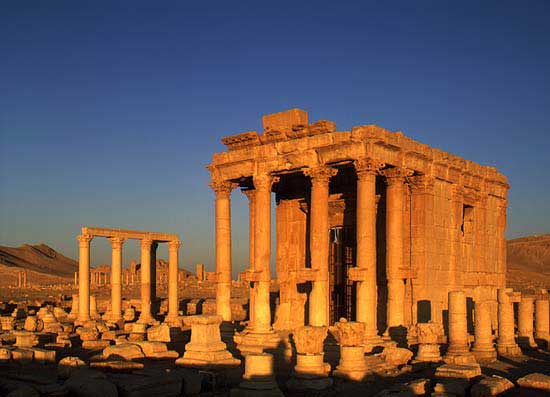
Temple of Baal in Shamin Syria

Having preached Sunday on King Josiah’s renewal of God’s covenant in 2 Kings 22, I am fascinated with his reforms afterwards. According to the book of 2 Kings, Josiah was one of the few kings who followed in the path of God. Despite being raised in a palace where the fertility idols of Asherah and Baal were preferred, Josiah placed his trust in the God of Abraham, Isaac, Jacob and David. And when he heard the Book of the Law for the first time, he became zealous to reform the religion of Jerusalem and surrounding Judah.

First he cleaned out the temple of Solomon, the house of the Lord, removing all the foreign idols (2 Kings 23:4). He burned them outside of Jerusalem and scattered their ashes on public graves, which desecrated these ancient cultic objects. He marched out into the countryside to destroy the “high places” or non-Temple worship sites. He also expelled any foreign priests.

Such “zealous” action may sound excessive to our tolerant ears. Living in our pluralistic culture, we may read such harsh actions as bigotry and intolerance. Yet Josiah and the people of Judah had been given a very specific mission from God: to trust in the Lord God alone. Without this radical obedience their mission could easily be diluted into cultural irrelevance by the neighboring nations. No one would be following God’s covenant. Still, I doubt that we are called to burn or destroy the temples of other religions today. Such a brutal attack would not be honoring Jesus command to love our neighbor (Matt 22:39).

There is a second part to Josiah’s reforms that speaks more directly to our day and culture. It was a revitalization of worship towards the Lord God. He reintroduced the celebration of Passover in Jerusalem, a celebration of God’s victory in releasing the Hebrew slaves in Egypt. (2 Kings 23:21-23). The same holds true today. As Christians we need to more completely understand and celebrate our heritage as God’s people. The narrative lectionary has helped our congregation rediscover some of the Vibrant Life of Faith that can be found in the Old Testament. We don’t need to burn “high places,” but we can certainly burn with the light of faith in God. Our light can beckon our neighbor to a Vibrant Life of Faith in Christ.

How do you bear witness to faith in God in our pluralistic society?

Lord Jesus, may I be faithful as you are faithful.