Category Archives: story

A Thanksgiving Story

Thanksgiving seems like an odd holiday to me. After all shouldn’t we be thankful every day? Why give this virtue a special holiday? We don’t set aside a holiday for patience, joy, peace, kindness or hope. (We might consider Valentine’s Day as the special “love” day, but that is a blog unto itself). Still a thanksgiving story seems appropriate.

In the 1930s, George Strester remembers his father who tried farming in Nebraska in 1873. Thanksgiving was approaching and the family had a tough harvest due to the dry and dusty summer. They wanted to give thanks, but the pantry was nearly bare, so George’s father decided to butcher the cow. It had become nice and fat from eating a variety of vegetables, including some rotten onions, but had gone dry and was not giving any milk.

The children all shed a few tears when Old Broach the cow was killed, for she was a family pet, but the family needed to have something to eat. The cow was butchered the day before Thanksgiving and the next day George’s mother planned a real Thanksgiving feast. — a large roast of meat with potatoes and carrots lay around it. Something the family had not had for years.

However a peculiar odor filled the house as the meal was cooking. Mother said it might have been something on the stove, which now was causing the terrible odor. The table was set and the roast was brought out and how delicious it looked. George’s father first gave a prayer of deep thanks for the many blessing that the family had enjoyed and then he carved the roast, placing a liberal helping of meat, carrots and spuds on each plate. George’s mother took a bite and looked at her husband; he took a taste and looked at the kids.

George took a mouthful and his stomach heaved, – horror of horrors, the taste of rotten onions had permeated every piece of beef. Their cow had not simply fattened up on vegetables, but on rotten onions. Their entire dinner was spoiled and all they had to eat were johnnycakes with nothing to put on them.

Still George observed that though his father was greatly tempted, he did not say any cuss words, but decided on that day, to quit farming and reaffirm his vocation as a Methodist minister.

The Strester family took a moment that could be called a family disaster and turned it into a memory of laughter and joy. It was also turning point in their lives. Their father rediscovered his calling and the family was able to adapt to the changes.

God takes our crisis points, small or large, and turns them into his moments of joy and thanksgiving.

Lord Jesus, thank you for your gifts of grace, love and joy.  Create within me a thankful everyday.
Honoring Our Elders

I am in the sandwich phase of life. Though my children need me less each day, my mother’s care continues to grow.   I recently wrote a post about her fall and hip surgery: 86 and Laughing.  Her recovery continues and hopefully she will return to her apartment soon.

I sometimes wish my mother had made some long-range decisions before her dementia restricted her choices. She had always wanted to die at home in her own bed, but living alone became less and less an option as her dementia grew. My siblings are scattered from Atlanta to Kodiak, Alaska, and we knew we had to do something but no clear choice arose. We talked to Mom about moving, but she resisted any conversation on the topic. Her local neighbors and friends in Washington State kept telling us she should not be living alone. But anytime we suggested a home health care aide, she adamantly refused. Mom knew she was losing control but did not want some stranger to enter her home. Who can blame her?

My siblings and l wrestled with the fourth commandment: Honor your father and mother. What did honoring meaning in this situation? How do we love mom and make her final years happy, significant ones? There was no simple solution.

Finally in the summer of 2010, my sister  flew with mom to Minnesota for an extended visit. We had Mom visited a gerontologist, lawyer and financial planner. After three months in our home, my wife and I found a memory-care assisted-living apartment in Woodbury, near Resurrection Lutheran Church. With considerable reluctance my mom moved in and began the adjustment. We hung her family pictures on the wall, and made sure she had plenty of crossword puzzles to enjoy. Within a couple of weeks Stonecrest became her home.  Her recent fall and surgery may only be a temporary set-back.

I am still unsure how to honor my mom, other than to visit, pray and remind her that she is loved by all her children, grandchildren, friends relatives and God. Fortunately, she still honors me with a smile and a hug.  And I smile each time I am so honored.

Lord Jesus, thank you for the blessings of family.

Jesus and the Temple in John

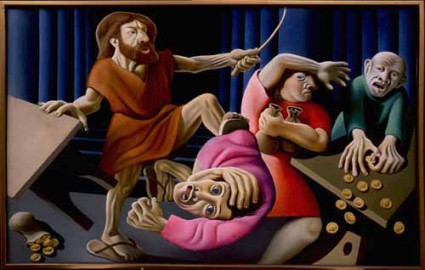
Christ Driving the Money Changers from the Temple by Michael Smithers

With my recent posts on Isaiah and the Temple in Jerusalem, I am reminded that Jesus had some harsh words about the Temple. Solomon’s temple had been destroyed in 587 BC by the Babylonians. The temple was rebuilt in 515 BC but it was not as grand as the previous temple. King Herod had started a major rebuilt of the temple prior to Jesus’ birth.

Early in John’s Gospel, Jesus had a confrontation with the Temple leaders. After driving the money changers from the courtyard with a whip, he was asked, “What sign can you show us for doing this?”

Jesus answered them, “Destroy this temple, and in three days I will raise it up.” The Jews then said, “This temple has been under construction for forty-six years, and will you raise it up in three days?” But he was speaking of the temple of his body.  (John 2:19-21)

Jesus and the Samaritan Woman by He Qi

Later in the gospel, Jesus had a conversation with a Samaritan woman regarding the proper place of worship. Samaritans worshipped on Mt. Gerizim while Jews claimed Mount Zion as the one true place to honor God. Jesus responded,

“Woman, believe me, the hour is coming when you will worship the Father neither on this mountain nor in Jerusalem. The hour is coming, and is now here, when the true worshipers will worship the Father in spirit and truth, for the Father seeks such as these to worship him. God is spirit, and those who worship him must worship in spirit and truth.” (John 4:21-24)

Jesus redirected our understanding of worship away from rituals and places to the essence of worship, a transformed heart or spirit. When our spirit aligns with God’s Spirit worship becomes true and real.

Finally in John’s Gospel, after Jesus’ crucifixion and resurrection, he appeared to the disciples in the locked upper room. Clearly this is not the Temple. But Jesus breathed on them and said to them, “Receive the Holy Spirit.” (John 20:22) The Spirit of God no longer resided in a building of stone, but in gathered human community. You are God’s Temple now. The temple of God has become the portable tabernacle again. Anyone have a tent?

Lord Jesus, send your Holy Spirit into my life today! Transform me into one who worships you in spirit and in truth.

Mountain Voices

Elijah, in a spiritual funk, ran away from Queen Jezebel to the mountain of God. Called Horeb by the northern tribes of Israel, it is the same mountain where Moses received the 10 commandments and saw the back side of God (Exodus 33). Moses had hid in a cleft in the rock when God passed by and scholars think it was this cleft or cave to which Elijah ran.  In this high place God was sure to meet him (I Kings 19).

Israel is a hilly country, with deep valley and high craggy peaks. The high places were often used for worship, whether for idols or for the Lord. Solomon’s Temple was built on Mt. Zion. Elijah confronted the priest of Baal on Mt. Carmel. Jesus preached his sermon on the mount (Matthew 5).  The most significant high place was a hill outside Jerusalem when Jesus was crucified.

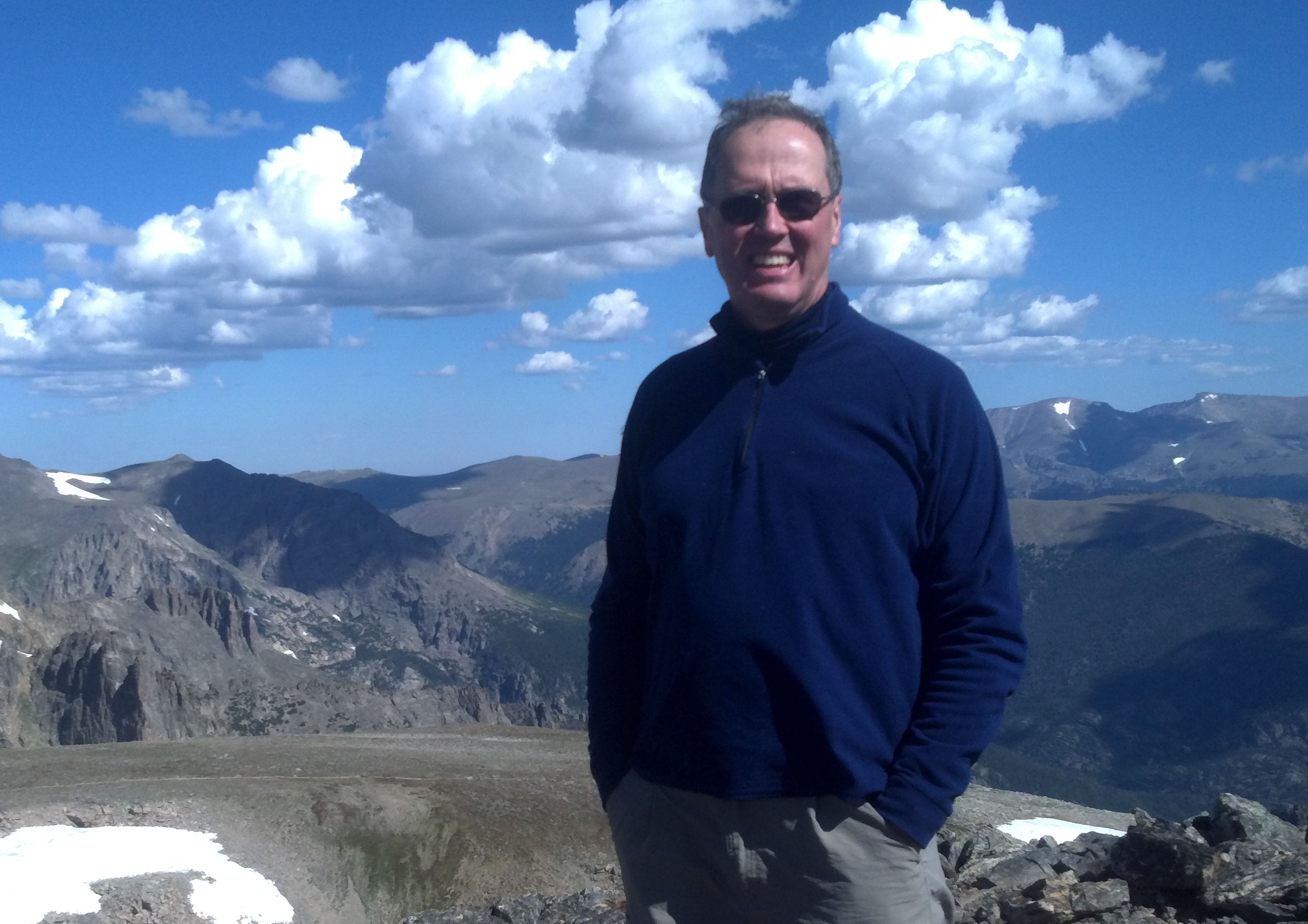
Atop Hallett Peak in RMNP

Mountains have always been associated with holiness and transcendence. They reach towards the heavens and can give a person a unique perspective on the world. I have been drawn to mountain peaks since boyhood, looking up at either Mt. Angeles or Mt. Rainier. Last summer I climbed Hallett Peak in Colorado as a kind of spiritual exercise in prayer.

But as Elijah discovered, God is not restricted to mountain peaks. Though Elijah experienced a dramatic sequence of wind, earthquake and fire, God was not in the dramatic. It was in the sheer silence that followed where Elijah heard God speak. This silence can be found anywhere, in the deepest valley as well as the loftiest peak. We seek a holy space where the ears of our souls yearn for simple assuring voice of God. And “voice” may not be the right word, more like presence, peace, hope, like a mother’s calm shush that ease’s a baby cries. As a child of God, I still yearn for that quiet, assuring voice of God’s grace.

God’s “voice” gives us the assurance to carry on the journey. Elijah did not stay on the mountain, but turned around and went back to face Queen Jezebel. More on that tomorrow.

Lord Jesus, quiet my noisy life that I may hear your loving voice.

Heavenly Reststop

On Sunday Resurrection Lutheran will engage the story of Elijah the prophet. Elijah lived about seventy-five years after the death of King Solomon or about 850 BC. He spoke against King Ahab and Queen Jezebel and their re-introduction of Baal worship and human sacrifice (I Kings 16:34). Elijah’s story is a roller coaster of spiritual and emotional energy.  I Kings 18 contains the story of Elijah’s victory over the Baal priests, calling down the fire of God on his sacrifice. I posted on it last June after re-telling the story at Vacation Bible Adventure.

Elijah in the Desert by Michael D. O'Brien

After securing this victory, one would think Elijah would be filled with supreme confidence. Instead he sank into depression when he learned that Queen Jezebel wanted him dead. He could face the 450 prophets of Baal, but not an angry queen. The instinct to escape took hold, and he ran away to the edge of the map and beyond. Beersheba is the southern edge of civilization and Elijah pushed beyond it into the wilderness. There he collapsed under a broom tree and prayed for death. Like the prophet Jonah after Nineveh’s repentance, Elijah asked the Lord to take his life. He had hit bottom, emotionally and spiritually. Exhausted he fell asleep.

At this low point, God intervened.

Suddenly an angel touched him and said to him, “Get up and eat.” He looked, and there at his head was a cake baked on hot stones, and a jar of water. He ate and drank, and lay down again. The angel of the Lord came a second time, touched him, and said, “Get up and eat, otherwise the journey will be too much for you.” He got up, and ate and drank; then he went in the strength of that food forty days and forty nights to Horeb the mount of God. (I Kings 19:5-8)

What a comforting moment, with  the angel’s touch, the warm cakes, and the jar of water. And then the cycle is repeated: rest, touch, cakes, water. It was if Elijah needed to slow down, to stop and rest.

Perhaps that is the intent for us as the reader. To stop and rest in this story for a moment. Are you able at this moment to simply rest in God’s grace and love?

You have made us for yourself, oh Lord, and our hearts are restless until we rest in you. Augustine.

Lord Jesus, teach me to rest in you.

The Riddle of King David

King David’s life is a complex riddle that defies easy classification. He was the greatest king of Israel, yet he and his family abused their royal authority. He was a friend of God yet capable of great sin.  In the book of II Samuel (during David’s reign as king) there are seven murders, ten executions, twelve rapes, and a suicide. Yet in spite of this personal violence, God’s presence and power permeates the book.

A clear example is after King David has raped Bathsheba and killed her husband, the warrior Uriah (II Samuel 11). At first, David seemed able to cover up his crimes and to carry on business as usual. Then in II Samuel 12:1-2

But the thing David had done displeased the Lord, and the Lord sent Nathan to David.

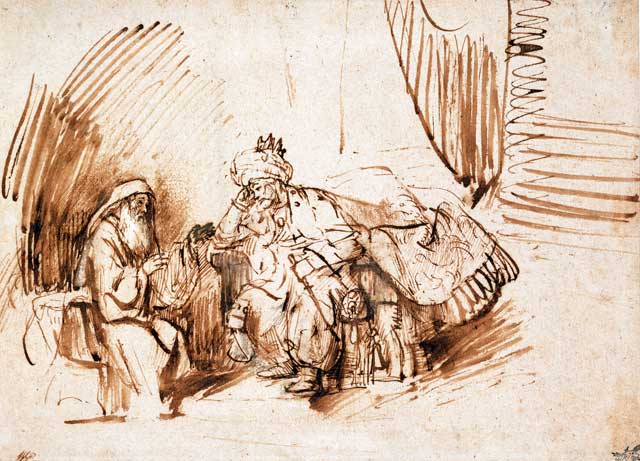
Nathan was the court prophet, one who spoke for God.  Nathan told David a parable in which a rich man with many sheep steals the only ewe lamb of a poor neighbor so that the rich man can prepare a meal for a guest. Hearing the story, David became angry against the rich man and said to Nathan, “As the Lord lives, the man who has done this deserves to die!”

Nathan said to David, “You are the man!”

Thus says the Lord, the God of Israel: I anointed you king over Israel, and I rescued you from the hand of Saul; I gave you your master’s house, and your master’s wives into your bosom, and gave you the house of Israel and of Judah; and if that had been too little, I would have added as much more. Why have you despised the word of the Lord, to do what is evil in his sight? You have struck down Uriah the Hittite with the sword, and have taken his wife to be your wife. (II Samuel 12:7-9)

David’s only response was simple and direct: “I have sinned against the Lord.” No excuses. David had abused his power.

David deserved death, yet God was merciful with him. We may not be as blatant in our abuse of power or authority, yet each of us has sinned against the Lord. We have not loved the Lord God with all our heart, mind and strength. We have not loved our neighbor as ourselves. Do we recognize our need for God’s mercy and forgiveness?  Are we not a riddle in our own behavior?

Lord Jesus, have mercy on me.

Heroic Flaws

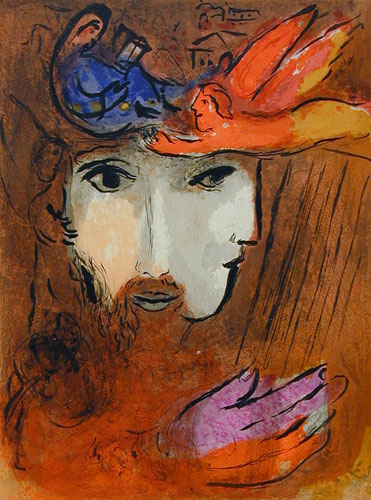
David and Bathsheba by artist Marc Chagall

King David is one of the truly great Biblical heroes.  He unified the twelve tribes of Israel, conquered the once dominate Philistines, expanded the borders and established Jerusalem as the nation’s capital. He also had a deep abiding loyalty to God that he expressed in song and dance. One of my favorite stories is how he brought the forgotten ark of the covenant (the holy box which contained the Moses’ stone tablets) to Jerusalem. As they brought the ark up into the city, “David danced before the Lord with all his might; David was girded with only a loincloth.” (2 Samuel 5:14).  His wife Michal was scandalized by his behavior, but he refused to stop.

David was the heroic leader, the model by which all future kings of Israel and Judah were judged. At the time of Jesus, one thousand years after David’s death, the people still yearned for a new “King David” to arise.  Many hoped Jesus would be that new king. As he entered Jerusalem the people shouted, “Hosanna to the Son of David!” Matthew 21:9.

Yet David had real human frailties, especially as a father and husband. He seduced his neighbor’s wife Bathsheba and then had her husband killed (2 Samuel 11). David’s son Ammon rapes his half-sister Tamar, but David refuse to punish him. So Absalom, Tamar’s brother, avenges her death by killing Ammon. He fled to a neighboring kingdom but eventually returns, only to lead a rebellion against his father, a rebellion that nearly succeeded (2 Samuel 13-17). David’s household was a real mess.

The contrast between David as King and David as husband/dad is so striking, yet true to life. God works through flawed individuals. When we read the stories of Abraham, Jacob, Moses, and David, we discover that they all stumbled in their relationship with God and others. Yet God’s grace was sufficient; God’s power was made manifest in spite of their weaknesses.

If God’s Spirit can work through such flawed, broken human beings like David, God can certainly work through flawed, broken people like you and me. Maybe we just need to dance a bit more?

Lord Jesus, forgive me my sins of doubt and mistrust. Use me for your purposes today.

You Are In the Story

A big question for many Bible readers is “Where do I fit in?” The Bible feels like ancient history about long-dead people. In Deuteronomy chapter five, Moses spoke to this concern. The people of Israel were about to enter the Promised Land after wandering in the wilderness for 40 years. The generation that had experienced the exodus of Egypt had died; a new generation had been born during the wilderness journey. The new generation had heard the stories of the Exodus, Mt. Sinai (also called Mt. Horeb), the Ten Commandments, and Moses, but they did not directly experience these events. Or did they?

Moses spoke to the new generation regarding this:

The Lord our God made a covenant with us at Horeb. Not with our ancestors did the Lord make this covenant, but with us, who are all of us here alive today. The Lord spoke with you face to face at the mountain, out of the fire. (At that time I was standing between the Lord and you to declare to you the words of the Lord; for you were afraid because of the fire and did not go up the mountain.) And he said: I am the Lord your God, who brought you out of the land of Egypt, out of the house of slavery; you shall have no other gods before me. (Deut 5:2-7)

Please note that second sentence, Not with our ancestors did the Lord make this covenant, but with us, who are all of us here alive today. Moses made the audacious claim that the covenant at Mt. Horeb (Mt. Sinai) was for us alive today. God’s covenant includes YOU and ME. This is not some ancient story, but an ongoing relationship with God.

This is critical reason for walking through the whole story of scripture. It is our story, our identity, our connection to God, the creator and savior. We are the ones who are in danger of making false gods. We are the ones who forget the gift of Sabbath or dishonor our parents. The Ten Commandments address us today. Do we have ears to hear?

Which stories in the Bible have become YOUR story? Which stories challenge or pull you in?

Lord Jesus, speak your Word that it may become my word of life.

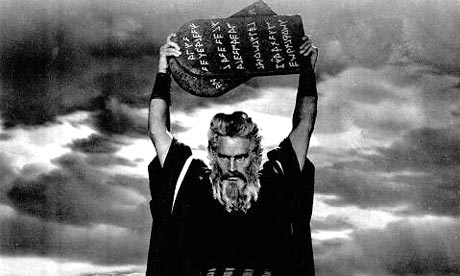
Mountain Man Moses

I am convinced Moses must have been a trained mountain runner. Though raised on the plains of Egypt, he was constantly moving up and down mountains as if they had escalators. First he had to approach the burning bush on Mt. Sinai where he was commanded to take off his sandals because it was holy ground. God never commanded him to put them back on, so he was probably the first barefoot trail runner as well.

Then at the age of 80, he was commanded to clean his clothes and then to climb Mt. Sinai. (Exodus 19:18-20). Of course Moses’ clean clothes were immediately covered in soot and smoke from the mountain’s eruption, but I am sure Moses brought a dry-cleaning receipt in case God asked. As soon as he reached the top, even before he caught his breath or posed for pictures, the Lord said to Moses, “Go down and warn the people not to break through and sneek a peak at ME.” As if the volcanic eruptions, smoke and lightening were not a sufficient barrier.  Moses, between deep panting breaths, reminded God, “God, you already told them that before I started up here.” God responded, “Yes, but you forgot to bring Aaron and remind the people not to try and peek under the curtain.” Somehow, when Moses reached the bottom he forgot about Aaron or even a chisel, since God had to write on two tablets of stone with his own finger when Moses climbed back up (Exodus 31:18).  Maybe Aaron carried the family chisel.

Meanwhile the Israelites got bored (like middle schoolers in worship) and built a golden calf to worship. A golden calf was so much more manageable than a ferocious storm cloud hovering over your head. God sent Moses down to break up the party (Exodus 32:7).  Moses, hot and tired, broke the tablets; repeated change of altitude can do strange things to a person. Afterwards, Moses climbed back up to apologize (not sure if he had time to clean clothes before this climb).

Finally Moses biggest mountaineering challenge arrived. He was commanded to cut two tablets of stone and to bring them up to the top of Mt. Sinai. There is no mention of a North Face rucksack or REI backpack. This time Moses had to write on the tablets; he must have remembered his chisel (Exodus 34: 1, 28).

The stories of the Bible are filled with such strange, wonderful examples of exaggerated humor and insight. Sometime in our serious study, we miss the humor that also challenges us. Moses was the mediator, negotiating the God’s covenant with the people, a very difficult task yet that covenant is still in effect. I rejoice that Moses could climb the mountain and make it back down.

What stories in the Bible challenge your sense of humor as well as your life?

Lord Jesus, teach me to laugh as well as to learn.

What If They Voted?

The Exodus is the identifying story of the Old Testament. The Israelites had been living in Egypt for more than 400 years but their once privilege status had collapsed into brutal slavery. They cried out to God for rescue and God responded. God called Moses to confront Pharaoh and to lead the people back to their promised land in Palestine. God directed ten plagues to beat Pharaoh down and finally, after the death of his own son, Pharaoh released the Israelites from his service.

Pharaoh, however, quickly changed his mind. He and his army pursued the escapees. The Israelites were camped by the Red Sea when they spot Pharaoh’s mighty chariots approaching. Great fear consumed the Israelites as they cried out to Moses,

Was it because there were no grave in Egypt that you have taken us away to die in the wilderness? What have you done to us, bringing us out of Egypt? Is this not the very thing we told you in Egypt, “Let us alone and let us serve the Egyptians” (Exodus 14:12).

I am guessing that if a vote was taken that day, the overwhelming majority of Israelites would have voted to return to Egypt. Their fear overruled their faith. The story of the Exodus would have been blown away on the desert winds. Has such fear attacked your heart?

No vote was taken. Instead Moses, God’s chosen leader, declared,

Do not be afraid, stand firm, and see the deliverance that the Lord will accomplish for you today. The Lord will fight for you, and you have only to keep still” (Exodus 14:13).

Song of Miriam by artist He Qi

Instead of a vote, God gave a promise through Moses. The people listen. God sent a strong east wind that drove back the chaotic sea and turned the water into dry land. The people crossed safely. When Pharaoh’s army tried to cross, “God tossed the Egyptians into the sea” (Exodus 14:27). Miriam sang a victory song.

Today our world may seem overwhelming and chaotic, instilling fear in us. We may fear financial or relational chaos; we may be too frightened to move forward in our life. Yet God’s promise stands today. The Lord will fight for you! God has not abandoned His people, only tested us to see if we will trust Him as God guides us into God’s  future.

How is fear holding you back from accomplishing God’s will?

Lord Jesus, your kingdom come, your will be done.