Category Archives: trust

What If They Voted?

The Exodus is the identifying story of the Old Testament. The Israelites had been living in Egypt for more than 400 years but their once privilege status had collapsed into brutal slavery. They cried out to God for rescue and God responded. God called Moses to confront Pharaoh and to lead the people back to their promised land in Palestine. God directed ten plagues to beat Pharaoh down and finally, after the death of his own son, Pharaoh released the Israelites from his service.

Pharaoh, however, quickly changed his mind. He and his army pursued the escapees. The Israelites were camped by the Red Sea when they spot Pharaoh’s mighty chariots approaching. Great fear consumed the Israelites as they cried out to Moses,

Was it because there were no grave in Egypt that you have taken us away to die in the wilderness? What have you done to us, bringing us out of Egypt? Is this not the very thing we told you in Egypt, “Let us alone and let us serve the Egyptians” (Exodus 14:12).

I am guessing that if a vote was taken that day, the overwhelming majority of Israelites would have voted to return to Egypt. Their fear overruled their faith. The story of the Exodus would have been blown away on the desert winds. Has such fear attacked your heart?

No vote was taken. Instead Moses, God’s chosen leader, declared,

Do not be afraid, stand firm, and see the deliverance that the Lord will accomplish for you today. The Lord will fight for you, and you have only to keep still” (Exodus 14:13).

Song of Miriam by artist He Qi

Instead of a vote, God gave a promise through Moses. The people listen. God sent a strong east wind that drove back the chaotic sea and turned the water into dry land. The people crossed safely. When Pharaoh’s army tried to cross, “God tossed the Egyptians into the sea” (Exodus 14:27). Miriam sang a victory song.

Today our world may seem overwhelming and chaotic, instilling fear in us. We may fear financial or relational chaos; we may be too frightened to move forward in our life. Yet God’s promise stands today. The Lord will fight for you! God has not abandoned His people, only tested us to see if we will trust Him as God guides us into God’s  future.

How is fear holding you back from accomplishing God’s will?

Lord Jesus, your kingdom come, your will be done.

Grumbles and Grains

Shortly after I turned 50 a friend sent me an article written by Garrison Keillor. It was titled:

Stop Complaining.

When you hit 50, you have to stop complaining about getting old, the strangeness of it, the fascination, the horror, etc., etc. That was okay in your 30s and 40s, but now that you’re old, it’s time to shut up on the subject. You shouldn’t complain about aging for the simple reason that nobody gives a hoot. If you were to pay people to care, they might care a little bit for an hour or two, but you didn’t and they don’t. So learn to be cheerful about it. When people ask you how you are, tell them, “Absolutely great. Never better.” (from 50 Things to Do When You Turn 50) 

I thought about Garrison’s advice as I read parts of Exodus. The Israelites are set free from Egypt but they immediately start to complain and grumble. First they don’t have sufficient water to drink (Exodus 15:24). Then they don’t have enough food.

The whole company of Israel complained against Moses and Aaron there in the wilderness. The Israelites said, “Why didn’t God let us die in comfort in Egypt where we had lamb stew and all the bread we could eat? You’ve brought us out into this wilderness to starve us to death, the whole company of Israel!” (Exodus 16:2-3).

We humans seem to have this wonderful ability to compare our present situation to some “idealized past” and think we have some right to complain about it. The Israelites practiced selective memory, remembering the sufficient food of Egypt, while forgetting the suffering and hard labor they experience as slaves. So they grumbled to Moses.

Does a grumbling spirit ever take hold in your mind?

The Lord God was quick to answer. The Lord said to Moses, “I am going to rain bread from heaven for you.” (Exodus 16:4). God provided manna for the Israelites throughout their 40 year journey in the wilderness. Manna was a temporary solution until they arrived in the promised land which flowed with milk and honey. It was also a test by which to see if they could give up their complaining and trust in God’s provision.

Have you learned to stop complaining and to trust in God’s blessing?

Lord Jesus, give us this day our daily bread.

Seeking Sarah’s Tomb

The Narrative Lectionary that Resurrection Lutheran Church is using this year skips through the Old Testament at a fast pace. This coming Sunday we will be studying Joseph and his Amazing Technicolor Dreamcoat. But before I shift our focus to Joseph and Egypt, I want to examine one final story of Abraham. In Genesis 23, Abraham’s beloved wife Sarah dies and he must find her a tomb.

When God first called Abraham, God promised him land and descendants. When Abraham arrived in Canaan, the Lord said to him, “To your offspring I will give this land” (Genesis 12:7). His descendants will be as many as the stars of sky.  Yet as Abraham nears death, he has only one son and no land. Is God’s promise ever to be reality? Have you, like Abraham, ever wondered if God’s promises would become reality for you?

After Sarah’s death, Abraham goes to the Hittites who own the surrounding land and says, “I am a stranger and an alien residing among you; give me property among you for a burying-place, so that I may bury my dead.” (Genesis 23:4). The Hittites recognize Abraham as a great man and are willing to give him a burial site for his wife. But Abraham does not want a “gift” or “honorary guest” burial site; he wants to own the burial site with proper title. He wants something permanent and legal that can be passed on to future generation.

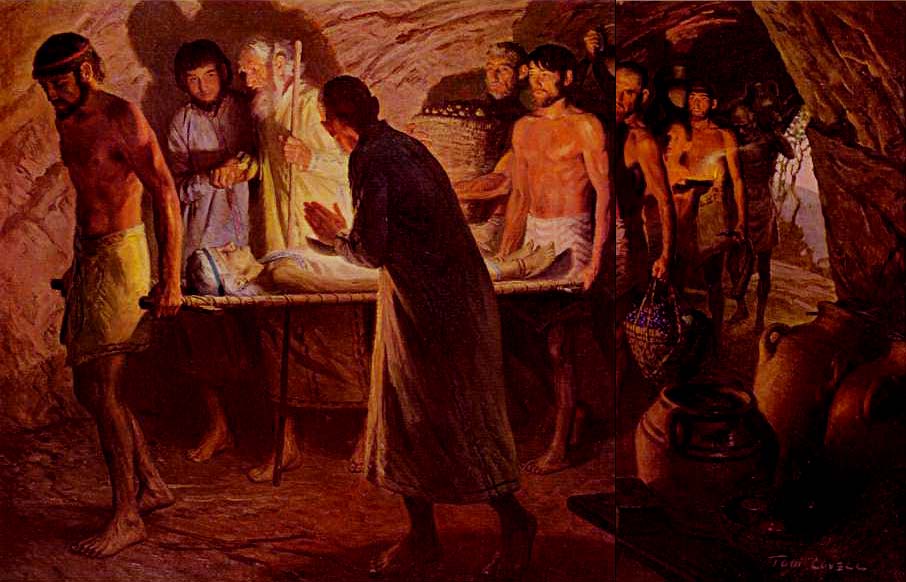
Abraham is willing to pay top dollar for it. (A stewardship sermon is buried in that verse!)  After skillful negotiation, he purchases the small field of Ephron in Machpelah where he buries his wife in a cave in the field (Genesis 23:15-19). Years later Abraham is buried there as well.

At first, a burial plot may seem like a useless, pathetic fulfillment of God’s great promise to Abraham and Sarah. Is this all the land God can give?  Yet it is the first step in God’s patient, enduring plan of salvation. It becomes a sign of hope and possibility.

After all, as Christians, we remember that God’s plan of restoration culminated in the empty burial tomb of Jesus on Easter Sunday. Jesus’ empty tomb is the first step, the first fruits, of a new heaven and a new earth.

 Christ has been raised from the dead, the first fruits of those who have died (I Corinthians 15:20).

In what ways does God give you hope in difficult times?

Lord Jesus, you are my rock and shield, give me the hope I need this day.

Blessed or Blessing?

Abraham and Sarah celebrate Isaac's birth

What an incredibly simple start.  After the mess of Genesis 3-11, God finds the best solution: an elderly childless couple! Abraham and Sarah become the start of God’s rescue plan for creation. They are blessed in order to be a blessing to others.

God said, “I will make you a great nation, and I will bless you and make your name great, so that you will be a blessing.” Genesis 12:2

God promised a son to Abraham and Sarah. They wait, and wait, and wait, and wait. They try their own shortcut and fail. But eventually their son Isaac is born. Eventually after centuries of waiting his offspring will be Jesus, the truest blessing for all.

We so often seek blessing only for ourselves. But God showers us with generous blessings, so that we can be blessings to others.

How have you been a blessing to others?

Lord Jesus, make me into a blessing for others today.

From Absurd to Obedient

Peace like a River in Colorado

I am on vacation this week, seeking rest and renewal.  I prepared this post before I left, but it contains my hope for this time away.

Wayne Muller, in his book Sabbath, writes about Henri Nouwen.

Henri Nouwn was a dear friend of mine, a brother, priest, mentor.   He was also a fiercely astute observer of our worried, overfilled lives.  Henri insisted that the noise of our lives made us deaf, unable to hear when we are called, or from which direction.  Henri said our lives have become absurd — because in the word absurd we find the Latin word surdus, which means deaf.  In our spiritual lives we need to listen to God who constantly speaks but whom we seldom hear in our hurried deafness.

On the other hand, Henri was fond of reminding me that the word obedient comes from the Latin word audire, which means “to listen.” Henri believed that a spiritual life was a pilgrimage from absurdity to obedience — from deafness to listening.  If we surrender fully into Sabbath time, we can slowly move from a life so filled with noisy worries that we are deaf to the gifts and blessings of our life, to a life in which we can listen to God, Jesus, all the Buddhas and saints and sages and messengers who seek to guide and teach us.

The world seduces us with an artificial urgency that requires us to respond without listening to what is most deeply true.  In Sabbath time, we cultivate a sense of eternity where we truly rest, and feel how all things can wait, and turn them gently in the hand until we feel their shape, and know the truth of them.

The theology of progress forces us to act before we are ready. We speak before we know what to say. We respond before we feel the truth of what we know.  In the process, we inadvertently create suffering, heaping imprecision upon inaccuracy, until we are all buried und a mountain of misperception.  But Sabbath says, Be still. Stop.  There is no rush to get to the end, because we are never finished.  Take time to rest, and eat, and drink, and be refreshed.  And in the gentle rhythm of that refreshment, listen to the sound the heart makes as it speaks the quiet truth of what is needed. (p.85)

Lord Jesus, teach me to listen.

Facing the Monsters of Our Life

A Teaching Story from R. Wayne Willis.

There’s an old Egyptian story about a little boy named Miobi who came to a village where the people were very strange. They did little more than moan and groan about almost everything. The fires didn’t get lit, the goats didn’t get milked, the children didn’t get clothed, and the crops didn’t get planted, all because the villagers were expecting any time to get eaten by the monster that lived on top of the mountain.

Miobi looked up, and behold — the monster was real. He had a head like a crocodile and a body like a hippopotamus and a tail like a very fat snake. Smoke and fire came from his nostrils. The villagers lived in dread that any day the monster might come down and devour them.

Miobi said to the villagers, “I will go up the mountain by myself and challenge the monster.” The villagers pleaded with him not to go, sure that he would never return. Miobi began to climb the mountain, and as he climbed higher and higher and got nearer and nearer, the monster looked smaller and smaller. “This is a very curious phenomenon indeed,” thought Miobi. “When I run away from the monster, the monster gets larger, but the nearer I get to it, the smaller it becomes.”

When at last Miobi reached the cave, instead of a gigantic monster, he found a quiet little creature about the size of a toad. It purred. Miobi picked it up and put it in his pocket and headed back down the mountain.

When the villagers saw Miobi safe and sound, they wanted to make him their god for slaying the monster. Miobi explained exactly what had happened and how he had brought the “monster” back down the mountain as a pet. He showed them the little-toad like creature. “What is your name?” the villagers asked. The monster answered, “I have many names. Some call me famine, and some pestilence; some call me war, and some cancer.” Then the little creature yawned and added, “But most call me What Might Happen.”

— R. Wayne Willis in Hope Notes

How do you face “what might have been?”

“Be strong and courageous, do not be frightened or dismayed, for the Lord your God is with you wherever you go.” Joshua 1:8

Lord Jesus, give me courage to face “what ever comes” with you.

Impulsive Trust

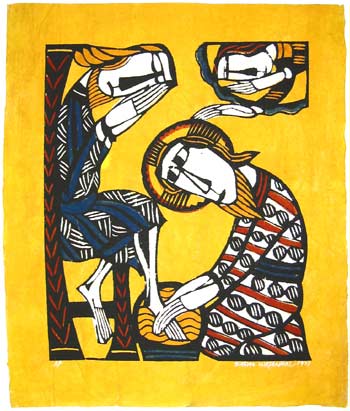
Even after preaching yesterday on Peter’s slippery stroll across the Sea of Galilee, I am still contemplating whether the story paints Peter as a model disciple or a counter-example to avoid.  Certainly Peter’s character of being impulsive is frequently mentioned in the Bible.  For example, when Jesus washed the disciples’ feet, Peter at first refused to have his feet washed, then asked to have his entire body (John 13:6-10).  Pete seemed to speak first and think later.

In the boat, I think Simon Peter blurted out his request without really taking time to think about it.  His mouth was engaged before his brain.  Jesus had given him his nickname of Cephas, which is Aramaic for Petra or Peter, which is the Greek word for “Rock.”  Rocks can be fairly dense and do not usually float.  Peter discovered this when he walked towards Jesus.  His mind caught up with his impulses and he sank.  Still he knew the author of his life, so as he sank like a rock, he called out to the Jesus, “Lord, save me.”   That impulsive cry was the right one, for Jesus lifted him out of the chaos of the sea and into the lifeboat of faith.

Peter’s impulsive behavior is something with which I can identify.  Yesterday, after outdoor worship was finished and people were greeting one another, I impulsively raised my voice and asked all to sing, “Happy Birthday” to my future daughter-in-law, Maggie Thomas, who was visiting.   Only afterwards did I stop to think whether this was something she might appreciate.   I have been known to shout, “Amen!” during a colleague’s sermon or to impulsively drag a confirmation student to help with a lesson.  Sometimes the impulses are great; other times an embarrassment.  

Shortly after his walk on the water, Jesus quizzed the disciples as to his identity.  He asked them first what the word on the street was.  The disciples responded, “Some people think you are John the Baptist returned from the dead, others think you are one of the Old Testament prophets like Jeremiah or Elijah.”  Then Jesus asked, “Who do you think I am?”  Peter responded, “You are the Christ, the Son of the Living God.” (Matt 17:13-16)  There is the model of impulsive trust that I want to follow.

Have you ever experienced an impulsive expression of faith?

Lord Jesus, rule the impulses of our hearts as well as the reflections of our minds.

Walkin’ on Water

Even Kids Like Peter's Walk

Jesus walking on the water is a familiar miracle (Matthew 14, Mark 6 and John 6).   In Matthew’s version not only Jesus walks on the waves, but Peter asks to join him.   Many Christian pastors and authors see Peter’s actions as a Christian model of what discipleship and trust means.  John Ortberg wrote a book called, If You Want to Walk on Water, You’ve Got to Get Out of the Boat.  He writes,

Deep within you lies the same faith and longing that sent Peter walking across the wind-swept Sea of Galilee towards Jesus.  In what ways is the Lord telling you, as he did Peter, “Come”?  Out on the risky water of faith, Jesus is waiting to meet you in ways that will change you forever, deepening your character and your trust in God.

I remember preaching an ordination sermon that basically said the same thing.  I preached about our need to take risks, climb out of our comfort zone and step in the liquid uncertainty of life.  But I am beginning to have second thoughts about that being the sole interpretation of the story. The great thing about scripture is its ability to call forth new insights and wisdom.

After all, Peter sinks beneath the waves and needs to be rescued by Jesus.  Peter is chastised for his doubts, not the disciples who stayed in the boat.   And when Jesus and Peter step into the boat, the wind stops and all is calm.

The ship was an ancient symbol of the church, the community of faith.  At the beginning of the story, Jesus compelled the disciples to enter the boat and head to the other side (Matthew 14:22).   At the end of the story those in the boat worshipped him, saying “Truly you are the Son of God” (Matthew 14:33).   I am beginning to wonder, “Should Peter simply have stayed in the boat?”   What do you think?

Do you think Peter’s actions are a model of discipleship or a distraction from Jesus?

Lord Jesus, thank you that you are always ready to rescue me whenever I begin to slip beneath the waves.

Asleep on a Cushion

Details in Bible stories can fun as well as insightful.  This Sunday I am preaching on Mark 4:35-41, Jesus calms a storm.  The detail that catches my eye is in verse 38. As the storm reaches a climax and begins to swamp the boat, Jesus remains asleep on a cushion in the stern of the boat. As I read this I wondered, Where did the cushion come from?  Did Galilean fishing boats carry them as standard equipment?  Or did a disciple pack a  travel pillow and loan it to Jesus?

On a more serious note is the fact that Jesus is asleep at this critical moment in the storm.  Was this a sign of his confidence in God’s care?  Or a reminder of his humanity and need for sleep? Or was he simply trusting Peter and the others to do their job as fishermen?

A core question that the story stirs in me is, “Jesus, shouldn’t you be awake so you can stir the boat around the storm?”  The ship was a Christian symbol of the church: the people of God as the ship’s crew and Jesus as our captain who guides our voyage.  And do not Christians often pray for such direction?  Do we not ask for God’s protection and guidance so that we do not have a storm to face or a crisis of faith to endure?  Whether the storm is an external crisis, like a death or financial loss, or an internal crisis, such as a broken relationship or sudden illness, do we not sometimes think Jesus could have prevented the “storm” from striking us?

Such questions can help us see the truth of the story for us, because Jesus does still the storm and then confronts the disciples regarding their lack of faith.  A storm or crisis often reveals our shallow trust and our need for Jesus as our savior. When my daughter faced open-heart surgery as an infant, I know that my prayers took on a new depth and clarity.   Without the crisis we would not call out for God’s help and then bear witness to God’s transforming power.  Jesus may be asleep for us, because we have not called out to him from the depths of our souls and asked him to transform our lives.

In what ways is Jesus’ power awake or asleep in your life?

Jesus, awaken me to the power of your love.

Go in Peace, Serve the Lord

Yesterday morning our youth mission team left for a mission trip to Lake Traverse Reservation in South Dakota.   They will be serving among the people of the Sisseton-Wahpeton Sioux tribe in both children’s programs and work projects.  I ask for your prayers as they live out our congregation’s mission statement: trust, live and serve.   They bear witness to the vibrant life of faith in Christ by their trusting in Jesus, their living in daily community with the Word of God and prayer, and by serving others. 

Launching our Mission Team for Service

We had a prayer of blessing as they prepared to leave.   As I reflect on their departure, I realize that this is a graphic illustration of what a congregation should be every week: a launching pad for ministry in the world.  This week our youth team is doing that in a very intentional way. 

I believe mission trips are vital to a congregation’s vitality.  Such trips provide opportunity for intentional reflection upon our place in God’s kingdom.  Participants  interact with people of different cultures and socio-economic backgrounds.  They discover how their unique gifts and dependable strengths can be used to help others.  And each day the team has devotions and conversation so that they can integrate their often physical experiences into their spiritual, emotional and mental lives.  Such trips can truly be life-changing.

Yet Christian service is not restricted to mission tripsWe can serve God by loving our neighbor wherever we are: in our homes, workplaces or community.  As we love our children or spouse, as we work with our staff and customers, as we visit with our neighbors, we can be God’s hands, feet, voice and heart in the world. We all can be servants of God in our daily lives.  A mission trip trains the heart and mind for such daily service.

At the end of worship each Sunday I announce. “Go in peace. Serve the Lord.”   The congregation responds, “Thanks be to God.”  I love this sending.  I just wish that some Sunday we would take time to report on how we serve the Lord this past week.  I am confident that our youth team will have some stories to share.

What helps you  to serve?

Lord Jesus, we ask you to bless and encourage the youth of Resurrection as they serve in your kingdom.