Category Archives: Uncategorized

Wilderness Journey – Day Three – Afternoon

As I continued my journey around Mummy Mountain I remained well above timberline.  I could see far down the West Creek basin, even spotting the place on a distant ridge where I had lunched two days before.
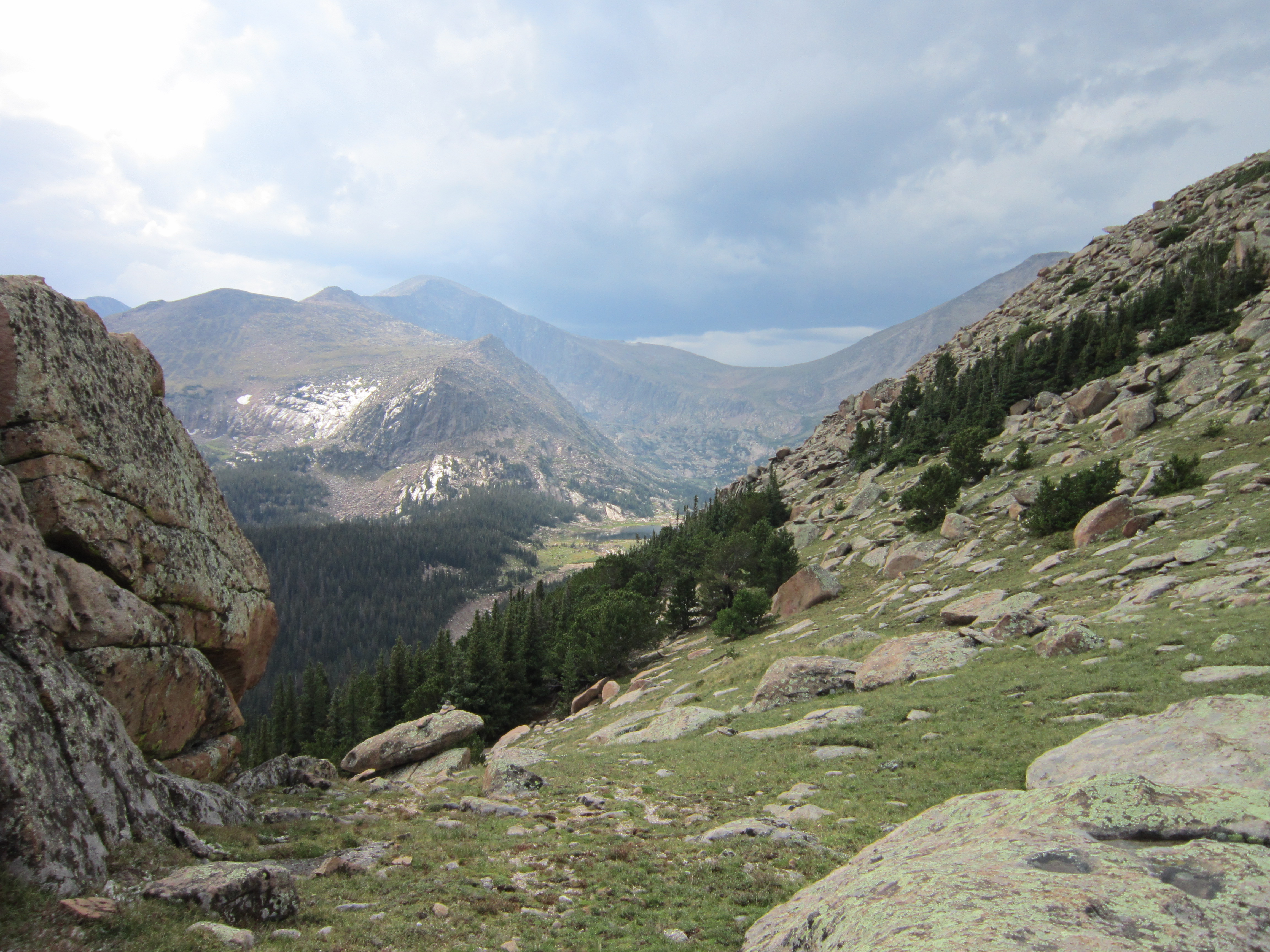
Gathering Storm Clouds

I also spotted a gathering thunderstorm to the west and I hurried my pace.

About 1:00 pm I ran into my first real challenge. The slope transitioned from a meadow to gigantic boulder field. I scrambled between boulders, always seeking a safe, secure route. This took time and energy. I slipped a few times. I also heard cracks of thunder in the distant and  felt a few  raindrops. I dropped lower on the slope, hoping to find fewer boulders. Dark clouds moved closer.  I started looking for a place to wait out the approaching storm.

Krummholz in West Creek Basin

I finally reached the open valley below the final ridge. It was free of boulder fields and had several small krummholz of alpine trees. These small dense stands of trees could give me some protection. As I looked over this isolated valley, I reveled at how beautiful it was, especially in the storm’s twilight.

My revelry was broken by the first splattering of large rain drops. I had to find shelter fast.

The thunder was louder and closer now. I headed toward a large boulder in the valley, close to a krummholz. Even though the boulder offered some protection, I realize the storm may last awhile and I needed better shelter. My problem was that I had not packed my backpack with such a need in mine. My trusty rain-tarp was at the bottom of my bag. I had to pull everything out into the rain to reach it. However, my experience of pitching a rain-tarp in wet Washington state proved helpful. In less than five minutes the rain tarp was set and my gear and I safely under it.
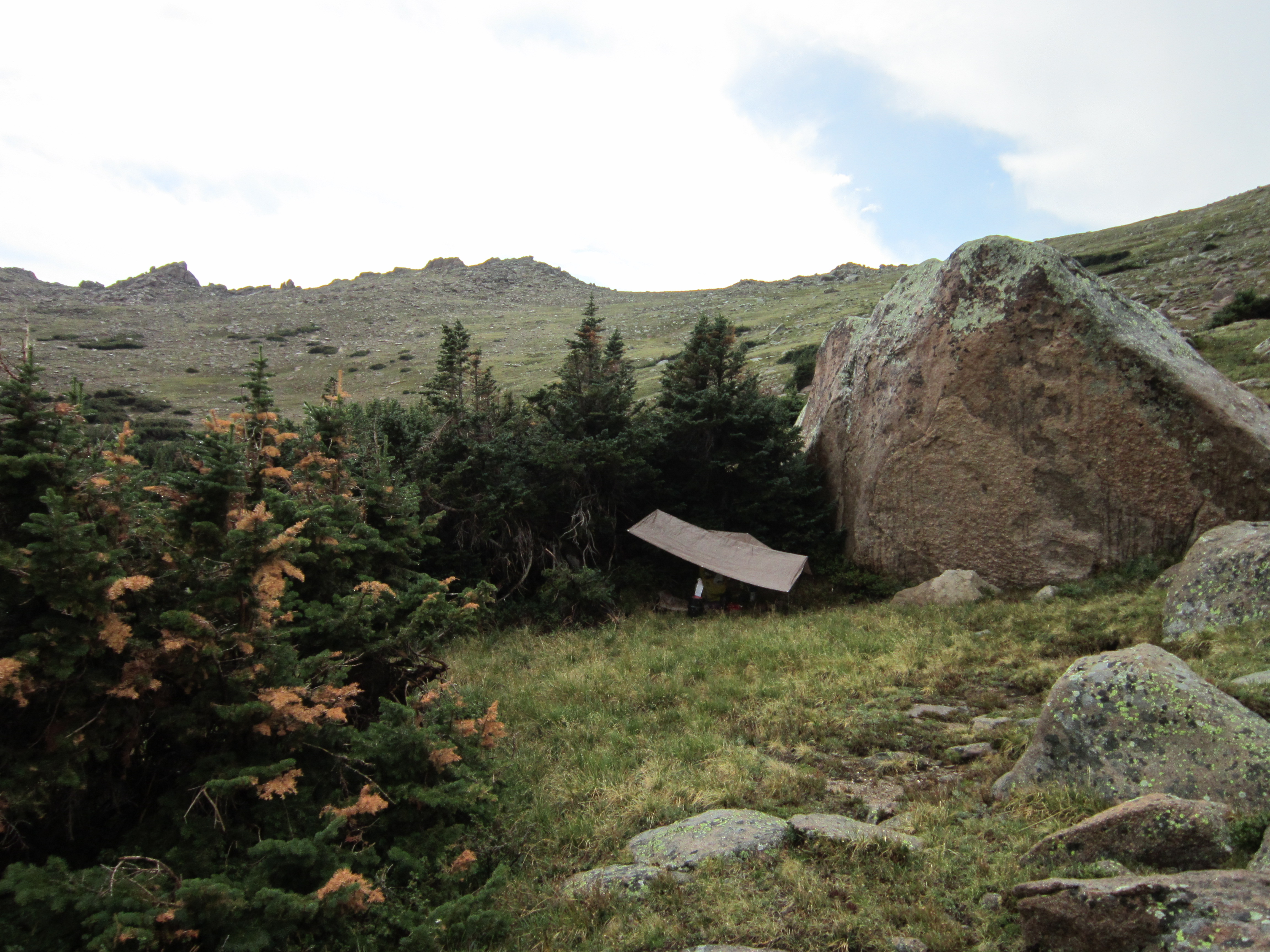
Shelter from the Storm

For the next two hours it rained, hailed, thundered and boomed. Counting the seconds between flash and thunder, the closest strike was less than a mile away. Fortunately, I was off the exposed ridge line, and away from the largest trees and boulders. I changed out of my wet clothes, fixed a cup of hot chocolate and waited. As the storm continued I wondered if I might have to spend the night here.

Just as suddenly as it started, the storm ended. The sun broke through the clouds and I again marveled at the beauty of this rain-splashed alpine meadow. I repacked my gear, this time keeping my wet rain-tarp tied to the outside of my pack for quick access.
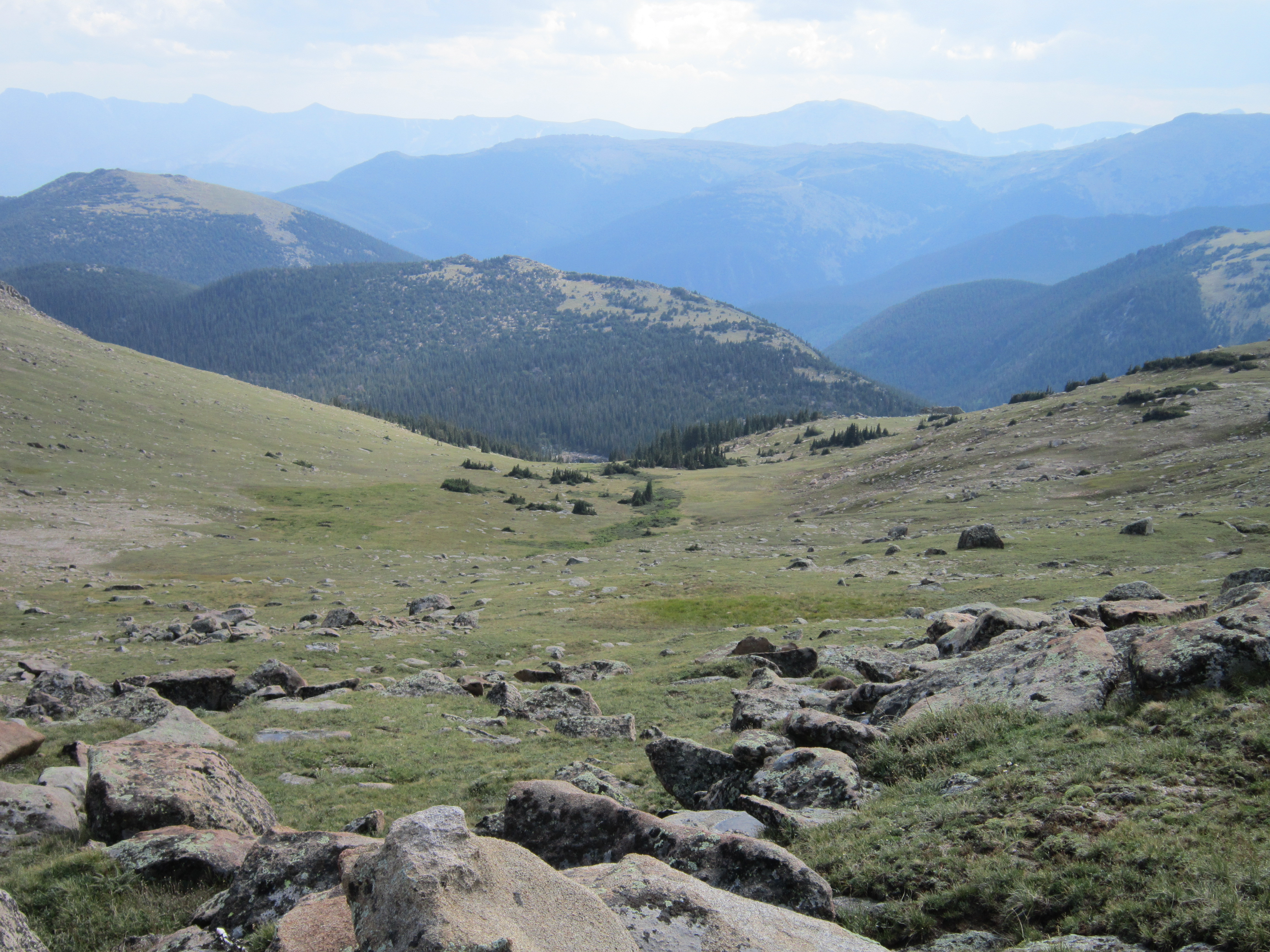
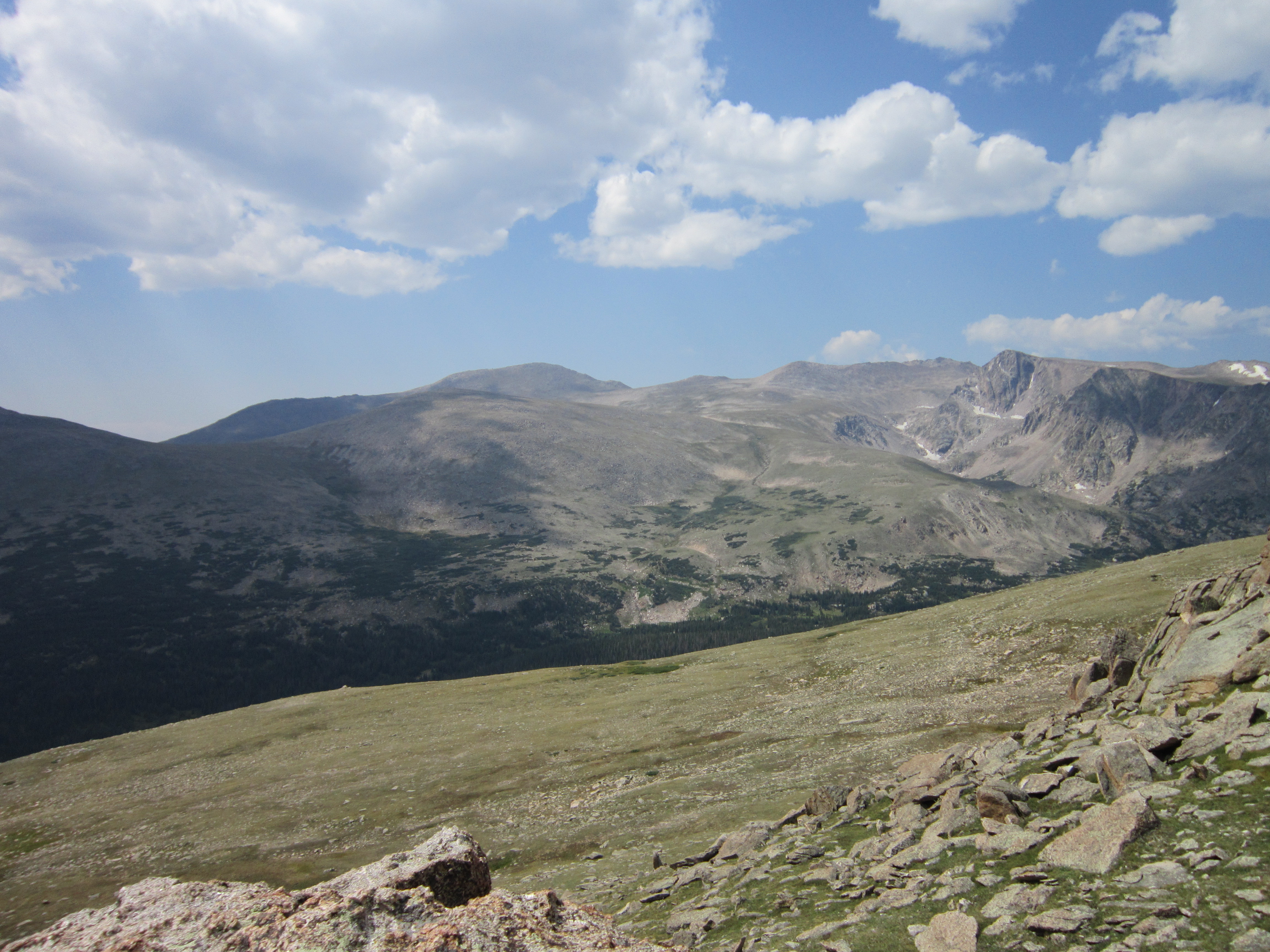
Looking south from the last Mummy Mountain ridgeI reached the final ridge shortly after 4:00 pm and crossed from the West Creek Basin into the Black Canyon. I quickly worked my way off the ridge and towards the forest below.

As I climbed down the ridge, I kept thinking about the thunder-storm and how it had humbled me.   I was not the master of this domain, but a simple wilderness wanderer.  The Israelites at Mount Sinai encountered God in a thunderstorm.

    On the third day at daybreak, there were loud claps of thunder, flashes of lightning, a thick cloud covering the mountain, and an ear-piercing trumpet blast. Everyone in the camp shuddered in fear. Moses led the people out of the camp to meet God. They stood at attention at the base of the mountain. Exodus 19:16-17

I reflected, “God is reminding me once again who is LORD!”

About halfway down, I spotted two rock cairns (small piles of stones) used to mark a way trail. Finally I had reached the improvised trail that leads directly from Black Canyon trail to Mummy Mountain. I followed it down, losing it a couple of times due to poor markings and tired legs and mind. Eventually I connected to the main Black Canyon trail and reached my campsite at Tileston Meadows about 5:15 pm, tired, but safe.

Lord Jesus, Let me never forget that you are LORD.

Wilderness Journey – Day Three – Morning

North Fork of the Big Thompson River

At dawn’s first light, I was up and on the last portion of National Park trail. I passed Lost Lake and quickly found a place to wade the North Fork of Big Thompson River (more like little Thompson creek at this altitude).

From here on, I would be off-trail, but I was above timberline and the slope was not too steep. I took my time, enjoying the unfolding view and relishing the challenge of finding my own route (which was no challenge at this point.)

By 10:00 I was on the wet plateau between Mt Dunraven and Mummy Mountain and I stopped for an early lunch.

Looking south towards Mummy Mountain

At this point I debated whether to climb Mummy Mountain, 13425 feet in elevation. It would delay me from climbing off the ridge and thus expose me to possible storms. However I figured I may never again have the opportunity to climb the peak and, like John Muir, I hungered for some mountain adventure. Just below the peak, at about 12,300 elevation, I dropped my pack near a large boulder and started hiking straight up.

Can you spot my pack?

As I climbed, I kept looking back to see where my pack was. I was glad I did, since after a while every boulder looked like another and I could have easily lost my pack.

I took my time, stopping to rest several times. The climb was challenging and I began to wonder if I might be one of the first people to climb Mummy Mountain this summer because of its isolation. Perhaps there would be climber’s log at the summit that would answer my question.

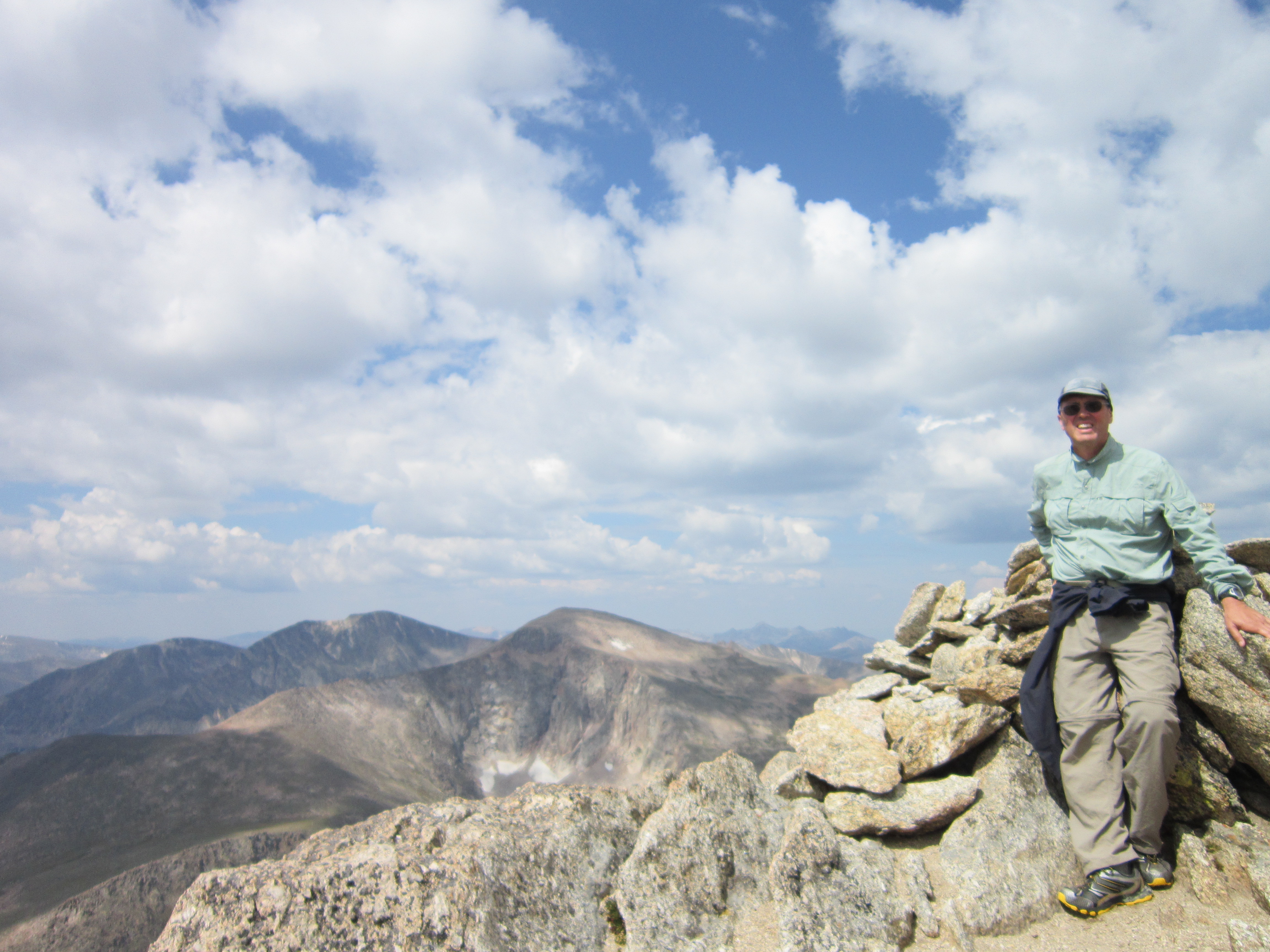
Looking West from Mummy Peak at Crystal Lake and Fairchild Mountain

At 11:10 I reached the summit. The peak has a spectacular view to the south and west. I could see Lawn Lake, Crystal Lake, the Saddle, Fairchild Mountain and even Ypsilon Mountain. I found the climber’s log in a plastic plumber’s pipe and discovered that I was the fourth climber that week! I realized that there must be an established route (directly up the ridgeline from the southeast?) and that I might be able to use a portion of it later on.

My pack remained a thousand feet below me so I decided to continue my original plan: to contour around Mummy Mountain, remaining in the West Creek basin until I came to the ridge above Tileston Meadow’s. The ridge was at 11,750 feet so I figured I could gradually lose some elevation as I hiked around the mountain side. I scrambled back to my pack and continued on.

The terrain remained mostly meadow with many large boulders. Occasionally I encountered large clumps of boulders that I had to go over or around. I generally chose to go around, dropping to a lower elevation.

Contemplating which path to take

As I picked my way along the slope, I reflected on what a seminary professor once regarding Psalm 119:105, Your word is a lamp to my feet and a light to my path.   He said, “Remember that the lamps of ancient Israel where not blazing maglite flashlights by which you can see the path for hundreds of feet.  Rather they were flickering oil lamps which gave you visibility of only a few feet.  But that is all you need.  The text reminds us that God does not reveal the whole path at once, but just enough to show us the way.”

As I worked my way around Mummy Mountain, I thanked the Lord for each small section of path that I could see.

Lord Jesus, show us our path for today.

Next: a stormy afternoon.

Wilderness Journey – Day Two

I awoke early, packed my backpack and headed up the trail. The trail climbed steadily as it followed the North Fork of the Big Thompson River. Breaks in the forest gave me opportunity to scout the high country near Mt. Dunraven.

I anticipated an easy day of backpacking to my next campsite, Lost Meadows. This was only a mile below Lost Lake, a high alpine tarn that is the end of the maintained trail. It was only five miles between campsites so I decided to take a side trip.

Looking toward Mummy Mountain from Stormy Peaks South campsite.

About halfway between Silvanmere Campsite and Lost Meadow was a spur trail that climbed the north side of the canyon to Stormy Peaks Pass. I left my backpack at the trail junction and started the 2000 foot climb to the pass with just lunch and water. The trail started out a series of switchbacks that quickly climbed above timberline. Here I encountered a flat shelf in the ridge where the National Park located the Stormy Peaks South backcountry campsite. It certainly had a spectacular view of the upper Big Thompson canyon, Rowe Peak and Mt. Dunraven.

The trail continued an additional 1.5 miles to pass. As I climbed towards the ridge line, I had to stop several times to scout how the trail proceeded. There was some thick growth of evergreen bushes and small trees where the trail seemed to disappear. I would be merrily hiking along and suddenly there was no trail beneath my feet, just alpine meadow. Now the meadow was fine for walking and I could find my own way, but the trail used the most efficient means to climb the ridge. It became a sort of game to find the trail in the midst of meadow and brush.

I was reminded of a conversation Jesus had with his disciples. In John 14, Jesus is preparing them for his coming crucifixion. He says to them, “I go to prepare a place for you. . ., that where I am you may be also. And you know the way to the place where I am going.”

Thomas responded, “Lord, we do not know where you are going. How can we know the way?”

Jesus said, “I am the way, the truth and life.”

Jesus is the way, the trail, that we seek to guide us through life. But it can be so easy to slip “off trail”, to think that I know the way on my own and don’t need Jesus. As I searched for the trail that morning, I reflected on who is my true trail guide.

Looking south towards Mummy Mountain from Stormy Peaks Pass

I finally reached a small peak just south of the pass. I knew that the next day, I would face the most difficult part of my backpack, climbing up over Mummy Mountain Ridge and down into the Black Canyon Trail. From the overlook near Stormy Peaks Pass, I could see the first half of my next day’s climb. It looked challenging but doable, so I hiked back down to my backpack and continued on to Lost Meadow campsite.

As I settled in for the night, I knew that the next morning I would be off trail for about eight miles, a serious challenge for me.  But I also knew that besides my map and compass, I had a good trail guide walking beside me, giving me encouragement, hope and wisdom. My simple prayer was, “Jesus, stay close and keep me on your path.”

Lord Jesus, you are the way.  Keep me close to your path for my life.

Wilderness Journey – Day One

As a young boy, my favorite playground was the large tract of woods behind my house. Port Angeles was a lumber town, with five mills busy turning Douglas fir into paper and lumber. My neighbors were loggers who cut the tress or drivers who transported the huge logs to the mills. The huge forests of the Olympic Peninsula were a magnet for my imagination. Only later did I see the devastation that clear-cut logging created.

North Boundary Trail in Rocky Mountain National Park

I remembered my childhood fascination with the forest as I started my four-day solo backpacking trip in Rocky Mountain National Park last week. Since I wanted to do a loop route, I started from Cow Creek trailhead and headed north along the North Boundary Trail. I normally see the mountain forests as a transition zone that I quickly want to ascend so as to reach the open alpine areas with their vast vistas. For me, the forest was only a prelude to the main event.

Yet I knew that my first day would remain in the forest. The North Boundary Trail ascends three ridges, each time descending to a mountain stream. The constant up and down challenged both my legs and my lungs. There were a few open meadows where one could see the higher peaks to the west, but mostly it was the forest that surround me. I yearned for the high alpine country ahead.

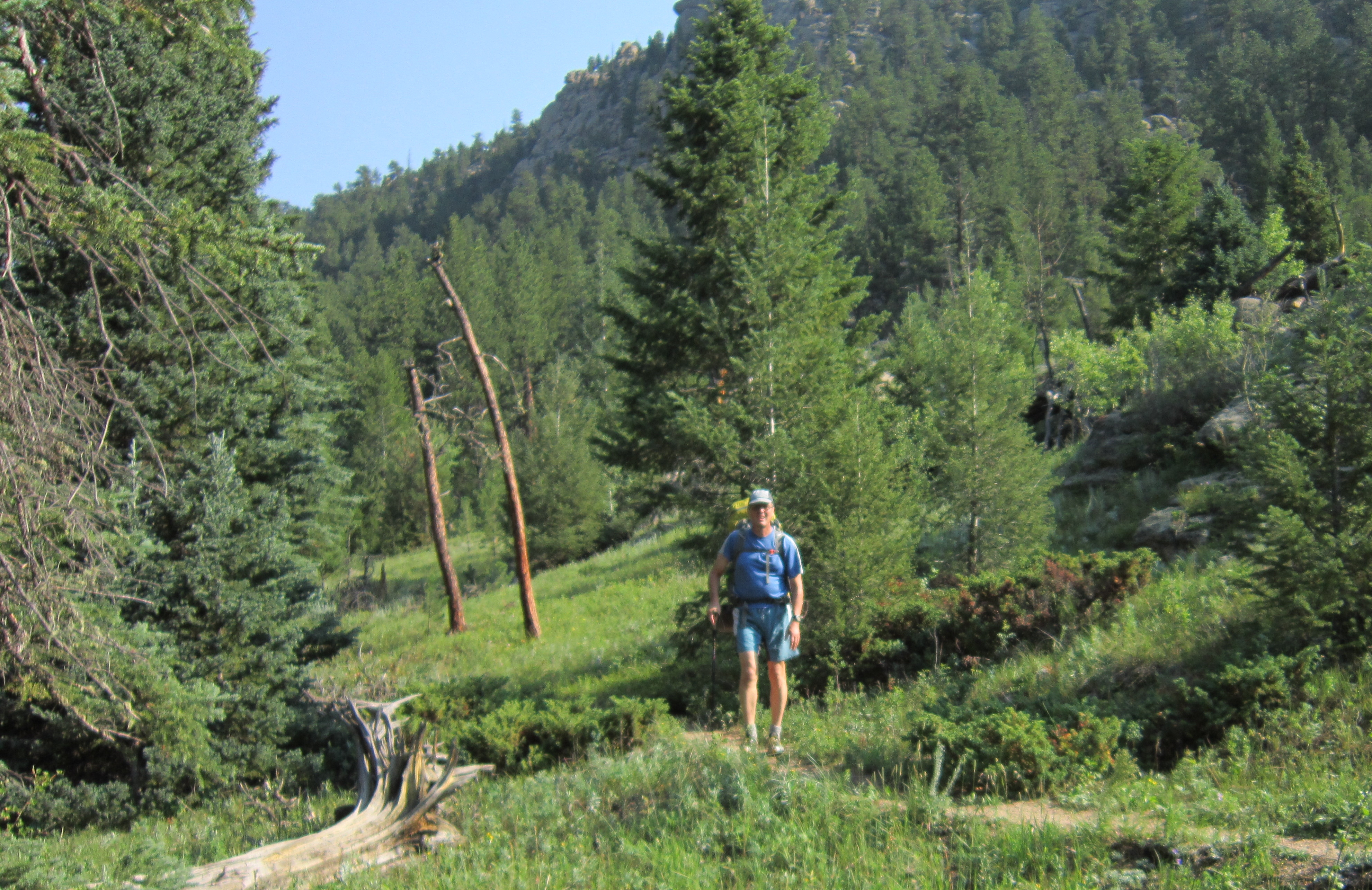
Crossing West Creek along North Boundary Trail

During my trip I was reading Baptized into Wilderness: A Christian Perspective on John Muir by Richard Cartwright Austin. In the book, Austin emphasizes Muir sensuous emersion into the wilderness. Muir became present to the trees, birds, insects, life of American wilderness, experiencing God in the midst of all of it.

Muir suggested that the path to the Spirit is not away from the world, but deeper into the world, deeper into communion with nature and with the primary forces where is Spirit is lightly clothed. Probing the simplest elements to discover their full character and vitality, he developed an incarnational understanding of God’s personality incarnate in Jesus (p. 25).

God’s presence was all around me, in the beauty of the tall lodge pines and the tiniest of mushrooms. Could I simply open my heart and mind to experience the wonder and beauty of God’s creation?

Let the heavens be glad, and let the earth rejoice; let the sea roar, and all that fills it; 12 let the field exult, and everything in it. Then shall all the trees of the forest sing for joy before the Lord; for he is coming, for he is coming to judge the earth. He will judge the world with righteousness, and the peoples with his truth. Psalm 96:11-13

Lord Jesus, open my heart to see your beauty all around me.

After the Fire

Yesterday I returned from a wonderful trip into the Boundary Water’s Canoe Area of Northern Minnesota. Pictures and a complete trip review will be forthcoming. Overall it was a wonderful trip — great fellowship with the men of Resurrection, great wilderness solitude and great exercise.

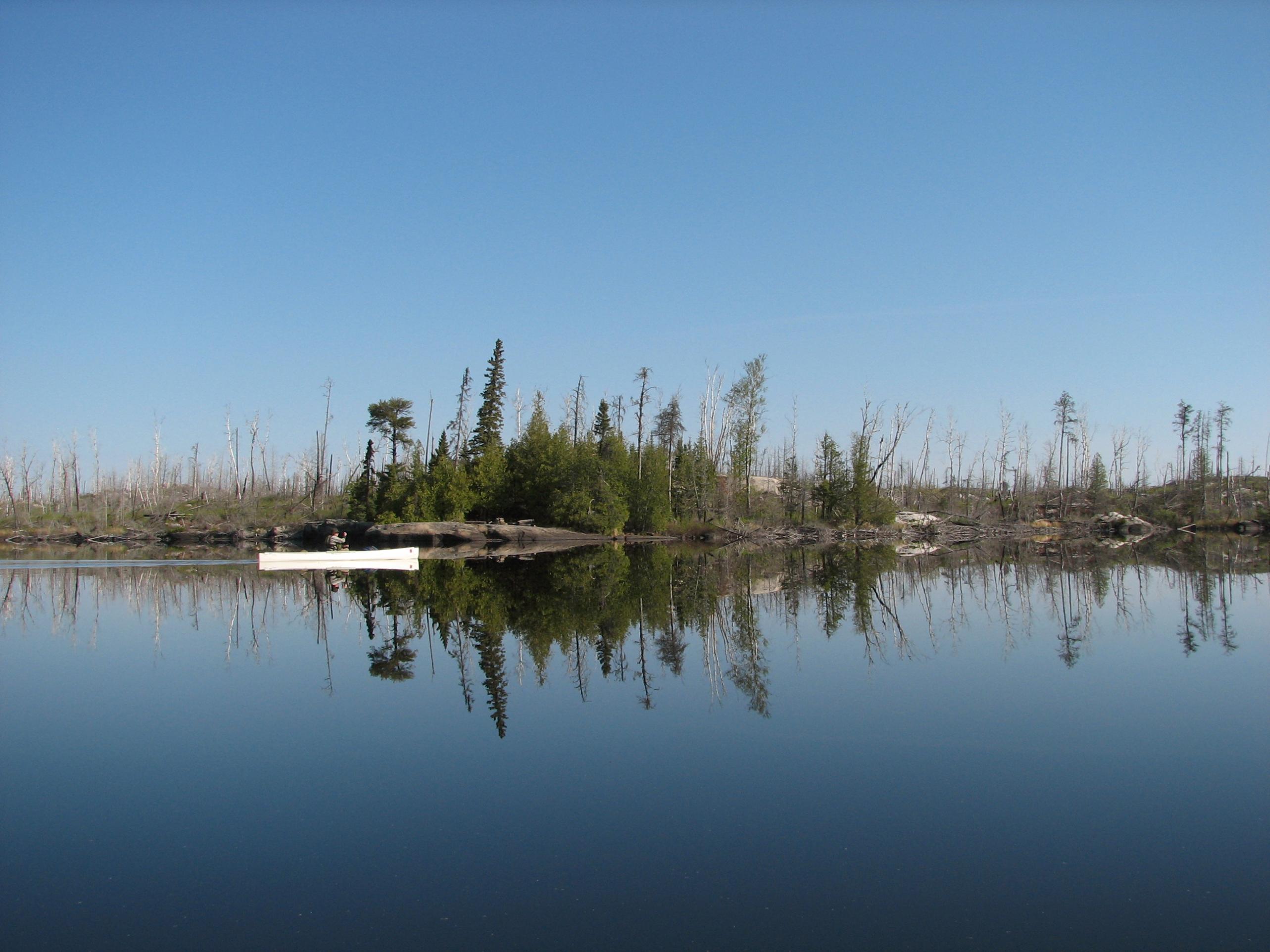
One strong impression came on the first day. After loading our canoes at the Kawishiwi Lodge at Lake One near Ely, MN we enjoyed an early morning paddle along a shoreline covered with green pine trees. After we crossed the first set of two short portages to Lake Two, we immediately we encountered a different sight. The shoreline had been heavily impacted by the Pagami Creek Fire last year. Large sections of the forest were burned to the ground, with only small patches of green trees still standing. It was a stark reminder of how fragile a wilderness environment can be.

But it also was an example of how resilient the forest can. Even as we paddled past acres of dead trees, we saw thousands of small shoots of green shrubs, flowers, and trees pushing up through the charred soil. In time the forest will restore itself. Fire is part of its life cycle.

When tragedy hits, we human often have a short-sighted vision of its consequences. We see only the pain and sorrow and rarely have the ability to see how good can arise from it. This is natural. Yet we have God’s promise that all things work together for good for those who love God and are called according to His purpose (Romans 8:28). Even when a forest is crushed by a fire, new life can begin. Even when God’s own Son is executed on a cross, resurrection becomes reality.

Lord Jesus, continue to remind us that all will be well with you.

Canoe Journey Begins

This morning I start a four-day canoe trip in the Boundary Water Canoe Area Wilderness with my son and nine other men from Resurrection Lutheran Church. It will be journey not only through the beautiful wilderness of northern Minnesota, but also a spiritual journey into the wonder of God’s grace.

The image of journey or pilgrimage has deep roots in the Christian tradition. A person starts in one place, travels to another, and then returns to the starting point. The person make look the same, but the journey has transformed him or her.

The Biblical narrative is filled with journey stories from Abraham and Sarah to the Exile in Babylon. The life of Jesus is primarily a journey. Each Gospel records how Jesus’ ministry begins in northern Galilee but eventually he heads south to Jerusalem to the cross and empty tomb.

The Gospel of Luke perhaps takes this image most seriously. Mary travels through the hill country to visit her cousin Elizabeth after the angel Gabriel’s visit (Luke 1:39). Mary and Joseph go to Bethlehem for Jesus’ birth and then to the temple in Jerusalem for his dedication (Luke 2). As a boy Jesus makes the pilgrimage to the Passover Festival in Jerusalem where he is lost for three days. (An excellent post on this story here).

As an adult Jesus’ ministry is a journey from town to town and across the Sea of Galilee. Two of my favorite parables from Luke focus on people who travel—the Good Samaritan (Luke 10) and the Prodigal Son (Luke 15). Jesus sends his disciples on not one, but two training missions (Luke 9, 10). After his resurrection Jesus meets two disciples on the road to Emmaus (Luke 24). The final scene in Luke is Jesus leading his disciples out as far as Bethany for his ascension. (I will only mention that the Book of Acts, written also by Luke, contains more journey stories.)

I do not know how or where God will encounter our two canoe groups, but I am confident that through the journey, the Spirit of God will be working to transform us into his glorious image. I’ll let you know when we return.

Lord Jesus, may we walk, canoe, run, move, dance, play, work, serve with you today.

Citizens with the Saints

Eight youth and two adults from Resurrection Lutheran Church are on their way to the Evangelical Lutheran Church in America (ELCA) National Youth Gathering in New Orleans. They will join more than 36,000 participants from across the country for five days of service, study, and worship. They will gather under the theme of Citizens with the Saints, based on Ephesians 2:14-20:

Jesus is our peace. In his life and death on the cross, Jesus broke down the dividing walls so that we are no longer strangers and outsiders, but we are citizens with the saints and also members of the household of God. The foundation of God’s house was built of apostles and prophets, and Jesus, the cornerstone, holds it all together.

Like many of the participants, this will be a mile-stone for our youth. Growing up in a congregation like Resurrection, where their confirmation class is from 15-20 classmates, our youth often perceive the church as a small intimate group. Gathering with several thousand other youth will expand their vision of what the church is and can become. The Holy Spirit power of 36,000 youth singing and rocking the Superdome will energize and renew the faith of many who attend.

A couple of years ago, I attended a similar Christian gathering called Catalyst. About 10,000 young adults gathered from across the nation in a small arena in suburban Atlanta. The packed arena of singing, cheering, stomping, passionate followers of Jesus Christ made my heart sing.

I am so proud of how Hannah Koehler, our first-year youth director, has worked to make this mission trip become reality for our youth. She attended a National Youth Gathering several years ago and the experience transformed her life. She and others on the trip are writing their own blog to keep our congregation informed.

I invited you to join me in praying for all the youth in New Orleans this week as they discover their place as Citizens with the Saints.

Lord Jesus, bless, encourage and nurture all the youth who have gathered in New Orleans this week.

Marathon Dreams and Christian Hope

This summer I am training for the Twin Cities Marathon. After taking a couple of years off from such focused training due to injuries and my new call to Resurrection Lutheran Church, I will attempt to complete my eleventh marathon on October 7. Finishing is not some vague wish that I am hoping to accomplish. It is an honest assessment of my fitness, training and experience.

Like almost any physical endeavor, patient, persistent training leads to success. From past experience I know that if I am able to run consistently 35-45 miles per week, complete several long runs of 16+ miles and stay injury free, I have a better than 90% chance of finishing the 26.2 mile course. Factors that may contribute to not finishing are an unforeseen injury or illness. I have had some poor race performances (Des Moines Marathon in 2009 and Grandmas in 2007) but even in my poor races I finished.

In recent years my marathon goal has been more ambitious than simply finishing the race. I  aspire to qualify and run the historic Boston Marathon. To qualify for Boston, a runner needs to run a marathon under a certain time based on their age and gender. I qualified once in 2005, but a running injury kept me from running Boston in 2006 and the qualifying time is only valid for about eighteen months. This fall I am hoping to run under 3:55 so that I can qualify for the 2014 Boston.

Now that hope is not outrageous, but it will be a true test of my abilities. It will require proper training and rest. (Overtraining can be as detrimental in marathon preparation as under-training.) It will require focused nutrition and stress management. It will also require some good luck on factors I cannot control (like race day weather).

Still I have the hope and dream of qualifying.

What distinguishes this aspiration from my Christian hope is that my marathon dreams primarily rests in myself and my abilities. My Christian hope rests totally in Jesus Christ and what he has accomplished through his death and resurrection. To quote a famous hymn, my hope is built on nothing less than Jesus’ blood and righteousness. I am a fallible human being who may twist an ankle tomorrow, ending my marathon dreams. But my hope in Jesus remains steadfast because of the promise of God’s Word.

We have our hope set on the living God, who is the Savior of all people, especially of those who believe. I Timothy 4:10.

Lord Jesus, thank you for being my rock and my hope.

American Optimism And Christian Hope

ImageAs I mentioned in my sermon yesterday, title Abounding in Hope, our American culture promotes optimism for a better future. To use an old proverb, we tend to promote the idea that the glass is half-full, not half-empty. To quote President Ronald Reagan, “Well I’ve said it before and I’ll say it again — America’s best days are yet to come. Our proudest moments are yet to be. Our most glorious achievements are just ahead.”

Part of our American optimism comes from our predominant Christian heritage. Hope is a central virtue of our faith in Jesus Christ. But there is at least one key distinction between American optimism and Christian hope. American optimism places our basic trust in ourselves and our ability to solve our common problems. We see a challenge, roll up our sleeves and get to work, whether it is placing a man on the moon, fighting terrorism or recovering from natural disasters. As Americans we believe in the possibility of creating a “better life” for ourselves, by overcoming obstacles and challenges.

Christian hope has a different focus. Our Christian hope is not in ourselves, but in our God who loves us and saves us from ourselves. We believe God is at work in the world, calling all people to God’s rule of justice and peace. We know that there will be struggles and difficulties. Jesus calls us to take up our cross and follow him (Mark 8:34). The cross is hardly a symbol of optimism.   Paul goes so far as to say that he boasts in his struggles.

we also boast in our sufferings, knowing that suffering produces endurance, and endurance produces character, and character produces hope, and hope does not disappoint us, because God’s love has been poured into our hearts through the Holy Spirit that has been given to us (Romans 5:3-5).

As an American Christian I do not reject an optimistic glass-half-full attitude. There are many problems in our world that need a positive can-do attitude — poverty, hunger, and racism to name a few. However I also know that as follower of Jesus Christ, there will be times and situations that I cannot overcome. The primary ones are my sin and my death. No amount of optimism and self-encouragement will help me here. My only hope is Jesus Christ; his death and resurrection are my source of hope today and forever.

How do you connect or distinguish American Optimism and Christian Hope?

Lord Jesus, continue to fill my heart with hope in you.

Beat the Heat

Like much of the country, Minnesota is going through an extended heat wave. Our temperature is regularly topping out at over 95 degrees with plenty of humidity. It would be easy to complain, but complaining about the weather rarely helps. Rather I recommend some other coping strategies.

  1. 1.  Remember last winter when it was sub-zero and the cold seemed relentless. This heat is refreshing as I look back.
  2. 2. Read “cold” books. I remember listening to Jon Krakauer’s book, Into Thin Air, which describes the 1996 group climbing disaster on Mount Everest. Krakauer’s descriptions of the cold and ice were extremely realistic. Our family was traveling through Kentucky in the heat of summer, but as we listened to the book we had to take breaks at rest stops so that we could warm-up from the “cold.” Other possible “cold” books are Roland Huntford’s The Last Place on Earth and Caroline Alexander’s The Endurance: Shackleton’s legendary Antarctic expedition.

    Mo Farah Enjoying an Ice Bath
    Photo Credit: Simon Freeman

  3. Exercise in the cool of the morning. Most of my runs now start before 6:30 am.  And after my weekly long run, an ice bath for my legs feels oh so good.
  4. At the Spirituality and Practice website I found inspiration on their posts: Spiritual Practices for Hot Weather. One story in particular struck me.

The Catholic priest Anthony De Mello tells a story that sums up the best way to live with scorchers:

“Traveler: ‘What kind of weather are we going to have today?’

Shepherd: ‘The kind of weather I like.’

“Traveler: ‘How do you know it will be the kind of weather you like?’

“Shepherd: ‘Having found out, sir, I cannot always get what I like, I have learned always to like what I get. So I am quite sure we will have the kind of weather I like.’ “

5.    Pray for those who are truly struggling with the heat: the poor and powerless, those
whose work requires them to be outdoors, and those who have breathing difficulties.

Rejoice always, pray without ceasing, give thanks in all circumstances; for this is the will of God in Christ Jesus for you (I Thess. 5:16-18).

Lord Jesus, comfort and aid those who are struggling with the heat.