Category Archives: Uncategorized

Racing with St. Patrick

Today we celebrate one of God’s great saints.

There will be a variety of St. Patrick Day celebrations, including road races. Many of the races will feature post-race celebrations, including green alcohol.

It has always been curious to me that a day dedicated to an evangelist and missionary should become the focus of such drinking and carousing. Not that I am against parties, since I can  enjoy post-race celebrations very much. But when people think of St. Patrick they seem to focus on the Patrick and not the Saint.

But that is even more curious, since St. Patrick was born in England, captured by Irish raiders and sold as a slave in Ireland. After serving as a shepherd for six years, he escaped and made his way back to England. During this adventure, he had a conversion to Christianity and he felt the call to preach the faith to (surprise!) the Irish people. He studied for the priesthood in France but was not a very good student. His superiors did not want him to go, but still he went. He preached all over Ireland, making converts and founding monasteries. He became a great hero, not only for Ireland, but for the Christian faith.

In his confession he wrote, “If I am worthy, I am ready also to give up my life, without hesitation, and most willingly, for his name. I want to spend myself in that country, even in death, if the Lord should grant me this favor. I am deeply in his debt, for he gave me the great grace that through me many people would be reborn in God, and then made perfect by confirmation, one people gathered by the Lord.”

St. Patrick reminds me of St. Paul.  St. Paul wrote, “I have fought the good fight, I have finished the race, I have kept the faith” (2 Timothy 4:7). St. Patrick, like St. Paul, ran the good race. Maybe we should try to run like him.

Lord Jesus, teach me to run the race of life with you and your saints.

Hope Runs Eternal

The biggest problem with Minnesota winters is not the severity: not the deep cold, not the large snow falls, not the short dark nights. The real problem is the duration. Winter drags into March and even parts of April. There may be teasers of warm weather, but winter usually has a second or third slam to deliver.

What a difference this year. Not just one day of beautiful warm spring weather, but a whole week. I was able to run the trails at Afton State Park today and though muddy, it was a delight. What a joy to be alive. The exercise, prayer and sunshine gave me a feeling of hope. After all, hope runs eternal.

As a Christian, hope is a critical part of my belief system. I recognize that life is often cruel, unfair and extremely difficult. I remember that every time I do a funeral or visit a hospital room. I also remember it when I make the yearly journey with Jesus to Calvary and the cross. Here is someone who was willing to suffer and die, in the hope of the resurrection. Jesus died for me and he rose for me. I cannot prove the resurrection, but I see plenty of evidence in the New Testament and in the lives of God’s people. I am hopeful that though the wrong seems oft so strong, God is the ruler yet. “While we wait for the blessed hope and the manifestation of the glory of our great God and Savior, Jesus Christ” Titus 2:13 (NRSV)

 My own hopeful news is that after nearly a year layoff, my running is back strong. Thanks for the many words of encouragement and prayers. As I was running Afton, I thought about its 25K trail race this July. Anyone want to join me? God is good!

Lord Jesus, let me run or walk or sit or be with you daily.

Hunger Games and Compassion

Several youth and adults recommended Hunger Games by Suzanne Collins for me to read. Since the movie version is coming out later this month, I downloaded it to my Droid and read it yesterday. Though it has a disturbing theme, the story kept me “flicking” pages. In a postapocalyptic future, a ruling class keeps tight control over its outlying resource districts by holding a televised survival competition. Twenty-four youth between the ages of 12 and 18 are selected from the twelve districts to enter the Hunger Games, which are a fight to the death.

The story is a classic “haves” versus the “have-nots”; the empire versus the colonies; the ruling elite versus the struggling masses. In this fictional future, the districts struggle to have enough food and other resources, while the Capital has superfluous abundance. Food plays a role through-out the book with many descriptions of meals. For example, “The stew’s made with tender chunks of lamb and dried plums today. Perfect on the bed of wild rice.” The lamb stew becomes a symbol of the Capital and it capricious ways, giving gifts when it chooses to the districts’ young competitors.

There is no religious or spiritual component in this fictional world. God is not even mentioned in the book. Yet two Christian themes stand out. One is compassion for the neighbor. Katniss, the narrator, remembers being given two loaves of bread by a baker’s son, Peeta, when her family is near starvation. This incident becomes a major subtheme. I can’t help but be reminded of Jesus’ declaration, “I was hungry and you fed me, thirsty and you gave me something to drink” (Matthew 25:35). Katniss and Peeta both practice compassion at times and seek to do good, yet I wonder where is the source of their compassion in a world that knows so little of it.

The other Christian theme is that of sacrifice. Katniss “volunteers” for the Games when her younger sister’s name is drawn as the “tribute.” Katniss sacrifices her security to save her sister from almost certain death. Jesus speaks of this the night before his crucifixion, “Not one has greater love that this, to lay down one’s life for one’s friends” (John 15:13).

In such an evil and corrupt world as Hunger Games, it makes me wonder where Katniss finds the courage and power to be compassionate.  If it is a natural human quality, why is there so little of it elsewhere in the book? I continue to believe the ultimate source of all compassion and love is God, for we are created in God’s image. Jesus said, “Do not work for the food that perishes, but for the food that endures to eternal life . . . I am the bread of life. Whoever comes to me will never be hungry, and whoever believes in me will never be thirsty”( John 6:27,35.)

Heavenly Father, give us today our daily bread, which is you.

What A Friend We Have

As my mother’s dementia progresses, one deep part of her remains: her love of hymns. She grew up in the Lutheran church and sang in choirs occasionally. She learned hymns as a child and continues to sing them today.

One hymn that we both love is “What a Friend We Have in Jesus.” I like to sing it with her when I visit,

What a Friend we have in Jesus, all our sins and griefs to bear!
What a privilege to carry everything to God in prayer!
O what peace we often forfeit, O what needless pain we bear,
All because we do not carry everything to God in prayer.

The hymn was written around 1855 by Joseph Scriven, a Canadian. He wrote it as poem of comfort and hope to his ailing mother in Ireland. Joseph was a member of the Plymouth Brethren and was known for his compassion and care of the poor and forgotten in his community. He never intended his poem to become a hymn, yet it continues to bring great comfort to those who sing it.

When I sing the hymn, I am reminded of the promise of Hebrews 7:24-25,

Jesus holds his priesthood permanently, because he continues forever. Consequently he is able for all time to save those who approach God through him, since he always lives to make intercession for them.

The book of Hebrews makes the case that Jesus is better than any ancient levitical priest who served in the Jerusalem temple, because Jesus’ sacrifice was pure and sinless.

Since, then, we have a great high priest who has passed through the heavens, Jesus, the Son of God, let us hold fast to our confession. For we do not have a high priest who is unable to sympathize with our weaknesses, but we have one who in every respect has been tested as we are, yet without sin. Let us therefore approach the throne of grace with boldness, so that we may receive mercy and find grace to help in time of need. (Hebrews 4:14-16).

The function of a priest is to give us access to the High and Holy God.  Jesus is our access to God, the one who hears our cries for help and mercy. We truly can take anything to him in prayer, even the love of our aging parents.

Lord Jesus, thank you for bearing all our cares and woes.

Seeds that Bear Fruit

Yesterday was a great day of worship at Resurrection. The youth lead us in prayer, preaching and song. All did a great job, from the sound and video team to the ushers and greeters.  I am especially grateful for our three preachers, Cooper Dillon, Garth Natwick and Ryan Garbe. All three have been active in the congregation for years and they each expressed their appreciation for how the congregation and pastors have shaped their faith. Each declared their faith in Jesus as a dynamic, growing relationship that has grown over many years of participation.

Being the newcomer at Resurrection, I need reminding that a solid foundation has been laid prior to my coming. I tend to live my life in episodes and seasons, seeing only the immediate events around me. I forget that God is weaving a much bigger narrative through the life of this congregation and through the history of the global church. The Holy Spirit has been shaping the lives of the youth and families long before I began my ministry here. It is joy to witness the seeds that were planted bear fruit for God’s Kingdom.

Paul wrote about this in his first letter to the Corinthians as the congregation argued over which pastor had the more lasting spiritual impact,

What then is Apollos? What is Paul? Servants through whom you came to believe, as the Lord assigned to each. I planted, Apollos watered, but God gave the growth. I Corinthians 3:5-6

The good news of yesterday was highlighted in the generous response of the congregation for our Youth Scholarship Fund. Over $3500 was donated so that eight of our High School Youth can attend the ELCA Youth Gathering in New Orleans this summer. Thanks be to God!

How has your church community shaped your faith?

Lord Jesus, continue to call me back into deeper relationships with all your children, young and old.

Adam versus Jesus

If death got the upper hand through one man’s wrongdoing, can you imagine the breathtaking recovery life makes, sovereign life, in those who grasp with both hands this wildly extravagant life-gift, this grand setting-everything-right, that the one man Jesus Christ provides?  (Romans 5:17.The Message)

The story of Adam and Eve is central to the Christian’s understanding of the world and humanity’s place in it. In Genesis chapter two and three, God creates man (Hebrew: Adam) from the dust of the earth (Hebrew: Adama). He places Adam and later Eve, in a garden called Eden to till and keep it. They are given great freedom, with one rule to remind them of their dependence on God, their creator: do not eat from the tree of the knowledge of good and evil.

All goes well until the serpent talks Eve into the fatal bite. Adam joins her in the rebellion against God. When God comes to visit, they hide, ashamed of their nakedness. God give them the opportunity to confess but in turn they blame another. Adam blames Eve. Eve blames the serpent. God casts them out of the garden as the consequence of their rebellion.

The story is way for humans to talk about our in-born tendency to rebel against God. We want to run things our way, to be in charge of our destiny. We all trespass against God’s rule. As Paul write in Romans 5, one man’s trespass shows us the reality of sin and death in each of us.

But humanity’s rebellion is not the end of the story, but rather the beginning. God immediately begins a rescue mission. In Genesis 3:21 God provides garments for Adam and Eve from the skins of animals. Death provides protection to humans, a foreshadowing of the cross.

The rescue is completed in the death and resurrection of Jesus Christ. If death can come through one man, then surely new life can come through one man, Jesus Christ, the son of God. Jesus is so much greater than Adam or you or I. Jesus Christ lavishly dispenses the free gift of God’s mercy and grace. New Vibrant Life flows forth from the cross of Christ. We are sinners, but we are REDEEMED and FORGIVEN sinners. We are sons and daughters of muddy earth, yet we are also Princes and Princesses of God’s Kingdom. Let’s rejoice in that reality.

Lord Jesus, let me live as your forgiven child, trusting always in your grace.

Tempted or Tested?

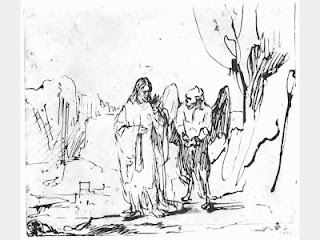
Yesterday many Lutheran churches read Mark 1:14: Jesus tempted in the wilderness.  Jesus was in the wilderness forty days, tempted by Satan; and he was with the wild beasts; and the angels waited on him. A seminary classmate of mine, Bishop Larry Wohlrabe, preached on this text at the installation of a new pastor and posted his sermon on line.  Here is a section that I really appreciated from his sermon.

What does it mean to be tempted? Temptation is about something far, far worse than falling off your diet or reneging on your no-smoking pledge. Temptation is about doubting your God-given, God-claimed identity. Temptation for Jesus in the parched wilderness was about being distracted from his mission, side-tracked on his path to the Cross, for us and for our salvation.

So what we need to picture here is a battle royal out in the wilderness. Satan, whose name means “adversary,” assaults Jesus repeatedly over the course of a forty day period. Mark doesn’t give us a blow-by-blow account, but maybe that’s OK. Mark’s narrative leaves a lot to our imaginations, and perhaps that helps us identify with Jesus all the more.

Because we, too, have our own “good long times” in the wilderness of doubt and despair. You and I also are pressed to the max, pinned to the wall, by all the “wouldas, couldas, shouldas”—all the ways we doubt ourselves and despair of trusting that God is with us.

Bishop Wohlrabe continued by reminding the local pastor of her task as a preacher in her new congregation.

When they are in the wilderness, serve these folks the same life-giving Word of God that sustained our Lord Jesus in the desert. Proclaim to them the nearness of God’s Kingdom, God’s gentle and glorious rule over all things, in Christ Jesus. Amen.

Yes, Amen.  The ministry of God’s Word continues to give life to thirsty, testy, tempted people.  And God’s Word wins.

Lord Jesus, save us from the time of trial and sustain by your saving word.

The US Run

Therefore, since we are surrounded by so great a cloud of witnesses, let us lay aside every weight and sin that clings so closely, and let us run with perseverance the race that is set before us, looking to Jesus the pioneer and perfecter of our faith. Hebrews 12:1-2

The physical exercise of running appeals to many for its solitary nature. Unlike other sports, one can easily do it alone. When I run by myself, I can do some mental reflection and prayer, seeking peace and tranquility in the steady rhythm of breath and footsteps. I run my own pace, walk when necessary, sprint when desired. Alone, I can enjoy many running benefits.

Yet I also know the power of a community run. The group gives me encouragement and incentive, pushing me beyond my normal boundaries. I especially appreciate other runners during the long runs of marathon training. The Saturday morning ritual of gathering with others gets me up early. I feel a certain obligation to be ready for the sake of other runners. The group conversation can keep me going when the miles are long or when I struggle with some bad patches. I have discovered that a good running group is essential for my development as a runner.

The writer of Hebrews seems to have that community focus as well. In chapter eleven, the writer highlights a number of Old Testament heroes who demonstrated faith in God: Noah, Abraham, Moses and Rehab. And at the beginning of chapter twelve, the writer describes these deceased heroes as “a cloud of witness,” rooting and cheering us on in our faith race. We do not run alone, the writer makes clear. He does not write, “Let me run with perseverance the race that is set before me.” Rather, “Let us run with perseverance the race that is set before us.” Our faith, though personal, is never in isolation.

I am so thankful for those friends and companions who have pushed me to become a better runner. I am even more thankful for my brothers and sisters in Christ, who push me to become a more faithful follower of Jesus Christ. Together we can finish the race of faith.

Lord Jesus, connect me to your people that I might look to you, the pioneer and perfecter of our faith.

Young and Rich

I am preparing to preach this Sunday on Jesus’ encounter with a rich man in Mark 10: 17-27. The man kneels at Jesus’ feet and asks what he must do to inherit eternal life. Jesus responds, “Keep the commandments.”

The man responds, “I have kept them all from my youth.”

Jesus responds with words of love, “You lack one thing; go, sell what you own and give it to the poor, and you will have treasure in heaven; then come follow me.”

The man was shocked and went away grieving, because he had many possessions.

I think many of us are shocked by Jesus’ words as well. “You want me to do what? Sell everything?”

Barbara Taylor Brown in wrote in her book, The Preaching Life, about the two ways we mangle this story, “First by acting as if it were not about money, and second, by acting as if it were only about money.”

As far as Jesus is concerned, money is like nuclear power. It may be able to do a lot of good in the world, but only within strongly built and carefully regulated corridors. Most of us do not know how to handle it. We get contaminated by its power, and we contaminate others by wielding it carelessly ourselves – by wanting it too desperately or using it too manipulatively or believing in it too fiercely or defending it too cruelly.

But it is not a story that is only about money, because if it were we could all buy our way into heaven by cashing in our chips right now and you know that is not so. None of us earns eternal life, not matter what we do. We can keep the commandments until we are blue in the face; we can sign our paycheck over to Mother Teresa and rattle tin cups for our supper without earning a place at God’s banquet table. The kingdom of God is not for sale. The poor cannot buy it with their poverty any more than the rich can buy it with their riches. The kingdom of God is God’s consummate gift, to be given to whomever God pleases, for whatever reason please God. (The Preaching Life., p. 124)

Strong words for a great story. God’s grace is even greater than the world, and especially our love of riches.

Lord Jesus, set me free from the love of money and center my heart on you.

Ashes and Water

Today, Ash Wednesday, begins the 40 days of Lent. In several Christian traditions, the placement of ashes upon one’s forehead is a reminder of our mortality and our need to repent. As Abraham spoke to Almighty God, “Let me take it upon myself to speak to the Lord, I who am but dust and ashes.” Adam was made from the dust of the ground (Genesis 2:7). We each return to the dust and ash when our bodies die and decompose. We may not like to face that fact, but the truth keeps coming back.

Ashes are also a sign of repentance, our need to turn back to God. The book of Jonah describes how the people of Nineveh responded to Jonah’s message to turn back to God.

And Jonah cried out, “Forty days more, and Nineveh shall be overthrown!” And the people of Nineveh believed God; they proclaimed a fast, and everyone, great and small, put on sackcloth. When the news reached the king of Nineveh, he rose from his throne, removed his robe, covered himself with sackcloth, and sat in ashes. (Jonah 3:4-6).

The imposition of ashes also connects us to our baptism. Many Lutherans and others were baptized with water on their forehead. It was a sign of washing and renewal, of dying with Jesus and rising again to new life. Paul writes how baptism is connected to Jesus crucifixion and resurrection.

But if we have died with Christ, we believe that we will also live with him. We know that Christ, being raised from the dead, will never die again; death no longer has dominion over him. The death he died, he died to sin, once for all; but the life he lives, he lives to God. So you also must consider yourselves dead to sin and alive to God in Christ Jesus. (Romans 6:8-11):

The ashes are thus a reminder that we have already died in our baptism. We died to sin and corruption, and have begun to live the new life in Christ. The ashes we place on our head will eventually wash away; the promise of our baptism is not so easily removed. The Holy Spirit holds us in Christ Jesus.

Lord Jesus, let me die to sin and death that I might live with you now and forever.