Category Archives: Uncategorized

Preparing the Pre-Wedding Feast

This week will have fewer posts due to the joyous celebration on Friday of my son Jon and Maggie’s wedding.  I have taken the week off so I can assist my wife and daughter as they prepare the rehearsal dinner on Thursday.   Since daughter Suzanne is passionate about cooking, she will be preparing a marvelous meal for the 60 guests at Jon and Maggie’s church in Edina.  My primary task is grocery pick-up and delivery plus airport taxi.

I have been reflecting upon how the Bible use the metaphor of the wedding feast as a description of God’s kingdom.   In John 2, Jesus preformed his first miracle at the wedding of Cana, turning several large barrels of water into the best wine.   In Mark 2, the Pharisee’s criticize Jesus for not fasting.   Jesus responded, “The wedding guests cannot fast while the bridegroom is with them, can they? As long as they have the bridegroom with them, they cannot fast.”   And in Revelation 19, St. John has a vision of the church prepared as the bride of Christ and an angel says, “Blessed are those who are invited to the marriage supper of the Lamb.”

I am not sure if our rehearsal dinner will be comparable to the heavenly banquet, but I am confident that our week-end celebration will be a kind of foretaste of the feast to come.  And I certainly want to invite you to that most glorious wedding when the King of Heaven and Earth gathers in his bride, the church.  We all have an open invitation from Jesus,

Listen! I am standing at the door, knocking; if you hear my voice and open the door, I will come in to you and eat with you, and you with me. (Rev. 3:20)

Doesn’t it make you hungry to feast with God?

Lord Jesus, let our joy be ever as your bride.

“That’s Stupid!”

This Sunday I am preaching on Deuteronomy 6:4-9, during which Moses instructed the people, “You shall love the Lord your God with all  your heart and with all your sould and with all your might.”  Moses goes on to say, “Recite these words to your children.”

Like many parents, my wife and I struggled to communicate our faith to our children, especially being the offspring of two pastors.  Being pastor’s kids is rarely easy.   People sometimes carried unhealthy expectations for their behavior.  But we did our best to teach them, sometimes with odd results.

I had read about a family devotional in which the object lesson was “following the crowds can be foolish; following Jesus is wise.”   The devotional instructed me to buy frozen popsicles for my kids and then tell them that there was a new fad that I had just heard about: “microwaved popsicles.”  I showed them the popsicles and how “everyone” was microwaving their popsicles before eating them.  My kids, ages 8, 6, and 3, thought it was a stupid idea from the beginning.  My wife agreed.  Still I placed the popsicle in the microwave and we watched them melt.  When I took the popsicles out, they just stared at me and said, “that’s stupid.”  I tried to explain that they were right, that doing what “everyone” else is doing can be “stupid.”  But my daughter just stared at me and said, “But you just did it, Daddy.  Does that mean you’re stupid?”  I had no good response, except to laugh.

Fortunately, my children had an excellent mother who instructed them well on the love of God.

What are ways that you have taught children the love of God?

Lord Jesus, teach me how to teach my children your Word.

You Are In the Story

A big question for many Bible readers is “Where do I fit in?” The Bible feels like ancient history about long-dead people. In Deuteronomy chapter five, Moses spoke to this concern. The people of Israel were about to enter the Promised Land after wandering in the wilderness for 40 years. The generation that had experienced the exodus of Egypt had died; a new generation had been born during the wilderness journey. The new generation had heard the stories of the Exodus, Mt. Sinai (also called Mt. Horeb), the Ten Commandments, and Moses, but they did not directly experience these events. Or did they?

Moses spoke to the new generation regarding this:

The Lord our God made a covenant with us at Horeb. Not with our ancestors did the Lord make this covenant, but with us, who are all of us here alive today. The Lord spoke with you face to face at the mountain, out of the fire. (At that time I was standing between the Lord and you to declare to you the words of the Lord; for you were afraid because of the fire and did not go up the mountain.) And he said: I am the Lord your God, who brought you out of the land of Egypt, out of the house of slavery; you shall have no other gods before me. (Deut 5:2-7)

Please note that second sentence, Not with our ancestors did the Lord make this covenant, but with us, who are all of us here alive today. Moses made the audacious claim that the covenant at Mt. Horeb (Mt. Sinai) was for us alive today. God’s covenant includes YOU and ME. This is not some ancient story, but an ongoing relationship with God.

This is critical reason for walking through the whole story of scripture. It is our story, our identity, our connection to God, the creator and savior. We are the ones who are in danger of making false gods. We are the ones who forget the gift of Sabbath or dishonor our parents. The Ten Commandments address us today. Do we have ears to hear?

Which stories in the Bible have become YOUR story? Which stories challenge or pull you in?

Lord Jesus, speak your Word that it may become my word of life.

Spying On Our Fears

As Resurrection moves quickly through the Old Testament, many wonderful stories must be skipped. This Sunday we will jump to the book of Deuteronomy which is Moses’ final sermon to the Israelites before they entered the Promised Land (recounted in the book of Joshua).

But this was not Israel’s first attempt to enter Palestine. The book of Numbers recounted a previous attempt to invade the land (chapters 13 and 14). Moses selected twelve spies from the twelve tribes to spy out the land of Canaan. They were selected leaders and instructed to be bold and observant. The spies returned with a huge cluster of grapes suspended on a pole. Their report emphasized a land flowing with milk and honey and with abundant fruit.

However their report also stated that the occupants of the land were many and strong, their towns fortified and very large. Caleb, one of the spies, countered “We can take the land.” The other spies disagreed, saying, “We cannot go up against this people for they are stronger than we.” Their fear overrode their trust in God’s promise. The fear of the leaders/spies also infected the people.

The whole congregation said to Moses, “Would that we had died in the land of Egypt! Or would that we had died in this wilderness! Why is the Lord bringing us into this land to fall by the sword, would it not be better for us to go back to Egypt?” (Exodus 14:2-3)

Fear can destroy a family, a congregation or a nation. We see a potential danger and magnify it beyond reality. We feel threatened and we either seek to fight or flee. The people of Israel wanted to flee.

Caleb spoke again to the people, trying to turn their focus to God.,

The land that we went through as spies is an exceedingly good land. If the Lord is pleased with us, he will bring us into this land and give it to us, a land that flows with milk and honey. Only, do not rebel against the Lord; and do not fear the people of the land, their protection is removed from them, and the Lord is with us; do not fear them.” (Exodus 14:7-9)

The people did not listen to Caleb that day. Their rebellion against God resulted in God’s declaration that this generation which yearned for Egypt must die so that a new generation of hope can arise. The story has a Christian connection: the fearful “old Egyptian” in each of us must die so that the new Christ can rise up within us. Baptism is a reminder of our being joined to Jesus’ death and resurrection.

I have been crucified with Christ, it is no longer I who live, but Christ who lives within me. And the life I now live in the flesh, I live by faith in the Son of God who loved me and gave himself for me. (Galatians 2:19-20

When has fear diverted your trust in God? When has your faith in God overcome fear?

Lord Jesus, today, kill the fear within me and reignite my trust in you.

What If They Voted?

The Exodus is the identifying story of the Old Testament. The Israelites had been living in Egypt for more than 400 years but their once privilege status had collapsed into brutal slavery. They cried out to God for rescue and God responded. God called Moses to confront Pharaoh and to lead the people back to their promised land in Palestine. God directed ten plagues to beat Pharaoh down and finally, after the death of his own son, Pharaoh released the Israelites from his service.

Pharaoh, however, quickly changed his mind. He and his army pursued the escapees. The Israelites were camped by the Red Sea when they spot Pharaoh’s mighty chariots approaching. Great fear consumed the Israelites as they cried out to Moses,

Was it because there were no grave in Egypt that you have taken us away to die in the wilderness? What have you done to us, bringing us out of Egypt? Is this not the very thing we told you in Egypt, “Let us alone and let us serve the Egyptians” (Exodus 14:12).

I am guessing that if a vote was taken that day, the overwhelming majority of Israelites would have voted to return to Egypt. Their fear overruled their faith. The story of the Exodus would have been blown away on the desert winds. Has such fear attacked your heart?

No vote was taken. Instead Moses, God’s chosen leader, declared,

Do not be afraid, stand firm, and see the deliverance that the Lord will accomplish for you today. The Lord will fight for you, and you have only to keep still” (Exodus 14:13).

Song of Miriam by artist He Qi

Instead of a vote, God gave a promise through Moses. The people listen. God sent a strong east wind that drove back the chaotic sea and turned the water into dry land. The people crossed safely. When Pharaoh’s army tried to cross, “God tossed the Egyptians into the sea” (Exodus 14:27). Miriam sang a victory song.

Today our world may seem overwhelming and chaotic, instilling fear in us. We may fear financial or relational chaos; we may be too frightened to move forward in our life. Yet God’s promise stands today. The Lord will fight for you! God has not abandoned His people, only tested us to see if we will trust Him as God guides us into God’s  future.

How is fear holding you back from accomplishing God’s will?

Lord Jesus, your kingdom come, your will be done.

A Rabbi’s Taste of Manna

One of the joys of writing for Resurrection Lutheran and others is that I learn from other blogs. Recently I discovered a blog from a Jewish rabbi in Pennsylvania who has great perspective on the story of manna in the wilderness.

One of the recurring themes of the Exodus is complaining. The people whine about being thirsty, hungry, tired, scared, or because they want to go back to Egypt. No matter how much Moses reassures them, or how often they see God’s power displayed, they remain discouraged and depressed. This week, we see them rebel against the manna.

The manna, however, is really just the symptom. The Israelites aren’t dealing with the real issue and the underlying problem that permeates every other situation: They don’t want to be there! They would prefer slavery to independence, because it means they don’t have to move, they don’t have to change, and they don’t have to try. How often don’t we see this happening today? People put up with an awful lot if it means they can avoid change.

Only once the Israelites take ownership of the Exodus, and feel a desire to conquer Canaan and become a nation, are they able to enter the Land. As long as we keep avoiding the real problem, we’re really just going around in circles. We have to face our fears and take on challenges head-on, otherwise we’ll keep chewing on the same bland manna for 40 long years.

How is God challenging you to change?  In what ways are you resisting?

Lord God, teach me again to trust in your grace and mercy to lead me into the changes you desire.

Grumbles and Grains

Shortly after I turned 50 a friend sent me an article written by Garrison Keillor. It was titled:

Stop Complaining.

When you hit 50, you have to stop complaining about getting old, the strangeness of it, the fascination, the horror, etc., etc. That was okay in your 30s and 40s, but now that you’re old, it’s time to shut up on the subject. You shouldn’t complain about aging for the simple reason that nobody gives a hoot. If you were to pay people to care, they might care a little bit for an hour or two, but you didn’t and they don’t. So learn to be cheerful about it. When people ask you how you are, tell them, “Absolutely great. Never better.” (from 50 Things to Do When You Turn 50) 

I thought about Garrison’s advice as I read parts of Exodus. The Israelites are set free from Egypt but they immediately start to complain and grumble. First they don’t have sufficient water to drink (Exodus 15:24). Then they don’t have enough food.

The whole company of Israel complained against Moses and Aaron there in the wilderness. The Israelites said, “Why didn’t God let us die in comfort in Egypt where we had lamb stew and all the bread we could eat? You’ve brought us out into this wilderness to starve us to death, the whole company of Israel!” (Exodus 16:2-3).

We humans seem to have this wonderful ability to compare our present situation to some “idealized past” and think we have some right to complain about it. The Israelites practiced selective memory, remembering the sufficient food of Egypt, while forgetting the suffering and hard labor they experience as slaves. So they grumbled to Moses.

Does a grumbling spirit ever take hold in your mind?

The Lord God was quick to answer. The Lord said to Moses, “I am going to rain bread from heaven for you.” (Exodus 16:4). God provided manna for the Israelites throughout their 40 year journey in the wilderness. Manna was a temporary solution until they arrived in the promised land which flowed with milk and honey. It was also a test by which to see if they could give up their complaining and trust in God’s provision.

Have you learned to stop complaining and to trust in God’s blessing?

Lord Jesus, give us this day our daily bread.

Send Someone Else!

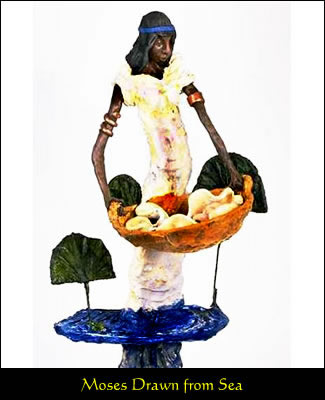
The book of Exodus is rich in stories: Hebrew mid-wives protecting the newborn children, Moses drawn out of the Nile River by Pharaoh’s daughter, the cry of the Hebrew slaves for God’s mercy. The central story is the exodus itself as God battles Pharaoh for the freedom of the Hebrew slaves until Pharaoh’s army drowns in the Red Sea. What a spectacular victory, worthy of song and dance (Exodus 15:20-21).

Art Prints
Yet my favorite story is the call of Moses at the burning bush (Exodus 3). God calls out of the bush to Moses by name. He tells Moses to remove his sandals because he stands on holy ground. God continues, “I am the God of your father, the God of Abraham, the God of Isaac and the God of Jacob. I have heard the cries and know the suffering of my people in Egypt. I will bring them to a good land flowing with milk and honey. I will send you to Pharaoh to bring my people out of Egypt.”

One can hear Moses cheering through the first part of God’s speech. “Yes, Lord, it’s about time you set your people free.” But then Moses’ cheering stops when he hears God’s plan includes him. Immediately Moses interjects, “Who am I that I should go to Pharaoh and bring the Israelites out of Egypt?” Moses then puts forward five different complaints as to why he should not be the one. My favorite comes at the very end, “Oh my Lord, please send someone else” (Exodus 4:13).

I confess that I see myself in Moses’ response. Like Moses, I know that there is mistrust, injustice and need in the world. Like Moses, I know that God needs pioneers who will prepare the way of God and lead God’s people to freedom. Like Moses, I know God is pulling at my heart, mind and soul to be a leader. But like Moses, I too often say, “Lord, send someone else!

The good news in this story is that Moses, after complaining long and hard, went to Egypt and confronted Pharaoh. Moses caught fire and blazed with God’s Spirit. God is trustworthy to give us each the strength and courage to do his will.

To what adventures is God calling you?

Lord Jesus, give me ears to hear and feet to follow.

The Good Becomes Bitter

Exodus has an odd beginning. At the end of Genesis, Joseph had brought his large family to reside in Egypt to avoid the famine in Palestine. Joseph died as did his brothers, yet their clan remained in Egypt, fulfilling Genesis 1:28 by being fruitful and multiply.

But the Israelites were fruitful and prolific; they multiplied and grew exceedingly strong so that the land was filled with them. Exodus 1:7

This sounds like good new; the clan was becoming a nation. However Egypt was not the land God had promised for Israel. Though it had large food reserves and tremendous opportunities, this was NOT where God want the Israelites to be. At the very end of Genesis, Joseph reminded the people that someday they would return to Palestine.

There was a gap of some 430 years during which the Bible is silent regarding God’s interaction with the Israelites in Egypt. Only after this silent gap do we read how God moved the people from Egypt to the Promised Land. I wonder if God was speaking during this time, but the Israelites were not listening.

Whatever the case, the story of Exodus begins with a Pharaoh who did not know Joseph. The Pharaoh decided to oppress and restrict the Israelites. The Pharaoh declared forced labor, “The Egyptians became ruthless in imposing tasks on the Israelites and made their lives bitter with hard service.” Exodus 1:13-14.

What had started as a place of refuge and safety became a land of oppression and slavery. I wonder if that might not be true for many who live in our modern suburban landscape. So many of us move here as a place of safety and prosperity, but then we become trapped by our expectations and appetites. We need to work longer hours to meet the mortgage and other financial obligations we seek. We enroll our children in sports or the arts, but then become slaves to their schedules and expectations. Marriages crumble under the strain and alcohol becomes the master of our lives. Or we simply wake up one morning wondering why we feel empty and alone. The “good life” has slipped away in the night.

Fortunately the Exodus story does not remain in bondage. Freedom is coming.  God will lift Moses up.

How have you experienced bondage or slavery in your life?

Lord Jesus, awaken my spirit to hear your call to freedom.

The Call of the Cottonball

Vocation and God’s calling has always been an interest of mine. I blogged about a few times.  How do we discern what God is calling us to do with our lives?  How do young adults discern their career path?   Too often the church has restricted God’s callings to specific Christian ministries like pastors or missionaries.  But God calls us to love our neighbor in such a wide variety of ways.  Here is a post from a college student who is beginning to grasp her calling as a teacher:  Catapulting Cotton Balls.

When I read this blog, I had a strong sense of pride, hope and humility.   I had the strong sense of pride because my daughter is connecting her vocational calling to her Christian faith.  I had a sense of hope because she and many, many other young adults see their vocation as a way of serving the world and not simply a way to make money.  And humility that she is learned this in spite of my sporadic, often absent, parenting skills.   God is truly good.

How have you experienced God’s calling in your life?  In your family life?

Lord Jesus, remind me again today that I am called to love my neighbor.  Call me once again to be your hands, feet, voice and heart in the world.