Category Archives: Uncategorized

Storms and Trust

Compassion in Joplin

The deadly tornados that struck Joplin, Oklahoma City, and Minneapolis this week evoke spiritual questions. “Why would a loving, compassionate God allow such suffering to happen among His people?” “Was this God’s plan?” I did post a partial answer to these questions after the Japanese earthquake in March. Today I will respond to the question, “Was this an act of God?”

It is our human tendency to seek blame for such tragedies. Since tornados are such chaotic forces that we struggle to understand or predict, we tend to see God as the instigator of such storms. After all, God is the sovereign Lord of the universe, naming every star and directing their path (Psalm 147:4). Certainly God controls the path of every tornado?

Christians have argued this question for generations. My perspective is that in creating the universe, God released this world from strict determinism and gave us and the creation some freedom and control. God gave dominion over creation to humanity (Genesis 1:28). God loves the world, interacts with the world, redeems the world, but has chosen not to “control” the world like some gigantic computer game.

In Mark 4:35-41, Jesus and the disciples climbed into a boat to cross the Sea of Galilee. Jesus fell asleep while a great windstorm arose and the boat nearly swamped. The disciples panicked in the storm. Some Christians believe that God should steer us around the storms, should protect us from such violent destruction. In a sense, we believe God should wrap us in a kind of spiritual “bubble-wrap” that will protect us from all harm.

The disciples awaken Jesus with a question, “Teacher, do you not care that we are perishing?” Jesus then rebuked the wind, “Peace! Be still!” Jesus has the power to still the storm, but more often he stills the storm of doubt and confusion in our hearts. God’s deepest and truest plan is for us to trust Jesus, in the midst of storms and doubts.

Tornados will continue to disrupt creation. Like the tsunami in Japan, the best response of Christians is to love our neighbor in need, to bring tangible compassion to the people. One way to respond is the ELCA disaster relief. Such love is certainly part of God’s plan for creation.

How do you see God in the midst of such suffering?

Lord Jesus, bring healing and hope to those devastated by this week’s tornados.

The Journey to Transformation – Return

Minivan Delight

I returned safely from my quick trip to Bloomington, Indiana.  Quick is the key word.  I picked up the rental van at 7:30 am Tuesday, arrived in Bloomington at 7:30 pm, left at 11:00 am the next morning and was home by 10:30 Wednesday evening with my daughter Suzanne and her possessions.  I drove 1400 miles in less than 40 hours which for many Americans is not that extraordinary.  It was an efficient trip, but not transformative.

The strongest memory of this trip will probably be the walk and meal I had with my daughter and her roommate.  As we walked, Suzanne detailed some of her adventures and I realized that I had missed her over the past months. Parenting is filled with best guesses.  Though I had my reservations about her post-college move, I knew she had to try it.  Suzanne moved to live with a former college roommate.   Her part-time job as a tele-marketing interviewer was frustrating as she really wanted to be a baker.  After eight months in Bloomington she was ready to try something new.  The trip became more about her journey than my own.  Fortunately God weaves various people into our life journeys to help guide the way.

Bacon Ice Cream Delight

The other strong memory from this trip will be the desert Suzanne and I shared at the Upland Brewing Restaurant: BACON ICE CREAM.  I had never heard of it but Suzanne assured me it was for real.  Suzanne has always loved bacon and seeing it on the menu I knew she would order it.   I asked for two spoons so I could simply taste it.   After I tasted it, I wished that I had ordered my own dish.  Suzanne waxed eloquently about the combination of sweet cream and salty bacon.  I just kept eating.  Transformative it wasn’t, but still a delight.  And I remain thankful for the delight of seeing my daughter and enjoying bacon ice cream.

You show me the path of life. In your presence there is fullness of joy; in your right hand are pleasures forevermore.
Psalm 16:11

What has provided you delight or joy in recent days?  How have you celebrated that joy?

Lord Jesus, thank you for the joy that joy bring to life for you are the source of all real joy.

The Rock

Raise Your Ebenezer

Our house has a large granite rock in our backyard. Over two feet high, it is not something easily moved. It may have been there since the house was constructed or perhaps since the glaciers covered Minnesota. The rock is a pain to mow around, but it is a marker in our yard.

Several years after we moved into our house, I looked out the window one day and saw a young boy sitting on the rock. At first I did not recognize him as one of the neighborhood children, but when his mother walked over and called him, I knew who he was. He was the son of the former owner of our house. The son had come back to see, touch, and sit upon the rock that had long been his.  I sensed that he received some strength and comfort in that visit to the rock.

In Israel, large rocks were very common and became part of their faith language. In I Samuel 7, the prophet Samuel invokes God’s help to lead the Israelites in victory over the Philistines. He marks the victory by raising a stone marker.

Samuel took a single rock and set it upright between Mizpah and Shen. He named it “Ebenezer” (Rock of Help), saying, “This marks the place where God helped us.” I Samuel 7:12

In Psalm 18:2 rock is used a symbol of strength and security, where we can find safety.

The Lord is my rock, my fortress, and my deliverer, my God, my rock in whom I take refuge.

Jesus uses the image of a rock to describe his teachings and how we are to rely on his teachings as a firm foundation:

“Everyone then who hears these words of mine and acts on them will be like a wise man who built his house on rock.” (Matt 7:24)

Paul, using the story from Exodus when Moses provided water to the thirsty Israelites in the wilderness, described Jesus as the Rock from which comes spiritual water:

For they drank from the spiritual rock that followed them, and the rock was Christ. (I Cor 10:4).

How is a rock a helpful image of God for you? Would you use a different image today?

Lord Jesus, be my rock and fortress today.

Screwtape Letters I

The Screwtape Letters by C. S. Lewis

C. S. Lewis’ Screwtape Letters is my current read (more accurately, my commuting audio-book). This book launched Lewis as a popular Christian author in 1942 and is a series of letters written by a senior devil, named Screwtape, to his nephew and junior tempter, Wormwood, instructing him on how to lead a young British man (call the patient) towards damnation and hell. These clever letters give the reader a humorous, yet wise perspective on the temptations to pride, lust, greed, gluttony, and self-righteousness.

Lewis’ insights still speak truth today. For example in letter eight, Screwtape writes regarding the natural ebbs and flows, (the undulation) of human emotions, even for Christians.

Humans are amphibians—half spirit and half animal. . . As spirits they belong to the eternal world, but as animals they inhabit time. This means that while their spirits can be directed to an eternal object, their bodies, passions, and imaginations are in continual change, for to be in time means to change. Their nearest approach to constancy, therefore, is undulation—the repeated return to a level from which they repeatedly fall back, a series of troughs and peaks.

If you had watched your patient carefully you would have noticed this undulation in every department of his life—his interest in work, his affection for his friends, his physical appetites, all go up and down. As long as he lives on earth, periods of emotional and bodily richness and liveliness will alternate with periods of numbness and poverty. The dryness and dullness through which your patient is now going are not, as you fondly suppose, your workmanship.

Lewis goes on to write that the trough of spiritual dryness and dull heart can be the true place of spiritual growth, because in these valleys we learn to walk with God out of obedience and trust, and not simply because we feel some good pleasure in it. As a moody Scandinavian I often wrestle with my darker emotions. The tempter wants me to see the dark valley as God’s abandonment; God wants me to see the valley as a training ground for deeper faith and commitment.   As Lewis writes,

Hence prayers offered in the state of dryness are those that please Him (God) best.

How do you understand your emotional, spiritual, and physical ebb and flow?

Lord Jesus, teach me to be faithful, especially at my low points.

Acts 2:42 part 1

Studying the Apostle's Teachings

Life in the early church may sound strange to our contemporary ears. The description of miracles and healings, the passionate letters of Paul, and the missionary zeal of the apostles can appear to be other-worldly.  Our lifestyle, political systems, technologies and economic complexities can seem distant from the stories of the Bible. Perhaps that is why I value Acts 2:42 so much.

Acts 2:42 describes the life of the early church in Jerusalem, shortly after Peter preached his first sermon and several thousand people placed their trust in Jesus as their Savior and Lord.

They devoted themselves to the apostle’s teaching and fellowship, to the breaking of bread and prayers. (Acts 2:42)

Their four signs of devotion are still practiced by followers of Jesus today:
1. Apostle’s Teachings
2. Fellowship
3. Breaking of Bread
4. Prayers

Followers of Jesus continue to study the “apostle’s teaching:” Matthew, Mark, Luke, John, the Book of Acts, the Epistles of Paul, John and Peter.   The apostle’s teachings became our New Testament. We study them to understand who Jesus is and what his life, death and resurrection mean for us.

As we study together we continue to create fellowship, because we discover how the teachings impact our shared lives.  We listen to each other’s joys and sorrows.  We care for one other during times of illness, stress or hardship.  Fellowship is more than a shared cup of coffee after worship; fellowship is the shared cup of blessing and generosity through all of life.

One of my deepest tastes of apostle’s teaching and fellowship came in college when I participated in the Haverford-Bryn Mawr Christian Fellowship.  Every Friday evening twenty to forty college students would gather to study God’s Word and to reflect together how it impacted our lives.  It created a missionary zeal in many of us.  We did not want to simply survive college with our faith intact. We felt a calling to bear witness to Jesus Christ in an often academically hostile environment.   The study and fellowship gave us the courage and compassion to speak.  The ancient devotions brought us life.

How has the study of the apostle’s teaching affected your fellowship?

Tomorrow, reflections on the breaking of bread and prayers.

 Prayer: Lord Jesus, teach me to be devoted to your ways.

Hidden With Christ

Hidden Picture #1

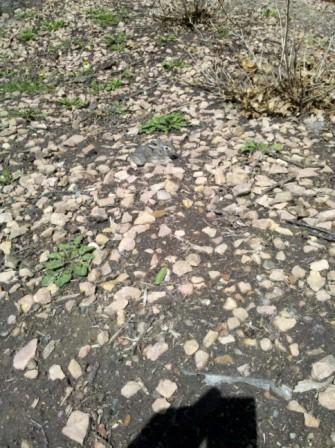
Yesterday, I was cleaning out a small pile of fallen leaves around a bush near our house when suddenly I was startled by a flash of movement from the pile.  A small animal scurried out, frighten by my invasion of its space.  I was startled as well, not sure what kind of animal it was.  I first thought it was a gopher or mole, but after looking more carefully I discovered it was a small rabbit. 

I left the small rabbit burrow alone, and went inside for my camera.  The rabbit stayed motionless for several minutes so I was able to take a picture.   After taking the picture, I saw how well the rabbit blended into its surroundings (see picture #1).  It was hidden even while in plain sight.  Only on closer examination could it be seen (see picture #2).   

Hidden Picture #2

As I thought about this encounter, a Bible phrase flashed into my head, hidden with Christ.  I had to do a search on the computer to find the exact verse. 

Set your minds on things that are above, not on things that are on earth,  for you have died, and your life is hidden with Christ in God. Colossians 3:2-3

Paul, the writer of Colossians, is encouraging us to see our lives as having a secure anchor in the midst of constant earthly turmoil and temptation.  Our place of safety is our relationship with Jesus Christ.  He is our secure burrow, our hiding place, when the evil one attacks.

I have not gone near the rabbit burrow since that first encounter, nor have I seen the small bunny.  I am unsure if I damaged the burrow beyond repair.   And upon further reflection, after seeing the horrific destruction this week by tornadoes in Alabama and other parts of the south, I can never be sure that my own home is forever safe from such destruction.  

The one secure promise is that my life is hidden with Christ and I am safe with him.

In whom is your life hidden?  Where do you find safety and security?

Prayer: Lord Jesus, keep me safe in you, my rock and shield.  Bring comfort, strength and courage to those whose homes and families have been devastated by storms.

Saint and Sinner – Stoning Greg Mortenson

How do you use stones?

This is a rare second posting, but I want to respond to all the recent accusations surrounding Greg Mortenson, the author of Three Cups of Tea and Stones into Schools.   The mission of his foundation, Central Asia Institute, is to build and support schools in the isolated mountain villages of Afghanistan and Pakistan.   Mortenson has received incredible publicity and significant donations for this work.  No one denies that he and his foundation have done incredible work for the children of the region.

However the TV show 60 minutes and the author Jon Krakauer have made substantial and credible accusations that Mortenson partially fabricated some of the stories in his books and that he has mismanaged funds.  Mortenson has not totally denied these accusations, but continues to stand by the work he has done. 

I cannot discern who has the total truth in this tempest.  I suspect the truth is somewhere in middle.  

What disturbs me is how quick I was “to judge” Greg Mortenson.   I felt this incredible disappointment as I read the Jon Krakauer’s report and saw some of the major blemishes on the “saintly” portrait I made of Mortenson.  I discovered that my hero has feet of clay.  But this should not surprise me.

Greg, like I, grew up a Lutheran and one of Martin Luther’s contributions to our spiritual heritage is the concept of saint and sinner: simul Justus et Pecator or simultaneously saint and sinner.   We are all sinners by our actions.  We all have self-serving hearts that seeks only our interests.  Greg Mortenson is a sinner just like me.  When Jesus was confronted with the woman caught in adultery he responded by asking the person without sin to cast the first stone.  Her accusers all slipped away one by one, leaving her alone with Jesus.  He did not condemn her, but sent her away to sin no more.  (John 8:1-11)

Greg Mortenson will need to be held accountable for any mismanagement he has done.  His foundation will need to take drastic steps to rebuild the trust that is being eroded by these reports.  I am praying that such steps will be taken wisely and courageously.

But I also want to state that Greg is still a saint in my eyes.   Our sainthood is not based on our reputation, but on the grace of God.   I am praying that Greg will find his faith and mission strengthened and renewed by God’s Spirit, just as I am praying that prayer for myself and my congregation.  After all I prefer stones to be used in building schools, not attacking reputations.

Holy Week Story – Tuesday

Continued Reflections on the Holy Week Story

Readings for today: Matthew 26:17-46

And while they were eating, he said, “Truly I tell you, one of you will betray me. Matt 26:21

And he gave (the cup) to them saying, “Drink from it all of you, for this is my blood of the covenant, which is poured out for many for the forgiveness of sins.” Matt 26:27-28

What a sharp contrast of emotions in today’s text!  We are again reminded that one of Jesus’ own disciples will betray him.   Jesus, who loved each disciple deeply, was wounded by Judas’ act.  Judas was not an outside official who simply wanted to keep the status quo.  Judas was a friend, who had seen, heard, and experienced Jesus’ ministry of healing and hope.  Scholars speculate what motivated Judas to do this.   Was it greed?  Or disillusionment that Jesus was not the Messiah Judas wanted?

I think the motivation is left unclear so that we can have identification with Judas.  At some time each of us has betrayed God or God’s children either in thought, word or deed.  We profess that we love Jesus with our lips, but our actions towards his children betray our fickle hearts.  We betray Jesus, when we do not love our neighbor as ourselves.

Yet on that night of betrayal, Jesus gave us the gracious gift of communion, the promise of forgiveness.  In Luke’s gospel, it is clear that Judas was still present when the cup of the new covenant was passed among the disciples.  God’s forgiveness was offered to Judas, even as he prepared to turn Jesus over to the high priest.   God’s forgiveness knows no boundaries, and here is a clear example of his gracious, forgiving love.  No matter who we are or what we have done, the promise of God’s forgiveness is declared for us.  We are forgiven people.    

When have you seen or visited someone who needed a tangible expression of God’s love?  How can you help that person realize how precious they are to God?

Prayer: Lord God, thank you for the gift of your own body and blood.  Let that gift strengthen me in the knowledge that you love me more than anything.  Amen

Crowd Power

Catalyst had Crowd Power

This morning’s Palm Sunday worship reminded me once again of the power of a crowd.  As American I don’t think we reflect on the dynamic power of mass audiences because we tend to think we are all independent individuals.  Yet we experience the power of a crowd when we go to a crowded athletic venue, and the spectators begin to chant, holler and scream as the score becomes close.  Or when we go to a music concert and the performer is very good at stirring up the audience during the performance.   We say that the performer feeds off the energy in the room.

This crowd power can be a positive influence.  Last fall I attended a large Christian Conference in Atlanta called the Catalyst Conference. This home-made video captures just a bit of the energy I experienced in that auditorium with 12,000 other Christians.  I strongly encourage people to experience a large gathering of fellow believers in worship, prayer and praise together.  The power of the Holy Spirit can be magnified in such settings.

As one reads the story of Jesus’ entrance into Jerusalem, one has the feeling that there is incredible crowd power in that parade with palms and cloaks, shouts and songs.   The crowd truly believed the King was in their midst and they could not hold back.  Jesus does not chastise them but rather the religious officials who try to stop the celebration.  Jesus said to them, “If they keep quiet the stones will cry out.” Luke 19:40.

The problem with crowd power is not their enthusiasm but their fickle character.   In a sport’s arena, one play can suddenly change the game and the crowd becomes deflated, even hostile.   In politics, Hitler was able to utilize mass rallies to gather and solidify support for his totalitarian regime.  The crowd is not always right.

Friday morning we will read again the Gospel story of the crowd as it gathered outside Governor Pilate’s court.   Their cries will have turned from “Hosanna!” to “Crucify him.”

How have you experience crowd power in a positive or negative way?

Does crowd power have a place in our contemporary life with Jesus?

Write Habits

The Write Stuff

Writing this blog has become one of my daily work habits.  My original intention was to help my new congregation get to know me by telling some of the stories that have shaped my life, especially my faith life in Jesus Christ.  Yet I also believe that the act of writing shapes my faith as well.  Writing this blog has pushed me to express my faith in meaningful, concrete ways.

I have kept a journal since college, but it has always been a private thing.  Sometimes it has been my Bible study and prayer journal.  During the call process last summer, it was one way to reflect on whether or not to pursue the call to Resurrection. There have been long stretches where I did not journal much.  Other times where it was a daily MUST-DO to stay sane and keep perspective. 

In recent years, as I embraced running, my journal habit became my running log.  There are several on-line programs where a runner/biker/walker/blader can log their daily miles and work-out notes.  I became pretty meticulous in my record keeping, measuring my daily workouts  to the nearest tenth of a mile and second.  I could not go running without my heart-rate-monitor watch to record all the detail.  After the summer and fall of 2005, when I trained and ran my best marathon, my log from that training period shaped all my future marathon training programs.  

In a way this blog has taken on some of the characteristics of my journal and exercise log.  Since I have embraced this practice, I want to grow in my ability as well as my faith.   The one big difference is now I have a public audience (small but growing) that I seek to encourage, provoke, inform and challenge.  The readers’ comment help shape this blog and in turn shape me.  Thank you.

Proverbs 27:17 Iron sharpens iron, and one person sharpens the wits of another.

What habits shape your faith life?