Category Archives: vocation

Baptism Fire

Teaching confirmation last week, I told our students that Jesus’ baptism by John was not a sign of repentance of sin, but an ordination into ministry. Baptism is a multifaceted experience for Christians that needs to be lifted up in various ways for us to see the beauty and wonder of this gift from God.

Barbara Brown Taylor writes this about baptism connecting all God’s people together, both ordained and laity.

What we have in common is our baptism, that turning point in each of our lives when we were received into the household of God and charged to confess the faith of Christ crucified, proclaim his resurrection, and share in his eternal priesthood. That last phrase is crucial. Our baptism are our ordinations, the moments at which we are set apart as God’s people to share Christ’s ministry, whether or not we wear clerical collars around our necks. The instant we rise dripping from the waters of baptism and the sign of the cross is made upon our foreheads, we are marked as Christ’s own forever. (The Preaching Life, p. 30)

Our baptism is our call into ministry. We all have a place to serve in God’s family and God’s world. Through baptism, the Holy Spirit is placed within us to be a burning ember of power and life.  To discover our place can be a challenge in the free-market society we have. There are so many options from which to choose. Yet God has given the Holy Spirit to guide, nudge, empower, coax and affirm our direction in life. The community of faith and our inner voices become crucial in the discovery process.

Luther Seminary has a process called the Dependable Strengths Articulation Process which helps congregations and individuals discover their calling for daily life.  Resurrection Lutheran will be using this process on Saturday morning to help people discover how they can use their baptism fire for God’s glory.

Holy Spirit, ignite us with a passion to serve Jesus and his people.

“Do I Have To Go?”

Barbara Brown Taylor wrote a helpful book on preaching that extends way beyond preaching. Here is a section that she wrote regarding where we go when we follow Jesus.

Affirming the ministry of every baptized Christians is not an idea that appeals to many lay people today. It sounds like more work, and most of them have all the work they can do. It sounds like more responsibility, while most of them are staggering under loads that are already too heavy. I will never forget the woman who listened to my speech on the ministry of the laity as God’s best hope for the world and said, “I’m sorry, but I don’t want to be that important.”

Like many of those who sit beside her at church, she hears the invitation to ministry as an invitation to do more —to lead the every member canvas, or cook supper for the homeless, or teach vacation church school. Or she hears the invitation to ministry as an invitation to be more—to be more generous, more loving, more religious. No one has ever introduced to the idea that her ministry might involve being just who she already is and doing what she already does, with one difference: namely that she understands herself to be God’s person in and for the world. (The Preaching Life, p.27-28)

I totally agree with Barbara that our ministry is our daily activities and relationships, but lived with the identity of being a child of God. God has placed each of us in our unique settings to be God’s agent, God’s hands, feet, heart and voice in God’s world. We don’t need to travel to a distant land to do “mission” work, we do “mission” work in our homes, offices, schools, and community as we interact with others. A “mission” trip may help us to see the needs of God’s world and to discover our dependable strengths and gifts to meet those needs. It may strengthen our relationship with God and others, but mission can happen wherever we are.

Lord Jesus, let me rediscover my mission in you today.

A Thanksgiving Story

Thanksgiving seems like an odd holiday to me. After all shouldn’t we be thankful every day? Why give this virtue a special holiday? We don’t set aside a holiday for patience, joy, peace, kindness or hope. (We might consider Valentine’s Day as the special “love” day, but that is a blog unto itself). Still a thanksgiving story seems appropriate.

In the 1930s, George Strester remembers his father who tried farming in Nebraska in 1873. Thanksgiving was approaching and the family had a tough harvest due to the dry and dusty summer. They wanted to give thanks, but the pantry was nearly bare, so George’s father decided to butcher the cow. It had become nice and fat from eating a variety of vegetables, including some rotten onions, but had gone dry and was not giving any milk.

The children all shed a few tears when Old Broach the cow was killed, for she was a family pet, but the family needed to have something to eat. The cow was butchered the day before Thanksgiving and the next day George’s mother planned a real Thanksgiving feast. — a large roast of meat with potatoes and carrots lay around it. Something the family had not had for years.

However a peculiar odor filled the house as the meal was cooking. Mother said it might have been something on the stove, which now was causing the terrible odor. The table was set and the roast was brought out and how delicious it looked. George’s father first gave a prayer of deep thanks for the many blessing that the family had enjoyed and then he carved the roast, placing a liberal helping of meat, carrots and spuds on each plate. George’s mother took a bite and looked at her husband; he took a taste and looked at the kids.

George took a mouthful and his stomach heaved, – horror of horrors, the taste of rotten onions had permeated every piece of beef. Their cow had not simply fattened up on vegetables, but on rotten onions. Their entire dinner was spoiled and all they had to eat were johnnycakes with nothing to put on them.

Still George observed that though his father was greatly tempted, he did not say any cuss words, but decided on that day, to quit farming and reaffirm his vocation as a Methodist minister.

The Strester family took a moment that could be called a family disaster and turned it into a memory of laughter and joy. It was also turning point in their lives. Their father rediscovered his calling and the family was able to adapt to the changes.

God takes our crisis points, small or large, and turns them into his moments of joy and thanksgiving.

Lord Jesus, thank you for your gifts of grace, love and joy.  Create within me a thankful everyday.

The Call of the Cottonball

Vocation and God’s calling has always been an interest of mine. I blogged about a few times.  How do we discern what God is calling us to do with our lives?  How do young adults discern their career path?   Too often the church has restricted God’s callings to specific Christian ministries like pastors or missionaries.  But God calls us to love our neighbor in such a wide variety of ways.  Here is a post from a college student who is beginning to grasp her calling as a teacher:  Catapulting Cotton Balls.

When I read this blog, I had a strong sense of pride, hope and humility.   I had the strong sense of pride because my daughter is connecting her vocational calling to her Christian faith.  I had a sense of hope because she and many, many other young adults see their vocation as a way of serving the world and not simply a way to make money.  And humility that she is learned this in spite of my sporadic, often absent, parenting skills.   God is truly good.

How have you experienced God’s calling in your life?  In your family life?

Lord Jesus, remind me again today that I am called to love my neighbor.  Call me once again to be your hands, feet, voice and heart in the world.

Trail Crew

Trail Crew near Lake Haiyaha in Rocky Mountain National Park

A final thought from Labor Day. While hiking in Rocky Mountain National Park last month, I encountered a trail crew building a new bridge. As a teen-ager I had thought trail crew would be the greatest job. They were paid to hike in the wilderness, surrounded by the wonder and beauty of God’s creation. Their work had tangible results, a path that leads from point x to point y.

Only later did I realize how hard their work truly was. Rocks, streams, trees, even mountains block their route. The crew had limited resources, mostly assorted hand tools, to construct the trail. Earlier that I had seen a crew moving large stones with only shovels and pickaxes so that the path could pass through a large boulder field.  They had to battle rain, heat, cold, mosquitoes and biting flies, while eating only the food they carried in. Watching them work, I realized their job is not as idyllic as I once thought.

The Bridge below Lake Haiyaha

Still as I watched, I gave a silent prayer of appreciation and thanks for the work they were doing. For years I have hike mountain trails, prepared and cleared by others. I realize that a small part of my tax dollars go to pay for this as does part of my user fees. Still I am benefiting from other’s labor. I am thankful for those who planned, surveyed, built and maintain our national parks and wilderness areas.

I am also mindful that Jesus has prepared the way for us to the Father.  He cleared the trail for us.  He lifted the heavy burden of our sin off our souls and buried it in the deepest sea. He continues to maintain the path that leads to eternal life.

You show me the path of life. In your presence is fullness of joy; Psalm 16:11.

What path are you following through life and who constructed it?

Lord Jesus, place me on the path that leads to yourself, that I might become what you created me to be.

Labor Day Ministry

As we enter the Labor Day week-end, I am mindful of the various ways we labor. Our careers or vocations can dominate our lives, though we rarely take time to reflect on their significance. Yesterday I explored my daughter’s vocation; today I will reflect on my son’s. (Part of my vocation as a papa!)

I have written on Luther’s concept of vocation in the past (Light work and Deep Gladness). Luther’s emphasis was that our daily work was where we love our neighbor, where we make the world a more trustworthy place for all, Christians and non-Christians alike.

The prince should think: Christ has served me and made everything to follow him; therefore, I should also serve my neighbor, protect him and everything that belongs to him. That is why God has given me this office, and I have it that I might serve him.. . . When a prince sees his neighbor oppressed, he should think: That concerns me! I must protect and shield my neighbor….The same is true for shoemaker, tailor, scribe, or reader. If he is a Christian tailor, he will say: I make these clothes because God has bidden me do so, so that I can earn a living, so that I can help and serve my neighbor. When a Christian does not serve the other, God is not present; that is not Christian living. “Sermon in the Castle Church at Weimar” (25 October 1522)

Recently I met my son, Jonathan, for lunch. He and friends are starting their own business which will be serving our neighbors by providing safe, non-skid floors for pools and bathrooms. The product is called Life Floor.

Often people think that the Christian ministry needs to be done in or through a church and that it must be tagged with the name of Jesus. That is too narrow. Ministry or service happens in our homes, schools, offices and community centers when we serve others.  Our love of God is reflected in our love for our neighbor.

My son’s work is a form of ministry, of serving and loving our neighbor. He will soon install Life Floor in my mother’s apartment bathroom. This will be a true benefit for her since she recently fell while showering and made a trip to the emergency room. Life Floor will be a benefit to my mom. Seeing and addressing the needs of others in our complex world is Christian ministry.

How is your vocation serving your neighbor?

Lord Jesus, may my daily life become a path to love and serve my neighbor: at home, at school or work, or in my community.

Baker’s Vocation or Vacation

Vocation and vacation sound alike, but rarely overlap in meaning. Vocation means calling and is often used interchangeably with job or career. Vacation means freedom from occupation or time away from job or career. My trip to Coloraod was a vacation from my role as pastor, but it was also a chance to witness my daughter’s vocation.

Suzanne Smiles in Her Domain

Though she graduated from college with a creative writing degree, Suzanne’s current passion and love is baking. Two years ago she went to Estes Park with a college friend to seek summer employment. I remember the frustration in her voice when she phoned home to tell us, she could find no work in Estes, not even at McDonald’s or Subway. I was preparing to drive out and bring her home, when my friend, Michael Johnson, suggested she look at guest ranches in Colorado. A few phone calls later, she had an interview at Lane’s Guest Ranch. The interview led to a job as pastry chef and my opportunity to enjoy her baking and cooking.

Baking in the mountains was a challenge. The high altitude affected dough and the kitchen was often over 100 degrees. This summer they were short staff most of the season. Still I enjoyed her strawberry shortcake, whole wheat rolls, white chocolate Torte and blueberry pancakes. I also discovered a big secret to making delicious brownies is a cup of brandy in the batter (at least I think it was a cup; Suzanne is very secretive about her recipes).  Suzanne is now back in Minnesota, seeking a winter vocation.

On the drive home Suzanne reminded me of the significance of bread in the Bible. God told Adam that it would be “by the sweat of your face you shall eat bread,” when God removed Adam and Eve from the Garden (Genesis 3:19). Thus the work for bread is part of the curse we endure as rebellious sinners. Yet God provided bread for the Israelites in the wilderness (Exodus 16) and for the prophet Elijah in his journey (I Kings 19).

Jesus transformed bread from Satan’s temptation in the wilderness (where it is a reminder of Adam’s curse) to the miracle of feeding 5,000 with just five loaves. Afterwards Jesus stated, “I am the Bread of Life” (John 6:35). Finally Jesus promised Holy Communion when we eat the bread that is his body (Matthew 26:26). To be a baker is to have a holy vocation.

How is your vocation a place for God to work?

Lord Jesus, thank you for all who sweat and work for my daily bread.

Down and Out

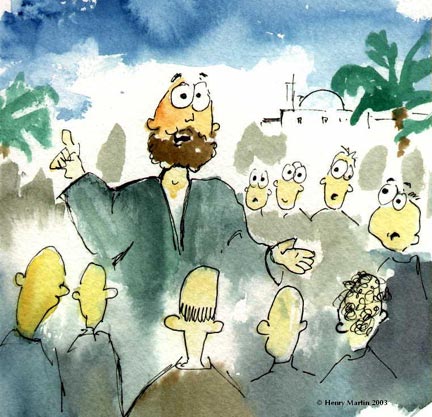
Peter at Pentecost by artist Henry Martin

Last night I met with an amazing group of people who are passionate about using their gifts and strengths for God’s kingdom through Resurrection Lutheran. We are working as a team to prepare for a workshop titled “Discover Your Call – Uncovering Your Dependable Strengths” on November 4 and 5.   The workshop will equip members of Resurrection for service in the world.  

In preparation we watched part of a DVD from Luther Seminary that emphasized the concept that God came “down” to us in Jesus Christ, so we don’t need to “climb” up to God through our actions or good deeds.  As one speaker said, “God does not need your good works. Your neighbor does.”  God calls us to use our gifts and strengths “out” in the world for our neighbor.  Thus the title of the DVD: “Down + Out: Where Grace Takes You.    

God has created each of us with dependable strengths.  God “wires” each of us differently with different abilities, passions and dreams.  Isolated each of us can do a little, but together as the church we can do so much more.  The church is a movement of people, working together to bring healing and hope to a broken world.  The church is not simple to gather in a building and feel good about ourselves.  No, we are to go OUT.

We are to be God’s hands and feet, his voice and presence among the people we interact with each day. This is what Lutheran mean by the word: vocation or calling.  God calls us to serve in the world.

On the day of Pentecost, the Holy Spirit pushed the disciples out into a confused, perplexed world.   Peter was called to preach, but all the disciples had to use their gifts and strengths once the people responded to Peter’s message about Jesus.  They each used their dependable strengths to lead the church out of Jerusalem and into every corner of the world.

What are your dependable strengths and how are you using them in your calling?

Lord Jesus, help me to discover my dependable strengths and to use them for service in your world.


Deep Gladness and Deep Hunger

The Wonderous Joy of Graduation

Yesterday Resurrection Lutheran honored our high school seniors who will soon be graduates. There are seventeen seniors in our congregation who now embark on a new section of their life journey. For many of them the journey includes further education or training before embracing a vocation or career. Rarely will that choice be a life-long decision in which they work at one setting all their lives.

I have posted before on Martin Luther’s perspective on God’s role in our vocation or calling. Yesterday with the seniors I quoted from author Frederick Buechner,

Vocation comes from the Latin vocare, “to call” and means the work a person is called to by God. There are all different kinds of voices calling you to different kinds of work, and the problem is to find out which is the voice of God rather than of society, say, or the superego, or self-interest.

By and large a good rule for finding out is this: The kind of work God usually calls you to is the kind of work (a) that you need to do and (b) that the world needs to have done. If you really get a kick out of your work, you’ve presumably met requirement (a), but if your work is writing cigarette ads, the chances are you’ve missed requirement (b). On the other hand if your work is being a doctor in a leper colony, you have probably met requirement (b), but if most of the time you are bored and depressed by it, the chances are you have not only bypassed (a), but probably aren’t helping your patients much either.

Neither the hair shirt nor the soft berth will do. The place God calls you to is the place where your deep gladness and the world’s deep hunger meet. (F. Buechner, Beyond Words, p. 404-405)

Buechner’s words ring true for me. I have discovered great joy as I grow into my calling as pastor of Resurrection. I see it in my family as my daughter prepares again to be a pastry chef for the summer and as my son works to start a new business. Each of us is doing something we love and in a setting that will benefit others.

How have you heard God’s calling in your life?

Lord Jesus, show me how I can best love my neighbor through my vocation.

Screwtape Letters II

Temptation by artist Sabzi

In C. S. Lewis’ book Screwtape Letter, Senior demon, Screwtape, instructs junior tempter, Wormwood, to take full advantage of the trough or dry periods in his patient’s spiritual life:

In the first place, I have always found that the Trough periods of the human undulation provide excellent opportunity for all sensual temptations, particularly of sex. . . . The attack has a much better chance of success when the man’s whole inner world is drab and cold and empty. . . It is often true with other desires of the flesh. You are more likely to make your man a sound drunkard by pressing drink on him as an anodyne (pain reliever) when he is dull and weary. . .

Never forget that when we are dealing with pleasure in its healthy and normal and satisfying form, we are, in a sense, on the Enemy’s ground. I know we have we have won many a soul through pleasure. All the same, it is His invention, not ours. He made the pleasures: all our research so far has not enabled us to produce one. (Letter IX)

Lewis was a strong advocate of God as the real source of pleasure, joy and happiness; someone who is a party-giver, not a party kill-joy. Remember the Father in the prodigal son story in Luke 15, who starts a celebration when his wayward son returns home. Our Father in heaven enjoys a good party, where all his children are welcomed and loved.

Satan is the one who perverts pleasure into unhealthy or destructive habits and sins. When we turn a pleasure like sex, which is made for a committed married relationship, into lust and perversion, the pleasure itself dissipates and dries up. It is like the alcoholic who needs more and more alcohol to derive whatever pain-relief he seeks. Seeking pleasure away from its true source leads into spiritual bondage. Satan delights in such bondage. God, however, calls us back to his ways through forgiveness and healing.

My own temptation is to compare myself with others, especially other pastors. There is pleasure in doing a job well; in heaven God will greet his faithful servants with the words, “Well done, good and faithful servant” (Matt 25:21). But to waste time comparing myself to other preachers or leaders is to neglect the gifts and strengths God has given to me. My focus needs to be on God’s call, not other pastors’ accomplishments.

What are your temptations? How do you find strength from God for deliverance?

Lord Jesus, save us from the time of trial.