Tag Archives: faith

Embracing Gentleness: The Strength of Meekness

In a world where loud voices often dominate and confidence is measured by brashness, the Christian value of gentleness stands out as a quiet yet powerful call to action. Philippians 4:5 urges, “Let your gentleness be known to everyone.” This simple yet profound statement challenges us to embody Christ’s love, patience, and humility in a culture that prizes assertiveness and power.

Gentleness is not weakness; it is strength under control. It listens with compassion, speaks with kindness, and responds with grace. Jesus affirmed this in the Sermon on the Mount: “Blessed are the meek, for they will inherit the earth” (Matthew 5:5). In a world that equates success with dominance and boldness, meekness is countercultural. Yet, it is Christ’s way—a way that values humility over pride, listening over speaking, and compassion over confrontation.

Our culture often celebrates forceful speech and unwavering confidence, creating a world where people shout over one another rather than seek understanding. This division makes gentleness a rare and precious gift—one that can heal wounds, build bridges, and restore relationships.

The practice of Centering Prayer offers a powerful antidote to this cultural noise. In my own life, daily quiet sitting with God is transforming me. Centering Prayer teaches us to “return ever so gently to the sacred word” when our minds wander. This practice nurtures a spirit of gentleness, helping us approach our thoughts—not with harshness or self-condemnation, but with patience and grace. Instead of forcing control over our minds, we gently return to God’s presence. In doing so, we cultivate endurance—not just for prayer, but for life’s challenges and relationships.

Gentleness is not just for moments of peace; it sustains us in life’s storms. In a chaotic world, we are called to reflect Christ’s gentleness. When we let our gentleness be known, we demonstrate a power that transcends human strength—a power of peace, love, and grace.

So today, let’s embrace gentleness. Find a spiritual practice, like Centering Prayer, that nurtures a gentle heart. By doing so, we reflect Jesus to the world—one act of kindness at a time.

To learn more about Centering Prayer check out these past blog posts
Centering Down In Patience
Building Resilience Through Contemplative Prayer
Remembering Uncle Jerry: A Life of Gratitude and Guidance

Last Saturday, I had the solemn honor of preaching at the funeral of my Uncle Jerry. More than just an uncle, Henry Jerome Mathre was my Godfather, the Lutheran pastor who officiated at both my wedding and my ordination. Jerry was a pioneer in the field of Clinical Pastoral Education, a mentor to countless clergy and seminarians, guiding them in the delicate art of pastoral care and conversation. In his retirement, he embarked on a different kind of pioneering journey, embracing the freedom of RV life with his wife Nola, long before the age of ubiquitous cell phones and internet. He kept family and friends connected through occasional mailed newsletters, each bearing the title, “Gratitude is the attitude of the latitude of the beatitudes.”

Myself and Uncle Jerry at my ordination November 1984

Jerry had a remarkable capacity to find joy in the simplest things: a grandchild nestled in his arms, a rare bird at his feeder, or a breathtaking sunset painting the sky. His gentle, ever-present smile mirrored this innate gratitude. An early adopter of digital photography, he’d always include a snapshot or two of his “latitudes.” He journeyed from Minnesota’s summer embrace, spending time with his children and grandchildren, to the warmth of the Texas Gulf Coast each winter. His life, a testament to God’s grace, exemplified the beatitudes; he found wonder and joy in simply being a child of God. For his funeral passage, he chose John 3:16: “For God so loved the world, that he gave his only Son…” This verse reflected his deep, unwavering trust in God’s promises of love and forgiveness.

Though Jerry wasn’t a direct mentor in the traditional sense—I lament the informal pastoral lessons I missed by not spending more time with him—he was a guiding light. He showed me how a pastor could transition successfully from congregational ministry to chaplaincy. And he provided a joyful blueprint for retirement, demonstrating the possibility of living a full life on the open road. I often think of Jerry and Nola’s RV adventures as I embark on my own camping trips through the western United States.

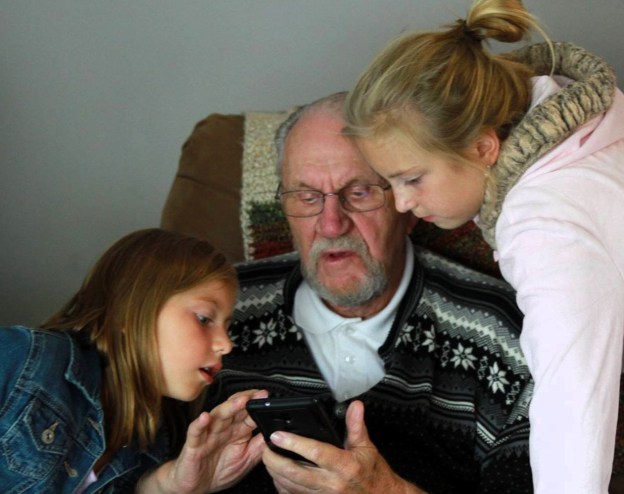
Jerry taught his great-grandkids about the latest technology.

I am profoundly grateful for the moments when our “latitudes” intersected. I hope we all have a similar figure in our lives, an “Uncle Jerry,” whose impact is gentle and subtle, rather than dramatic and forceful. We often celebrate the larger-than-life heroes who rush in, changing our lives in extraordinary ways. In doing so, we risk overlooking the daily faithfulness of God’s more gentle shepherds.

Who is one of God’s children who has offered you gentle guidance and support? How can you express your gratitude for the quiet, consistent impact they’ve had on your life?

Read about another gentle pastor who shaped my life and others. Heroes

Baptism ABC: D is for Dying

Our mortality is difficult to face. Even more difficult is to contmeplate the mortality of our children. Yet the ritual of baptism faces the reality of death head on.

When my daughter Suzanne was about two years old, she was diagnosed with mitral valve insufficiency, which means she had a small hole in her heart. The cardiologist told us that she would need open heart surgery to repair her heart. Such surgery required stopping Suzanne’s heart and placing her on a heart/lung machine while the surgeon closed the hole. Such surgery had become routine in the early 90’s, yet nothing is routine when it comes to one’s own child. The news rocked my world.

That night I stood over her bed as Suzanne slept. I prayed for Suzanne and her upcoming surgery. I prayed concerning my own fear and apprehension. Tears welled up.  Then I contemplated the promise God made to her in her baptism.

Baptism holds a bold declaration and even bolder promise. In his letter to Romans, Paul writes

Do you not know that all of us who have been baptized into Christ Jesus were baptized into his death? Therefore, we have been buried with him by baptism into death, so that, just as Christ was raised from the dead by the glory of the Father, so we too might walk in newness of life (Romans 6:3-4).

Paul uses the act of baptism by immersion, where the baptized person is completely submerged under the water. This immersion is a symbolic burial, just as Jesus died and was buried. In baptism we die with Jesus. Paul goes on to write that in baptism, “our old self was crucified with him (Jesus) so that the body of sin might be destroyed, and we might no longer be enslaved to sin (Romans 6:6).” Baptism recognizes our mortality comes from our sin, our rebellion with God, and overcomes the power of sin by burying our sinful self with Christ. In stark terms, baptism declares us dead.

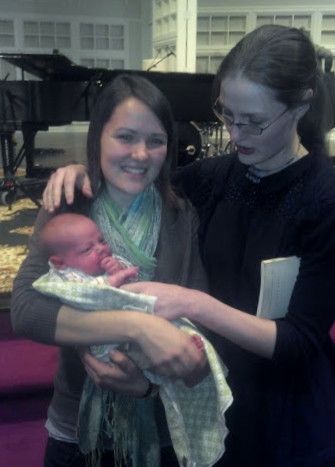
Christina and Suzanne at Jacks Baptism

Daughters Christina and Suzanne enjoy their nephew Jack at his baptism

But it goes beyond that declaration to a more glorious promise. Not only are we buried with Jesus, but, like Jesus, we are raised to newness of life. The central belief of Christianity is that Jesus rose from the dead. In baptism we are joined to his resurrection. Symbolically this is expressed in an immersion baptism when the newly baptized is raised up out of the water, breathing the new life.

As I stood over my daughter’s bed, contemplating her pending surgery, I remembered this promise. She was alive in Christ and was already experiencing the newness of life. Even if she were to die in surgery, she was Christ’s child and held by the promise of eternal life.

Her surgery went well and she recovered quickly (though, as with any trauma, she did have some emotional residue that was challenging for her and her family at times). Today, twenty years later, she is a vivacious, creative young woman who I deeply love. I am glad that she remains on this earth.

Lord Jesus, let me die to sin and walk in newness of life with you today.

Mystery of Trust

Paul at the Areopagus by artist Kennedy Paizs

One of the great mysteries of faith is why some people believe in Jesus and others do not.  One trusts completely while another turns away.  In Acts 17, Paul comes to Thessalonica and preaches in the Jewish synagogue.

And Paul went in, as was his custom, and on three sabbath days argued with them from the scriptures,  explaining and proving that it was necessary for the Messiah to suffer and to rise from the dead, and saying, “This is the Messiah, Jesus whom I am proclaiming to you.”  Some of them were persuaded and joined Paul and Silas, as did a great many of the devout Greeks and not a few of the leading women. (Act 17:2-4)

Paul was persuasive and some came to trust in Jesus, yet many did not believe. I recognize that the Holy Spirit, prayer, and human temperament all play a role, yet I am amazed that within one family, exposed to the same environment and influences, some members place their trust in Jesus and other members do not. The parents and church community express the gospel in word and deed, but not everyone hears and responds. It is like the seed in Jesus’ parable of the sower in Mark 4. Some seed falls on rocky soil, some among the weeds, some on the trodden path, and some on the good soil. Only the see in the good soil takes root and bears fruit.

Occasionally what seems to be the random nature of faith can be disheartening. My intellectual curiosity can twist me into knots. At those times, I “fold the wings of my intellect” and simply rest in  Jesus. I trust in his mercy and grace. Jesus has touched and changed my life through the gift of the Holy Spirit. The Word of God has impacted my life. And I have seen other lives changed as well. With hope I continue to fling the seed of God’s Word, trusting in God and not myself.

So faith comes from what is heard, and what is heard comes through the word of Christ, Romans 10:17

Lord Jesus, create in each of us a faith that bears fruit for your kingdom.

“Come and See” Invitation or Command?

Jesus said, "Come and See"

After Jesus’ baptism, two of JB’s disciples began to tag after Jesus (John 1:35-39).  Jesus spotted these secretive observers and asked a deep question, “What are you looking for?”  I could write my whole Sunday sermon on Jesus’ question. What are we looking for when we come to prayer, Bible study, or worship? 

The two responded with their own question, “Rabbi, where are you staying?”  Again, one could dwell with that question for a long time; where is Jesus staying today?  Where do we find him?  Is he in the obvious or in the hidden? 

Then came Jesus’ response, “Come and see.”   I have often thought of these words as a gracious invitation to explore a relationship with Jesus Christ.  As if Jesus were giving the two followers the choice on whether to stay with him or go someplace else.  In our American culture, we like to have choices, options, possiblities.  We want to decide what we do or don’t do.   And so we see this word of Jesus as a choice.  A choice that seems to ebb and flow in our lives among the many choices.  Some days we respond with joy; some days with hesitation or fear. 

But could “come and see” be more like a command or declaration?   Like when Jesus commands the sea to be calm or when Lazarus is raised from the dead (John 11)?   Later Jesus declared, “No one can come to me unless drawn by the Father who sent me” (John 6:44).  The two disciples responded as if it was a command. “They came and saw where he was staying” (John 1:39).  

Could it be that our faith is more a gift of God than a heroic choice by us?  I find comfort and hope in the promise that the Father draws me to Jesus.  Some called it “irrestible grace.” Jesus pulls me along, rather than me running to catch up.  The more I think about it the more I am looking forward to preaching on Sunday!

How have you experienced the pull of God in your spiritual life?

The Certainty of Questions

As the new lead pastor I have been asking lots of questions.  Who prepares the worship folders, the video slides, or the confirmation materials? Who plows the parking lot?  How much money is in the budget for mission outreach? Who cleans the bathrooms?   Like any new hire I am in the midst of a sharp learning curve, realizing everyday that there is more and more I don’t know.   That can be unnerving at times, especially when my personality is one that likes to appear very competent and knowledgable.  I hate looking foolish!

So I am struck by the amount of questions in this Sunday’s scripture lesson, Matthew 11:2-11.  First, John the Baptist has a question for Jesus, “Are you the promised Messiah that so many people are expecting, or should we start looking for someone else?”  Wow!   The fiery, intense John suddenly has cold feet about Jesus.   John questions whether he has prepared the way for the wrong guy. 

Second, Jesus asks the crowd questions about John, “What were you all expecting when you went out to hear John preach?”  Jesus challenges the expectations and assumptions of the people. Could it be that we allow our assumptions to dictate what God should do or be?   Do we at times assume that God’s ways should match our expectations?  Can questions break open a new perspective, a new vision?  Can doubt play a role in shaping faith?

What questions do you wrestle with as you seek to trust, live and serve?