Jonah the Gardener

Pure speculation but I think Jonah was a gardener prior to his call as a prophet. 

"Sower with Setting Sun" by Vincent Van Gogh, 1888

How else can the reader understand his roller coaster of emotions in chapter four?  When God is merciful and does not punish Nineveh, Jonah plunges into despair and wants to die.   He pouts outside the city.  God causes a “bush” to grow up rapidly.  Its shade provides Jonah comfort; “so Jonah was very happy about the bush” (v.7).  The next day God sends a tiny worm to attack the bush so that it withered.   Without the bush, the hot sun and sultry east wind hit Jonah so that he wants to die (v.8).  Jonah’s passion for a plant reminds me of a gardener’s deep identity with her garden.

Castor Bean Plant

Scholars speculate as to what kind of bush it was.   The Hebrew word here is qiqayon which is used nowhere else in the Bible.   Some think it was castor bean plant which can grow very quickly, up to ten feet in a few months (but not overnight, which is God’s doing in the story). Whatever kind it was, Jonah immediately sees its value.  He has it for a day and then it is gone.

After the bush dies, God confronts Jonah again, “Is it right for you to be angry about the bush?”Clearly Jonah valued the bush and its comfort and he makes the judgment that he is angry enough to die.  God challenges Jonah’s perspective and judgment.

God said, “What’s this? How is it that you can change your feelings from pleasure to anger overnight about a mere shade tree that you did nothing to get? You neither planted nor watered it. It grew up one night and died the next night.  So, why can’t I likewise change what I feel about Nineveh from anger to pleasure, this big city of more than a hundred and twenty thousand childlike people who don’t yet know right from wrong, to say nothing of all the innocent animals?”   Jonah 4:10-11 The Message

The book of Jonah ends with this question.  The tension between God and Jonah is left unresolved.  It is as if God is now the gardener, planting a seed of compassion and mercy in the reader’s heart to see if it will grow.  Will it grow in you?

Lord Jesus, Master Gardener, plant and water the seeds of compassion and grace in my life.

Is it right to be angry?

Last night we wrapped up the study of Jonah for Summer Lite Worship.   Most remember Jonah’s attempt to escape from God’s mission to Nineveh and how God sends his pet whale to retrieve him.  What happens next is even more fantastic, because when Jonah finally reaches Nineveh, a city renown for sin, he preaches a one-sentence sermon and the ENTIRE CITY REPENTS, including the cattle, sheep, dogs and cats.   It is a marvelous scene with everyone wearing ashes and gunnysacks, seeking the mercy of a God they did not know prior to Jonah’s arrival.    And wonder of wonders, “God changed his mind about the calamity that he had said he would bring upon them and he did not do it.”  Jonah 3:10

The reader would think that Jonah would rejoice.  After all, what preacher has ever had 100% positive response to her sermon?   But not Jonah; he despairs!   He wants Nineveh to be punished for what it had done to Israel.   Jonah starts to argue with God,

“O Lord! Is not this what I said while I was still in my own country? That is why I fled to Tarshish at the beginning; for I knew that you are a gracious God and merciful, slow to anger, and abounding in steadfast love, and ready to relent from punishing.  And now, O Lord, please take my life from me, for it is better for me to die than to live.” Jonah 4:2-3  

The mercy of God causes Jonah pain because he sees others getting away with “murder.” Even though he received mercy when the great fish rescued him from the depths of the sea, he cannot stomach others receiving mercy.  God’s mercy irks him so much that he wants to die.

So God asked Jonah a fateful question, “Is it right for you to be angry?”

Almost all emotions involve some kind of judgment.   We are sad when we are deprived of something that we valued.  We are happy when we receive something we value.  A Garmin Forerunner 410 as a birthday present could give joy to an avid runner and disappointment to a six-year-old.  

God asks Jonah if his anger towards God’s compassion is right.  Should God be merciful to all sinners, even the most horrendous ones? Should God be gracious towards those who have hurt you?

Lord Jesus, wash me in mercy, that I might be merciful.

Body Mind Spirit

As I continue my return to running, my mind has been reflecting on my body.  Twice in his first letter to the Corinthians, Paul states that our human bodies are the temple of God’s Spirit.

Do you not know that you are God’s temple and that God’s Spirit dwells in you?  I Corinthians 3:16.

Do you not know that your body is a temple of the Holy Spirit within you, which you have from God and that you are not your own?  For you were bought with a price; therefore glorify God in your body. I Corinthians 6:19-20

Paul writes a rhetorical question, as if they already know the answer but have forgotten it.   Have we forgotten as well?  I fear that our American culture has compartmentalized everything, so that we do not see the connections between the body, mind and spirit.   We have gyms and pools to exercise the body, classes and books to educate the mind, and worship and prayer to nurture the spirit, but we rarely work to integrate these three components together.  Can exercise and prayer, meditation and study work together?

Post-Run Stretch

I recently read an article by John N. Sheveland in the Christian Century titled “Is Yoga Religious?”  The article touched on how most Americans see yoga simply as a physical exercise consisting of poses that has no spiritual content.  The Hindu American Foundation is working to change this misconception by reasserting the Hindu roots of yoga as a religious practice.   In turn, the push to reestablish yoga as a Hindu practice has caused some Christians to reject yoga as anti-Christian and harmful. Sheveland seeks a middle way. 

Might asanas (postural yoga) influence a Christian’s understanding of herself as a physical body created in the image and likeness of God and thus an object of unutterable dignity, held in being and redeemed by God?  Might postural yoga, with its well-documented physical and mental benefits, help me to better understand my stewardship responsibilities to my own body—which Paul says is not my own—and to other bodies in creation? So too, the effect of asanas on the mind can demonstrate to Christians what they already know to be true, namely, that body and spirit are one.

Can other physical activity beside yoga have spiritual and mental benefit?  How do we help integrate these benefits into our daily lives?

Lord Jesus, teach me to be a good steward of my body, mind and spirit.


Try A Little Kindness

I am guessing that many think kindness is a great virtue. It is listed as a fruit of the Holy Spirit in Galatians 5:22. Stories about stopping to help a stranded motorist or ailing neighbor pull at our heart-strings. Frequently when we read about a natural disaster hitting a community, we also read how members of the community reach out in kindness to one another, providing meals, shelter, and cleanup activities. Kindness is something we value, but we often neglect. Why?

I think there are at least two things that stop me from being kind. One is my busyness. To express an act of kindness to an individual in need means that I need to suspend my agenda for a time and focus on the concerns of someone else. Jesus’ parable of the Good Samaritan in Luke 10 is a prime example. The traveling Samaritan gave up his agenda to help the person wounded and bleeding at the side of the road.

The second thing that holds me back is that I am unsure what to do. In a natural disaster, there are clearly identifiable needs, but with my co-worker who is having a bad day I’m not sure what kindness looks like. Perhaps it is just a listening ear, a kind word of encouragement, a cup of cold water? Perhaps the simplest way to act is to do unto others as I would like them to treat me.

Kindness is not so very hard, yet I struggle with it every day. I pray that God will make my heart and my schedule open to acts of kindness for others. For in acts of kindness we see the heart of God. “Whoever gives even a cup of cold water (or lemonade) to one of my children will not lose their reward.” Matthew 10:42.

When has an act of kindness touched your life deeply?

Lord Jesus, help me to perform at least one act of kindness this week-end.

Teach Your Children Well

Yesterday’s post reminded me of the importance of teaching our children well.  They are watching everything we do, even at church.

A family was riding home from church one afternoon and the father was complaining about the pastor going past the noon hour and the fact that he has missed the first inning of his favorite team.  The daughter was distraught with the fact that her boyfriend sat in a row with another young lady and the mom was commenting on what she thought was the poor quality of some members of the worship band.  After a couple of moments of silence the little six year old brother commented from the corner in the back seat “Well, I thought it was a pretty good show for a buck”.

Son Jonathan and I hiking

Parents remain the primary teachers for our children.  What I value as a dad has certainly influenced my children.  I know that my son learned to enjoy camping, hiking and backpacking primarily because he and I would spend a week camping every summer during his childhood.  It was something my father passed on to me and I have shared with my son.   I also know that my children highly value their education because my wife stressed its importance from an early age.  She was constantly seeking ways to enhance their learning beyond the classroom, helping each child reach his or her full potential.

The same is true for spiritual formation, from prayer to Bible reading, from stewardship of finances to volunteering.  As parents we are the primary models of what it means to follow Jesus Christ.  Our words and actions are being watched each Sunday morning as well as the rest of the week.  Are we being models that reflect God’s grace and power?

Hear, O Israel: The Lord is our God, the Lord alone. You shall love the Lord your God with all your heart, and with all your soul, and with all your might.  Recite these words to your children and talk about them when you are at home and when you are away. Deut. 6: 4-7

O God, giver of all life, provide wisdom and encouragement to all mothers and fathers. Make them teachers and examples of righteousness for their children.  Let their light shine brightly so that their children can discover the path to you, our Lord and Savior

Elijah and the Fireman

The joy and excitement of last week’s Vacation Bible Adventure still resonates in my soul.  It was a great week of singing songs, making crafts, playing games and telling Bible stories.  The coordinators, Laura Holtmeier and Tonya Bushard, asked me to be the storyteller and I was able to tap some of my passion for the dramatic.  With the help of Adam Behnken,  we relived stories from the Old and New Testament.  The children were called to imagine God’s great acts of power and compassion.

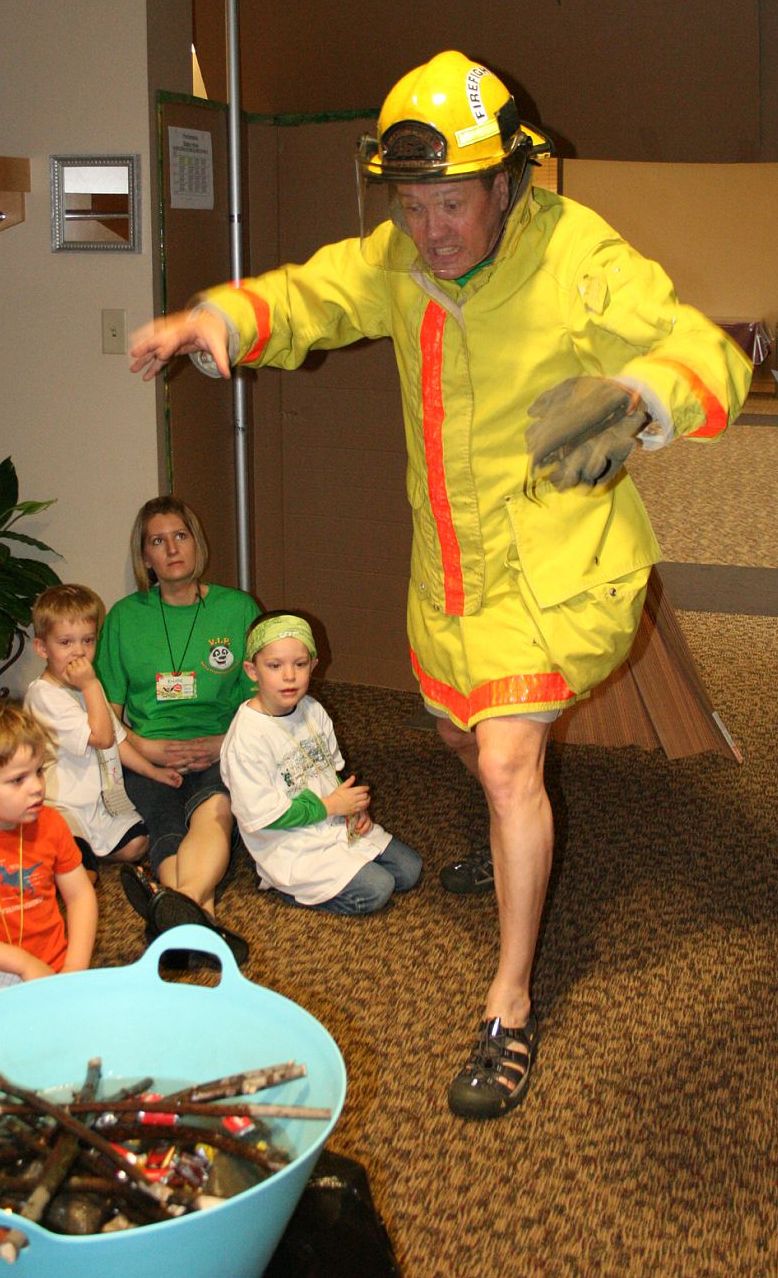
One day we retold the story of Elijah confronting the 450 prophets of Baal from I Kings 18.  We had the children build an altar in a plastic tub with stone and wood. They prepared a sacrifice of chocolate as we reimaged the story.  We even had the children drench the “altar” with pitchers of water, like Elijah.  Then, prior to calling for the LORD God to send down fire, I had to intervene as a fireman.  I warned them because when Elijah called down the fire, it consumed not just the sacrifice, but the wood, stones and water.  I had to prevent the children “from burning down the church.”  Unfortunately, the chocolate was still lost due to the pitchers of water.

Our story telling may not be “historically accurate,” but it does place us in the story, participants in God’s great story.  One of my criticisms of modern Biblical studies is that we can get so bogged down in the historical analysis that we forget the story is meant to engage us as readers.  Scholarship can sometimes place us “over” the text, as a kind of superior critic, when actually God wants to place us “under” the text or “within” the story, so that our hearts, minds, imaginations can be reshaped in God’s image.

As I read the story of Elijah, and visualize the people watching this confrontation, I wonder which side I would be rooting for.  After all, Baal is the ancient version of our own idols and false gods that we give allegiance to: popularity, success, wealth and status.  Baal was the popular god of Israel at the time, that is why 450 prophets stood against Elijah.  As I enter the story, sometimes I am Elijah, but often I am one of bystanders or a prophet of Baal. Through the story, I encounter the call of God to be faithful in my time and place.

How has a Biblical story confronted you and your life?

Lord Jesus, help me to read your Word so that your Word enters into my life.

How Long, oh Lord?

Yesterday in worship I was struck by the cry of Psalm 13.

How long, O Lord? Will you forget me forever?
How long will you hide your face from me?
How long must I bear pain in my soul?
How long shall my enemy be exalted over me?

Like many, I am naturally drawn to the psalms of trust and praise.  I seek to be an upbeat, positive person who sees the cup half-filled.  I prefer the happy psalms that shout praise to God.  Bless the Lord, o my soul, and forget not all his benefits. Psalm 103:2  So when I hear the psalms of complaint and lament, it seems to grate upon my ears and rub against my soul.  Shouldn’t we rejoice and avoid lamentations?

However the book of psalms has almost an equal number of lament psalms as praise psalms.  The book reflects God’s desire to hear our tears and anguish as well as our joys and thanksgiving.  All of life is God’s territory. 

One of the wonders of Psalm 13 is how the psalmist addresses God, even when God seems hidden and aloof.  These questions are not for casual conversation with friends, but a deep cry of the soul to God. Four times the psalmist cries out to God, “How long?”, not knowing when the answer will come, but trusting it will be heard.

Kathy was a parishioner who was wrestling with a potentially terminal illness.  She wanted to live, yet unsure if she had the strength to continue the journey.  When she came to my office, I listened to her complaint and then together we prayed Psalm 13.  The words touched a deep part of her soul, giving her permission to express the throttle cries of her heart, “how long, oh Lord?”

Psalm 13 has a marvelous ending of hope, common to many psalms of lament.

But I trusted in your steadfast love;
m
y heart shall rejoice in your salvation.
I will sing to the Lord,
Because he has dealt bountifully with me.

The psalmist still trusted God, even in the sorrow. God has been faithful in the past and will be faithful in the future, so sing to the Lord.  Weeping may linger for the night, but joy comes in the morning. Psalm 30:5

When was a time you cried out in complaint to God?  How did God respond?

Lord Jesus, teach us to trust in your steadfast love.

Male Factor in Faithbuilding

We just completed a great week of Vacation Bible Adventure, my first at Resurrection.  I continue to be impressed with the creative energy, commitment and passion of our volunteers.  Tonya Roberts and Laura Holtmeier provided masterful coordination by recruiting, training and leading the teams as we discovered God’s tremendous promises in Psalm 139.  Over a hundred children were touch by the contagious joy of God’s people.

Men of VBA

Among the many impressive volunteers was a strong male contingent.  Don’t get me wrong.  There were many impressive female crew guides, station leaders and organizers.  All played a part.  But in our suburban setting it would be easy for females to overwhelm this nurturing role for children.  So I was doubly pleased to see many of our young men participating in VBA.  They demonstrated that Christian education is not just a female role.  Our young guides provide role models for the younger boys to see how they can live out their faith in Jesus. I was delighted to serve among these talented, spirit-filled male leaders   

The Bible story for the last day was Peter’s denial of Jesus during the passion (Mark 14).  Whenever I tell that story, I remember my theology professor, Gerhard Forde, and his remark to those who claim to be self-confident in their faith in Jesus. Forde would respond, “cock-a-doodle-doo!” Forde saw Peter’s promise that he would remain steadfast as a reflection of the sinner’s trust in one-self.  He would caution us to never look at our faith as something we possess but to always look to Jesus as the one who rescues us.  Any promise I make to God is the faintest echo of God’s promise to us in Jesus Christ. 

As I reflect on this week of VBA, I continue to rejoice in God’s faithful promise to work through his people, male and female, young and old, sinners and saints.  As we sang all week, “God is wild about you.”

Do you have any special memories of Vacation Bible School from your childhood?

Lord Jesus, continue to raise up leaders for your church so that your good news can be heard.


Youngdahl, Pastor Of Largest ELCA Church In Nation, Dies « CBS Minnesota

Youngdahl, Pastor Of Largest ELCA Church In Nation, Dies « CBS Minnesota.   I remember meeting Pastor Youngdahl as a student at Luther Seminary.   Mt Olivet offered a retreat to all senior seminarians during which he and the staff would offer pastoral insights and tips that they had learned over the years.  Though several of my classmates were suspicious of his church’s “success,” I found him to be a gracious pastor who truly cared about each of us as future pastors.   I pray for his family as they grieve his sudden death and for Mt. Olivet as they seek to transition to new leadership.

The Contest at Vacation Bible Adventure

Singing out "God is wild about us!"

This week my blogging is down but energy is up as Resurrection hosts Vacation Bible Adventure.  I am so excited with all the volunteers who add their passion, gifts and strengths to transform Resurrection into a Pandamania Jungle as together we learn about God’s creation, Elijah’s contest, Jonah’s trip, and Peter’s denial.  I am working with a talented seventh grader Adam Behnken and creative Micki Fredin to tell the Bible stories each day. 

This morning we retold Elijah’s contest with the 450 prophets of Baal (see I Kings 18). The people of Israel were waffling in their allegiance to the God of Abraham, Isaac, Jacob and Elijah.  So Elijah challenges the prophets of Baal to a contest. Each would prepare an altar with sacrifice, but neither would bring fire.  They would each call upon their god to light the sacrificial fire. 

First the prophets of Baal tried to coax their god to send fire upon their altar.  Like those ancient prophets, the children and I shouted, danced and called for the fire, but nothing happened. Then the children imitated Elijah and prepared an altar with stones, wood and a sacrifice of “chocolate.”  They even doused the altar three times with water, just like Elijah.  But just before they called down God’s fire, a firefighter (with the initials JVK) entered to stop any fire from happening.  We did not want to burn the church down with it.  Instead we retold  the ending of I Kings 18.

Elijah cried out, “O LORD, God of Abraham, Isaac and Israel, let it be known this day that your are God in Israel, that I am your servant, and that I have done all these things at your bidding.” Then the fire of the Lord fell and consumed the burnt offering, the wood, the stones and the dust, and even licked up the water that was in the trench.  When all the people saw it, they fell on their faces and said, “The LORD indeed is God; the LORD indeed is God.” (I Kings 18:36,38,39)

Where or when have you experienced God’s power?

Almighty God, send the power and fire of your Holy Spirit into our lives.